When the worker became a Slovene, a Serb, a Croat, an Albanian…: how the social crisis became a national question
How economic insecurity, regional inequality, constitutional disputes and political elites increasingly translated conflict into national terms.
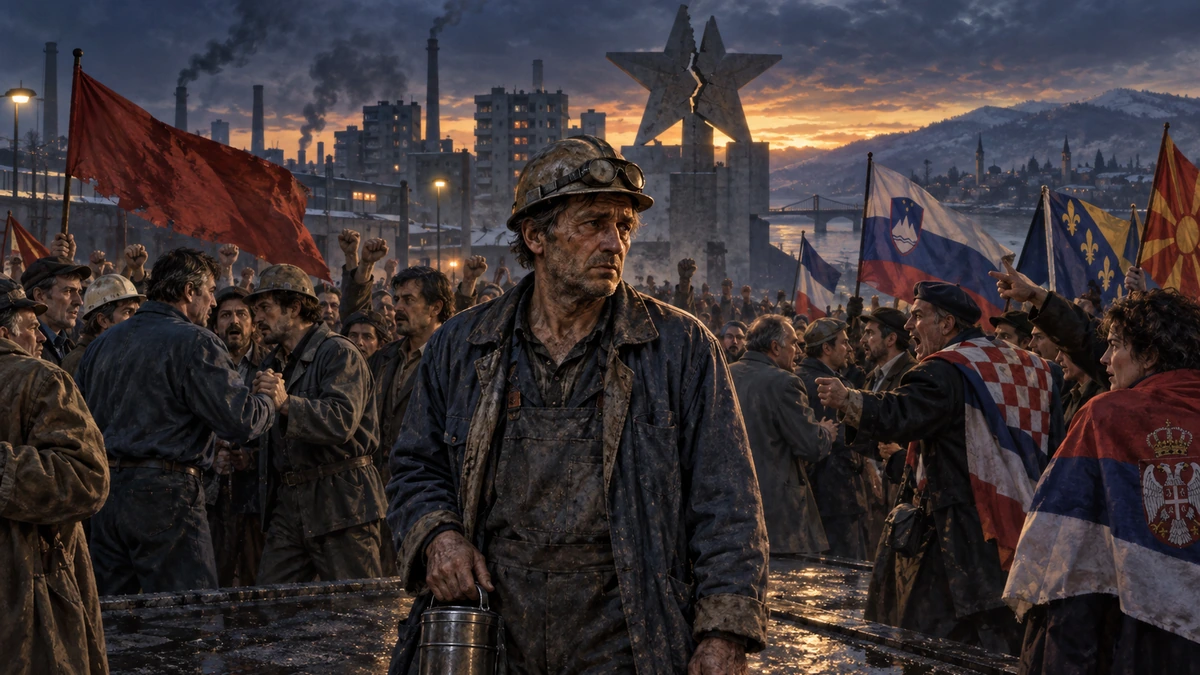
The worker was first angry as a worker
If we began the story of Yugoslavia’s end only with nationalism, we would skip something very important. In the 1980s, people were massively dissatisfied. But their dissatisfaction was not, at the beginning, primarily national. It was social. The wage was losing value. The enterprise lacked raw materials. The director had privileges. Politicians spoke of reform while living standards were falling. Young people found it difficult to get jobs. Inflation devoured savings. The country was burdened with debt. And more and more people were convinced that someone in the system was living better because others were paying the bill.
In 1980, 247 strikes were officially recorded in Yugoslavia, involving around 13,500 participants. By 1988 there were already 1,851 strikes, involving more than 386,000 workers.[1] That is an extraordinary figure. It shows that the end of Yugoslavia did not begin only with crowds first demanding their own national states. It also began with workers walking out of factories and demanding: higher wages, accountability from management, less bureaucracy,
protection of social property, and a fairer distribution of the costs of crisis. Research on workers’ protests shows that a large part of this movement, even in 1988, still used an explicitly Yugoslav language of class. The problem was “bureaucrats.” The problem was directors. The problem was a system that was losing control. The problem was not yet necessarily the neighbor of another nationality.[1][2] That is the key starting point. Nationalism was not an automatic result of poverty.
Economic crisis does not in itself produce nationalism. If it did, every economic crisis in a multinational state would lead to disintegration. It does not. Crisis does something else. It increases the number of questions to which people want an answer. Why is my wage falling? Why is our enterprise financing another one? Why is our republic richer, yet we have less control over our own money? Why is our republic poorer and still not catching up? Why does another republic have more political power? Why can the federal center solve nothing? Why are taxes, prices, credit, and foreign exchange distributed the way they are?
In good times, a state can cover many of these questions with growth. If almost everyone has a little more next year, it is easier to tolerate the sense that someone else is getting too much. But when the economy contracts, politics changes. The question is no longer: How shall we distribute growth? But: Who is taking from us? And this is precisely where space opens for a national explanation of economic crisis.
Yugoslavia was a very unequal economic state
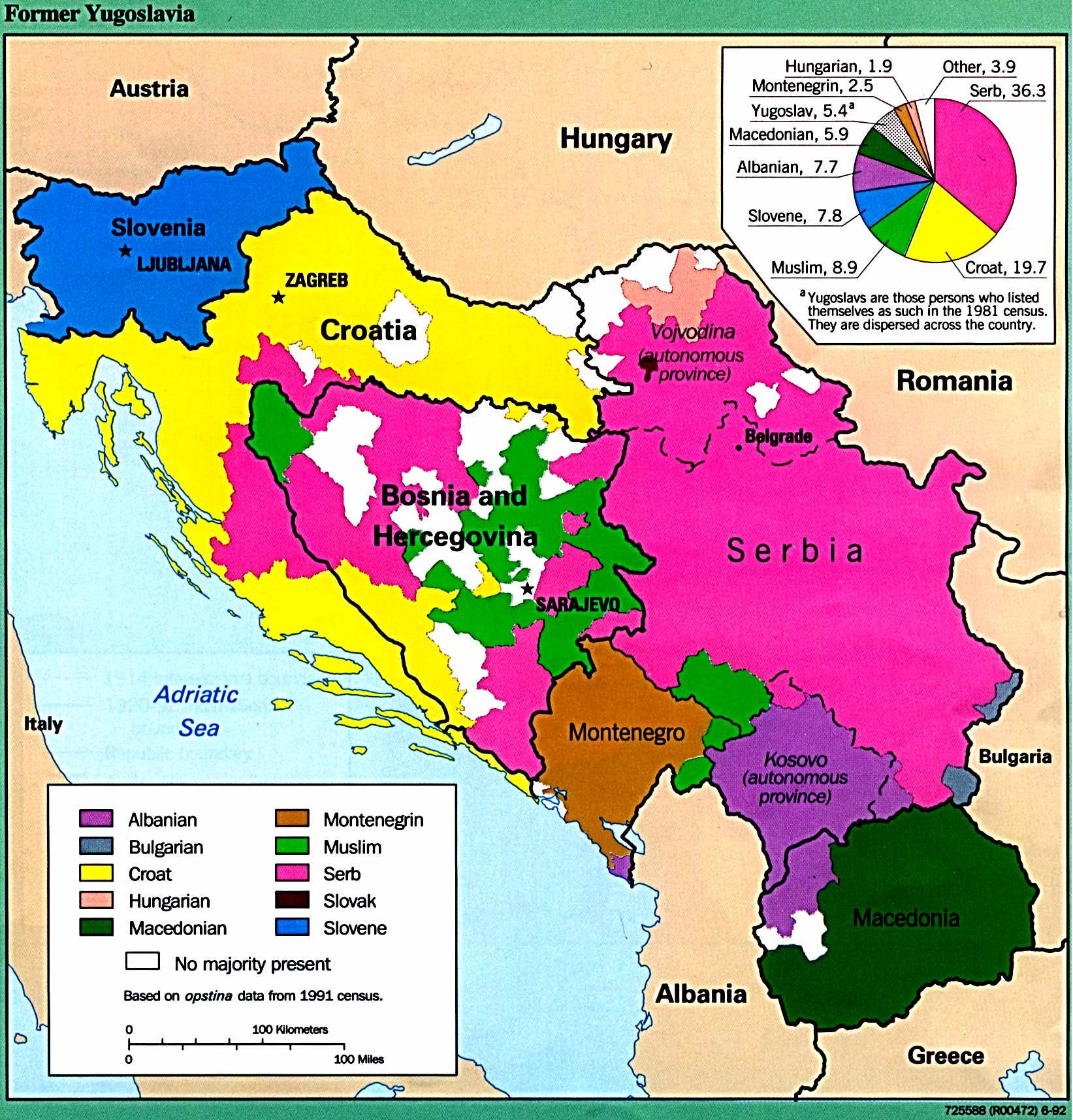
Regional differences in Yugoslavia were not invented. They were large and long-standing. Already in the early 1980s, the World Bank observed that per capita income in the most developed Slovenia was approximately six times higher than in Kosovo.[3] Bosnia and Herzegovina, Macedonia, Montenegro, and Kosovo were officially treated as less developed areas. The federation therefore used a special fund to accelerate their development. Resources were transferred from the more developed parts of the country to the less developed. For one side, this was an expression of solidarity and an attempt to reduce historical inequalities. For the other, it could look like permanent subsidization of regions that, despite decades of assistance, were still not catching up.
Both perceptions could exist at the same time. And both were politically useful. In Slovenia, one could say: “We produce, others spend.” In Kosovo or Macedonia, one could say: “For decades we were the periphery, and now, in crisis, we are supposed to pay first for austerity.” This is a typical example of how the same economic structure can generate two completely opposite national stories. A federation in which no one could simply command anymore.
The 1974 Constitution strongly decentralized Yugoslavia. The republics and autonomous provinces had extensive competences. In the federal institutions, many important decisions were tied to consent or balance among the republics and the two provinces.[4] As long as Tito’s personal authority existed, the system had a political arbiter above it, one the constitution could not fully replace. After his death, it became increasingly difficult to answer a simple question: What happens when the republics do not agree on something essential? One possible answer was a stronger federation. Another was even greater sovereignty for the republics.
Both sides could claim they were solving the same problem. Centralists said: without an effective center, the state cannot conduct monetary, fiscal, economic, and political policy. Decentralists replied: the federal center itself is dangerous, because larger republics or federal institutions can limit the autonomy of individual nations. Economic crisis was therefore becoming a constitutional crisis as well.
Kosovo 1981: an early sign that social and national conflict could become the same question
Kosovo showed this process earlier than most other parts of the country. In March and April 1981, protests began among students. Part of the original demands was connected with study conditions and everyday living standards. But the demonstrations quickly spread and acquired political and national demands, among them the demand that Kosovo become a republic.[5] The authorities suppressed the protests and interpreted them primarily as a nationalist or separatist challenge to the state. This was followed by political and security measures that further increased distrust between a large part of the Albanian population and state institutions.[5][6] Kosovo was at the same time the poorest part of Yugoslavia. It was therefore practically impossible to separate completely:
social dissatisfaction, the question of development, the position of Albanians, the constitutional status of the province, and the question of relations between Kosovo and Serbia. When economic and national conflict overlap, every economic failure quickly becomes proof of political discrimination. And every political repression becomes proof that the economic problem is not only economic.
The SANU Memorandum: a document that translated crisis into a Serbian national question
In 1986, a draft memorandum by a group of members of the Serbian Academy of Sciences and Arts — SANU — entered the public sphere. An important detail: the memorandum in this form was never formally adopted as the official program of the entire Academy. It leaked into the press and caused a political scandal.[7] The document contained a sharp critique of the Yugoslav economic and political system. But it also interpreted much of the crisis through the position of the Serbian nation. It described especially dramatically the position of Serbs in Kosovo and argued that the constitutional arrangement of Serbia after 1974 had placed the republic in an unequal position.[7][8] The memorandum is important.
But we need to avoid the simple story that it was some fully developed blueprint for the later wars. Historiography warns that the relationship among Serbian intellectuals, nationalism, and Milošević’s later rule was more complex than the image of a single ideological conspiracy allows.[9] Even Slobodan Milošević initially criticized the memorandum publicly. But in the following years, many themes that in 1986 were still treated as dangerous nationalist discourse increasingly became part of mass politics. That matters more than the question of who wrote a program for whom. Milošević and Kosovo Polje: when national protection becomes political capital.
In April 1987, Slobodan Milošević visited Kosovo Polje. There he stood before a crowd of Kosovo Serbs who were complaining about their situation in the province and about police behavior. The event became a turning point in his political rise. Research often treats it as the moment when Milošević showed how much political power a leader could gain by presenting himself as the protector of a nationally threatened community.[10]
In September that same year, at the famous Eighth Session of the Central Committee of the League of Communists of Serbia, he defeated the political circle of Ivan Stambolić and consolidated control over the Serbian party organization.[11] Here too, precision matters. Milošević did not come to power in a country without real problems. There were genuine interethnic tensions in Kosovo. There was migration of part of the Serbian and Montenegrin population. There was great economic misery. There were conflicts over Serbia’s constitutional structure. His political strength did not depend on inventing all problems. It depended on increasingly connecting real problems into a single national political frame. The “anti-bureaucratic revolution”: social language gets a national direction.
In 1988 and 1989, Serbia, Vojvodina, and Montenegro were flooded by mass rallies that came to be known as the anti-bureaucratic revolution. The name was politically very effective. “Bureaucrat” had for decades already been a legitimate enemy in Yugoslavia. Communist ideology itself had taught people that an alienated bureaucracy was dangerous to workers’ self-management. Workers across the country, because of the crisis, were attacking the privileges of directors and political officials. That is why the movement could speak in two languages at once: social — against a privileged bureaucracy; and national — for the rights of Serbia or of Serbs, especially in Kosovo.[1][2]
Research warns that these crowds should not be described only as passively manipulated people. The social dissatisfaction was real. Many workers genuinely wanted a more effective and just Yugoslavia. But in Serbia, Milošević’s political project gradually succeeded in linking this social revolt with the national question.[2][12] “The people” began to mean both: the working people against the privileged; and the Serbian people against political structures allegedly denying them equal status. This was a very powerful combination. Vojvodina and Montenegro: a rally can also replace a leadership.
By autumn 1988, the anti-bureaucratic movement was no longer only protest rhetoric. Mass pressures helped replace the political leadership in Vojvodina and then in Montenegro. Contemporary research points out that the protests were presented as expressions of spontaneous popular dissatisfaction, while at the same time enjoying important support from the political center around Milošević.[13] This changed the balance within the federation. The question of Serbia was no longer only: Should the competences of Kosovo and Vojvodina be reduced? It also became the question: How much political influence can the Serbian leadership gain within the federal institutions through republics and provinces whose leaderships are favorable to it?
For the other republican leaderships, this increased the fear of centralization. What Milošević’s circle presented as the restoration of Serbia’s normal statehood was increasingly understood in Slovenia and parts of other republics as a change in the federal balance. The same event was again producing two entirely different stories.
Slovenia 1987: the national question comes from the intellectual opposition
In Slovenia, the political process developed differently. In February 1987, issue 57 of the journal Nova revija published Contributions to the Slovenian National Program. The authors opened questions of: Slovenian sovereignty, multi-party democracy, national self-determination, Slovenia’s place in Yugoslavia, and the relationship to Europe.[14] This still did not mean that Slovenia had already politically decided on departure in 1987. Quite the contrary. New archival research on the attitudes of the Slovenian communist leadership shows that even in 1987 it remained officially strongly Yugoslav-oriented and rejected separatism. At that time, the Slovenian leadership even supported some transfers of competences to the federation, although it opposed broader centralization.[4]
That matters. Slovenia’s later independence was not a simple plan that its authorities had secretly held from the beginning of the decade. Positions evolved. And they evolved in interaction with what was happening elsewhere in Yugoslavia. JBTZ 1988: when a conflict with the army becomes a Slovenian mass question.
In 1988 came the JBTZ affair. Janez Janša, Ivan Borštner, David Tasić, and Franci Zavrl were accused of revealing military secrets and were tried before a military court. The trial triggered a massive civil-society mobilization in Slovenia. The Committee for the Protection of Human Rights was formed. The protests were not only a defense of four individuals. They became a question of: the rule of law, freedom of the press,
the language of judicial procedure, the relationship between the Yugoslav People’s Army and the republic, and the question of who had the right to intervene in the Slovenian political space.[15] The Slovenian government and party leadership were no longer simply on the same side as the federal structures against the opposition. They increasingly found themselves between the federal institutions and their own public. This was a major shift. The conflict between democratic opposition and communist authority began to overlap with the conflict between Slovenia and the federal center. Democratization was becoming a national question as well. At the same time, the Croatian worker could still speak as a Yugoslav worker.
It is important not to project the development of Slovenia or Serbia automatically onto the entire country. Research on work collectives in northwestern Croatia shows that even in the first half of 1988, criticisms of bureaucracy and the falling standard of living were very similar to those in other parts of Yugoslavia. Workers in Rijeka and its surroundings criticized the administration, privileges, and economic difficulties in strongly social language. Only around mid-1988 did concern about nationalism and rallies in Serbia grow more strongly.[16] This is a valuable chronological detail. It shows that national polarization did not grip all republics and all social groups at the same time. The process spread. And people responded to it also as to something new and dangerous.
Kosovo 1988–1989: when a workers’ strike becomes national mobilization
Perhaps the clearest example of the transition from social to national conflict is provided by Trepča. The miners in Kosovo lived in an environment of economic decay, hard labor, and internal conflicts in a large self-managed enterprise. Their problems were genuinely workers’ problems. But in 1988 the political environment around them was changing rapidly. Milošević’s mobilization in Serbia. Rallies of Kosovo Serbs. Media polarization. Proposals for constitutional changes that would reduce Kosovo’s autonomy.
Replacement of the Albanian political leadership. In November 1988, around 1,500 mostly Albanian workers from Trepča marched toward Priština. In February 1989, around 1,300 miners barricaded themselves in the Stari Trg mine and began a hunger strike against political changes and constitutional amendments.[6] This newer research is important precisely because it does not explain the mobilization simply through “eternal ethnic hatred.” It shows the connection between: the decline of the mining economy, social conflicts within the enterprise, changes in the position of ethnic groups, Serbian political mobilization, and Albanian counter-mobilization.[6] The former mine director Burhan Kavaja later summarized the process simply: it began with social questions but ended as political and national mobilization.[6] That is the core of this article.
National politics has one great advantage: it offers a simple answer. Economic crisis is complicated. External debt. The exchange rate. Productivity. Federal development funds. Interest rates. The banking system. Self-management. Enterprise losses. Taxes. Monetary policy. The constitutional division of competences. This is not politically attractive language. A national explanation is much simpler. We are paying for them. They decide instead of us. Our people are being discriminated against. Their republic has privileges. Our republic does not have enough rights. The federal state is exploiting us. The republics are destroying the state. In this language, one does not have to understand monetary policy. One only has to know who “we” are and who “they” are. That is why nationalism is not only an ideology of identity. In crisis, it can also be a technology of political simplification.
But people were not mass-demanding breakup from the start
Here too an important correction is needed. After the wars of the 1990s, it is very easy to look backward and imagine that all the nations had long been waiting only for the opportunity to form their own states. Research on public opinion does not confirm this so simply. An analysis of two Yugoslav-wide surveys from 1986 and 1990 found that mass support for national independence was limited in most of the federation.
It was more pronounced among Kosovo Albanians and later among Slovenians, but even on the eve of collapse we do not get a picture of all Yugoslav peoples already uniformly decided in favor of mono-national states.[17] Such surveys have limitations. People can shift their positions quickly. Questions are not always identical with political decisions. But the result matters. The breakup was not a simple execution of a decade-old, mass desire shared by all inhabitants. Political preferences were formed in crisis. Political elites did not create all problems — but they determined their meaning.
The opposite extreme is too simple as well. It cannot be said that a few politicians simply hypnotized completely calm and satisfied peoples into nationalism. People had real concerns. Kosovo Serbs had real grievances. Kosovo Albanians had real grievances. Slovenians had real economic and constitutional interests. The less developed republics had real development problems. Croatia had its own disputes about its place in the federation and about the relationship between national and Yugoslav politics.
But politics also decides how a problem is explained. If someone is unemployed, a political party can say: the problem is an inefficient enterprise; the problem is the director; the problem is the IMF; the problem is the federal state; the problem is the republic; the problem is another nation. Each explanation leads to a different political solution. An elite therefore does not need an invented crisis. It is enough to translate a real crisis into the political language that benefits it most.
Croatia 1989: political pluralism also opens national competition
In Croatia, political liberalization was slower than in Slovenia. But in 1989 a multi-party space began to form rapidly. New parties and political organizations appeared. Among the important ones were the Croatian Social Liberal Alliance, the Croatian Democratic Union, and the reformed communists.[18] The programs did not speak only about nationalism. They also spoke about: democratization, human rights, market economy, private property, political pluralism. But the question of Croatia’s relationship to Yugoslavia was increasingly becoming the central political dividing line.[18][19]
With that, something happened that would become decisive in 1990. Economic and democratic reform was no longer only the question: What kind of Yugoslavia do we want? It was also becoming the question: Is the future still in Yugoslavia at all? 1989: the year when three crises merged.
Historian V. P. Gagnon described 1989 as the moment when three processes in Yugoslavia began to overlap: reform of the political and economic system, the struggle over the future of the League of Communists, and changes in the meaning of national identities and their connection with political programs.[20] This is a useful framework. Up to that moment, it was still possible to imagine: economic reform without state breakup; democratization without state breakup;
the transformation of communism without national division. But all three changes were taking place at once. And they were not identical in all republics. In Slovenia, democratization increasingly meant protection of republican sovereignty. In Serbia, Milošević’s mobilization increasingly meant renewed strengthening of Serbia’s statehood and a change in the position of the provinces. In Kosovo, defense of autonomy was becoming Albanian national mobilization. In Croatia, multi-party competition was opening at the very moment when the national question was already becoming central. The federation no longer had one common political language.
Serbia’s constitutional changes of 1989: the same act, two stories
In March 1989, amendments to the Serbian constitution were adopted that substantially reduced the autonomy of Kosovo and Vojvodina in important areas and increased the competences of the republican organs of Serbia.[6][21] For the Serbian political leadership, this was the correction of an anomaly created by the 1974 constitution: Serbia, it argued, was the only republic unable to exercise normal authority over its entire territory. For many Kosovo Albanians, it was the removal of political autonomy. For the Slovenian leadership and public, it was evidence that a change in the balance within one republic could change the balance of the entire federation. Again: one legal event, three different stories. When a state no longer has a common way to decide which story is politically legitimate, legal questions become questions of national survival.
Slovenian solidarity with the Kosovo miners widened the conflict even further. The February strike of the Trepča miners did not remain only a Kosovo question. In Slovenia, it received substantial public and political support. The Slovenian political and civil-society space increasingly criticized the way Serbia was changing Kosovo’s status.[6] For the Serbian political public, this could be understood as an unacceptable intervention by another republic in Serbia’s internal affairs. For Slovenia, Kosovo was a question of: federalism, human rights, constitutional autonomy, and the danger of centralization. The dispute between Serbia and Slovenia was therefore no longer only a quarrel between two party leaderships. It became a dispute between two increasingly different models of Yugoslavia’s future. By the end of 1989, the economy too had become a national weapon.
When political trust disappears, economic relations change as well. The republics increasingly defended: their own banks, their own foreign exchange, their own taxes, their own enterprises, their own markets. Slovenia demanded more economic and political autonomy. The Serbian leadership defended a more effective and integrated state, but under conditions that in Slovenia were seen as centralizing. By the end of 1989 there was even an open economic conflict between Serbia and Slovenia and a partial interruption of economic relations.[22] This is symbolically extremely important. For decades Yugoslavia had been a common economic space. Now the republics were increasingly using economic measures as instruments of mutual political pressure. When the common market begins to be treated as a weapon, the political federation is already in deep crisis.
January 1990: the party that had held the state together breaks apart
In January 1990, the 14th Extraordinary Congress of the League of Communists of Yugoslavia was held in Belgrade. The Slovenian delegation demanded deeper democratization and a more confederal organization of the common party. Its key proposals did not win support. The delegation walked out of the congress. The Croatian communists did not want to continue as if nothing had happened. The congress broke up without a political solution.[23] This was a rupture that goes beyond the history of a single party. For decades, the League of Communists had been the only organization with an institutional structure across all of Yugoslavia, linking republican leaderships into one political system.
When its capacity for common decision-making broke down, there was no other all-Yugoslav democratic political structure automatically ready to take over its integrative role. Multi-party politics was arriving in the republics. But not as a single Yugoslav democracy. Rather, as six different republican political spaces. Democracy came through the republics, not through the federation.
This is one of the most important paradoxes of 1990. Yugoslavia was democratizing. But the elections did not first create a common democratic political space of Yugoslavia. They took place primarily at the republican level. Parties therefore competed for: the Slovenian voter, the Croatian voter, the Serbian voter, the Bosnian-Herzegovinian voter, the Macedonian voter, the Montenegrin voter. Even when a program was not nationalist, its institutional space was republican. This created a strong incentive: a politician who wants to win in a republic must first explain what he or she will do for that republic. The federal political space was becoming ever weaker precisely at the moment democratic competition opened up. This was a structural problem, not only a problem of the character of individual politicians.
When “our” problem received a national culprit
By this point, the process that began in social insecurity had reached a new stage. The worker still had a problem with: inflation, wages, employment, housing, the director, the bank. But the political explanation of these problems was becoming different. The Slovenian worker could hear: Slovenia is being drained by an inefficient federation. The Serbian worker: Serbia is constitutionally divided and does not enjoy the same statehood as the other republics. The Kosovo Albanian: Belgrade is taking away our autonomy and political rights. The Croatian voter: Croatia must decide for itself about its own status and economy. Each of these stories drew on real problems. But none represented the full economic and political reality of Yugoslavia. Yet in politics, the full explanation often loses to the understandable explanation.
The greatest loss was not money — it was common trust. Debt can be rescheduled. Inflation can be stopped. An unsuccessful enterprise can be reorganized. A constitution can be amended. What is harder is to rebuild a system in which every political actor believes that common rules will still apply even when that actor loses a vote. By the end of the 1980s, Yugoslavia was increasingly losing precisely that. Slovenia no longer trusted centralization. Serbia no longer trusted an arrangement that limited its authority over the provinces.
Kosovo Albanians no longer trusted Serbian rule. The republics no longer trusted common financial mechanisms. Political leaderships no longer trusted the League of Communists as a space of compromise. And ordinary people no longer trusted that the state would solve the economic crisis. When common trust disappears, every further dispute becomes harder. Even a purely technical question begins to be read as evidence of the other side’s intentions.
This is still not war
By January 1990, we have: economic crisis, mass strikes, national mobilizations, a dispute over Kosovo, a conflict between centralization and republican sovereignty, the collapse of the common communist party, and emerging multi-party systems. But we still do not have the answer to why the political conflict would have to become war. That is the essential boundary. Nationalism can destroy political consensus. But it is not by itself an explanation of every later shot.
Before we get to weapons, we still have to look at: the international environment, the end of the Cold War, the policy of Germany, the United States, the European Community, the question of recognition of the republics, attempts to preserve or transform the federation, and the moment when the internal constitutional crisis became a European and global diplomatic question. The series therefore continues with When the Yugoslav Crisis Became International: Germany, the United States, the European Community, and the Question of Recognition
Sources and further reading
- Musić, Goran / Nationalities Papers. “Provincial, Proletarian, and Multinational: The Antibureaucratic Revolution in Late 1980s Priboj, Serbia.” Documents the growth of strikes from 247 with 13,507 participants in 1980 to 1,851 strikes and 386,123 participants in 1988 and emphasizes that a large part of workers’ protest still used the language of class or Yugoslav solidarity. Source
- Grdešić, Marko. “Antibureaucratism as a Yugoslav Phenomenon: The View from Northwest Croatia.” Nationalities Papers 47(4), 2019. Shows the broader Yugoslav social critique of bureaucracy and the process by which Serbian national mobilization in 1988 gradually nationalized part of this language. Source
- World Bank. Yugoslavia: Adjustment Policies and Development Perspectives. Documents large regional development differences: in the early 1980s the ratio of per capita income between Slovenia and Kosovo was roughly 6:1, and there existed a Federal Fund for the accelerated development of the less developed republics and Kosovo. Source
- Rahten, Andrej. “Changes in the Attitudes of Slovenian Communist Leaders toward Yugoslav Statehood in the Late 1980s.” Nationalities Papers, 2024. Archival study of constitutional debates, limited federal competences, and the evolution of the Slovenian party leadership from a Yugoslav orientation toward growing demands for republican sovereignty. Source
- Hetemi, Atdhe. “Student movements in Kosova (1981): academic or nationalist?” Nationalities Papers 46(4), 2018. Discusses the transition from student and social demands to broader political demands, including the demand for a Republic of Kosovo. Source
- Troch, Pieter. “Ethnopolitics in a Mining Enterprise in Crisis: Revisiting the Albanian Miners’ Protests in Late Socialist Kosovo.” Nationalities Papers, 2024/2025. Detailed analysis of Trepča, the November 1988 protests, and the underground strike of February 1989; connects economic decay, workers’ conflicts, ethnic relations, and political counter-mobilization. Source
- Serbian Academy of Arts and Sciences Memorandum, 1986 — primary-source presentation. World History Commons. The text of the unfinished draft that entered the public sphere in 1986. Source
- Pavković, Aleksandar. “Anticipating the Disintegration: Nationalisms in Former Yugoslavia, 1980–1990.” Nationalities Papers 25(3). Discusses the renewed public visibility of different national ideologies during the 1980s and the history of the SANU memorandum draft. Source
- Emmert, Thomas A. “Serbia and its Intellectuals: Introduction.” Contemporary European History 13(2), 2004. Warns against overly simplified interpretations of the relationship among the SANU memorandum, Serbian intellectuals, and later national mobilization. Source
- Contemporary European History. “Demographers as Desk Perpetrators? Population Experts and Serbia’s Kosovo Obsession in the 1980s and Thereafter.” Reviews Milošević’s appearance at Kosovo Polje in April 1987 and the transfer of formerly more marginal nationalist motifs into mass politics. Source
- Nationalities Papers. “Provincial, Proletarian, and Multinational …” Discusses the Eighth Session of the Central Committee of the League of Communists of Serbia in September 1987 as a key turning point in Milošević’s rise. Source
- Grdešić, Marko. “Serbia’s Anti-Bureaucratic Revolution as Manipulation? A Cultural Alternative to the Elite-Centric Approach.” Comparative Studies in Society and History 58(3), 2016. Critiques the overly simple model of pure manipulation from above and analyzes the fusion of socialist and nationalist political language. Source
- Flere, Sergej. “The Hot Vojvodina Summer of 1988: Did Vojvodinians Seek to Overthrow Their Government?” Nationalities Papers, 2023. Discusses the rallies in Vojvodina, their apparent spontaneity, and support from the political center in Belgrade. Source
- E-encyclopedia of Slovenian Independence / Museum of Contemporary History of Slovenia. “National Program of Nova revija (1987).” Overview of issue 57 of Nova revija, questions of Slovenian sovereignty, political pluralism, and the official response. Source
- Government of the Republic of Slovenia. “History of Slovenia.” Official historical overview of JBTZ in 1988, the mass mobilization for human rights, and the conflict between military structures and the Slovenian public space. More detailed: Source 1 Source 2
- Grdešić, Marko. “Antibureaucratism as a Yugoslav Phenomenon: The View from Northwest Croatia.” Demonstrates the similarity of social and anti-bureaucratic grievances across republican borders and the more visible shift into national polarization only around mid-1988. Source
- Klanjšek, Rudi & Flere, Sergej. “Exit Yugoslavia: longing for mononational states or entrepreneurial manipulation?” Nationalities Papers 39(5), 2011. Analysis of Yugoslav-wide surveys from 1986 and 1990 finds limited mass support for independence in most of the federation, with stronger exceptions among Kosovo Albanians and later Slovenians. Source
- Dunatov, Šime. “The Origins of the Multi-Party System in Croatia in 1989.” Radovi Zavoda za povijesne znanosti HAZU u Zadru 52, 2010. Discusses the formation of political pluralism, new parties, and the attitude of Croatian political actors toward the Yugoslav crisis. Source
- Building Democracy in the Yugoslav Successor States. Chapter “Building Democracy in Croatia since 1990.” Points out that within the emerging multi-party space, democratic and national questions increasingly overlapped. Source
- Gagnon, V. P. (Chip). “Yugoslavia in 1989 and after.” Nationalities Papers 38(1), 2010. Analyzes the overlap of federal reform, the crisis of the LCY, and changing political meanings of ethnic identities in 1989. Source
- Krieger, Heike, ed. The Kosovo Conflict and International Law, chapter “Kosovo’s Status in Yugoslavia before 1999.” Cambridge University Press. Overview of Kosovo’s broad autonomy after the 1974 constitution and of the changes in the late 1980s. Source
- Vodopivec / historical studies of the Slovene-Serbian conflict in 1989. Overviews note the economic conflict and partial interruption of relations after the political escalation at the end of 1989. For a broader review: Source
- United Press International, 26 May 1990; contemporary reports on the 14th Congress of the LCY. In January 1990 the Slovenian delegation walked out of the congress over the pace and direction of reform; continuation of the common congress collapsed. Context of the transformation of the Slovenian party: Source 1 Source 2