Kosovo Before 1999: Autonomy, Repression, Parallel Society, and the Road from Rugova to the KLA
From autonomy and protests to Rugova’s nonviolent resistance and the rise of the KLA: Kosovo’s political road before the 1999 war.
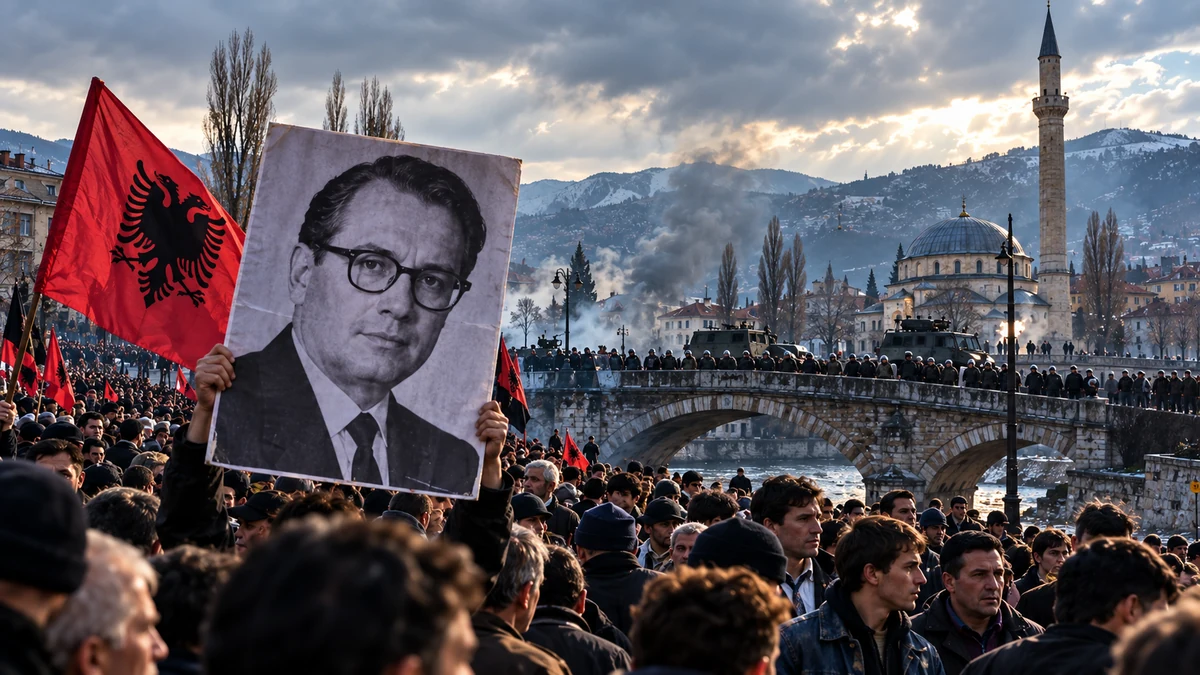
Kosovo had always been somewhat different
Kosovo formed part of the Socialist Republic of Serbia. But under the 1974 Yugoslav Constitution it was not an ordinary province. Together with Vojvodina, it had the status of a Socialist Autonomous Province, with its own: assembly, executive institutions, constitutional or statutory order, judiciary, police, education system, and direct representation in important federal institutions.[1] Within the federal system, Kosovo participated in the Presidency of the SFRY and other federal bodies separately from Serbia. Constitutional experts later heard by the ICTY described the arrangement as unusual: the provinces were inside Serbia, but in several federal institutions they functioned almost like separate federal subjects.[1]
Kosovo was nevertheless not one of the six republics. That distinction is essential. In 1974 it had broad political autonomy. It did not have the same constitutional status as: Slovenia, Croatia, Bosnia and Herzegovina, Serbia, Montenegro, or Macedonia. The question: “Why not a republic as well?” would become one of the central political demands of Kosovo Albanians. The demographic change was substantial.
According to the 1981 census — the last one in which participation by Kosovo's population was close to universal — the province had roughly 1.585 million inhabitants. Approximately: 77 percent were Albanians, 13 percent were Serbs.[2] The remainder included Montenegrins, Turks, Roma, Muslims, and other groups. Kosovo was therefore already a strongly Albanian-majority territory long before the war. But in Serbian historical and political consciousness it occupied a special place: medieval monasteries; the Battle of Kosovo; Serbian historical mythology; and the fact that Kosovo remained constitutionally part of Serbia. Two powerful legitimacies therefore existed on the same territory. The Albanian one: we are the majority population. The Serbian one: this territory is part of Serbia and central to our historical identity. For decades, Yugoslav federalism attempted to hold both propositions together.
1981: from the student cafeteria to the demand for a republic
In March 1981, student protests began at the University of Priština. The initial demands concerned student conditions: food, housing, and social conditions. But the protests quickly became political. During demonstrations in March and April the demand appeared: Kosovo Republic. Some of the more radical political currents also advocated links with Albania.[3] The authorities suppressed the demonstrations. Emergency or special security measures were introduced and security forces from different parts of Yugoslavia were sent to Kosovo.[4] From that point onward Kosovo was no longer only a question of economic development in an underdeveloped province.
It became a question about the future constitutional structure of Yugoslavia. The demand for a republic did not mean the same thing to all Albanians. Albanian politics should not be treated as a single line either. Research on the 1981 protests identifies at least two important currents. More radical groups demanded: a republic, greater national self-determination, and in some cases union with Albania. Other Albanian political and academic actors still sought a solution inside socialist Yugoslavia: greater practical equality, economic development, respect for autonomy, and broader rights.[3] As elsewhere in Yugoslavia, a nation was not one political person.
The Serbian side: the problems were not entirely invented
After the 1981 demonstrations, interethnic relations deteriorated. Kosovo Serbs and other minorities reported: pressure, harassment, attacks, damage to property, and a sense that the Albanian-led local authorities did not adequately protect them. The ICTY's historical reconstruction found that individual Serbs and members of other minorities were indeed targeted in attacks.[4] Some Serbs left Kosovo during the 1980s. But an important correction is required here as well. The court explicitly found that emigration could not be explained only by ethnic violence. People also left because of: poor economic conditions, unemployment, better opportunities elsewhere in Yugoslavia, and broader migration patterns.[4] Two common claims are therefore too simple. “Serbs were leaving Kosovo solely because of Albanian terror.” Too broad. And:
“Serbian complaints were entirely fabricated propaganda.” That is also incorrect. Real problems existed. The next question is what politics did with those real problems. Milošević: when a local grievance becomes a national political platform.
In April 1987 Slobodan Milošević, then leader of the League of Communists of Serbia, visited Kosovo Polje. During clashes between Kosovo Serbs and the police he uttered the phrase that became symbolic of his rise: that nobody should beat the people there — remembered in the famous television formulation: “No one should beat you.”[4] The phrase was repeatedly broadcast on Serbian television. Politically it was extremely effective. Milošević increasingly presented himself as the politician who would protect Serbs where previous Yugoslav and Serbian leaders had failed. Kosovo became one of the central instruments of his rise. That does not mean he invented every Serbian complaint. It means he transformed existing grievances into a broader political mobilization. The 1974 settlement becomes Milošević's argument.
For Serbian national and centralist critics, the constitutional arrangement of 1974 was abnormal. Serbia was a republic. Yet its two provinces possessed: strong institutions of their own, their own representatives in the federal Presidency, and the capacity to constrain decisions made by Serbia. For defenders of autonomy, this was a protection mechanism: for Kosovo against an overly powerful Belgrade, for Vojvodina against centralization, and for national communities against majoritarian rule. For Milošević's camp, however, Serbia was the only republic that did not exercise full authority over its entire territory. The slogan: “Serbia must be whole.” therefore became both a constitutional and national demand.
1988–1989: Kosovo becomes the center of the dispute over Yugoslavia's future
During 1988 and 1989, through the so-called Anti-Bureaucratic Revolution, Milošević expanded political influence over: Vojvodina, Montenegro, and Kosovo's leadership. In Kosovo, Azem Vllasi and Kaqusha Jashari were regarded as important defenders of the existing autonomy. Their removal triggered mass opposition among Albanians.[5] At the same time preparations were under way for amendments to the Serbian Constitution. These would restore substantially greater powers to Belgrade over both provinces. For the Albanian population, this was understood as the dismantling of the 1974 constitutional settlement. Trepča: when the miners go underground.
On 20 February 1989 around 1,300 Albanian miners at the Stari Trg/Stantërg mine in the Trepča complex went underground and began a hunger strike.[5] They opposed the constitutional amendments. They also demanded the resignation of the new political leadership being promoted by Milošević's camp. The strike lasted about a week. The miners returned to the surface after some of their personnel demands were formally accepted. But the political process did not stop. There followed: new demonstrations, emergency security measures, arrests, and ultimately the constitutional changes.[5] Trepča also matters to the wider Yugoslav story. Slovenian political and civil-society circles publicly expressed support for the miners. The Kosovo dispute therefore contributed directly in 1989 to the deepening conflict between Slovenian and Serbian political leaderships.
March 1989: voting under emergency conditions. Changes to Serbia's constitution also required the consent of Kosovo's assembly. It met on 23 March 1989. The ICTY's judicial reconstruction described the environment in which the vote occurred: security forces were deployed around the building; police were present inside; and there was heavy political and security pressure on deputies.[1] Two days later new mass protests erupted. On 28 March the Serbian assembly adopted the amendments. Different views were later advanced on their legal meaning. Serbian constitutional experts appearing before the ICTY argued that autonomy had not been abolished but that powers had merely been redistributed.[1] The practical effect, however, was clear: Belgrade obtained substantially greater control over:
the police, constitutional changes, the judiciary, economic policy, and other key areas.[1][6] The most precise formulation is therefore: the 1974 level of political autonomy was drastically reduced or effectively removed, rather than claiming that every formal reference to an autonomous province vanished.
1990: the next step is direct control
Tensions did not disappear after March 1989. In 1990 Serbia adopted additional measures. On 2 July 1990 Albanian deputies of the Kosovo assembly, standing outside the locked parliament building, adopted a declaration proclaiming Kosovo an equal republic within Yugoslavia.[6][7] On 5 July the Serbian assembly dissolved the Kosovo assembly.[6] In September, the deputies met secretly in Kačanik and adopted a constitution of the Republic of Kosovo.[7] On 28 September 1990 Serbia adopted a new constitution that further strengthened direct Belgrade control over the province's central political, economic, judicial, and security institutions.[8] Formally Kosovo remained an autonomous province of Serbia. The practical self-government of 1974 was gone.
Mass dismissals and two societies on the same territory. In the following years something unusual developed. Kosovo did not divide along an international border. It divided institutionally. Serbian authorities took control of: the police, courts, public-sector administration, media, the university, the school system, and many enterprises. Thousands of Albanian: teachers, doctors, professors, police officers, judges, civil servants, and workers lost their jobs.[6][9] Different sources give different total numbers. We therefore should not compress them into one falsely precise figure. What matters is the scale: this was a mass institutional exclusion of Albanian personnel from the state system. Kosovo Albanians responded by building their own system. A parallel state almost nobody recognized.
In September 1991 Kosovo Albanians organized an unofficial referendum on sovereignty and independence. Voting took place partly in private homes and clandestinely because of police pressure. Organizers reported roughly 87 percent turnout and almost unanimous support for independence.[7] Serbs boycotted the referendum. Belgrade declared it illegal. Almost nobody internationally recognized it. The Republic of Kosovo was recognized by Albania.[7][10] On 24 May 1992 Kosovo Albanians held unofficial parliamentary and presidential elections. Ibrahim Rugova was elected president.[10] The same territory now contained a paradox: under Serbian law there was one state; for most Kosovo Albanians, a separate political legitimacy existed.
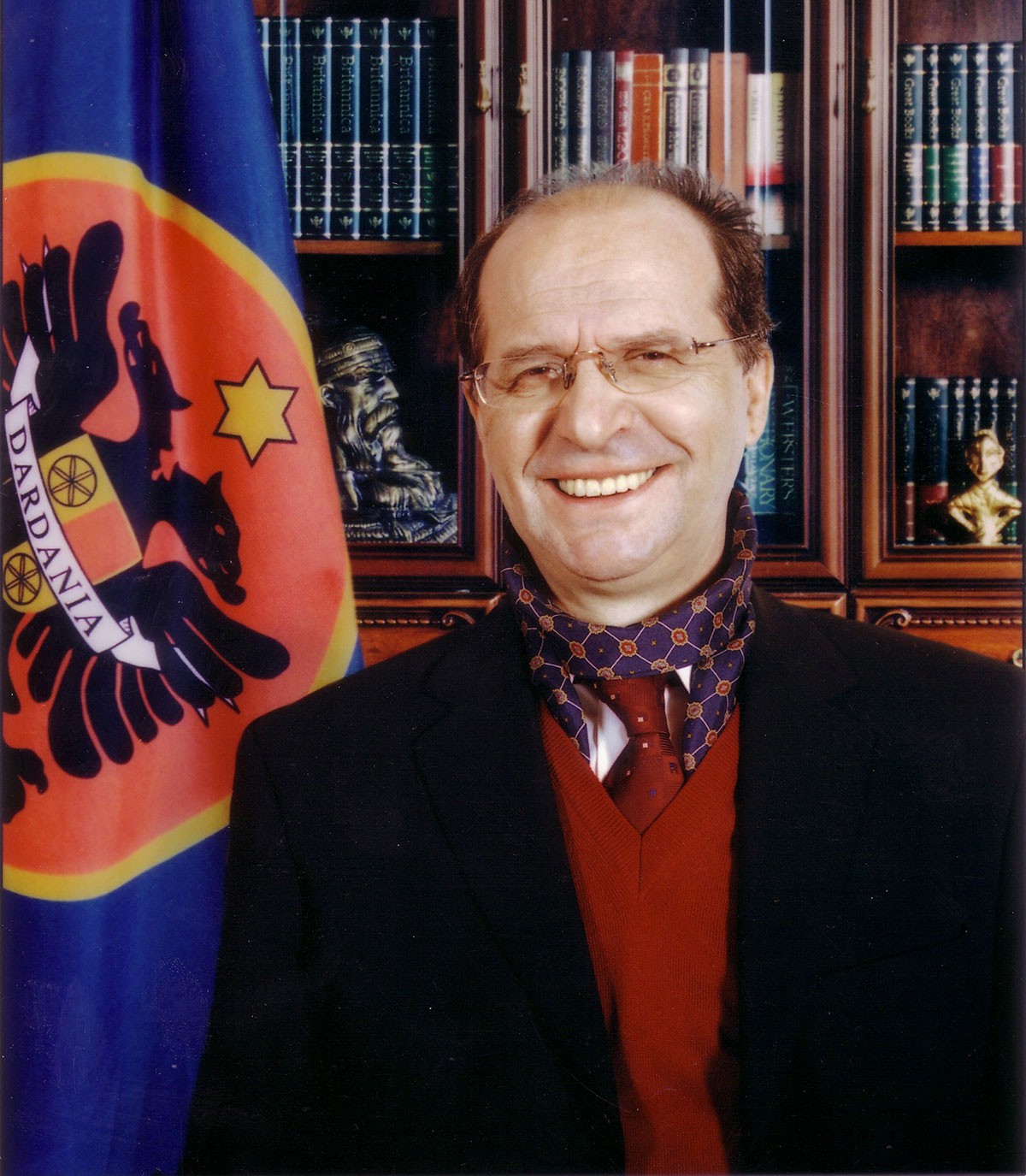
Ibrahim Rugova: resistance without an army
Rugova was a literary critic and intellectual. His strategy was unusual in the Yugoslavia of the early 1990s. While Slovenia, Croatia, and Bosnia moved into armed conflict, Kosovo's Albanian leadership tried to achieve independence: without armed rebellion, without frontal confrontation with the Yugoslav Army, and through construction of a parallel society.[10][11] The logic was pragmatic. Kosovo Albanians were the demographic majority. But the state possessed: the police, the army, heavy weapons, and the experience of the wars in Croatia and Bosnia. Rugova's strategy therefore sought to avoid a scenario in which Belgrade could exploit overwhelming military superiority.
How does a state without a state function? With money and self-organization. Kosovo Albanians created parallel: schools, health-care structures, political institutions, social networks, and a partial tax system.[9] Diaspora money was especially important. The government in exile collected an informal three-percent contribution from Albanian emigrants and residents to finance parallel institutions.[12] Schools often operated in: private houses, garages, empty commercial buildings, and improvised classrooms.[9] This was not a normal state. But neither was it merely a political declaration. Millions of everyday choices created a society that increasingly bypassed Serbian institutions. Education becomes a front line.
One of the most important consequences of the institutional split concerned education. Albanian teachers and pupils were excluded from much of the official system. A parallel Albanian-language school system emerged. For a generation of children, a normal school could be: a neighbor's house, a living room, an improvised classroom, or part of a private building.[9] In 1996 Milošević and Rugova, with mediation from the Community of Sant'Egidio, signed an agreement intended to allow Albanian students to return to school buildings.[9] But implementation was delayed. The agreement did not solve the underlying political conflict. In 1997 Albanian students again held mass demonstrations demanding access to the university. Police dispersed the demonstrations violently.[9] Students increasingly asked: how long can nonviolent resistance continue simply to wait? Why did Rugova fail to obtain a political result?
The nonviolent strategy achieved several important things. It prevented a large war at a time when Croatia and Bosnia were already burning. It preserved an organized Albanian political society. It gave Rugova enormous legitimacy among Kosovo Albanians. It gained international sympathy. But it did not achieve the central objective: independence or restoration of the 1974 autonomy. The Dayton Agreement of 1995 ended the war in Bosnia. It did not resolve Kosovo. For many Kosovo Albanians, the message was damaging: war in Bosnia had brought world leaders to the negotiating table; almost a decade of peaceful resistance in Kosovo had not produced a comparable political settlement. This was one of the key reasons confidence in Rugova's strategy eroded.
The KLA did not appear in 1998
The Kosovo Liberation Army — KLA, or UÇK — was for years a small and poorly understood organization. Its roots reached back into older Albanian radical and émigré organizations. By the mid-1990s it began carrying out or claiming armed attacks. In 1996 it carried out or claimed responsibility for several attacks on: Serbian police, state employees, and individual Albanians it labeled collaborators with the authorities.[13] That matters. The armed conflict did not begin with an entirely peaceful Kosovo suddenly attacked by police in 1998 with no prior guerrilla activity. The KLA was already using violence. At the same time, it was not yet a large army controlling Kosovo in 1996. It was a small armed organization at the margins of Rugova's dominant political strategy.
Was the KLA a terrorist organization? The terminology must be handled precisely. In February 1998, U.S. special representative Robert Gelbard publicly described KLA actions as terrorist and called the organization a terrorist group at a press conference.[14] At the same press conference he also said that in the U.S. assessment the great majority of violence in Kosovo came from police or official forces.[14] The United States did not place the KLA on its formal list of Foreign Terrorist Organizations, and Gelbard later softened or withdrew the designation.[13] Two common claims are therefore both inaccurate: “The United States never called the KLA terrorist.” It did, through Gelbard's public statement. And: “The KLA was formally designated as a U.S. terrorist organization.” It was not placed on the formal FTO list. This distinction becomes very important when we later examine the evolving American relationship with the KLA.
1997: Albania collapses — and weapons cross the border
In 1997 Albania's pyramid investment schemes collapsed. The result was near-total breakdown of public order. Military depots were looted. Estimates suggest that more than 100,000 small arms entered circulation.[13] Many could be purchased very cheaply. Some crossed the border into Kosovo. For the KLA this changed everything. An organization that had previously struggled to obtain weapons now gained: automatic rifles, ammunition, logistical routes, and new possibilities for armament. By late 1997 Drenica already had a strong KLA presence.[13] On 28 November 1997 uniformed and masked KLA members appeared publicly before a large crowd for the first time at the funeral of Halit Gecaj.[13] The guerrilla movement was no longer merely a mysterious acronym on faxed communiqués. It was becoming a visible military alternative.
The KLA also attacked civilians. The Kosovo story quickly produces a simple moral map: the state represses; the KLA defends. The record is more complicated. The KLA attacked Serbian police and state representatives. It also attacked: Serbian civilians, Roma, and Albanians it regarded as collaborators with Belgrade.[13][15] Later ICTY proceedings addressed crimes by KLA members against prisoners and civilians as well.[16] Some defendants were acquitted or some charges were not proven. The same evidentiary rule therefore applies: the organization should not be absolved of crimes, but neither should an indictment automatically be treated as proof of the guilt of every leader.
February 1998: the cycle of violence closes. By early 1998 Kosovo already contained all the elements of dangerous escalation. The Albanian majority did not recognize Serbian rule. Serbian police controlled the state apparatus. Rugova's strategy was losing credibility. The KLA attacked police. Police conducted increasingly extensive counter-guerrilla operations. Each side could present its next move as a response to the previous one. Then came Drenica.
Drenica and Prekaz: the event that transformed the KLA
On 28 February and 1 March 1998 Serbian special police carried out operations after KLA attacks in the villages of Likosane/Likošan and Ćirez/Qirez. On 5 March a major attack followed against the compound of Adem Jashari's family in Donji Prekaz/Prekaz.[17] Jashari was a known KLA commander. The operation therefore targeted a real armed figure.
But the force used also killed a large number of civilians. In the Limaj case, the ICTY summarized that 83 Kosovo Albanians were killed in the February–March attacks in Drenica, including at least 24 women and children.[17] Human Rights Watch reported approximately 58 deaths in the Prekaz assault itself, including many women, children, and elderly people.[18] The later Đorđević judgment found that at least 54 members of the Jashari family were killed in the attack, including numerous women and children.[19]
Exact totals vary slightly between reconstructions because of the scope of the events, burial practices, identification, and whether neighboring incidents are counted together. The central fact is not in serious dispute: the assault killed Adem Jashari and much of his extended family. Why was Prekaz politically more important than militarily?
Because it changed the balance inside Albanian society. Until then Rugova could argue: armed resistance will produce catastrophe; patience and international support are safer. After Prekaz many Albanians drew the opposite conclusion: passivity does not protect us. Human Rights Watch described the event as a turning point. After the Drenica operations, thousands of people who had previously supported Rugova's nonviolent policy began supporting or joining the KLA.[13][18] Adem Jashari became a national symbol. A state operation intended to destroy the KLA helped it politically become a mass movement. Was it only police repression against civilians?
That formulation would also be incomplete. The KLA was operating militarily in Drenica. It attacked police stations and patrols. The Serbian state had a right to respond to armed attacks. But the right to conduct a counter-guerrilla operation is not a license for: indiscriminate force, killing civilians, executing detainees, or collective punishment of villages. Human Rights Watch documented serious violations of the laws of war during operations in Drenica.[18] In some ICTY proceedings the court also emphasized evidentiary limits and did not accept every prosecution allegation regarding individual events.[20] This is an important methodological boundary. Evidence does not need to be exaggerated for the underlying problem to be serious.
Summer 1998: rebellion becomes war
After Drenica, the KLA grew rapidly. In spring and summer it took control of a number of rural areas and roads. Serbian police and the Yugoslav Army responded with larger operations. Human Rights Watch documented: shelling of villages, destruction of homes, forced displacement, arbitrary arrest, torture, disappearances, and executions.[13][18] At the same time, it documented KLA crimes as well. By late 1998 it no longer made sense to speak only of: a police problem or a terrorist organization. There was an armed conflict.[13] Inequality of violence does not mean the absence of crimes by the other side.
This is one of the most important distinctions. Human Rights Watch found serious abuses by both sides in 1998. But in its assessment the greater part of the most serious abuses resulted from Serbian and Yugoslav state forces.[13] That is not the same as saying: “The KLA committed no crimes.” But it is an important correction to false symmetry. A state force has: far more weapons, more personnel, institutions, powers of arrest, and the ability to conduct operations across the whole territory. Comparison therefore requires examining not only whether an individual crime existed, but also: scale, systematic character, organization, and effect on civilians.
Why does the nonviolent strategy collapse at that moment? Because several factors accumulated between 1995 and 1998. Dayton did not resolve Kosovo. The education agreement was not implemented. Student demonstrations were suppressed. The international community did not recognize the parallel Republic of Kosovo. The KLA demonstrated that it could attack police. Albania opened a large source of weapons. Prekaz created a martyr and symbol. Each of these reduced the political value of Rugova's argument: “wait; nonviolence will produce a settlement.” That does not mean war was inevitable. It means that the political cost of waiting rose rapidly for the Albanian side.
The international community still did not support independence in February 1998. This is very important for understanding what follows. In February 1998 U.S. representative Robert Gelbard did not only condemn KLA violence. He explicitly stated that the United States did not support Kosovo independence and saw Kosovo's future within the Federal Republic of Yugoslavia, although with substantially enhanced status or autonomy.[14] This is a crucial chronological correction to later narratives. In February 1998 the West did not yet publicly hold the policy: “Kosovo must become an independent state.” The official line was: dialogue, greater autonomy, remaining within Yugoslavia. Over the following year that situation changed dramatically.
By late 1998 Kosovo had become an international crisis. Large Serbian and Yugoslav operations in spring and summer 1998 produced: deaths, refugees, internally displaced persons, destroyed villages, and mounting international pressure. The KLA meanwhile became strong enough to represent both a military and political reality. In autumn 1998 another round of international mediation followed. The OSCE Kosovo Verification Mission was established. The agreement was intended to reduce: the presence of forces, fighting, and danger to civilians. But the conflict did not end. Both sides continued to violate agreements and prepare for renewed fighting. Winter 1998–1999 was therefore only a surface ceasefire.
What can the evidence support with high confidence?
The 1974 Constitution gave Kosovo exceptionally broad autonomy. Kosovo remained part of Serbia, but possessed its own institutions and direct representation in federal bodies.[1] Kosovo was not a republic. Legally it did not have the same status as the six Yugoslav republics. The 1981 demonstrations did not remain merely social student protests. They quickly included a demand for republican status and broader Albanian national demands.[3][4] Serbian complaints in the 1980s were not entirely fabricated.
Attacks on Serbs and other minorities are documented. But Serbian emigration also had important economic and social causes.[4] Milošević used the Kosovo question for political mobilization. His rise was closely linked to protection of Serbian national interests in Kosovo and a demand for stronger central control.[4] The changes of 1989–1990 substantially reduced Kosovo's self-government. It is debatable whether “abolition” or “drastic redistribution of powers” is the most legally precise description. In practice, Belgrade obtained control over key functions.[1][6]
The March 1989 Kosovo assembly vote did not occur in a normal political environment. Heavy security presence and pressure are judicially documented.[1] Albanians built genuine parallel institutions during the 1990s. Education, health care, politics, and tax-based financing operated for years outside the official Serbian system.[9][12] Rugova's project was predominantly nonviolent. The LDK enjoyed mass support for a strategy of peaceful resistance for most of the decade.[10] The KLA conducted armed attacks before Drenica in 1998. From the mid-1990s it attacked police, state representatives, and also individual civilians and alleged Albanian collaborators.[13]
Gelbard publicly called the KLA a terrorist group in February 1998. But the organization was never placed on the formal U.S. Foreign Terrorist Organization list.[13][14] Drenica was not an entirely unarmed area. The KLA had a substantial presence and had carried out attacks. That does not erase documented crimes by state forces. Operations killed numerous civilians, including women and children, and evidence exists of unlawful killings and indiscriminate force.[17][18][19]
Prekaz politically strengthened the KLA. After the deaths of Adem Jashari and much of his family, support for armed resistance rose sharply.[13] Both sides committed crimes in 1998. But the available documentation does not support a simple equivalence between the scale of state violence and KLA violence.[13] The West did not support Kosovo independence at the beginning of 1998. The public U.S. position favored substantially greater autonomy within the FRY.[14] The greatest mistake: begin the story with NATO's bombing.
If we begin on 24 March 1999, we can construct two completely different propaganda narratives. The first: “NATO attacked a sovereign state without reason.” The second: “NATO had to intervene because ethnic cleansing suddenly began.” Both omit the decade that created the conflict. Before 1999 there was already: dismantled autonomy; mass exclusion of Albanians from state institutions; a parallel society; failure of nonviolent strategy; an armed KLA; attacks on police and civilians; large counter-guerrilla operations; civilian casualties; refugees; and international mediation. Only from that process do we arrive at: Račak, Rambouillet, the question of NATO military access, the ultimatum, rejection of the agreement, and the bombing campaign. That question is taken up in Rambouillet 1999: Račak, Appendix B, and the Road to NATO’s Bombing Campaign
Sources and further reading
- ICTY, Prosecutor v. Milutinović et al., Trial Judgement, vol. 1. Detailed judicial reconstruction of Kosovo's constitutional position after 1974, its direct federal representation, and the 1989 redistribution of powers. Source
- ICTY, Milutinović et al. indictments/background. 1981 census: around 1.585 million inhabitants, 77% Albanians and 13% Serbs; the 1991 census was largely boycotted by Albanians. Source
- Hetemi, Atdhe. “Student movements in Kosova (1981): academic or nationalist?” Nationalities Papers 46(4), 2018. Examines the transition from student/social demands to republican status and competing Albanian political currents. Source
- ICTY, Prosecutor v. Vlastimir Đorđević, Trial Judgement. Historical reconstruction of the 1981 protests, interethnic tension, attacks on Serbs, mixed causes of Serbian emigration, and Milošević's 1987 Kosovo Polje appearance. Source
- Nationalities Papers. “Ethnopolitics in a Mining Enterprise in Crisis: Revisiting the Albanian Miners' Protests in Late Socialist Kosovo,” 2024. Detailed study of Trepča, the 1988 protests, and the underground hunger strike of roughly 1,300 miners in February 1989. Source
- ICTY, Milutinović / Đorđević case materials. Constitutional changes of 1989, emergency measures, dissolution of the Kosovo assembly in July 1990, and later direct Serbian control. Source 1 Source 2
- OSCE/ODIHR. Kosovo/Kosova As Seen, As Told. 2 July 1990 declaration; 7 September Kačanik constitution; 1991 referendum with reported turnout of around 87% and near-unanimous support. Source
- Human Rights Watch. Early reports on human-rights abuses in Kosovo/Serbia. The 28 September 1990 Serbian Constitution transferred practical control over major political, economic, judicial, and security institutions to Belgrade. Source 1 Source 2
- Human Rights Watch. Under Orders: War Crimes in Kosovo. Documents mass dismissals, parallel Albanian education and health care, and police pressure on parallel institutions. Source
- ICTY — Ibrahim Rugova testimony/profile. Rugova discusses repression, the 1991 referendum, parallel institutions, and mass support for the LDK's nonviolent strategy. Source
- U.S. Department of State, Office of the Historian. “Kosovo.” Official retrospective overview of lost autonomy, Rugova's peaceful movement, the parallel government, and the later KLA rise. Used as an American policy perspective rather than as the sole historical authority. Source
- OSCE. Historical overview of Rugova's political structure: 1991 referendum, Bujar Bukoshi's government in exile, and the informal three-percent contribution financing parallel institutions. Source
- Human Rights Watch. Under Orders and Humanitarian Law Violations in Kosovo. KLA growth, attacks in 1996–1997, weapons influx after Albania's 1997 collapse, first public KLA appearance in November 1997, and KLA crimes against Serbs, Roma, and Albanians labeled collaborators. Source 1 Source 2
- U.S. Department of State, Robert Gelbard, press conferences of 22 and 23 February 1998. Primary source for U.S. condemnation of much police violence, Gelbard's public description of the KLA as a terrorist group, and the U.S. position against Kosovo independence at that time. Source 1 Source 2
- ICTY, Haradinaj et al. case materials. Allegations regarding KLA violence against Serbian, Roma/Egyptian, and Albanian civilians, especially those labeled collaborators. Individual charges are treated cautiously because indictments are not equivalent to final convictions. Source
- ICTY — Tribunal achievements / Limaj et al. The first completed ICTY Kosovo case dealt with KLA members and crimes at the Lapušnik/Lapušnik camp; outcomes are used to separate proven conduct from allegations. Source 1 Source 2
- ICTY, Prosecutor v. Limaj et al., Trial Judgement. Judicial reconstruction of the February–March Drenica operations: 83 Kosovo Albanians killed, including at least 24 women and children; assault on the Jashari compound on 5 March 1998. Source
- Human Rights Watch. Humanitarian Law Violations in Kosovo, 1998. Detailed field investigation of Drenica and Prekaz; serious humanitarian-law violations and around 58 deaths in the Prekaz assault, including many women and children. Source
- ICTY, Prosecutor v. Vlastimir Đorđević. Later judicial finding that at least 54 members of the Jashari family were killed in the assault on the compound of the well-known KLA commander Adem Jashari, including numerous women and children. Source
- ICTY, Prosecutor v. Milutinović et al., Trial Judgement. In several early-1998 incidents the court did not accept every prosecution claim concerning indiscriminate force because of evidentiary limitations; used as a safeguard against overstating the record. Source