Bosnia 1992: A Republic Without a Majority — Referendum, Three National Political Projects, and the Beginning of the Bloodiest War of the Breakup
Referendum, three national political projects, parallel authorities and armament: how Bosnia and Herzegovina moved into war in spring 1992.
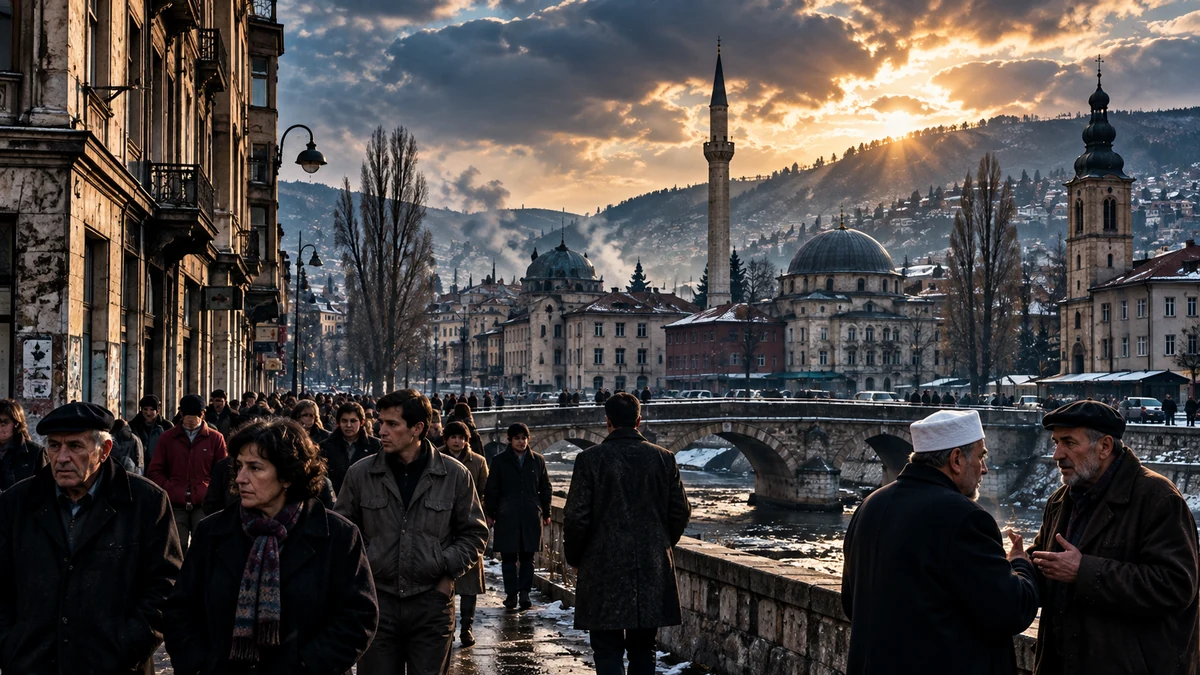
Bosnia was not Slovenia and it was not Croatia
Slovenia had a clear Slovene majority. Croatia had a clear Croat majority, although it also had a large and territorially concentrated Serb community. Bosnia and Herzegovina was different. According to the 1991 census, it had 4,377,033 inhabitants. Of these:
- 1,902,956, or 43.5%, identified as Muslims,
- 1,366,104, or 31.2%, as Serbs,
- 760,852, or 17.4%, as Croats,
- 242,682, or 5.5%, as Yugoslavs,
- with the remainder in other categories.[1]
The term Muslims was then the official national category. Today the same national community is generally called Bosniaks, but when describing documents from 1990–1992 we should not retroactively substitute modern terminology where the original sources used the constitutional term of the time. The most important fact was another one: no nation had an absolute majority. That meant that Yugoslavia's collapse did not pose Bosnia only the question: Should it remain in Yugoslavia or become independent? It also posed the question: Who has the right to decide? A majority of all citizens? Each of the three constituent peoples separately? The republican assembly? Or territories that each national political movement declared to be its own? That would become the heart of the crisis.
The 1990 elections: three national parties win together
Bosnia and Herzegovina's first multi-party elections were held on 18 November 1990. The winners were not parties built around a shared Bosnian political program. They were three parties organized primarily along national lines: SDA — Party of Democratic Action, representing primarily Muslims; SDS — Serb Democratic Party; HDZ BiH — Croatian Democratic Union of Bosnia and Herzegovina.[2] In the 240-seat bicameral assembly, together they won around 84 percent of all mandates. SDA held 86 seats.
SDS 72. HDZ 44.[2][3] Yet after the election they did not immediately become hostile governments. They formed a common government. Alija Izetbegović became President of the Presidency. Momčilo Krajišnik, a prominent SDS politician, became President of the Assembly. Jure Pelivan of HDZ became Prime Minister.[2] This is an important image. Bosnia in 1990 was not a state in which the three national parties could not even sit at the same table. They could. The problem was that beneath the common government lay very different answers to the future of Yugoslavia.
As long as Yugoslavia existed, the answer could be postponed
As long as there remained a possibility of a reformed Yugoslavia, the differences could still be contained. But on 25 June 1991 Slovenia and Croatia declared independence. A major war broke out in Croatia. Federal institutions were disintegrating. And Bosnia now had to answer a question it had previously been able to postpone: What remains of Yugoslavia if Slovenia and Croatia leave? For most of the SDA leadership, remaining in a new, strongly Serbia-centered Yugoslavia together with Serbia, Montenegro, and portions of other republics was unacceptable. For the SDS leadership, an independent Bosnia in which key decisions could be made by a common civic majority was equally unacceptable.
HDZ BiH stood in between: it supported Bosnia leaving the remaining Yugoslavia, while part of the Croat political leadership increasingly also organized its own territorial framework.[4] From this point forward Bosnia did not have one constitutional dispute. It had at least three.
The first project: SDA — an independent and territorially intact Bosnia
SDA under Alija Izetbegović was a national party. It was not a neutral civic party without a Muslim or Bosniak political identity. But by late 1991 its state program was increasingly oriented toward: an independent Bosnia and Herzegovina within its existing republican borders. That meant: Bosnia would not remain in a reduced Yugoslavia; it would not be divided between Serbia and Croatia; and it would not dissolve into three independent national states.
On independence, SDA found a common interest with HDZ. But that alliance did not mean that the two had an identical vision of Bosnia's internal order. Part of the Muslim/Bosniak political space increasingly emphasized the principle: citizens decide by majority. For SDS, that was dangerous. If one of the three constituent peoples made up almost 44% of the population and could combine with part of the Croat vote to outvote Serbs, then in the Serbian interpretation this was no longer a balance among three peoples. This was the beginning of a constitutional problem that could not be solved by counting votes alone. Muslims also armed themselves.
It is important not to create a picture in which only one side prepared for the possibility of war. ICTY judicial records establish that in 1991 and early 1992 all major communities were at least partly arming themselves.[5] On the Muslim side, the Patriotic League emerged. It organized clandestine acquisition of arms, military training, and local networks. Groups later known as the Green Berets also formed part of this wider process of self-organization.[5] That matters. Independent Bosnia did not emerge as a completely unarmed political project that considered creating armed forces only after the first attack. Its leaders were watching the war in Croatia.
They saw what state collapse meant. And they prepared. But armament on all sides did not mean equal military power. The JNA possessed: heavy weapons, barracks, depots, command structures, logistics, artillery, armor, and infrastructure throughout Bosnia. That imbalance would be decisive.
The second project: SDS — remain in Yugoslavia or remove Serb territories from an independent Bosnia
Radovan Karadžić's SDS opposed an independent Bosnia if it left Yugoslavia without Serb consent. Its policy increasingly became territorial. Already in 1991, municipalities with Serb majorities were linking themselves into: associations of municipalities, autonomous regions, and other parallel political structures.[6] On 24 October 1991 the Assembly of the Serbian People in Bosnia and Herzegovina was formed.[6][7] This meant that SDS had created an institution that was no longer merely a parliamentary caucus within the Bosnian assembly.
It was a parallel political center. On 9 and 10 November 1991, SDS held a plebiscite. Bosnian Serbs were asked whether they wished to remain in a common Yugoslav state with Serbia, Montenegro, and others who wished to remain.[8] The overwhelming majority of participating Serbs answered yes. But the plebiscite was not a common referendum of all Bosnia's citizens. Participation was almost exclusively Serbian, and different groups received different ballots.[8] Thus by late 1991 a paradox had emerged: one political side invoked the will of a majority of all inhabitants of the republic; the other invoked the separate will of one constituent people. Both spoke about democracy. They were measuring a different demos.
Serbian autonomous regions were not merely symbolic. By late 1991 Serbian regionalization was not merely a cultural or administrative concept. In several proceedings the ICTY found evidence that SDS: organized separate Serbian institutions; coordinated local crisis structures; participated in the arming of the Serbian population; and, together with elements of the JNA, prepared structures for the takeover of power in municipalities.[6][9] In the later Radovan Karadžić judgment, the court found that from October 1991 a broader common project existed to permanently remove Muslims and Croats from territories claimed by the Bosnian Serb leadership for its state.[10] Karadžić was later finally convicted for:
persecution, extermination, murder, deportation, forcible transfer, and the campaign of terror against Sarajevo.[10] An important legal boundary remains, however: the ICTY did not find genocide in the Bosnian municipalities in 1992. Karadžić's final genocide conviction concerned Srebrenica in 1995, not all crimes committed in 1992.[10] Crimes against humanity and genocide are not the same legal category. January 1992: a Serbian republic exists before the Bosnian referendum.
This date is very important. On 9 January 1992 the Assembly of the Serbian People proclaimed the Serbian Republic of Bosnia and Herzegovina.[7][11] Its name would be changed in August to Republika Srpska. This happened: before Bosnia's independence referendum, before European recognition, and before American recognition. It is therefore chronologically wrong to say: “The Bosnian Serbs created their republic only in response to international recognition of Bosnia.” Its political and institutional structures had been developing during 1991. The republic was formally proclaimed in January 1992. That does not mean the referendum and recognition later had no effect on escalation. It means that the separatist institutional infrastructure already existed.
The third project: HDZ BiH — for an independent Bosnia, but not necessarily a fully centralized Bosnia
Croat politics in Bosnia was the most dual. HDZ BiH under Stjepan Kljuić still advocated an independent and indivisible Bosnia and Herzegovina in 1991.[12] At the same time, leaders within the party who wanted a separate Croat territorial organization were becoming stronger. On 18 November 1991 the Croatian Community of Herceg-Bosna was proclaimed in Grude.[7][13]
Great caution is necessary here. We should not automatically project everything that occurred in the Croat-Bosniak war of 1993 backward into November 1991. The later judgment in Prlić et al. located the criminal joint project of ethnic territorial transformation in a later phase, especially from early 1993.[14] But other judicial findings show that by late 1991 some leaders of Herceg-Bosna were already publicly speaking about Croat territory in Bosnia and links with Croatia.[15] The most accurate formulation is therefore: the Croat project at the end of 1991 was internally divided and still evolving. HDZ supported the referendum for an independent Bosnia. At the same time it was constructing its own regional political structure.
That duality would later become one of the principal sources of the Bosniak-Croat conflict. October 1991: the common assembly fractures. On 15 October 1991 the Bosnian assembly adopted documents affirming the sovereignty of Bosnia and Herzegovina. Serbian representatives opposed the decision. The dispute was sharp and constitutional: could a parliamentary majority decide the status of the republic if representatives of one of the three constituent peoples argued that this was an issue on which they could not legitimately be outvoted?
SDS understood the decision as proof that common institutions no longer protected Serbian political equality. SDA and HDZ argued that a Serbian veto could not automatically prevent Bosnia from following Slovenia and Croatia out of a disintegrating Yugoslavia. After this confrontation, Serbian representatives increasingly operated through their own assembly. The Bosnian parliament increasingly ceased to function as a common arena for all three national political projects. This was an institutional turning point.
The Badinter Commission: Bosnia did not yet have a sufficiently clear answer
When the European Community opened a recognition process for new states in December 1991, Bosnia faced a problem. The Presidency of Bosnia and Herzegovina applied for recognition on 20 December. The Serbian members of the Presidency did not support the application.[7] On 11 January 1992, the Badinter Arbitration Commission found that the will of the population of Bosnia and Herzegovina to constitute an independent state could not yet be reliably established because there had been no referendum or comparable expression of the will of the population.[16]
It therefore called for a referendum. This is crucial. The referendum was not merely Izetbegović's unilateral idea. It was also a response to a European condition for recognition. January: Serbian deputies leave and the referendum is called.
On 25 January 1992, the Assembly of the Socialist Republic of Bosnia and Herzegovina called a referendum on sovereignty and independence. SDS deputies and part of the other Serbian representatives left the session and did not support the decision.[7][17] The referendum was scheduled for 29 February and 1 March. The question asked, in substance: Are you in favor of a sovereign and independent Bosnia and Herzegovina, a state of equal citizens and nations of Bosnia and Herzegovina — Muslims, Serbs, Croats, and members of other peoples living in it?[18] The phrase matters: a state of equal citizens and peoples. It tried to combine two sources of legitimacy: civic and national. But the dispute over which one had the final word did not disappear.
The referendum: 64.31 percent turnout, almost all votes in favor
The republican electoral commission determined the official results on 6 March. Of 3,253,847 registered voters, 2,073,568, or 64.31 percent, voted.[18] Of the valid votes: 2,061,932, or 99.44 percent, were in favor, and 6,037 were against.[18] This is a very clear result. But its meaning must be described precisely. Votes for independence represented approximately 63.4 percent of all registered voters. That is an absolute majority of the entire electorate. It was not, however, a consensus of all three constituent peoples. SDS boycotted the referendum. The great majority of Bosnian Serbs stayed home.[17][19]
Two political statements can therefore both be true: “A majority of all registered voters in Bosnia chose independence.” That is supported by the result. And: “Most Bosnian Serbs did not accept independence.” That too is supported by the boycott and the earlier Serbian plebiscite. Both propositions can coexist. The referendum was not ethnically uniform even on the “yes” side.
The result should also not be reduced to: Muslims against Serbs. HDZ BiH supported participation in the referendum and independence. Croatia also encouraged Bosnian Croats to vote in favor.[17] The referendum coalition was therefore, in broad terms: Muslim/Bosniak + Croat, with a mass Serbian boycott. Yet disagreements between HDZ and SDA over Bosnia's future internal structure already existed. HDZ wanted stronger recognition of constituent peoples and territorial organization. SDA placed more emphasis on the integrity of the state and civic majority rule. An alliance for independence did not yet mean a common vision of Bosnia. March: the killing at a Serbian wedding in Sarajevo.
On the first day of March, while the referendum was still under way, a Serbian wedding procession was attacked outside an Orthodox church in Sarajevo. Nikola Gardović, father of the groom, was killed, and an Orthodox priest was wounded. Among Bosnian Serbs the event became a symbol: proof that they would not be safe in an independent Bosnia. Barricades followed in Sarajevo. ICTY reconstruction indicates that SDS politically controlled the barricades and connected them to demands involving the suspension of international recognition, changes in the police, and other political issues.[20] The following day, large demonstrations took place in Sarajevo demanding removal of the barricades. For a time they were removed.
This matters. The killing at the wedding was real and politically explosive. But by itself it does not explain the entire war. Parallel Serbian institutions, autonomous regions, armament, and territorial plans had existed for months before it.

Lisbon, 18 March: a missed peace?
In March 1992 the European Community, through José Cutileiro, tried to prevent war. On 18 March Alija Izetbegović, Radovan Karadžić, and Mate Boban accepted a Statement of Principles for a New Constitutional Arrangement for Bosnia and Herzegovina as a basis for further negotiations.[21] The proposal preserved Bosnia and Herzegovina as a state within its existing borders. But it would divide the country into three constituent units based primarily on national criteria, while also taking geographic and economic factors into account.[21]
This is an important document because it shows that a negotiating space still existed immediately before the war. A later myth grew around it: “Peace had already been signed, then Izetbegović rejected it on American orders and thereby caused the war.” The primary record is more complicated. The document of 18 March was a statement of principles and a basis for further negotiations, not a final signed peace treaty.[21] The parties accepted it as a negotiating framework. The Bosnian Presidency later rejected it.[21] There are later testimonies and political claims concerning U.S. Ambassador Warren Zimmermann's role in Izetbegović's withdrawal of support.
But the documentation reviewed for this article does not allow us responsibly to state as fact that there was a proven American order: “Reject peace and go to war.” The more defensible conclusion is: in March 1992 there was a serious but unfinished negotiating possibility for an ethnically federalized Bosnia; it collapsed before the parties had agreed on a final map and constitutional implementation. Why was Lisbon a problem for every side?
For SDS the proposal was attractive because it recognized nationally defined constituent units. That was close to its objective of territorial autonomy. But the Serbian leadership already had its own republic and territorial claims. For HDZ the plan was also attractive because it recognized a Croat constituent unit. For SDA, however, it was dangerous. If Bosnia were divided into national units before the war, that could legalize precisely the ethnic partition that Izetbegović's policy sought to prevent. For supporters of the plan, the price of federalization was smaller than the price of war. For critics, an ethnic map was a recipe for further partition.
This conflict of interests cannot be reduced simply to the question of who was the last person to say no. Recognition did not create all armed structures — but it placed them into a new state framework. The European Community recognized Bosnia and Herzegovina on 6 April 1992. The United States did so on 7 April. Bosnia and Herzegovina was admitted to the United Nations on 22 May 1992.[7][22] But before recognition there already existed: the Serbian Republic of Bosnia and Herzegovina; Herceg-Bosna; Serbian autonomous regions; the Patriotic League; local armed formations; crisis staffs; and much of the JNA on Bosnian territory. Recognition therefore did not create all the actors from nothing.
It did change the legal framework. From that moment Sarajevo argued: the JNA and Serbian forces are operating on the territory of an internationally recognized state. The Bosnian Serb leadership argued: international recognition cannot nullify the right of Serbs to remain in Yugoslavia or live within their own state unit. The legal change did not resolve the political dispute. It placed it into an even sharper framework.
When did the war actually begin?
As in Croatia, there is no single completely neutral date. For some, the beginning is: 1 March and the wedding killing. For others: 3 or 6 March and the formalization of independence. For still others: late March in Bosanski Brod or Bijeljina. For Sarajevo: 5 and 6 April, when violence around the city and at demonstrations escalated and the systematic siege began. In individual municipalities, war arrived on different dates. The most accurate formulation is therefore: Bosnia moved from political crisis into open war between March and early April 1992, with different regions exploding at different moments. An ICTY judgment describes how, after the formalization of independence, conflict broke out and by early April fighting was recorded in Bijeljina, Foča, Kupres, Bosanski Brod, and elsewhere.[23]
Bijeljina: how quickly a political project can become violent territorial change
At the end of March and beginning of April 1992, members of Željko Ražnatović Arkan's Serbian Volunteer Guard entered Bijeljina. The ICTY later found that Arkan's men, together with local Serbian structures, Territorial Defence, and SDS, had taken control of the town by 4 April.[24] The court found that at least 45 non-Serb civilians were killed during the takeover. Many Muslims fled because of the violence.[24] Bijeljina matters because it shows a model that would be repeated elsewhere: seizure of police and municipal institutions; entry of local or outside armed formations; disarmament or removal of another community;
killings and intimidation; flight of the population; a new political authority. This is more than a spontaneous interethnic clash. It is a change of power on the ground. The JNA in Bosnia was not a neutral empty shell. By spring 1992 the question of the JNA resembled the situation in Croatia months earlier, but was even more significant. A large part of the JNA's military infrastructure was located in Bosnia. As the federation disintegrated, its personnel became increasingly Serbian. ICTY findings note that Bosniak and Croat conscripts and reservists increasingly refused mobilization while Bosnian Serbs continued to respond, changing the ethnic composition of the force.[25]
Evidence presented before the ICTY also documented large quantities of JNA weapons distributed to Bosnian Serbs before and during the beginning of the war.[26] When the JNA formally withdrew from Bosnia and Herzegovina in May 1992, much of its personnel, equipment, and organizational structure remained and became the basis of the Army of Republika Srpska. A later article in the series will examine the military structure of the war in more detail. For this article, the key conclusion is sufficient: the sides did not enter the war in spring 1992 with equal material capabilities.
Sarajevo: a city showing that the war was not only about distant national regions. Sarajevo may have been the most Yugoslav of Bosnia's large cities. Mixed marriages. Multiethnic neighborhoods. Shared companies. A university. The Olympic memory of 1984. That is precisely why its siege became so symbolically important. The ICTY found that Bosnian Serb forces carried out a campaign of sniping and shelling against civilians from April 1992 to November 1995, with the purpose of spreading terror among Sarajevo's population.[10] Civilians were attacked: in the streets; while fetching water; on public transport;
and even children at play.[10] This does not mean Bosnian government forces were absent from Sarajevo or that the war had no military objectives. It means that a systematic campaign against the civilian population was judicially established. Was Bosnia only Serbian aggression?
If that term erases the internal constitutional conflict, the political choices of Bosnian Serbs, and the fact that everyone initially lived in the same republic, it loses part of the story. If Bosnia is described only as a spontaneous civil war among three equally organized sides, another part is lost. SDS was already building a parallel state structure in 1991. Bosnian Serb forces had major support from the JNA. Links existed with Serbia and Serbian state-security structures. ICTY judgments established organized campaigns of forcible removal of Muslims and Croats from territory claimed by the Bosnian Serb leadership.[10] At the same time SDA and HDZ also armed themselves and built their own forces.[5] Later, Army of BiH and HVO forces would also commit documented war crimes.
But the symmetrical existence of crimes on multiple sides does not mean symmetrical chronology, military power, or territorial projects at every stage of the war. That distinction will remain essential throughout the Bosnia part of the series. Was Bosnia simply a war of three peoples?
That too is too simple. In 1991 more than 240,000 people still identified as Yugoslavs.[1] There were mixed marriages. People who rejected national partition. Local Serbs, Croats, and Muslims who remained loyal to a common state. People who served in forces whose ethnic label did not match their own. And people who fled from “their own” national side. National parties were the strongest political organizers. They were not identical with entire peoples. This must be repeated. The three political projects were not static.
If we reduce them to three sentences: SDA: an intact independent Bosnia. SDS: a Serbian Bosnia linked to Yugoslavia or Serbia. HDZ: Croat territorial autonomy together with support for an independent Bosnia. we get a useful starting map. But reality evolved. SDA would build an increasingly centralized state army during the war. SDS would turn its parallel republic into Republika Srpska. HDZ would develop Herceg-Bosna into a political and military structure that in 1993 would also enter open war with the Army of Bosnia and Herzegovina. This article is therefore not a final verdict on what all three sides “always wanted.” It is a snapshot of the political moment immediately before a major war.
The greatest mistake: begin with Srebrenica and read history backward. Today we know what happened in 1995. Srebrenica. Genocide — as legally determined by international courts. Dayton. But if that knowledge is projected backward into January 1992, we produce false history. People at the time did not yet know: how long the war would last; who would control which territory; that Sarajevo would be besieged for almost four years; that a Croat-Bosniak war would occur; that Srebrenica would become the site of the 1995 crimes later legally qualified as genocide by international courts; or that the state would end as two entities under Dayton.
They nevertheless had enough reasons for fear. The war in Croatia was taking place before their eyes. Weapons had already been distributed. Parallel authorities already existed. And the common political institution could no longer produce a decision that all three national blocs regarded as legitimate. That is the tragedy of the beginning of the Bosnian war.
What can be stated with a high degree of confidence?
Bosnia had no absolute national majority. Muslims were around 43.5%, Serbs 31.2%, Croats 17.4%, and Yugoslavs 5.5% of the population.[1] The three national parties won most of the political power in 1990. SDA, SDS, and HDZ together won about 84% of parliamentary mandates and initially formed a common government.[2] All three communities were at least partly organizing militarily before open war.
Muslim/Bosniak and Croat structures also acquired arms and formed armed units.[5] The Bosnian Serb parallel political system was developing already in 1991. Autonomous regions, the Serbian Assembly, the plebiscite, and then the Serbian Republic of Bosnia and Herzegovina all predated Bosnia's international recognition.[6][7][8] Herceg-Bosna was established in November 1991. But later crimes and the criminal project established for the 1993 phase should not automatically be projected backward to the moment of its creation.[13][14]
The Badinter Commission called for a referendum. It did not consider the will of Bosnia's population for an independent state sufficiently clearly established by January 1992.[16] The referendum obtained a majority of all registered voters, but not consensus among all peoples. 64.31% of voters participated; 99.44% of valid votes were for independence. SDS organized a mass boycott.[18][19] Lisbon was not a final signed peace treaty.
It was an accepted statement of principles as a basis for further negotiations and later collapsed.[21] The claim that the United States definitively ordered Izetbegović to reject an already concluded peace agreement exceeds the reviewed documentation. The role of American diplomacy is relevant, but the slogan about a direct order is insufficiently documented as a factual conclusion. The war has no single universally neutral starting date. Between March and early April 1992, the political crisis became open warfare in several regions.[23][24]
Bosnian Serb forces had a major material advantage because of the JNA and its stocks. Judicial records document armament and the institutional transition of much of the JNA into the Army of Republika Srpska.[6][25][26] Crimes in Bosnian municipalities in 1992 were not legally classified as genocide in Karadžić's final judgment. They did, however, support convictions for persecution, murder, extermination, deportation, and forcible transfer.[10] Why was the Bosnian war so destructive?
Because boundaries among communities were not clear. There was no single front line neatly separating three peoples. Municipalities were mixed. Villages interwoven. Cities multiethnic. Transport routes shared. JNA barracks distributed throughout the country. When a political project demands nationally homogeneous territory in a country with such demography, a terrible practical consequence follows: for the map to become ethnically homogeneous, people have to move. They will not all move voluntarily. Territorial politics therefore quickly turns into: intimidation, expulsion, detention, deportation, killing, destruction of homes, and destruction of religious and cultural sites. That process would later become widely known as: ethnic cleansing. The next step: Kosovo before 1999.
Bosnia shows what happens when: state collapse, constitutional conflict, national territorialization, parallel authorities, armament, and external support begin to operate at the same time. But the next major Yugoslav conflict had a different genealogy. Kosovo. There we need to go further back: to the 1974 constitution; the 1981 demonstrations; relations between Serbs and Albanians; Milošević's rise; the reduction of autonomy in 1989; parallel Albanian institutions; Ibrahim Rugova; nonviolent resistance; and only then the emergence of the KLA. From here the series continues with Kosovo Before 1999: Autonomy, Repression, Parallel Society, and the Road from Rugova to the KLA
Sources and further reading
- Federal Institute of Statistics / Agency for Statistics of Bosnia and Herzegovina. 1991 census: 4,377,033 inhabitants; Muslims 1,902,956 (43.5%), Serbs 1,366,104 (31.2%), Croats 760,852 (17.4%), Yugoslavs 242,682 (5.5%). Source 1 Source 2
- Parliamentary Assembly of Bosnia and Herzegovina. Official historical overview of the 1990 elections, coalition government, and breakdown of the common parliamentary arena. Source
- International Court of Justice case materials / official 1990 election result. SDA 86, SDS 72, HDZ 44 of 240 seats; the three national parties together held 202 seats. Used as a reproduction of official results rather than for partisan interpretation. Source
- ICTY, Prosecutor v. Stakić, Trial Judgement. Overview of the political split: SDA/HDZ rejected remaining in a reduced Yugoslavia without Slovenia and Croatia, while SDS strongly opposed independence. Source
- ICTY, Prosecutor v. Krajišnik, Trial Judgement. Documents the arming of multiple communities, including clandestine organization and training through the Patriotic League. Source
- ICTY, Krajišnik proceedings. Evidence on Serbian regionalization, autonomous areas, parallel institutions, and cooperation between SDS and JNA structures in arming Bosnian Serbs. Source
- Parliamentary Assembly of Bosnia and Herzegovina. Official chronology: Serbian Assembly formed 24 October 1991; Serbian Republic of Bosnia and Herzegovina proclaimed 9 January 1992; Herceg-Bosna established 18 November 1991. Source
- ICTY, Perišić / Mladić materials. Reconstruction of the Serbian plebiscite of 9–10 November 1991, including predominantly Serbian participation and different ballots. Source 1 Source 2
- ICTY, Prosecutor v. Karadžić. Detailed evidence on local armament, SDS crisis structures, and distribution of arms to Bosnian Serbs. Source
- ICTY, Prosecutor v. Radovan Karadžić. Karadžić was convicted for genocide at Srebrenica, persecution, extermination, murder, deportation, forcible transfer, the Sarajevo terror campaign, and other crimes; genocide was not established for the other Bosnian municipalities in 1992. Source
- ICTY, Prosecutor v. Perišić. Chronology of the 9 January 1992 proclamation of the Serbian Republic of Bosnia and Herzegovina. Source
- ICTY, Prlić case materials. Documents on internal HDZ BiH debates in 1991; Stjepan Kljuić and part of the leadership advocated an independent and indivisible Bosnia and Herzegovina while alternative territorial ideas also existed. Source
- ICTY, Prosecutor v. Prlić et al. / Parliamentary history of BiH. The Croatian Community of Herceg-Bosna was established on 18 November 1991. Source 1 Source 2
- ICTY, Prlić et al., Trial Judgement Summary. Temporal safeguard: the criminal joint project of ethnic territorial transformation is placed later and should not automatically be backdated to November 1991. Source
- ICTY, Kordić & Čerkez. Judicial findings concerning political statements by some Herceg-Bosna leaders in late 1991 and early 1992 about Croat territory and links with Croatia. Source
- Badinter Arbitration Commission, Opinion No. 4, 11 January 1992. The commission held that the will of the population of Bosnia and Herzegovina to constitute an independent state was not yet sufficiently established without a referendum or comparable expression of will. Source
- Parliamentary Assembly of Bosnia and Herzegovina / ICTY. The referendum was called on 25 January 1992; SDS and some other Serbian representatives left before the vote. Source 1 Source 2
- Constitutional Court of Bosnia and Herzegovina, case U 18/16. Reproduces official Electoral Commission results: 3,253,847 voters, 64.31% turnout, 2,061,932 or 99.44% of valid votes in favor; also reproduces the referendum wording. Source
- ICTY, Krajišnik Judgement. Referendum of 29 February–1 March 1992; Bosnian Serbs largely abstained in accordance with SDS policy. Source
- ICTY, Karadžić Judgement / Dragomir Milošević Judgement. Reconstruction of the 1 March Serbian wedding killing, subsequent barricades, and SDS political demands. Source 1 Source 2
- PA-X Peace Agreements Database. Statement of Principles for New Constitutional Arrangements for Bosnia and Herzegovina, 18 March 1992. Primary document preserving Bosnia within its borders while proposing three constituent units; accepted as a basis for further negotiations, not a final peace treaty. Source
- Parliamentary Assembly of BiH / United Nations / U.S. Department of State. EC recognition 6 April 1992, U.S. recognition 7 April, UN admission 22 May. Source 1 Source 2
- ICTY, Stanišić & Župljanin Trial Judgement. Describes the transition from political crisis into open armed conflict in March and April 1992 across several regions. Source
- ICTY, Stanišić & Simatović Trial Judgement, Bijeljina. Finds that Arkan's men, local Serbian structures, TO and SDS took control of the town by 4 April 1992 and that at least 45 non-Serb civilians were killed. Source
- ICTY, Karadžić Judgement. Documents the changing ethnic composition of the JNA in Bosnia and local distribution of weapons. Source
- ICTY, Prosecution case — Croatia and Bosnia and Herzegovina. Evidence concerning large-scale JNA distribution of weapons to Bosnian Serb structures before and during the beginning of the war; used together with judicial findings, not as a standalone final judgment. Source