Bosnia 1992–1995: From the Siege of Sarajevo to Dayton — Three Armies, Ethnic Cleansing, the Croat–Bosniak War, Safe Areas, NATO and the End of the War
From the siege of Sarajevo to Dayton: three armies, ethnic cleansing, the Croat-Bosniak war, safe areas and a changing military balance.
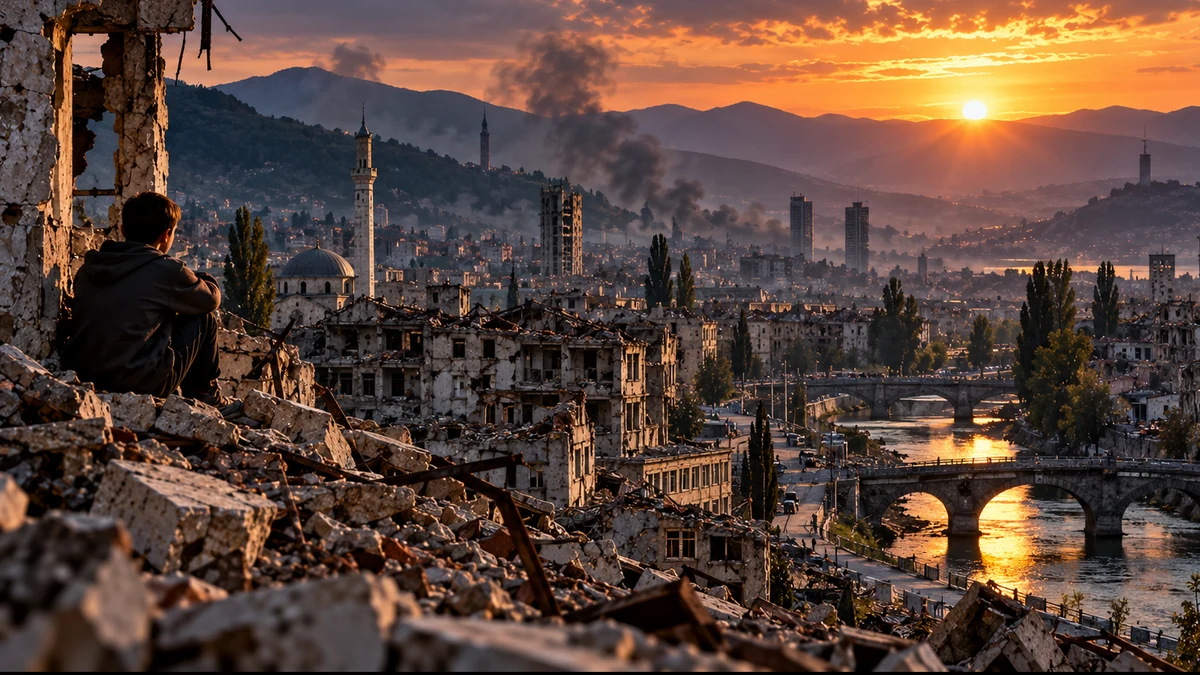
Three armies — but not three identical stories
By the second half of 1992, three principal organized military structures operated in Bosnia and Herzegovina: Army of Republika Srpska — VRS, Army of the Republic of Bosnia and Herzegovina — ARBiH and Croatian Defence Council — HVO. Alongside them operated police and special units, local armed groups, paramilitary formations and foreign volunteers. Why is it not enough simply to call it a “civil war”?
Because the conflict simultaneously had an internal component, strong external military, logistical and political support for particular sides and a wider connection with the breakup of Yugoslavia and the war in Croatia. Courts in different cases legally analyzed the nature of the conflict according to time, location and links between individual forces and outside states. This article therefore does not use a single political label as a substitute for: concrete analysis of actors and conduct.
Bosnian Serbs: from political territorialization to military control
The Army of Republika Srpska emerged from structures of the former JNA in Bosnia and Herzegovina, local Serbian territorial and military structures and the political project of the Bosnian Serb leadership. By mid-1992 it controlled a large part of Bosnia and Herzegovina. What has been finally established by the courts?
In the final Radovan Karadžić case, his participation was confirmed in the so-called: Overarching JCE whose common purpose was to permanently remove Bosnian Muslims/Bosniaks and Bosnian Croats from areas claimed by the Bosnian Serbs.[1] The IRMCT affirmed his convictions for persecution, extermination, murder, deportation and forcible transfer and other crimes.[1] Similarly, the final Ratko Mladić judgment confirmed his responsibility for the broader JCE aimed at removing Bosniaks and Croats from claimed territories, as well as for Sarajevo, the taking of hostages and Srebrenica.[2]
“Ethnic cleansing” is not merely a media term. During the war in Bosnia and Herzegovina the expression: ethnic cleansing became a description of policies aimed at changing the ethnic composition of territory through expulsion, deportation, forcible transfer, detention, violence, killings and destruction of homes. The UN Security Council used the term during the war itself.[3] Prijedor is one of the best-documented cases.
After the takeover of Prijedor in 1992, non-Serb residents were arrested, detained, beaten, tortured, killed and deported. The ICTY addressed in several final proceedings Omarska, Keraterm, Trnopolje and other locations in the municipality[4]. In the Stakić case, the court established mass killings and persecution of the non-Serb population; tens of thousands of people left the area or were deported.[5]
But the legal classification is not identical for every crime. This is an essential safeguard. For mass crimes in several Bosnian municipalities there were final convictions for persecution, extermination, murder, deportation and forcible transfer. But in the Karadžić and Mladić cases, a conviction for: genocide in the municipalities in 1992 was not finally upheld.[1][2] The genocide convictions in their final judgments concern: Srebrenica in 1995. That distinction must be preserved.
Sarajevo: war in a city that could not escape
Sarajevo became the most enduring symbol of the Bosnian war. For years the city was encircled, shelled, exposed to snipers and dependent on humanitarian supply. The ICTY finally confirmed a campaign of terror against civilians. Stanislav Galić, former commander of the Sarajevo-Romanija Corps of the VRS, was sentenced on appeal to: life imprisonment.[6] The Appeals Chamber confirmed that a: campaign of sniping and shelling whose primary purpose was to spread terror among civilians was carried out against Sarajevo's civilian population.[6] The court found that civilians were attacked at funerals, in trams and buses, while collecting water, at markets and during everyday activities[6].
Dragomir Milošević continues the siege period. After Galić, command of the Sarajevo-Romanija Corps passed to Dragomir Milošević. On appeal he was sentenced to: 29 years in prison for multiple crimes committed during the campaign of shelling and sniper attacks against civilians.[7] First explosion — 5 February 1994. In the Galić case, a majority of the Trial Chamber found that the mortar shell which struck the Markale market and killed about 60 people had been fired from territory controlled by the SRK.[8] Galić's final conviction for the broader campaign of terror against civilians remained affirmed.[6]
Second explosion — 28 August 1995. The Trial Chamber in the Dragomir Milošević case found that the shell that struck Markale was fired by the SRK.[9] The Appeals Chamber reversed Milošević's personal responsibility for that specific incident because he was undergoing treatment in Belgrade at the time and his deputy exercised operational command. What matters is that: the Appeals Chamber did not reverse the Trial Chamber's finding about the origin of the shell; it reversed Milošević's individual criminal responsibility for that incident.[7] That is the precise legal distinction.
The international community tries to stop the war with peace plans
The 1993 Vance-Owen Peace Plan sought to preserve Bosnia and Herzegovina while reorganizing it internally into provinces.[10] In April 1993 the Security Council expressed grave concern that the Bosnian Serb side had not accepted the interim arrangements and the proposed map and called upon it to accept the plan in full.[3] Why did the plans fail to stop the war? Because the map was not merely: a technical compromise. It determined who would control towns, transport routes, industry, countryside and areas where communities had already been forcibly displaced. When military reality on the ground did not correspond to the political proposal, the incentive to continue fighting remained strong.
1993: the war develops a second front — HVO against ARBiH
Bosnian Croats and Bosniaks often cooperated against the VRS in 1992. But political and territorial tensions between Herceg-Bosna/HVO and the Sarajevo government/ARBiH. developed into open warfare during 1993. Lašva Valley and Ahmići. On 16 April 1993 HVO operations in Ahmići and surrounding villages killed more than: 100 Bosniak civilians.[11] In the final judgment against Dario Kordić, the ICTY upheld his 25-year sentence and the finding that, as a responsible regional politician, he planned and encouraged. crimes in Ahmići directed at: ethnically cleansing the area.[11]
Prlić et al.: the wider final framework for Herceg-Bosna. In 2017 the ICTY delivered a final judgment against six senior political and military officials of Herceg-Bosna/HVO.[12] The Appeals Chamber upheld almost all of the key convictions relating to events between 1992 and 1994 in several areas of Bosnia and Herzegovina. The final sentences remained:
- Jadranko Prlić — 25 years;
- Bruno Stojić — 20 years;
- Slobodan Praljak — 20 years;
- Milivoj Petković — 20 years;
- Valentin Ćorić — 16 years;
- Berislav Pušić — 10 years.[12]
What matters for this article? The final judicial record documents persecution, unlawful detention, forcible transfer, killings and destruction. against Bosniaks and other non-Croats in areas controlled by HVO/Herceg-Bosna structures.[12] This means the Bosnian war cannot be accurately described as: only a war of the VRS against the ARBiH. Between 1993 and early 1994 there was: a real Croat–Bosniak war with its own network of crimes.
Members and structures of the ARBiH also committed war crimes. This is likewise documented. In the Čelebići case, final proceedings addressed killings, torture and inhuman treatment. of Serbian detainees in a camp run by Bosnian Muslim and Bosnian Croat forces in the Konjic area.[13] Several responsible persons were convicted. Central Bosnia.
In the Hadžihasanović and Kubura case, the Appeals Chamber partially upheld convictions of ARBiH commanders for failures to prevent or punish certain crimes by subordinates, including cruel treatment, killings and looting[14]. At the same time, the Appeals Chamber reversed parts of the findings, including aspects related to effective command over the El Mudžahid detachment.[14] “Crimes by all sides” does not mean “all sides committed the same crimes on the same scale”.
This distinction is essential. The judicial record documents that members of all three principal conflict sides committed war crimes and that victims came from all three main national communities. But it does not follow that there was: symmetry in scale, policy, organization or strategic objective. The final Karadžić and Mladić judgments specifically confirm a broader plan to permanently remove Bosniaks and Croats from areas claimed by the Bosnian Serb authorities.[1][2] That is a different level from: an individual or local criminal act by a particular unit.
Washington 1994: from three main warring structures back to two principal coalitions
In March 1994 an agreement was reached in Washington to establish the: Federation of Bosnia and Herzegovina in areas with Bosniak and Croat majorities.[15] The agreement politically ended the main Croat–Bosniak conflict. What did this create? HVO and ARBiH did not simply become: one army overnight. But politically they shifted from mutual war toward alliance, a federal framework and more coordinated resistance to the VRS. This dramatically altered the structure of the conflict.
Safe areas: a good idea without a complete military guarantee
In April 1993 the Security Council declared: Srebrenica and its surroundings a safe area.[16] In May, Resolution 824 expanded safe-area status to Sarajevo, Tuzla, Žepa, Goražde, Bihać and Srebrenica[17]. What did “safe area” actually mean? Resolution 824 demanded that the areas be free from armed attacks and hostile acts, withdrawal of Bosnian Serb forces to a distance where they no longer posed a threat and unhindered access for UNPROFOR and humanitarian organizations[17]. Resolution 836 then expanded UNPROFOR's mandate to deter attacks, monitor ceasefires, occupy some key points and assist humanitarian relief[18].
“Safe area” did not mean unlimited military protection. It was not: a classic heavily defended protection zone with enough forces physically to prevent every attack. The mandate was limited, dependent on cooperation by the parties, tied to international political decisions and subject to a multi-stage process for use of air power. In 1995, those limitations became catastrophic.
1994: NATO opens fire in combat for the first time in its history
From April 1993 NATO conducted: Operation Deny Flight to enforce the ban on military flights over Bosnia and Herzegovina.[19] On 28 February 1994 NATO aircraft shot down four Bosnian Serb aircraft violating the no-fly zone. This was: the first combat engagement in NATO history.[19] Goražde, Sarajevo and the gradual expansion of air power. In the following months NATO carried out close air support for UNPROFOR and limited air strikes against military targets. in connection with attacks on safe areas.[19] Air power, however, was still used: sparingly and under tight political control.
May–June 1995: UN personnel taken hostage. After NATO air strikes in May 1995, Bosnian Serb forces captured UN personnel and used them to deter further attacks. The final Karadžić judgment confirms his responsibility for the: Hostages JCE whose objective was to seize UN personnel and compel NATO to refrain from further air strikes.[1] Mladić's final judgment also upheld this part of the conviction.[2]
July 1995: Srebrenica falls
On 11 July 1995 the VRS captured: Srebrenica. In the days after the fall women, children and elderly persons were forcibly transferred, while thousands of Bosniak men and boys were captured and killed. Legal status. Final judgments of international courts have classified the Srebrenica killings as: genocide.[1][2] This article stops there. It does not open all earlier attacks around the enclave, the demilitarization question, Naser Orić, Meholjić's testimony, the Clinton/Izetbegović allegation and the documentary A Town Betrayed. All of that belongs to: Srebrenica 1995: What Is Proven, What Is Disputed and What the Documents Actually Say
It is important already here to separate the existence of a crime from the individual criminal responsibility of a particular accused person. The ICTY finally acquitted Naser Orić in 2008.[20] At the same time, the Appeals Chamber expressly emphasized that it did not doubt that grave crimes had been committed against Serbian detainees in Srebrenica, but held that Orić's individual responsibility for those crimes had not been proven to the required standard.[20] This distinction also matters for the separate Srebrenica review: the existence of a crime ≠ automatic responsibility of a particular accused person.
After Srebrenica, Žepa also falls. After Srebrenica, the Bosnian Serb Army also captured: Žepa. It became clear that the safe-area system in eastern Bosnia: could not by itself prevent military conquest. International pressure for a policy change increased.
28 August 1995: the second Markale explosion
At the Markale market on 28 August: 34 civilians were killed and: 78 were wounded.[9] The Trial Chamber in the Dragomir Milošević case found that the shell had been fired from SRK positions. As already noted the Appeals Chamber reversed Milošević's personal responsibility for the incident because of his absence, but did not reverse the finding on the shell's origin.[7] Operation Deliberate Force.
On 30 August 1995 NATO began: Operation Deliberate Force. Targets were primarily Bosnian Serb command structures, communications, ammunition depots and air-defense systems[19]. The campaign lasted approximately: 12 days.[21] What was the official objective? NATO publicly demanded an end to attacks on Sarajevo and other safe areas, withdrawal of Bosnian Serb heavy weapons from the exclusion zone around Sarajevo, freedom of movement for the UN and humanitarian organizations and use of Sarajevo airport[22]. Did NATO by itself end the war?
No. That would be too simplistic. In 1995 several developments occurred at the same time Croatia's Operation Storm, advances by Croatian and HVO forces in western Bosnia, ARBiH advances, NATO air strikes, an intensified US diplomatic offensive and a changing relationship between Belgrade and the Bosnian Serb leadership. NATO itself says Deliberate Force: helped alter the military balance and create conditions for a peace agreement.[21] That is stronger and more precise than: “NATO alone won the war.”
The military balance changes in summer and autumn 1995. After Storm and the NATO air campaign, Federation and Croatian forces advanced toward western Bosnia, Banja Luka and other areas under VRS control. Republika Srpska was losing territory. But the VRS was: not completely militarily defeated. The war stopped when the new balance had shifted enough that: compromise became more acceptable than continued warfare.

Diplomacy: from military pressure to framework principles
In September 1995 the parties agreed on the basic principles of a future settlement. Bosnia and Herzegovina would remain: one internationally recognized state with two entities:
- the Federation of Bosnia and Herzegovina;
- Republika Srpska.[23]
This was the core compromise. 5 October: ceasefire agreement. On 5 October 1995 the parties agreed a ceasefire that created the conditions for: peace negotiations in the United States.[24] The UN states that major fighting ended on: 11 October 1995.[24] Dayton — November 1995. Negotiations took place at: Wright-Patterson Air Force Base near Dayton, Ohio. On 21 November the: General Framework Agreement for Peace in Bosnia and Herzegovina was initialled.[23] On 14 December it was formally signed in: Paris.[24]
Who signed? The principal state parties were the Republic of Bosnia and Herzegovina, the Republic of Croatia and the Federal Republic of Yugoslavia[23]. Belgrade also acted in parts of the agreement on behalf of Republika Srpska pursuant to earlier authorization.[23] Dayton preserves Bosnia — but also divides it internally. The agreement preserved: the international continuity and external borders of Bosnia and Herzegovina.[25] At the same time it established two entities:
- Federation of Bosnia and Herzegovina;
- Republika Srpska.[25]
The state received common institutions, including Presidency, Parliamentary Assembly, Constitutional Court and shared competences in foreign, monetary and other policies[25]. Dayton is not merely a map. The agreement also covers military separation of forces, arms control, elections, human rights, return of refugees and displaced persons, civilian implementation and international policing[25]. Especially important is: Annex 7 on refugees and displaced persons. Its principle was: the right to return.
NATO becomes the implementation force after Dayton. UNPROFOR was not tasked with long-term military implementation of Dayton. That role went to: NATO-led IFOR. The Security Council authorized the multinational military implementation force.[26] IFOR was tasked with monitoring the cessation of hostilities, separating the forces, controlling the zone of separation and monitoring movements of heavy weapons[26]. On 20 December 1995 authority passed from: UNPROFOR → IFOR.[27]
Did Dayton eliminate the results of ethnic cleansing? On paper: no. The agreement provided for human rights, refugee return and restitution or resolution of property claims. But in practice the inter-entity boundary largely followed: the military territorial reality of 1995. Dayton therefore simultaneously ended mass warfare, preserved the state and institutionalized part of the territorial division produced during the war. That is one of its central paradoxes. Was Dayton a reward for war?
That is a political judgment. This article does not settle it with a moral verdict. It can document that Republika Srpska became a constitutional entity of Bosnia and Herzegovina after Dayton, the Federation of BiH became the other entity, crimes and ethnic cleansing were not legally validated, refugees were recognized as having a right to return and individual criminal responsibility remained a matter for the ICTY. Thus: recognition of an entity is not the same as legal recognition of crimes through which part of its territorial reality was produced. Why did Dayton succeed where Vance-Owen failed? There is no single answer. By autumn 1995, the following were different:
- the military balance;
- the situation in Croatia;
- the relationship between Zagreb and Sarajevo;
- the position of the VRS;
- NATO's willingness to use force;
- the intensity of US diplomacy;
- Serbia's role in negotiations;
- the degree of exhaustion of all sides.
The peace plan did not succeed merely because it was: better written. It succeeded in a: different balance of political and military power. Who bore the greatest responsibility? This article does not construct a political ranking. Final judgments nevertheless allow concrete factual findings. Bosnian Serb leadership. Karadžić and Mladić were finally sentenced to: life imprisonment for groups of crimes including the broader campaign to remove Bosniaks and Croats, terrorization of Sarajevo, taking UN personnel hostage and Srebrenica.[1][2].
Herceg-Bosna/HVO. Senior leaders in the Prlić et al. case were finally convicted of an extensive range of crimes against Bosniaks and other non-Croats.[12] ARBiH and associated structures. Final judgments in Čelebići and Hadžihasanović/Kubura document crimes against Serbian and Croatian victims and certain forms of command responsibility.[13][14]
But the number of judgments is not an automatic statistic of the entire war. The number of accused persons, convicted persons and cases. also depends on prosecutorial strategy, availability of evidence, deaths of suspects, arrests, jurisdiction and selection of representative cases. This article therefore does not use: the number of judgments as a mathematical index of collective guilt of a people. Criminal responsibility is: individual.
Bosnia was a war against civilian geography. If three and a half years of war had to be reduced to one mechanism, it would be: the struggle for territory through population. Territory mattered not only because of roads, rivers, factories and high ground. It also mattered because of: who lived there. That is why deportation, forcible transfer, detention camps, burning villages and destruction of religious buildings. became part of the military-political geography.
And that is why refugee return became part of the peace agreement. If war changes the map by changing: the population, peace cannot consist only of: stop shooting. It also had to answer may people return, what happens to their homes, who guarantees security and who decides property claims. Dayton is therefore also: an agreement about the consequences of ethnic cleansing.
What can we state with high confidence from the evidence?
VRS, ARBiH and HVO were the three principal military structures of the conflict. The legal and historical nature of the war is more complex than a single political label. Final Karadžić and Mladić judgments confirm a broader campaign to permanently remove Bosniaks and Croats from territories claimed by the Bosnian Serb authorities. The final genocide convictions in their cases concern Srebrenica, not the municipalities in 1992. Prijedor, Omarska, Keraterm and Trnopolje are judicially documented sites/camps of grave crimes.
Sarajevo was subjected to a finally established campaign of sniping and shelling aimed at terrorizing civilians. Galić was finally sentenced to life imprisonment. Dragomir Milošević was finally sentenced to 29 years. The 1994 first Markale incident was attributed in the Galić case to fire from SRK-controlled territory. For Markale 1995, the finding on the shell's origin must be separated from Dragomir Milošević's personal criminal responsibility. The Vance-Owen Plan was not accepted and implemented.
Open war between HVO and ARBiH took place in 1993–1994. The Ahmići crime is finally documented; Kordić's 25-year sentence was affirmed. Prlić and five other senior Herceg-Bosna/HVO officials were finally convicted. Crimes against Serbian detainees at Čelebići are judicially documented. The final Hadžihasanović/Kubura judgment affirms part of command responsibility and reverses part of it. The 1994 Washington Agreement established the Federation of BiH and politically ended the main Croat–Bosniak war.
Srebrenica, Sarajevo, Tuzla, Žepa, Goražde and Bihać were designated UN safe areas. Safe-area status did not amount to an absolute military guarantee against capture. NATO conducted the first combat engagement in its history in February 1994. Bosnian Serb forces took UN personnel hostage in 1995 in connection with NATO air strikes. Srebrenica fell in July 1995; the subsequent killings have been finally classified as genocide.
Naser Orić was finally acquitted by the ICTY, while the court expressly noted that grave crimes against Serbian detainees had occurred. Markale on 28 August 1995 immediately preceded NATO's Operation Deliberate Force. Deliberate Force contributed to a change in military and political conditions but was not the sole cause of the war's end. Dayton preserved Bosnia and Herzegovina as a state with two entities.
Dayton provides for the rights of refugees and displaced persons and an international military implementation mechanism. The agreement was initialled in Dayton on 21 November and formally signed in Paris on 14 December 1995. UNPROFOR transferred the military implementation role to IFOR in December 1995. The most precise answer to the question: why did the war end only in 1995? Not because one side: suddenly wanted peace. By autumn 1995 several things had changed at the same time:
- the military balance — the VRS lost part of its earlier territorial advantage;
- the Croat–Bosniak war had ended — the Federation reduced the number of principal warring blocs;
- NATO used substantially more air power;
- Croatia and Federation forces advanced on the ground;
- the United States led a more intensive diplomatic process;
- Belgrade assumed a larger negotiating role for Republika Srpska;
- all sides approached the point where continued war was becoming more costly than compromise.
Dayton was therefore: a product of the war and an instrument for ending it. What did Dayton not solve? It ended: large-scale organized war. It did not erase ethnic divisions, the refugee question, war trauma, disputes over history and questions about the state's political functionality. Much of that became: the post-war politics of Bosnia and Herzegovina.
Srebrenica cannot be fairly compressed into a single chapter of the wider Bosnian war. It therefore receives a separate article: Srebrenica 1995: What Is Proven, What Is Disputed and What the Documents Actually Say.
Sources and further reading
- International Residual Mechanism for Criminal Tribunals. Radovan Karadžić — Appeal Judgment, 20 March 2019; final convictions for the Overarching JCE, Sarajevo JCE, Srebrenica JCE and Hostages JCE; life sentence. Source 1 Source 2
- International Residual Mechanism for Criminal Tribunals. Ratko Mladić — Appeal Judgment, 8 June 2021; convictions and life sentence affirmed. Source 1 Source 2
- UN Security Council. Resolution 820 (1993) — Vance-Owen plan, ethnic cleansing and strengthened sanctions. Source
- ICTY. Tadić / Kvočka et al. — Prijedor, Omarska, Keraterm and Trnopolje case materials. Source 1 Source 2
- ICTY. Milomir Stakić — judgment summary concerning Prijedor killings, persecution and deportations. Source
- ICTY. Stanislav Galić — Appeals Chamber, life sentence for campaign of sniping and shelling intended to terrorize Sarajevo civilians. Source 1 Source 2
- ICTY. Dragomir Milošević Appeals Judgment — convictions substantially affirmed, sentence 29 years; individual responsibility for specific 1995 incidents distinguished from findings on origin. Source 1 Source 2
- ICTY. Stanislav Galić Trial Judgment summary — first Markale incident and broader Sarajevo campaign. Source
- ICTY. Dragomir Milošević Trial/Appeal material — second Markale incident, 28 August 1995. Source 1 Source 2
- UN Secretary-General / International Conference on the Former Yugoslavia. Vance-Owen Peace Plan, 1993. Source 1 Source 2
- ICTY. Kordić & Čerkez Appeals Judgment — Ahmići and Lašva Valley; Kordić 25 years. Source
- ICTY. Prlić et al. final Appeals Judgment, 29 November 2017. Source 1 Source 2
- ICTY. Čelebići Appeals Judgment — crimes against Bosnian Serb detainees. Source
- ICTY. Hadžihasanović & Kubura Trial and Appeals material — crimes by subordinates of ABiH commanders and limits of superior responsibility. Source 1 Source 2
- United Nations. Washington/Federation Agreement transmitted to the UN, March 1994. Source
- UN Security Council. Resolution 819 (1993) — Srebrenica safe area. Source
- UN Security Council. Resolution 824 (1993) — Sarajevo, Tuzla, Žepa, Goražde, Bihać and Srebrenica designated safe areas. Source
- UN Security Council. Resolution 836 (1993) — expanded UNPROFOR safe-area mandate. Source
- NATO. Bosnia and Herzegovina operations — Deny Flight, first NATO combat action and later air support. Source
- ICTY. Naser Orić Appeals Judgment — final acquittal; court notes grave crimes against Serb detainees but individual responsibility not established. Source
- NATO. Peace support operations in Bosnia and Herzegovina — Operation Deliberate Force and its role in changing conditions for negotiations. Source
- NATO. Secretary General statements during Operation Deliberate Force, September 1995. Source
- U.S. Department of State. General Framework Agreement for Peace in Bosnia and Herzegovina — initialled in Dayton on 21 November 1995. Source
- United Nations Peacekeeping. Bosnia and Herzegovina background — ceasefire, Dayton initialling and Paris signature. Source
- U.S. Department of State. Summary of the Dayton Peace Agreement — state continuity, two entities, rights, institutions and implementation framework. Source
- UN Security Council / United Nations. Authorization of IFOR and military implementation of Dayton. Source
- U.S. Department of State. Dayton implementation chronology — transfer of authority from UNPROFOR to IFOR, 20 December 1995. Source