Croatia 1992–1995: From Frozen Front to Flash and Storm — UNPROFOR, Krajina, the Serbian Exodus, Crimes and Peaceful Reintegration
From UNPROFOR to Flash, Storm and peaceful reintegration: Croatia’s war after 1991 and the consequences for the Serb population.
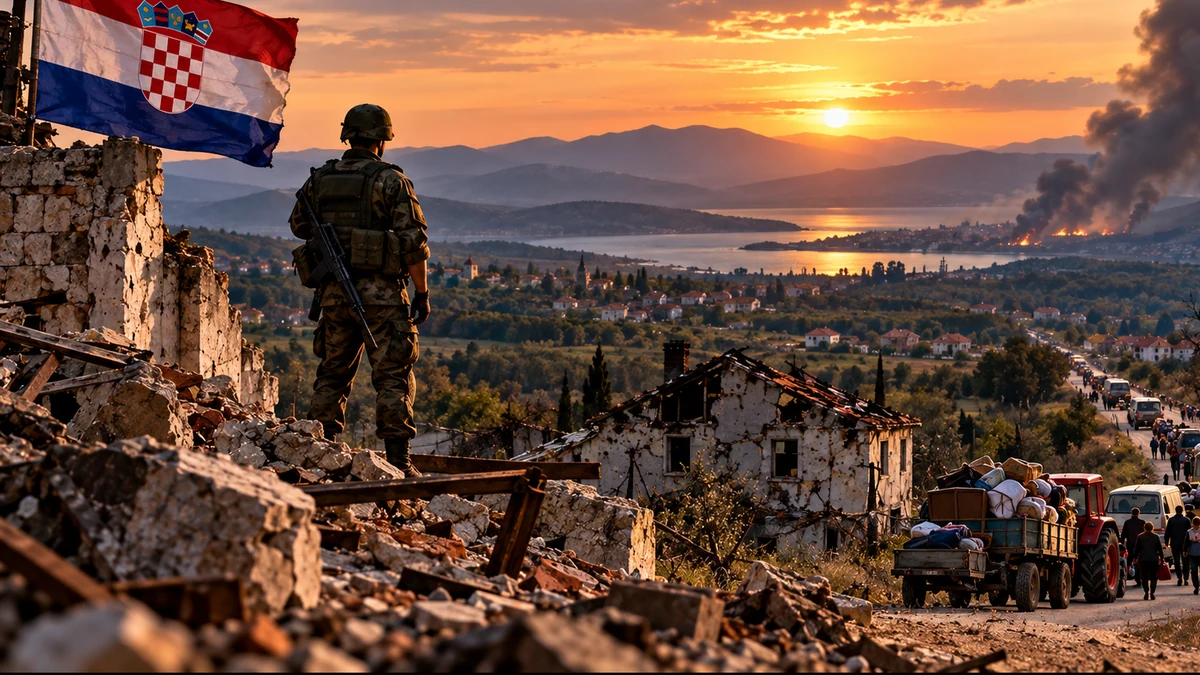
1992: the war does not end — it changes form
At the beginning of 1992, an international peace framework based on the Vance Plan began operating. UNPROFOR was initially established in Croatia to ensure the demilitarization of designated: United Nations Protected Areas — UNPAs and to protect the population against renewed armed attacks.[1] These were areas with substantial Serbian populations that, after the 1991 war, were under the control of local Serb authorities or forces. What did the peace regime actually accomplish?
It stopped most large-scale frontline fighting. But it did not solve the central question: to whom would the territory politically belong and under what conditions would it return under Croatian sovereignty? Croatia was an internationally recognized state. Zagreb regarded the Krajina areas as: temporarily occupied parts of its own territory. The leadership of the Republic of Serbian Krajina, meanwhile, developed its own institutions, army, police and political authority, and sought to remain outside Croatia's effective rule. The result was: a frozen war, not peace.
UNPROFOR was not an army tasked with “returning” Krajina to Croatia. This is frequently misunderstood. UNPROFOR was not given a mandate to: militarily disarm Krajina and then hand the territory to Zagreb. Its mandate was to demilitarize the UNPAs, monitor the ceasefire, protect the population and help create conditions for a political settlement. In practice, demilitarization was not fully implemented. Local Serbian military structures remained functional. Croatia increasingly lost confidence that the international mission by itself would lead to: restoration of its territorial control.
Before 1995, we must not forget what happened to Croats and other non-Serbs in Krajina
This article does not begin history in August 1995. In the final Milan Martić case, the ICTY found that from areas under Krajina Serb authority: virtually the entire Croat and other non-Serb population had been expelled.[2] Martić was finally sentenced to: 35 years in prison for crimes against humanity and war crimes.[2] The court confirmed criminal responsibility for persecution, killings, deportations and attacks on civilians in several locations in Croatia. This is an essential part of the historical background. But earlier crimes do not authorize later crimes. The legal logic is straightforward a crime by one side and does not justify a crime by the other side. Two facts therefore have to be preserved simultaneously:
- the RSK emerged and operated in a context of mass displacement and crimes against Croats and other non-Serbs;
- Serbian civilians who remained or left in 1995 were equally protected by international humanitarian law.
Operation Maslenica. In January 1993 the Croatian Army launched an offensive in the Maslenica area and the Zadar hinterland. UN Security Council Resolution 802 demanded an immediate cessation of hostilities, withdrawal of Croatian forces from or adjacent to UNPA areas, return of heavy weapons to UNPROFOR control and observance of the ceasefire[3]. At the same time, the resolution again demanded: disarmament and demobilization of Serbian territorial and similar units in accordance with the peace plan.[3] This matters. The Security Council did not accept a purely one-sided interpretation. It demanded withdrawal from Croatia, and implementation of the demilitarization obligations by Serbian structures.
Medak Pocket: a military operation and documented crimes
In September 1993 the Croatian Army attacked the so-called: Medak Pocket south of Gospić. Before the operation, approximately: 400 Serbian civilians lived in the area.[4] The ICTY later transferred the case against Rahim Ademi and Mirko Norac to Croatia. The final judicial result matters. Croatian courts acquitted Rahim Ademi and convicted Mirko Norac of war crimes against civilians. Croatia's Supreme Court reduced Norac's sentence to: six years in prison and upheld Ademi's acquittal.[5] That is the final domestic judicial outcome.
What does Medak Pocket tell us? That military legitimacy of an objective and criminal responsibility for conduct toward civilians: are not the same question. An army may lawfully attack opposing military positions, while individuals may simultaneously commit murder, destruction of civilian property and other criminal acts. That distinction will also be central to Operation Storm.
1994: an attempt at stabilization without a final political settlement
In 1994 Zagreb and the local Serbian authorities concluded a new ceasefire. UNPROFOR monitored its implementation.[1] The Security Council also demanded practical confidence-building measures reopening rail links, highways, the oil pipeline, the Maslenica crossing and restoration of electricity and water supplies[6]. This shows that the international strategy sought gradually to: depoliticize the conflict through normalization of daily connections. The final status of Krajina nevertheless remained unresolved.
Z-4: the largest political initiative before the end of the war
In January 1995 American, Russian and European diplomats presented the so-called: Zagreb-4 or Z-4 Plan. The proposal offered Serbian areas within Croatia: very broad autonomy while formally recognizing Croatian sovereignty. What happened to the plan? The UN Secretary-General's March 1995 report states that:
- the Croatian government accepted the plan as a basis for negotiations;
- the Serb leadership in Knin on 30 January would not formally receive the document until the future presence of UNPROFOR had been clarified;
- once extension of the UNPROFOR mandate became possible, they expressed willingness to begin political discussions from April onward.[7]
US Ambassador Peter Galbraith later testified more sharply before the ICTY at the January meeting, Milan Martić: would not even take the document into his hands.[8] Both descriptions can coexist the formal process was blocked, but the diplomatic picture was somewhat more complex than the slogan: “the Serbs definitively rejected the plan and never wanted to talk again.”
Spring 1995: the international mission weakens while both sides prepare for a new situation. In March 1995 UNPROFOR in Croatia was reorganized into: UNCRO — United Nations Confidence Restoration Operation. This did not solve the core problem. Croatia wanted: restoration of sovereignty over its entire territory. The RSK wanted: continued political separation or exceptionally broad autonomy. Diplomacy was running out of time. Military options became more important.
Flash — 1 May 1995
On 1 May 1995 the Croatian Army launched: Operation Flash against Western Slavonia, then part of UNPA Sector West. By 4 May Croatia had retaken control of the area.[9] How many people left? Human Rights Watch estimated at the time that during the fighting: approximately 5,000 to 7,500 Serbs left Western Slavonia for areas controlled by Bosnian Serbs.[9] About: 13,000 Serbs had lived in the area before the offensive.[9]
Crimes and violations. After field research, HRW assessed that violations of the laws of war during the offensive: were not widespread to the extent initially alleged by some UN representatives, but did occur, including threats, robbery, beatings and mistreatment of some detained Serbs[9]. This is an important correction in both directions Flash is poorly described either as: “an operation without violations,” or as: “a proven mass slaughter of the entire population.”
Rocket attacks on Zagreb
After Flash, RSK leader Milan Martić ordered rocket attacks on Zagreb on 2 and 3 May 1995. The ICTY finally confirmed that Martić ordered: indiscriminate rocket attacks on the city.[2] The attacks killed: seven people and wounded more than: 200.[2] Orkan rockets with cluster munitions were used. Martić publicly acknowledged ordering the attack as: retaliation for the Croatian offensive in Western Slavonia.[10] This was a judicially established attack on a civilian area.
After Flash the central unresolved problem remains: Krajina. By May 1995 it was clear that: the status quo was not stable. Croatia had demonstrated that it could militarily retake territory held by Serbian authorities. The RSK did not possess power comparable to the Croatian Army, which since 1991 had expanded, reorganized, gained combat experience and improved command. At the same time the war in Bosnia was changing the strategic environment.
Operation Storm — 4 August 1995
On 4 August 1995 Croatia launched the large offensive: Operation Oluja / Storm. The principal objective was to restore control over most RSK-held territory in northern Dalmatia, Lika, Kordun and Banija. Knin fell the following day. Militarily, the operation was: rapid and decisive. Within several days most RSK territory was under Croatian control. Did the ICTY declare the decision to launch the military operation itself criminal?
No. This is one of this article's most important legal safeguards. When delivering the 2011 Trial Judgment, Presiding Judge Alphons Orie explicitly emphasized that the case: did not concern the legality of resorting to or conducting the war as such.[11] The case concerned crimes against Serbian civilians and individual responsibility of the accused. It is therefore inaccurate to write: “the ICTY declared Operation Storm illegal.” It did not.
The Serbian population begins leaving on a massive scale. During the operation, most of the RSK population left their homes. The causes require great care. Several factors are documented. Factor 1 — war and fear of the Croatian Army. The offensive, shelling and collapse of Krajina's defensive structures produced fear, panic and flight. Civilians also knew the history of violence between the communities. Factor 2 — a decision/order by the Krajina leadership to evacuate.
On 4 August 1995 the RSK Supreme Defence Council adopted a decision for the organized evacuation of civilians from: northern Dalmatia and southern Lika.[12] Documents in the case record show that: evacuation plans had existed beforehand.[12] This is a real and important factor in the mass departure. Factor 3 — conduct by Croatian forces and events after the territory was captured. After the area was taken, there were documented looting, burning of homes, killings of civilians who had remained and destruction of Serbian property[13]. This further reduced the possibility or willingness to: remain or return quickly.

It is therefore wrong to seek a single cause for the exodus
Two absolute explanations are methodologically weak. Explanation A. “The Croatian state alone expelled the Serbs.” Too simplistic. It ignores the Krajina leadership's evacuation order, planned evacuation, military defeat and widespread fear among civilians. Explanation B.
“The Serbs left only because their own leadership ordered them to.” Also too simplistic. It ignores the offensive, artillery and other combat operations, documented crimes after Croatian forces took control and later barriers to return. The most defensible explanation is: the mass exodus resulted from a combination of military defeat, fear, organized evacuation and actual or expected violence. How many people left? The exact figure varies between sources and definitions. A 1996 report by the UN Secretary-General estimated that after Croatia's summer 1995 military operations: nearly 200,000 Croatian Serbs had fled to:
- the Federal Republic of Yugoslavia;
- Bosnia and Herzegovina.[14]
The figure covers the broader summer wave and is best treated as an order-of-magnitude estimate. This article therefore avoids false precision: we are speaking of roughly 200,000 people, not one mathematically undisputed figure. What happened to the people who stayed? This is the darkest part of the story. Human Rights Watch and other international observers documented killings of elderly Serbian civilians, looting, systematic burning of homes and destruction of villages[13]. HRW reported that burning and looting continued: for months after the main offensive had ended.[13] In some places villages were almost completely destroyed.
The Security Council demanded the right to remain, leave and return. On 10 August 1995, Security Council Resolution 1009 demanded that Croatia fully respect the rights of the local Serbian population, guarantee the right to remain, leave or return safely, allow access for humanitarian organizations and create conditions for the return of those who had left[15]. The resolution again stressed: individual criminal responsibility for violations of international humanitarian law.
ICTY 2011: Trial Chamber convictions of Gotovina and Markač
In 2011 the ICTY Trial Chamber:
- sentenced Ante Gotovina to 24 years;
- sentenced Mladen Markač to 18 years;
- acquitted Ivan Čermak.[11]
The Chamber found the existence of a: joint criminal enterprise — JCE whose objective was the permanent and forcible removal of the Serbian population from Krajina. An important part of that reasoning also relied on a finding of: unlawful artillery attacks. ICTY 2012: Appeals Chamber reverses the convictions. A year later came the legally decisive reversal. By majority, the ICTY Appeals Chamber reversed Gotovina's conviction, reversed Markač's conviction and acquitted both men[16]. Why?
The Appeals Chamber unanimously found error in the use of the so-called: 200-metre standard by which the Trial Chamber had assessed the legality of artillery impacts.[16] The majority then concluded that unlawfulness of the artillery attacks had not been proven on that basis, a central foundation for the JCE finding no longer stood and the existence of a JCE aimed at permanently and forcibly removing Serbs had not been proven to the required standard[16]. Gotovina and Markač were therefore: finally acquitted. That is the final outcome of their ICTY case.
What does the Appeals Judgment not mean? It does not mean: “the ICTY found that no crimes against Serbian civilians occurred during or after Storm.” It means: that the criminal responsibility of Gotovina and Markač for the charged crimes under the theory used by the Trial Chamber was not proven beyond reasonable doubt. That is the crucial distinction between the existence of individual crimes, individual criminal responsibility of particular accused persons and proof of a broader state plan or JCE. The Trial Judgment and Appeals Judgment must not be mixed together.
The most precise formulation is: 2011. The Trial Chamber convicted Gotovina and Markač and found a JCE. 2012. The Appeals Chamber reversed the key findings, reversed the convictions and finally acquitted both men[16]. It is therefore inaccurate today to write only: “Gotovina was sentenced to 24 years by the ICTY.” The final result is: acquitted. It is equally inaccurate to write: “the ICTY proved that there were no crimes after Storm.” That conclusion does not follow from the acquittals.
What about Franjo Tuđman? Franjo Tuđman: was not indicted and was not tried in the Gotovina case. The Trial Judgment discussed him as part of its analysis of the alleged JCE. But after the key JCE reasoning was reversed on appeal, it is not accurate to present: the Trial Chamber's findings as a final conviction of Tuđman. No such conviction: exists. Flight did not mean the problem was over.
After the war, new questions emerged refugee return, housing and property rights, rebuilding homes, documents, security and criminal proceedings. Even in 1996 the UN noted that of more than 9,000 Serbs who had received permission to return: fewer than one quarter had actually returned.[14] The UN also warned about fear, obstacles to returning to homes and legal and administrative barriers. The military end of Krajina therefore: did not mean immediate social reintegration of the population.
Eastern Slavonia shows that another path was possible
After Flash and Storm, a further area remained under Serbian control Eastern Slavonia, Baranja and Western Sirmium. Croatia could have attempted another military reconquest. Instead, in November 1995 the parties signed the: Basic Agreement / Erdut Agreement. UNTAES: reintegration without another large offensive. In January 1996 Security Council Resolution 1037 established: UNTAES — United Nations Transitional Administration for Eastern Slavonia, Baranja and Western Sirmium.[17] Its mandate included demilitarization, transitional civil administration, policing, elections, refugee return, integration of public services and gradual restoration of Croatian law and institutions.
Demilitarization was actually implemented. UNTAES reported that demilitarization of the area was completed on: 20 June 1996.[18] Heavy weapons belonging to local Serbian forces were removed, handed over for destruction and withdrawn from the area. This sharply contrasts with the incomplete demilitarization of the original UNPAs. Peaceful reintegration was successful — but not the entire story.
UNTAES ended its mandate in January 1998 after achieving its core objective: peaceful reintegration of Eastern Slavonia, Baranja and Western Sirmium into Croatia.[18] But the UN also continued to emphasize the right of all refugees to return, removal of administrative obstacles, equal civil rights for Serbs and problems of arbitrary arrest and returnee security[18]. So: peaceful reintegration was a success, not a magical solution to every inter-ethnic consequence of the war. Why was Eastern Slavonia different from Krajina?
Several factors mattered the post-1995 military balance, direct proximity to Serbia, the danger of a larger regional war, the simultaneous Dayton process, greater willingness on both sides to accept an international transitional administration and the new political reality after most of the RSK had been defeated. There was no single cause. But historically it matters that: one part of Croatia's territorial problem ended through military operations, while the final part ended through negotiated and internationally supervised reintegration. Who “won”? This article does not create a moral or political ranking. What is documented is:
The Croatian state. By 1998 it had restored sovereignty over its entire internationally recognized territory. The RSK. It ceased to exist as a political-territorial structure. Croatian Serbs. A large part of the community left Krajina and experienced displacement, loss of homes and difficult return. Croatian refugees and displaced persons. They obtained the possibility of returning to areas from which they had been expelled or had fled in 1991–1992.
Civilians of both communities. They bore the consequences of war, expulsion, destruction and retaliation. These are not: identical experiences, but all belong to the final account of the war. What can we state with high confidence? UNPROFOR was deployed in Croatia in 1992 to demilitarize UNPAs and protect the population. The peacekeeping mission did not resolve Krajina's final political status. The RSK was associated with systematic crimes and removal of Croats and other non-Serbs.
Croatia launched Maslenica and Medak Pocket operations in 1993. Mirko Norac was finally convicted for crimes in Medak Pocket; Rahim Ademi was finally acquitted. Croatia accepted Z-4 as a basis for negotiations; the Knin leadership initially refused formally to receive it under the then-existing conditions. Flash restored Croatian control over Western Slavonia. Approximately 5,000–7,500 Serbs left during Flash. Milan Martić was finally responsible for the Zagreb rocket attacks.
Operation Storm in August 1995 broke most of the RSK and returned most of Krajina to Croatian control. The RSK leadership adopted a decision on 4 August for organized evacuation of civilians from northern Dalmatia and southern Lika. Roughly 200,000 Serbs left Croatia during the summer 1995 wave. Crimes against remaining Serbian civilians, looting and widespread burning of property occurred after Storm. ICTY convicted Gotovina and Markač at first instance in 2011.
ICTY finally acquitted them in 2012. The Appeals Judgment reversed key findings on unlawful artillery attack and JCE. The acquittals do not amount to a finding that no crimes were committed against Serbian civilians. Franjo Tuđman was neither indicted nor tried in the Gotovina case. Eastern Slavonia was not retaken by another major Croatian offensive. UNTAES successfully carried out peaceful reintegration between 1996 and 1998.
The most precise answer to the question: how did the Croatian war actually end?
Not through one event. It ended in three steps: Militarily. Flash and especially Storm destroyed the territorial core of the RSK. Demographically. Most Krajina Serbs left the area during and immediately after defeat. Diplomatically. Eastern Slavonia returned to Croatian authority through the Erdut Agreement and UNTAES without another major war. The final result therefore simultaneously includes: restoration of Croatia's territorial integrity;, the end of the RSK;, a mass Serbian refugee movement;, documented post-war crimes; and and later peaceful reintegration of the final remaining territory.. None of those truths cancels another.
The Croatian war in 1995 was tightly connected to events in Bosnia. If Bosnia 1992: A Republic Without a Majority — Referendum, Three National Political Projects, and the Beginning of the Bloodiest War of the Breakup covered the opening of that conflict, the arc continues with Bosnia 1992–1995: From the Siege of Sarajevo to Dayton — Three Armies, Ethnic Cleansing, the Croat–Bosniak War, Safe Areas, NATO and the End of the War. Srebrenica appears there as part of the 1995 chronology, while its full evidentiary and legal review remains in Srebrenica 1995: What Is Proven, What Is Disputed and What the Documents Actually Say.
Sources and further reading
- United Nations Peacekeeping. UNPROFOR — mandate in Croatia, United Nations Protected Areas, later extensions and ceasefire monitoring. Source
- ICTY. Milan Martić — Trial and Appeals Judgments; 35-year sentence; persecution of Croats and other non-Serbs; Zagreb rocket attacks. Source 1 Source 2
- UN Security Council. Resolution 802 (1993), 25 January 1993 — Maslenica/UNPA, cessation of hostilities and implementation of the peace plan. Source
- ICTY. Indictment background, Medak Pocket — attack beginning 9 September 1993, civilian population and alleged destruction. Source
- ICTY. Status of transferred cases — Ademi/Norac: Ademi acquitted, Norac finally sentenced to six years by the Croatian Supreme Court. Source
- UN Security Council. Resolution 871 (1993) — ceasefire, confidence-building, infrastructure links and restoration of Croatian authority in pink zones. Source
- UN Secretary-General. S/1995/222 — Z-4 plan: Croatia accepted it as a basis for negotiation; Knin Serb authorities initially refused to receive it pending the UNPROFOR question. Source
- ICTY Outreach / testimony of Ambassador Peter W. Galbraith. Z-4 negotiations and Martić's refusal to take the plan at the 30 January 1995 meeting. Source
- Human Rights Watch/Helsinki. The Croatian Army Offensive in Western Slavonia and Its Aftermath, July 1995. Source
- ICTY. Milan Martić judgment material — Zagreb rocket attacks of 2–3 May 1995; seven killed and more than 200 wounded. Source
- ICTY. Gotovina et al. Trial Judgment / press summary, 15 April 2011 — Gotovina 24 years, Markač 18, Čermak acquitted; scope of case. Source 1 Source 2
- ICTY case record. Evidence concerning the 4 August 1995 RSK Supreme Defence Council evacuation decision and pre-existing evacuation planning. Source
- Human Rights Watch. Civil and Political Rights in Croatia and subsequent Krajina reporting — burning, looting and abuses against remaining Serbs. Source 1 Source 2
- United Nations Security Council / Secretary-General reporting. 1996 human-rights reporting: nearly 200,000 Croatian Serbs estimated to have fled to FRY and BiH after summer 1995 operations; return obstacles. Source
- UN Security Council. Resolution 1009 (1995), 10 August 1995 — rights of Serbs to remain, leave or return safely; humanitarian access and individual responsibility. Source
- ICTY Appeals Chamber. Gotovina and Markač, Appeal Judgment, 16 November 2012 — reversal of convictions and acquittals; errors regarding the 200-metre standard, unlawful artillery finding and JCE. Source 1 Source 2
- UN Security Council. Resolution 1037 (1996) — establishment of UNTAES. Source
- United Nations Peacekeeping. UNTAES chronology/background — demilitarization and peaceful reintegration of Eastern Slavonia, Baranja and Western Sirmium, 1996–1998. Source 1 Source 2