Kosovo after the Bombing: UNSCR 1244, UNMIK, KFOR, Post-War Violence, Status Negotiations and the Road to 2008
From Resolution 1244 and UNMIK to postwar violence, status negotiations and Kosovo’s 2008 declaration of independence.
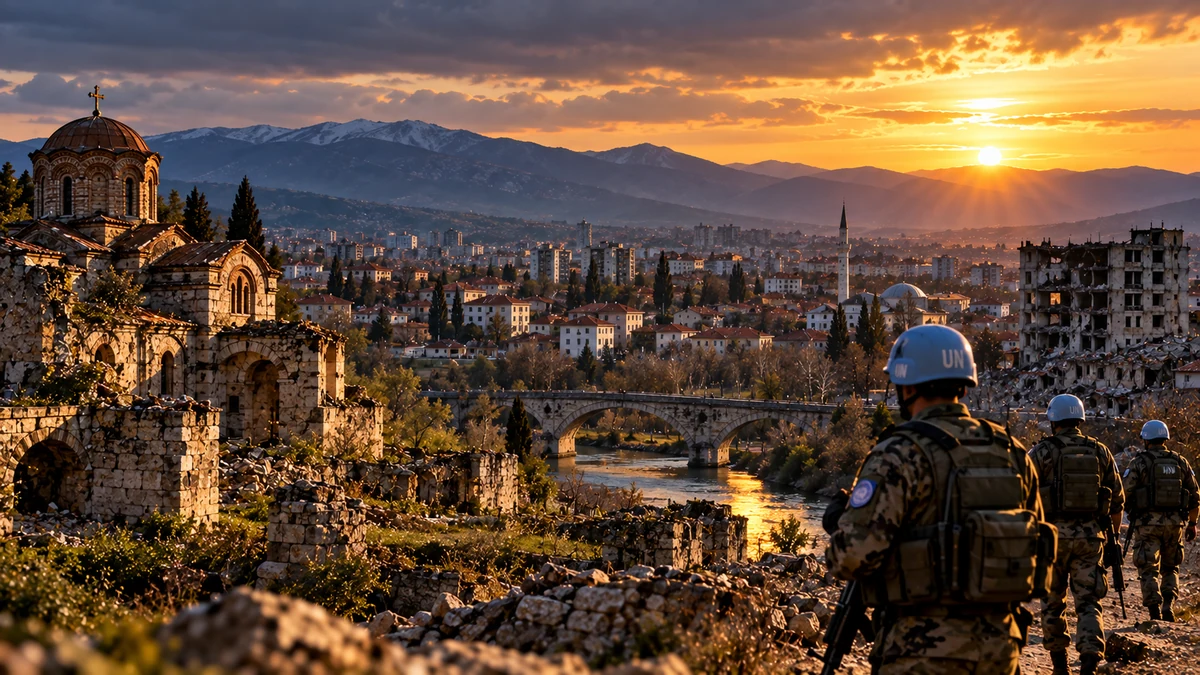
June 1999: the war ends, but the status question does not
On 9 June 1999 the: Military Technical Agreement was signed at Kumanovo between the future KFOR command and representatives of the Federal Republic of Yugoslavia and Serbia. The agreement provided for withdrawal of the Yugoslav Army, withdrawal of Serbian police forces, security zones and deployment of an international military presence[1]. On 10 June, after the beginning of a verifiable withdrawal, NATO suspended its air campaign. The same day the Security Council adopted: Resolution 1244.[2] Resolution 1244 was a post-war compromise.
The resolution simultaneously contained elements that political sides today often quote separately. Its preamble reaffirmed: the commitment of UN member states to the sovereignty and territorial integrity of the FRY and the other states of the region.[2] At the same time it required full withdrawal of Yugoslav and Serbian military, police and paramilitary forces, an international civil presence, an international security presence, interim administration, substantial autonomy and self-government and a political process to determine future status[2]. It was not a simple document. It was: a transitional compromise between the principle of territorial integrity and the fact that after June 1999 Belgrade no longer exercised ordinary civilian authority in Kosovo.
What Resolution 1244 did NOT do. It did not proclaim Kosovo an independent state, set a date for independence, recognize a general right to unilateral secession and transfer Kosovo into the sovereignty of another state. But it also did not: finally determine Kosovo's ultimate status. In 2010 the ICJ specifically emphasized that Resolution 1244 established: an interim regime and contained no provision predetermining final status.[3] What about the “return of Serbian personnel”?
Resolution 1244 envisaged the possible return, after withdrawal, of: a small agreed number of Yugoslav and Serbian military and police personnel for limited functions.[2] Its annex referred to: hundreds, not thousands. The envisaged tasks included liaison with the international civil and security presences, marking/clearing minefields, presence at Serbian cultural-heritage sites and certain border functions[2]. This was not a right to: re-establish Serbia's normal security control over Kosovo. KFOR: the military component of the new regime. On 12 June 1999 the first units of: KFOR — Kosovo Force began deploying into Kosovo.[1] KFOR's mandate rested on:
- Resolution 1244;
- the Military Technical Agreement.
Its initial responsibilities included deterring renewed hostilities, establishing a secure environment, public security in the initial period, demilitarization of the KLA, support for humanitarian activities and coordination with UNMIK[4]. 20 June: the withdrawal is complete. On 20 June NATO announced that: all FRY and Serbian military and police forces had left Kosovo in accordance with the Military Technical Agreement.[5] The NATO air campaign was formally terminated. At the same time a process began for the: demilitarization and transformation of the KLA.[1]
UNMIK: the UN was not merely an observer. Resolution 1244 established the: United Nations Interim Administration Mission in Kosovo — UNMIK. Its initial role was extraordinarily broad. The head of the mission stated publicly in June 1999 that during the transitional period UNMIK would exercise: executive functions of government until legitimate local authorities could be created and responsibilities transferred to them.[6] The UN was therefore not merely a mediator, an observer and a humanitarian agency. It effectively became: Kosovo's interim civil authority.
The four pillars of UNMIK. The original administration was organized around four major pillars: humanitarian assistance — UNHCR; civil administration — United Nations; democratization and institution-building — OSCE; economic reconstruction — European Union.[7] This illustrates the scale of the task. After the war it was not enough merely to: stop the shooting. It was necessary to rebuild the police, courts, schools, hospitals, municipal administration and public services, while also restoring the economy and organizing elections.
The large-scale return of Albanian refugees. After Serbian and Yugoslav forces withdrew, a large proportion of Kosovo Albanians who had been expelled, driven out or had fled during the war returned rapidly. For many people, June 1999 meant: the end of state repression and the possibility of returning home. But the end of repression against one community: did not bring security to another. Post-war violence against Serbs and Roma begins almost immediately.
By August 1999 Human Rights Watch had documented killings, abductions, beatings, threats, arson, looting and forced abandonment of homes among Serbian and Roma populations.[8] According to HRW, also citing UNHCR, in the first weeks after KFOR arrived: more than 164,000 Serbs left Kosovo, alongside large numbers of members of other minorities.[8] Early figures vary depending on the date used, population categories and whether only Serbs or other communities are included. This article therefore treats the number as: an approximate contemporary estimate of a mass post-war exodus, not an absolutely final statistic.
Roma: double vulnerability. Many Roma were attacked after the war because parts of the Albanian population believed they had: collaborated with Serbian authorities.[8] This produced collective accusations, expulsions, arson and violence. Individual collaboration: does not establish collective responsibility of an entire ethnic community. Who carried out the post-war violence?
HRW documented participation by individual Albanian civilians, returnees, people wearing KLA uniforms and local armed structures[8]. The most serious incidents were frequently connected with: persons or members associated with the KLA. At the same time, HRW explicitly stated that it was unclear whether the violence represented: a centrally coordinated policy of the KLA leadership or acts by local units and individuals.[8] This article therefore does not state: “the KLA was proven to have centrally organized the post-war ethnic cleansing of Serbs.” That general claim does not follow from the source used.
Revenge is not a legal explanation for attacks on civilians. Post-war violence occurred in an environment in which many returnees had lost relatives, lost homes, been expelled and suffered violence by Serbian or Yugoslav forces. That can help explain: a motive of revenge. It does not justify murder, abduction, expulsion and collective punishment of Serbs or Roma.

KFOR and UNMIK did not effectively prevent post-war violence
HRW described the response of international structures already in 1999 as: late and uneven.[8] A central problem was also the: security vacuum. Serbian and Yugoslav police structures were gone. The new international and local police forces: were not yet sufficiently developed. The KLA must demilitarize. After KFOR arrived, an agreement was reached on the: demilitarization and transformation of the KLA.[1] That did not mean that: all former members disappeared overnight from politics or the security environment. Some political parties emerged from: former KLA structures. Former members also entered the: Kosovo Protection Corps — KPC/TMK, which formally was not the successor to the KLA as an army with the same military mandate.
Parallel structures and a divided Kosovo. UNMIK sought to create: a unified interim administration. In practice there remained Albanian political structures formed during the conflict, Serbian parallel institutions and areas with very different forms of effective control. The north of Kosovo and Mitrovica in particular became: symbols of enduring institutional and ethnic division.
Missing persons: the war did not end for thousands of families in June 1999. According to ICMP, at the end of the conflict approximately: 4,400–4,500 persons were missing.[9] The figure includes members of different communities. Missing-person cases cover the armed conflict, its immediate aftermath and abductions and disappearances before and after June 1999. Later forensic work resolved most, but not all, cases.
ICMP states that through DNA, exhumations and institutional cooperation. it has resolved the identities of many missing persons.[9] According to its more recent figures, approximately: 1,700 persons remain missing or unaccounted for.[9] This is a current figure and therefore: must be refreshed before publication. Missing persons are not the issue of one ethnic community. Among the missing are Albanians, Serbs, Roma and members of other communities. It is therefore politically misleading to use the missing-persons issue as: proof that one community has a monopoly on victimhood. The humanitarian task is: to determine the fate of every person.
From direct international administration to provisional self-government
Under Resolution 1244 UNMIK was required to exercise authority initially, build local institutions and gradually transfer responsibility to them. This led to municipal elections, provisional administrative structures, police, courts, parliamentary institutions and a provisional government. Between 1999 and 2008 Kosovo therefore became: institutionally more self-governing while final status remained unresolved. Why was status not resolved immediately?
Because the basic positions were: incompatible. Belgrade insisted on: preserving sovereignty and territorial integrity of Serbia/FRY while offering broad autonomy to Kosovo. Most Kosovo Albanian political leaders insisted on: independence. UNMIK therefore had no mandate to: unilaterally choose the final status. “Standards before status”. In the early 2000s UNMIK developed the policy of: standards before status. The idea was that Kosovo should first demonstrate progress in areas such as democratic institutions, rule of law, freedom of movement, community rights, refugee return, economic development and dialogue with Belgrade, and only then should final status be addressed.[10]
The logic of the policy was clear — and problematic. The international community did not want discussion of: borders and flags to precede the construction of: institutions capable of protecting all residents. But the policy also had a problem. If final status remained uncertain too long local institutions lacked full responsibility, investment and political development remained uncertain and both sides waited for a future status reversal.
March 2004: the greatest failure of the post-war system
On 17 March 2004 Kosovo was engulfed by: a wave of mass interethnic violence. The immediate trigger was reporting that three Albanian children had drowned after allegedly being: chased into a river by Serbs. That early media narrative proved: unverified or inaccurately presented.[11] By then, however, the violence had already spread. Scale of the violence. According to the UN, OSCE and HRW, over two or three days:
- 19 people were killed;
- 954 were injured;
- more than 4,100 were displaced;
- hundreds of minority homes were damaged or destroyed;
- numerous Serbian Orthodox churches and monasteries were damaged or destroyed.[11][12]
HRW referred to: 27 Orthodox churches and monasteries that were burned, while the UN, using a broader category of damaged or destroyed Orthodox religious and cultural sites, cited: 36 locations.[12][13] The figures therefore are not necessarily contradictory: the sources use different categories. The principal targets were non-Albanian communities. The violence most heavily affected Serbs, Roma, Ashkali and other non-Albanian minorities[11]. But: Albanians also died. HRW's breakdown of the 19 dead included:
- 8 Serbs;
- 11 Albanians.[11]
This was not merely a spontaneous street riot. Some parts of the violence spread rapidly, repeated similar patterns and systematically targeted minority settlements and religious sites. HRW described: effective and targeted removal of remaining Serbian presences from some locations.[11] But without additional evidence this article does not claim: that the entire wave of violence was centrally planned by one political command.
KFOR and UNMIK again failed to protect minorities. HRW titled its report on March 2004: Failure to Protect. In several places KFOR failed to intervene in time, UNMIK police were too weak and local police were unable or unwilling to stop the crowds[11]. A security system that had existed for almost five years: failed to prevent a large wave of organized anti-minority violence. Why was March 2004 politically decisive?
Because it demonstrated that: several years of international administration had not automatically produced multiethnic security. That weakened the idea that status could be postponed: indefinitely while waiting for all standards to be fully met. Paradoxically: violence showing the failure of standards accelerated debate over status. That does not mean violence “rewarded” one side. The status process was not: a legal reward for March violence. Politically, however, the event increased the sense that: the existing interim regime was not a stable long-term answer. That is an analysis of political dynamics, not a legitimization of violence.
2005: Kai Eide reviews the situation
The UN Secretary-General appointed Norwegian diplomat: Kai Eide to conduct a comprehensive review of conditions and implementation of standards.[14] Eide found serious shortcomings, uneven progress and poor conditions in some minority-related areas, but concluded that: the time had come for the next phase of the political process.[15] The Security Council opens the status process.
On 24 October 2005 the President of the Security Council announced consensus that: the time had come to begin the process to determine Kosovo's future status within the framework of Resolution 1244.[15] This is important. Status negotiations were not: a private initiative of Kosovo's institutions. They began through: a UN process. Martti Ahtisaari. In November 2005 the Secretary-General appointed former Finnish president: Martti Ahtisaari as Special Envoy for the future-status process.[16] His mandate was to: lead the political process between Belgrade and Pristina.
What did the sides want? The positions remained almost opposite. Serbia offered: very broad autonomy without independence. Kosovo Albanians demanded: an independent state. The talks therefore focused heavily on decentralization, protection of Serbian municipalities, cultural and religious heritage, economic questions and security, but no agreement was reached on: final status. The 2007 Ahtisaari proposal. In March 2007 Ahtisaari submitted to the Security Council the: Comprehensive Proposal for the Kosovo Status Settlement.[17] The proposal included extensive community rights, decentralization, protection of the Serbian Orthodox Church, an international civilian presence, a European rule-of-law mission, an international military presence and security-sector provisions.
Ahtisaari went beyond compromise autonomy. In his report he wrote that in his assessment: the only viable option was independence for Kosovo, initially under international supervision.[18] This was: the assessment of the UN Special Envoy. It was not: a new Security Council resolution. That distinction is essential. The Security Council did not adopt Ahtisaari's status proposal as a new resolution.
There was no agreement among Security Council members. Therefore the Ahtisaari proposal: did not become a new resolution replacing 1244. One must distinguish between: the proposal of a UN envoy and a binding decision of the Security Council.. Another attempt: the EU–US–Russia Troika. In 2007 the process continued through a: Troika of the European Union, United States and Russian Federation. Over four months it considered independence, supervised independence, autonomy, confederal models, partition and other compromise models[19].
December 2007: no agreement. The Troika's final report concluded: the parties had not reached agreement on status.[19] This matters for the later legal and political dispute. Independence in 2008 was not: the result of a bilateral Belgrade–Pristina agreement. It was: a unilateral declaration following the failure of negotiations. 17 February 2008. On 17 February 2008 Kosovo's Assembly adopted a: declaration of independence.[20] Kosovo's leadership committed itself to a democratic and secular state, community rights, implementation of elements of the Ahtisaari proposal and continued international presence.
Serbia rejects the declaration. The same day Serbia's president informed the UN that Serbia regarded the declaration as: a unilateral and forced secession of part of its territory without legal effect for Serbia.[20] The declaration therefore did not itself resolve: the status dispute. The UN did not terminate its mission after the declaration. On 17 February 2008 the Secretary-General stated that unless the Security Council decided otherwise: Resolution 1244 would remain the legal framework for UNMIK's mandate.[20] UNMIK therefore: did not automatically dissolve after the declaration.
EULEX: a new European layer of international presence
In 2008 the EU established: EULEX Kosovo as a major civilian mission covering police, justice, customs and broader rule of law. Following the declaration and entry into force of Kosovo's constitution, UNMIK was: substantially reduced and reconfigured, while some operational functions were assumed by EULEX.[21] The status-neutral problem.
EULEX had to operate in a politically sensitive environment. Within the EU: not all member states held the same view of Kosovo's status. The legal and diplomatic formula therefore became: status-neutral, without prejudice to member-state positions on status. Contemporary EU documentation likewise uses a disclaimer that references to Kosovo are without prejudice to status and consistent with:
- Resolution 1244;
- the ICJ opinion.[22]
2008 therefore did not legally close every question. The declaration changed: political reality. But by itself it did not amend the text of Resolution 1244, secure Serbian recognition, create consensus among all Security Council members and automatically produce UN membership. That is why the status issue: remains present in international institutions. Serbia requests an ICJ opinion. At Serbia's initiative, the UN General Assembly asked the International Court of Justice whether Kosovo's unilateral declaration of independence was: in accordance with international law. The ICJ delivered its advisory opinion on: 22 July 2010.[3]
What did the ICJ actually decide?
By ten votes to four, the Court concluded: the declaration of independence of 17 February 2008 did not violate international law.[3] More specifically, it did not violate:
- general international law;
- Resolution 1244;
- the Constitutional Framework established under UNMIK.[3]
What did the ICJ NOT decide? The Court expressly stated that it did not need to decide whether international law gives Kosovo a positive right to secede, whether there is a general right to remedial secession, whether other states are required to recognize Kosovo and whether Kosovo is a state for all purposes of international law[3]. It answered the: narrower question of the legality of the declaration itself.
Why did the ICJ find that 1244 did not prohibit the declaration? The Court found that Resolution 1244 established: an interim regime and did not itself prescribe: the final status.[3] It also concluded that, in its interpretation, the authors of the declaration were not acting as: the Provisional Institutions of Self-Government within the UNMIK-created framework, but as representatives of the people of Kosovo outside that institutional framework.[3] This was one of the central elements of the majority reasoning.
The judges were not unanimous. The opinion contained separate opinions and dissenting opinions. Some judges considered that the majority interpreted the question too narrowly, separated the declaration's authors too sharply from the provisional institutions and underestimated the significance of Resolution 1244 and territorial integrity[3]. It is therefore incorrect to say: “the ICJ unanimously confirmed Kosovo's independence.” It did not.
What does Resolution 1244 mean today?
As a UN legal instrument: Resolution 1244 has not been repealed. UNMIK remains active in September 2026 as a mission established on its basis.[23] KFOR likewise continues to cite: Resolution 1244 and the Military Technical Agreement as the legal foundations of its mandate.[4] But today's reality is not the same as in 1999.
UNMIK in 2026 does not run the entire civil administration, issue all laws, operate ministries and manage everyday justice. After the 2008 declaration and the new constitution, its role changed substantially. Today it focuses mainly on peace, security, stability, human rights and dialogue and confidence-building[23]. This means: the same underlying mandate, but a very different operational reality. KFOR also remains.
NATO still leads: KFOR in September 2026.[24] Its contemporary role remains contributing to a safe and secure environment, ensuring freedom of movement and acting for all communities[24]. This is one of the clearest signs that the post-war regime created in 1999: is not entirely a closed historical chapter. EULEX remains present. EULEX also continues to operate. The EU extended its mandate in 2025 until: 14 June 2027.[22] Its present mission is focused primarily on monitoring, mentoring, advising and limited executive security functions[22]. This is no longer: the same EULEX as in its early post-2008 period, when it exercised considerably broader executive functions.
Kosovo after 1999: different consequences for different communities
This article does not create a political ranking. It can document different consequences. Kosovo Albanians
- end of direct Serbian state repression;
- mass return of refugees;
- development of local institutions;
- declaration of independence in 2008.
Kosovo Serbs and some other minorities
- a major post-war refugee/displacement wave;
- violence and abductions;
- loss of homes;
- life in enclaves;
- March 2004 as another major security shock.
Serbia
- after June 1999 loses effective civil and security control over most of Kosovo;
- retains its legal-status claim;
- does not recognize the 2008 declaration.
International community
- assumes an exceptionally broad civil and military responsibility;
- builds institutions;
- repeatedly fails to protect all communities effectively.
Was Resolution 1244 “fully implemented”? The answer requires looking at its individual provisions. 1244 required withdrawal of Serbian/Yugoslav forces — implemented, international presence — implemented, KLA demilitarization — a formal process was conducted, safe return of all refugees and displaced persons — only partially realized, protection of all inhabitants — repeatedly unsuccessful, substantial self-government — institutionally developed and a political process on future status — conducted, but without agreement between the parties. The political slogan: “1244 was fully implemented” is therefore too simple. The same is true of: “1244 meant nothing after 1999.”
Was the Kosovo question definitively resolved after 2008? Not as: a universally accepted international legal and political situation. Many states recognize Kosovo. Others do not. Serbia does not recognize Kosovo as an independent state. UNMIK and KFOR continue to operate on the basis of Resolution 1244.[23][24] The EU continues to facilitate: dialogue on normalization between Belgrade and Pristina.[23][24] The most neutral formulation is: Kosovo's institutions function as a state in practice, but its status is not universally accepted. Why is the term “occupation” methodologically problematic? Different political actors use terms such as:
- occupation;
- liberation;
- protectorate;
- international administration;
- independence.
This article avoids adopting one political label as: a neutral fact. Documented facts are:
- FRY/Serbian military and police forces withdrew;
- KFOR entered pursuant to an agreement and Resolution 1244;
- UNMIK assumed interim civilian authority;
- Kosovo declared independence in 2008;
- Serbia does not recognize that status.
Different political theories may draw: different interpretations from those facts. Why is “liberation” also insufficient? For many Kosovo Albanians, June 1999 meant the end of repression, return from exile and the possibility of political self-determination. That is a real experience. For many Serbs and Roma, however, the same period meant violence, flight, loss of homes and long-term insecurity. The word: “liberation” therefore describes the perspective of one community, not all consequences of the event.
What can we state with high confidence from the evidence?
The Military Technical Agreement enabled withdrawal of FRY/Serbian forces and deployment of KFOR. Resolution 1244 was adopted on 10 June 1999. Resolution 1244 contains language reaffirming FRY sovereignty and territorial integrity. simultaneously establishes international administration, substantial autonomy and a political process on future status. definitively fixed Kosovo's final status as a permanent Serbian province. authorized Kosovo's future independence.
permits the return of a small agreed number of Serbian/Yugoslav personnel for limited tasks. KFOR began deploying on 12 June 1999. All Serbian/Yugoslav security forces had withdrawn by 20 June according to NATO verification. UNMIK originally exercised executive functions of interim administration. UNMIK had four principal pillars. Post-war mass violence and displacement of Serbs and Roma occurred. HRW reported early on that more than 164,000 Serbs had left Kosovo.
All post-war violence was centrally ordered by the KLA leadership. Serious attacks by persons associated with the KLA against Serbs and Roma are documented. KFOR and UNMIK were often ineffective in protecting minorities in the first period. Approximately 4,400–4,500 people were missing at the end of the conflict. Around 1,700 persons currently remain unaccounted for. “Standards before status” was a central UNMIK framework before the status talks.
In March 2004, 19 people were killed, 954 injured and roughly 4,100 displaced. The March 2004 violence primarily affected Serbian and other non-Albanian minorities. KFOR and UNMIK successfully protected minorities everywhere in March 2004. The March 2004 violence proves a unified central political conspiracy of all Kosovo Albanians. In 2005 the Security Council supported the beginning of the status process. Ahtisaari served as the UN Special Envoy for status.
In 2007 Ahtisaari proposed supervised independence. The Ahtisaari proposal became a new Security Council resolution. The EU–US–Russia Troika concluded at the end of 2007 that the parties had not reached agreement. Kosovo declared independence on 17 February 2008. Serbia accepted the declaration. The UN immediately repealed Resolution 1244 after the declaration. In 2010 the ICJ concluded that the declaration did not violate international law, 1244 or the UNMIK Constitutional Framework.
The ICJ recognized a general right of Kosovo to unilateral secession. The ICJ legally required all states to recognize Kosovo. The ICJ unanimously confirmed Kosovo's independence. UNMIK still exists in 2026 on the basis of 1244. KFOR still operates in 2026 on the basis of 1244 and the MTA. EULEX has a mandate through at least June 2027. Kosovo's status is universally accepted. The most important legal distinction in this article.
Three statements are not the same: A — “Resolution 1244 reaffirms FRY territorial integrity.” “Resolution 1244 reaffirms FRY territorial integrity.” Yes — such language appears in the text.[2] B — “Therefore 1244 permanently prohibited any different future status.” “Therefore 1244 permanently prohibited any different future status.” The ICJ did not accept that reading; it interpreted the resolution as an interim regime without a final-status clause.[3] C — “Therefore the ICJ created a right to Kosovo's secession.” “Therefore the ICJ created a right to Kosovo's secession.” No. The Court expressly said it did not need to decide that issue.[3] This three-part distinction is the most important safeguard against: politically selective reading of the law.
The most important historical distinction
June 1999 was simultaneously: the end of one violent regime and the beginning of a new security problem. The end of repression against Kosovo Albanians: is not an invented fact. Post-war violence, abductions and the mass departure of Serbs, Roma and others: are not invented facts either. Both belong to: the same post-war Kosovo. What did the international administration achieve? In the nine years before the 2008 declaration it helped rebuild infrastructure, establish police, restore administration, organize elections, create provisional democratic institutions, develop local self-government and create an environment in which everyday governance increasingly passed to local authorities. That was: a significant institutional achievement.
Where did the international administration fail? It did not ensure full security for returnees and minorities, rapid resolution of missing-person cases, successful mass return of Serbs and Roma, an effective response in March 2004 and an agreed status compromise between Belgrade and Pristina. This does not mean: the entire mission was a failure. It means: institution-building and protection of all communities did not advance equally successfully.
Why did 2008 arrive without an agreement? Because after almost nine years Belgrade did not accept independence, Pristina did not accept a return to effective Serbian sovereignty, the Ahtisaari proposal did not obtain Security Council consensus and the additional Troika process found no compromise. Continuation of interim status was becoming: increasingly difficult politically. Kosovo's leadership therefore chose: a unilateral declaration.
Was the declaration “legal”? Under the ICJ's narrow answer: it did not violate international law.[3] But that is not the same question as: whether there is a universal right to secession. The ICJ did not decide that. Therefore slogans such as “the ICJ proved secession is completely lawful” and “the ICJ declared Kosovo a state”. are too broad. Was the declaration “illegal” because of 1244?
The ICJ answered: no, in relation to the question put before it.[3] It held that Resolution 1244 contained no specific prohibition on such a declaration and did not predetermine final status. That is: the majority's valid legal answer. Political opposition to status: is not the same as a judicial finding that the declaration was unlawful.
Final answer: what happened to Kosovo after the bombing?
The most precise timeline is: 1999 — the war ends; FRY/Serbian forces withdraw; KFOR and UNMIK assume the security and civil framework. 1999–2000 — mass return of Albanians, accompanied by a major wave of violence and departure among Serbs, Roma and other minorities. 2001–2003 — construction of provisional institutions and transfer of parts of authority from the UN to local structures. 2004 — large-scale anti-minority violence demonstrates that the security and multiethnic project remains unstable. 2005 — the Security Council opens the future-status process. 2006–2007 — Ahtisaari negotiations fail to produce agreement. 2007 — Ahtisaari proposes internationally supervised independence; the Security Council does not adopt a new status resolution.
2007 — the EU–US–Russia Troika also fails to reach agreement. 17 February 2008 — Kosovo unilaterally declares independence; Serbia rejects it. 2010 — the ICJ concludes that the declaration itself did not violate international law. 2026 — UNMIK, KFOR and EULEX remain present in changed roles, while Belgrade–Pristina normalization dialogue continues.[22][23][24] The final conclusion of this article is as follows.
Kosovo after 1999 is not the story of: one simple transition from war to independence. It is the story of four successive regimes: Serbian/Yugoslav authority → international interim administration → increasing local self-government → declared independence without universal agreement on status. Resolution 1244 created: a legal and institutional bridge. But it did not itself resolve: where that bridge would lead. After eight years of unsuccessful negotiations, that question was addressed in 2008: unilaterally by Kosovo's institutions, not by agreement between Belgrade and Pristina. The ICJ later concluded that: the declaration itself did not violate international law.
It did not decide: that all comparable territories possess a right to secede, that all states must recognize Kosovo, or that the political status dispute had ceased to exist. The most precise concluding formulation is therefore: Kosovo today operates through its own state institutions and is recognized by many states, but its status is not universally accepted; Serbia does not recognize it as an independent state, Resolution 1244 remains the legal basis for UNMIK's and KFOR's mandates, and international dialogue on normalization continues.
Sources and further reading
- NATO. Kosovo, June 1999 — Military Technical Agreement, suspension of air campaign, entry of KFOR and demilitarization/transition arrangements for the KLA. Source 1 Source 2
- United Nations Security Council. Resolution 1244 (1999), adopted 10 June 1999 — sovereignty/territorial-integrity language, withdrawal, international civil/security presences, substantial self-government, future political process and limited returning personnel. Source
- International Court of Justice. Accordance with international law of the unilateral declaration of independence in respect of Kosovo, Advisory Opinion and Summary, 22 July 2010. Source 1 Source 2
- NATO. NATO's role in Kosovo — current KFOR mandate and original responsibilities under UNSCR 1244 and the Military Technical Agreement. Source
- NATO. Statement by the Secretary General, 20 June 1999 — confirmation that all FRY military and police forces had departed Kosovo and termination of the air campaign. Source
- UNMIK. Public Announcement on the Authority of the Head of UNMIK, 20 June 1999 — executive government functions during the transitional period. Source
- UNMIK / United Nations. Four-pillar structure of the original interim administration — UNHCR, UN, OSCE and EU. Source 1 Source 2
- Human Rights Watch. Abuses against Serbs and Roma in the New Kosovo, August 1999 — killings, abductions, intimidation, arson, displacement and limits of evidence about centralized KLA policy. Source
- International Commission on Missing Persons. Kosovo missing-persons programme — approximately 4,400–4,500 missing at end of conflict; around 1,700 currently unaccounted for; DNA-led identifications. Source
- United Nations Security Council / UNMIK. “Standards before status” as central UNMIK political project. Source
- Human Rights Watch. Failure to Protect: Anti-Minority Violence in Kosovo, March 2004 — trigger narrative, 19 killed, 954 injured, 4,100 displaced, homes and churches burned, failure of protection. Source
- OSCE Mission in Kosovo. Human-rights follow-up on March 2004 violence — 19 dead, 954 injured, 4,100 displaced, 550 houses and 27 Orthodox churches/monasteries burned. Source
- United Nations Security Council. Briefing on March 2004 violence — 19 dead, 954 injured, approximately 730 minority houses damaged/destroyed and 36 Orthodox religious/cultural sites damaged/destroyed. Source
- United Nations Secretary-General. Appointment of Kai Eide for comprehensive review of Kosovo, June 2005. Source
- UN Security Council. Presidential Statement S/PRST/2005/51, 24 October 2005 — support for beginning the process to determine Kosovo's future status. Source
- United Nations Secretary-General. Appointment of Martti Ahtisaari as Special Envoy for the Kosovo Future Status Process, November 2005. Source
- United Nations. Comprehensive Proposal for the Kosovo Status Settlement, S/2007/168/Add.1. Source
- United Nations / Martti Ahtisaari. Report on Kosovo's Future Status, S/2007/168 — recommendation of internationally supervised independence as the only viable option in the envoy's assessment. Source
- United Nations. Report of the EU/United States/Russian Federation Troika on Kosovo, S/2007/723 — wide range of options considered; no agreement reached between Belgrade and Pristina. Source
- United Nations Secretary-General. Statement of 17 February 2008 — Kosovo declaration, Serbian rejection, and continuation of UNMIK under Resolution 1244 pending Security Council guidance. Source 1 Source 2
- UNMIK. Mission fact sheet — original interim-government powers and post-2008 reconfiguration. Source
- Council of the European Union. EULEX Kosovo — current mandate extended to 14 June 2027; status-neutral formula referencing UNSCR 1244 and ICJ opinion. Source
- UNMIK. Current mission and mandate, 2026 — continuing operation under Security Council Resolution 1244 and current focus on peace, security, stability and human rights. Source 1 Source 2
- NATO. KFOR current mission, September 2026 — continued operation under UNSCR 1244, safe and secure environment and freedom of movement. Source