After Tito: Debt, Inflation, and a Decade of Insecurity
Debt, oil, interest rates, inefficient investment and inflation: how the economic crisis of the 1980s eroded Yugoslav social security.
Tito died, but the crisis was not born that day
Josip Broz Tito died on 4 May 1980. For Yugoslavia, the moment was symbolic. After almost four decades, the country was left without the man who was at once its most powerful political symbol, its most internationally recognizable face, and the final personal authority over a system in which more and more competencies had been distributed among republics, provinces, enterprises, and self-managing institutions. That is why it is very tempting to begin the economic crisis with his funeral. But that would be too simple. The crisis did not begin because Tito died. When he died, it was already in the country. External debt had been rising rapidly.
Inflation was high. The trade deficit was large. The oil shock had increased import costs. Part of the investments had been poorly chosen. The dinar was under pressure. And an economy that had been accustomed to fast growth for decades was approaching the moment when the external deficit could no longer be financed in the same way as before. Tito died in the year when Yugoslavia truly began to feel that the old economic rhythm could no longer simply be continued. That is an important distinction. The political turning point and the economic turning point overlapped in time. But they were not the same thing.
The 1970s: a decade of growth, investment — and ever more debt
If we want to understand the 1980s, we have to go back to the 1970s. Yugoslavia was still growing rapidly in the 1960s and 1970s. The World Bank later estimated that economic growth in the period before 1980 averaged around six percent per year.[1] Things were being built. Factories. Roads. Housing. Energy facilities. Hotels. Industrial complexes. The development of the less developed republics and provinces was a political objective of the federation, so investment was not directed only to where profitability was highest. This in itself is not unusual. Any state with a development policy also invests for employment, regional development, infrastructure, or political cohesion.
The problem appears when there are more investments than the economy can finance from its own resources. Yugoslavia increasingly covered the difference through credit. According to a World Bank analysis, total external debt rose from approximately 2 billion dollars in 1970 to 15.2 billion dollars in 1979.[2] In other historical series tracking debt in convertible currencies, a similar trajectory is visible: in the mid-1970s debt was significantly lower, but by the early 1980s it was approaching twenty billion dollars.[1][3]
For a while, such borrowing did not necessarily look dangerous. The country was growing. Exports were increasing. Millions of workers in Western Europe were sending foreign currency home. Tourism was bringing in hard currency. International credit was accessible. But debt has a characteristic that is easy to ignore in a period of growth: what matters is not only how much you borrowed. What matters is also under what conditions you will have to repay it when those conditions change. Credit enabled development — and concealed part of the problem.
A large share of Yugoslavia’s economic policy in the 1970s rested on very cheap money. Domestic interest rates were often lower than inflation. That means the real interest rate was negative. An enterprise could receive credit at an interest rate that was very favorable in real terms, so the incentive to invest was enormous. The World Bank later noted that ordinary domestic lending rates in the 1970s were often around 8 to 12 percent, while average inflation was around 17 percent.[2] In such an environment, it was rational to borrow. But enterprises did not always bear the full risk of their decisions. Banks were closely tied to enterprises, republics, and local interests.
If a project was politically important, financing was easier to obtain. If an enterprise got into difficulty, there was a possibility that the problem would be spread more widely across the system. This helped maintain employment and development. At the same time, it weakened discipline in the selection of investments. The crisis of the 1980s is therefore not a story about the state suddenly “spending too much” one day. It is a story about a system in which, over several years, the following accumulated: large investments, cheap credit, poorly assessed risks, and the expectation that fast growth would continue long enough for the problems to be paid off later.
Oil: the first major external shock
Yugoslavia was not energy self-sufficient. Industrial growth, motorization, and expanding consumption increased the need for imported oil. The first oil shock in 1973 had already made energy more expensive. The second, at the end of the 1970s, was even more painful. Oil prices rose sharply again precisely when Yugoslavia already had a large trade deficit and rapidly growing external debt. The World Bank later wrote that Yugoslavia initially absorbed the second oil shock through additional borrowing. In the short term, that prevented a sudden collapse of domestic demand. But the consequence was an even faster jump in debt.[1]
Between 1978 and 1981, according to the same analysis, external debt approximately doubled and reached almost 20 billion dollars.[1] Thus credit bought the country time. But it did not remove the problem. It only postponed it. 1979: when the bill began to add up.
The year 1979 was a turning point even before Tito’s death. Yugoslavia’s trade deficit rose from around 3.8 billion dollars in 1978 to approximately 6 billion dollars in 1979.[4] The country was therefore buying significantly more from abroad than it was selling there. Part of the difference was covered by tourism, remittances from workers abroad, and credit. But at the same time the second oil shock arrived. The international environment began to change rapidly. And the most dangerous change was not only the price of oil. It was the price of money. When debt becomes more expensive, even without borrowing one more dollar.
At the beginning of the 1980s, international interest rates rose sharply. For a country with large external debt, this meant that the burden of servicing debt increased even without new borrowing. The World Bank estimated that Yugoslavia’s interest payments rose from around 0.8 billion dollars in 1979 to approximately 2 billion dollars in 1982.[3] In addition, the country had to repay principal. In the same year, 1982, repayments of medium- and long-term debt amounted to approximately 1.9 billion dollars.[3] This was happening at an unfavorable international moment. Western countries were in recession. Yugoslav exports faced more difficult conditions.
The debt crisis in Latin America and the problems of Poland caused commercial banks to become far more cautious in lending to heavily indebted countries.[1][3] Something especially dangerous therefore happened to Yugoslavia as a debtor: precisely when it needed new credit to service old obligations more easily, credit became more expensive and more difficult to obtain. By 1982, the country was in a full balance-of-payments and foreign-exchange crisis.
Foreign currency becomes more important than dinars
For an ordinary person, the term balance of payments is abstract. In everyday life, however, it means very concrete things. If a country does not have enough convertible foreign currency, it has greater difficulty paying for: oil, imported raw materials, machinery, spare parts, medicines, industrial components, and other goods from abroad. At the beginning of 1983, Yugoslavia’s foreign-exchange reserves together with the foreign-currency funds of commercial banks amounted, according to the World Bank, to approximately 1.7 billion dollars, which corresponded to about one month of imports from the convertible-currency area.[3] Imports could therefore no longer be treated as before.
Administrative restrictions began. Enterprises had increasing difficulty obtaining imported components. Shops felt shortages of certain goods. The state had to conserve foreign exchange. A large macroeconomic crisis moved onto the shop shelf. “Odd-even”: the moment when the crisis became visible to everyone.
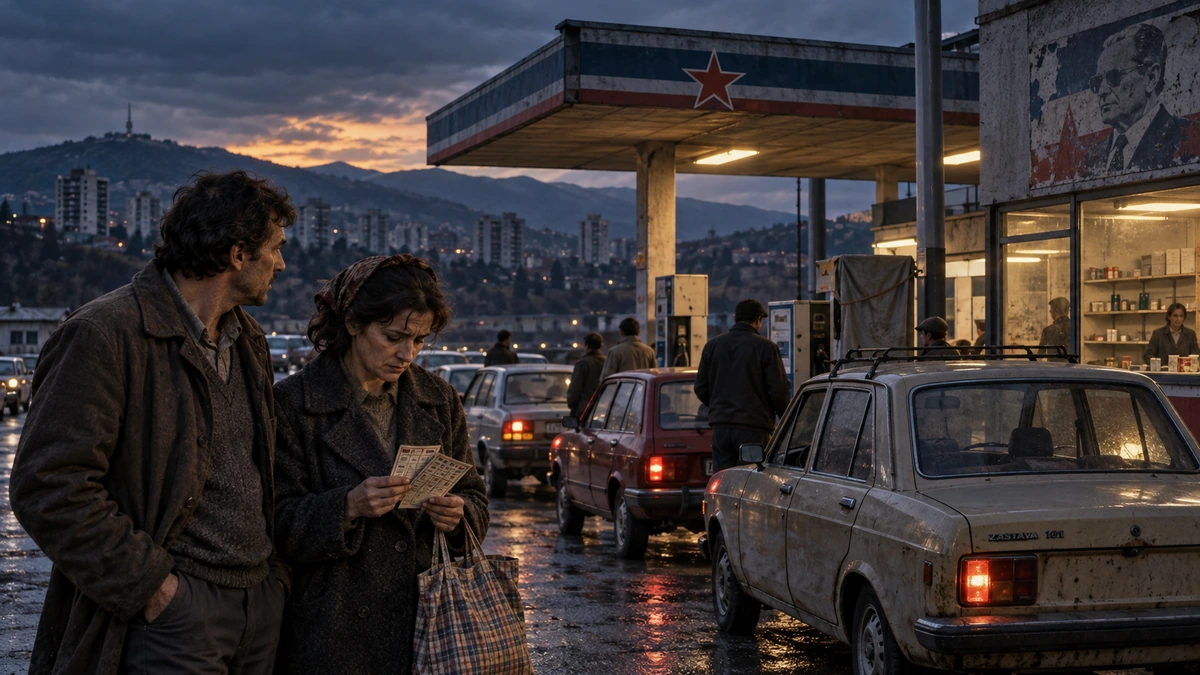
For many people, the most memorable image of the early 1980s was fuel. Driving according to the odd-even system limited car use depending on the last digit of the license plate. Later, fuel coupons were introduced. The National Museum of Contemporary History of Slovenia documents that fuel coupons were introduced at the end of October 1982, and the museum collection also preserves concrete examples of the coupons from that period.[5]
A historical museum overview of consumption in Yugoslavia notes that under the coupon system an individual car owner could not buy unlimited quantities of fuel; at one point the monthly amount was limited to approximately 40 liters.[6] But fuel was not the only thing. In certain periods and parts of the country there were shortages of: coffee, laundry detergent, oil, sugar, some medicines, spare parts, and certain imported raw materials. A study of the FAP factory in Priboj, based on local newspapers of the time, describes queues in front of shops because of shortages of coffee and detergent, and workers spending an ever larger share of their income simply on food.[7] The crisis thus acquired a very simple face. A queue.
An important correction: shortages did not last the same way throughout the decade. Here too, caution is necessary. The image of the 1980s as a decade of completely empty shops is exaggerated. Restrictions and shortages were most visible above all in the early years of the crisis. By the middle of the decade, the supply of most goods had improved.[6] But that did not mean the economy had returned to its old path. The problem merely changed. In the early 1980s, a person could have money but the product was not there. Later, the product might be on the shelf, but its price was rising faster because of inflation than the person could adjust his or her income. Shortage was gradually replaced by another problem: the loss of purchasing power.
The salary arrived — and began to lose value
Inflation in Yugoslavia did not begin only in the 1980s. The country had been struggling with it for decades. But in the 1980s the process accelerated. IMF analyses show that the average annual retail-price inflation was approximately 12.5 percent in the 1960s, 17.5 percent in the 1970s, and in the 1980s up to 1988 already around 75 percent.[4] Official Yugoslav statistics show further escalation. The retail price index compared with the previous year was approximately: 46 percent higher in 1981, 57 percent higher in 1984,
76 percent higher in 1985, 88 percent higher in 1986, 118 percent higher in 1987, and nearly 199 percent higher in 1988.[8] This is no longer ordinary inflation. It is an environment in which price quickly ceases to be a stable piece of information. If a person receives a salary today, it matters how quickly he or she will spend it. If an enterprise sets a price today, it is already thinking about how much input costs will be in a few weeks. If someone saves in dinars, those savings rapidly lose real value. Inflation gradually begins to change the behavior of the whole society. The dinar became a unit people no longer fully trusted.
Yugoslavia had a special additional problem. Its residents could also have foreign-currency savings. The Deutschmark, the dollar, or another hard currency therefore was not only something the state used in foreign trade for the ordinary person. It was also becoming a personal measure of value. If the domestic currency rapidly loses purchasing power, people begin to orient themselves toward a more stable one. The price of a car. An apartment. A large purchase. Savings. All of it increasingly began to be compared in German marks. For a domestic currency, that is a very dangerous psychological moment. Money works partly because people trust it. When they begin to calculate their future in another currency, part of that trust has already been lost. Why devaluation helped exports — and at the same time fed inflation.
The state had to do something about the large external deficit. One of the measures was the devaluation of the dinar. A cheaper dinar can help exports because a domestic product becomes cheaper for a foreign buyer. At the same time, it makes imports more expensive. For an economy that needs imported energy, machinery, and raw materials, this has a direct impact on domestic prices. The dinar was sharply devalued in 1980, and similar adjustments continued later as well.[4] The World Bank and the IMF later found that devaluations, wage and price indexation, and monetary responses created a complex spiral among: the exchange rate,
prices, wages, and the money supply.[9][10] It is important not to explain inflation with a single sentence, for example: “the state printed money.” Monetary expansion was important. But Yugoslav inflation was also connected with the foreign-exchange crisis, devaluations, enterprise losses, indexation, the banking system, and political attempts to protect employment and incomes. It was the result of a system that, when faced with losses, tried to prevent a sudden social collapse — and by doing so transferred part of the loss into the depreciation of money.

The price of rebalancing the external account
Yugoslavia did succeed in reducing the external deficit. But this did not happen without a price. Imports were sharply curtailed. Investments fell. Domestic demand was squeezed. In 1987, the World Bank wrote that goods imports in 1985 were approximately 30 percent below the 1980 level, while the share of fixed investment in the same period fell from around 30 to 20 percent of social product.[1] The external balance improved. But the economy almost stopped growing.
Between 1980 and 1987, average growth of social product was approximately one percent per year, compared with around six percent in the long earlier periods.[9] This is one of the key changes in the entire Yugoslav story. A country that for decades solved problems through growth suddenly had to solve problems without growth. Real wages: the moment when the number on the pay slip no longer says much.
Nominal wages could rise very quickly. But if prices rise even faster, a person is in reality losing ground. Already in 1983, the World Bank wrote that real wages were by then approximately 17 percent lower than in 1979.[3] Later research on the position of workers estimates an even larger cumulative decline in the first half of the 1980s; for the period 1979–1984, the literature contains estimates of roughly a one-third fall in real wages.[11]
More important than a single number is the direction. This was the first postwar generation of Yugoslavs to live for an extended period with the feeling that its real standard of living was declining. In previous decades, inflation had been unpleasant, but economic growth often created new opportunities. Now something else happened. Prices were rising. Wages were chasing them. Productivity was stagnating. Enterprises were in difficulty. And a person could do the same work as before, but be able to afford less for it.
The crisis did not strike everyone equally
Just as earlier growth was not the same across Yugoslavia, the crisis was not the same either. Slovenia entered the 1980s as the most developed republic, with a significantly better export position and lower unemployment. Kosovo, Macedonia, and some other less developed parts of the country already had much higher unemployment and lower productivity before the crisis. An industrial worker in a solid export-oriented enterprise could experience the crisis differently from a worker in an enterprise that could not obtain raw materials or sell its products.
A family that had a farm or relatives in the countryside could supplement its food more easily than an urban working-class family without such support. A worker with foreign-currency savings or a relative in West Germany had a different safety net from a person who was completely dependent on a dinar wage. So there was no single Yugoslav crisis. There was a common systemic pressure that fell upon very different regional and social positions. Employment remained protected — but a new job became harder to get.
The Yugoslav system tried for a long time to protect existing employment. Enterprise collapses were rare. Layoffs were not the main method of adapting to economic crisis. That meant that an employed worker often kept his or her job. But the problem shifted to the other side of the labor market. Young people found it harder to enter it. Regional unemployment remained high. Enterprises had fewer opportunities for new hiring.
With this, one of the basic promises of postwar modernization began to break: school → job → apartment → family. A person who was already inside the system had a certain protection. A young person only entering it had less and less certainty. This is a socially very important distinction. The crisis did not create only a poorer present. It began to take away confidence in the future. An enterprise can survive — the question is what happens to its losses.
The self-managing system strongly protected employment. But an enterprise that had a loss had to obtain resources somewhere to keep operating. If many such enterprises accumulate, the question changes from a business one into a systemic one. Who absorbs the loss? The bank? The republic? The federation? Another enterprise? The central bank? The consumer through higher prices? The worker through a lower real wage? Yugoslavia used almost all of these channels.
That is precisely why the economic crisis is hard to understand. Losses were not always visible as bankruptcy. They could appear as inflation. As a devaluation of the dinar. As a bad bank loan. As restricted imports. As lower wages. As less investment. The social system could thereby prevent a rapid collapse of enterprises. But the bill did not disappear. It was simply distributed through society in a different way.
The 1980s changed the political language as well
When an economy is growing, it is much easier to speak of common development. If one republic is growing faster, part of future growth can be redistributed. If an enterprise is employing new people, it is easier to preserve social peace. If real wages are rising, the discussion about who finances whom does not have the same sharpness. But when the entire space begins to contract, the question changes. It is no longer: How shall we distribute growth? But:
Who will bear the loss? The republics began to look much more sharply at the financial flows of the federation. The more developed parts of the country asked how much they contributed to common development mechanisms. The less developed parts asked whether, in a time of crisis, they would be left without the resources they needed to catch up. Enterprises defended their incomes. Workers defended their wages. Banks defended their liquidity. The republics defended their foreign exchange. And the federation found it increasingly difficult to formulate a policy that everyone would accept as fair. The economic crisis was not yet a national war. But it did create an environment in which a national political narrative could explain economic dissatisfaction more and more easily.
Debt was not only a number — it became a question of sovereignty
As long as a country can refinance debt without major difficulty, credit is an economic instrument. When there is no longer enough new money and creditors begin to condition further financing, credit also becomes a political question. By 1982, Yugoslavia had reached a position where it could no longer manage its external obligations merely through ordinary commercial borrowing. What followed were: agreements with the International Monetary Fund, restructuring of debts with foreign governments, negotiations with commercial banks, World Bank loans,
and economic adjustment programs.[1][3] Here begins the next major chapter. What did Yugoslavia itself want to do? What did creditors demand? Which measures were domestic? Which were conditions for new credit? Who bore the costs of adjustment? And did the programs stabilize the country — or did they deepen some of its internal problems? This question is too important to compress into a few paragraphs. That is why the continuation of the series is devoted to it.
By the end of the decade, the crisis had become something else
In the first half of the 1980s, Yugoslavia was a country of debt and foreign-exchange crisis. Toward the end of the decade, inflation became the central problem. Official and international statistics show the acceleration: around 75 percent average inflation in 1985, around 90 percent in 1986, around 120 percent in 1987, approximately 194 percent on average in 1988, and then an explosion in 1989.[9] By the final quarter of 1989, Yugoslavia had entered a hyperinflationary phase.[10] This is already a world in which normal economic logic begins to disintegrate. A salary can become outdated before it is paid. A price list has an ever shorter lifespan.
Enterprises try to protect themselves from the loss of value of money. Saving in the domestic currency becomes irrational. Contracts lose a stable unit of account. But hyperinflation is not the beginning of the story. It is its result.
What actually happened to the Yugoslav promise?
The first article in this series began with a generation that could for decades expect that the next period would be materially somewhat better. In the 1980s, that psychological foundation of the state began to crack. A person did not need to understand international interest rates. He or she did not need to know what the current account of the balance of payments was. He or she did not need to know the structure of external debt. He or she saw: that fuel required a coupon; that some products were not available;
that the dinar was losing value; that wages were not keeping up with prices; that enterprises lacked raw materials; that jobs for the young were harder to find; that investment was being halted; and that political leaders were increasingly quarreling over who would carry the burden. In this way the state lost something that may be more important than any single economic indicator: the conviction that the system knew the way forward.
Crisis is not proof that breakup had to come
This distinction will be crucial for the continuation of the series. Yugoslavia was in a deep economic crisis in the 1980s. That is demonstrable. It had a large external debt. That is demonstrable. It had high and then explosive inflation. That is demonstrable. The real living standard of a large part of the population fell. That too is demonstrable. But it still does not follow that war was inevitable. States survive severe debt crises. They survive inflation.
They survive recession. They survive political conflicts. The question, therefore, is not only: Why did Yugoslavia have an economic crisis? The real question is: How was economic crisis transformed into a crisis of legitimacy, then into a struggle among republics and political elites, and finally into the breakup of the state? To answer that, we now have to enter one of the most disputed parts of the story. The relationship between Yugoslavia and its creditors. The International Monetary Fund. The World Bank. Debt rescheduling. Austerity and stabilization measures. The economic reforms of Ante Marković. And the question of who actually paid the price of adjustment. The IMF, Debt, and the Transformation of Yugoslavia: Who Set the Rules for Exiting the Crisis?
Sources and further reading
- World Bank. Yugoslavia: Energy Conservation and Substitution Project, Report No. P-4476-YU, 1987, especially the overview of the economic crisis. The document gives average growth of around 6 percent in the 1960s and 1970s, the doubling of external debt between 1978 and 1981 to almost 20 billion USD, the impact of the second oil shock, world interest rates and recession, and the balance-of-payments crisis of 1982. Source
- World Bank. “Yugoslavia: Financial Restructuring in a Transition Economy, 1983–90.” Historical overview of investments, the credit system, and external debt; gives the rise of external debt from about 2.0 billion USD in 1970 to 15.2 billion USD in 1979 and negative real interest rates in the 1970s. Source
- World Bank. Yugoslavia: Adjustment Policies and Development Perspectives, Report No. 3954-YU / 4519-YU, 1982–1983. Documents the growth of interest payments from around 0.8 billion USD in 1979 to 2.0 billion in 1982, principal repayments, the fall in access to commercial credit, and foreign-exchange reserves at the beginning of 1983. Source 1 Source 2
- International Monetary Fund. Lahiri, Ashok. “Yugoslav Inflation and Money.” IMF Working Paper, 1991. Documents the rise of the trade deficit from around 3.8 billion USD in 1978 to 6.0 billion in 1979, the near-30-percent devaluation of the dinar in 1980, and the long-run acceleration of inflation. Full text: Source 1 Source 2
- National Museum of Contemporary History of Slovenia. “30 years of the Republic of Slovenia: Glimpses of the early 1980s.” Documentary photographs and overview of fuel coupons, the odd-even system, and shortages of basic goods. Source
- Museum of Yugoslavia. They Never Had It Better? Modernization of Everyday Life in Socialist Yugoslavia. Exhibition catalog documenting shortages, fuel restrictions, the odd-even system, and the later normalization of supply. Source
- Nationalities Papers. “Provincial, Proletarian, and Multinational: The Antibureaucratic Revolution in Late 1980s Priboj, Serbia.” Based on FAP material, documents shortages of raw materials, coffee, and detergent, queues before shops, and the falling living standard of industrial workers. Source
- Federal Statistical Office of the SFRY. Statistical Yearbook of Yugoslavia 1989. Official Yugoslav data on prices, employment, personal incomes, social product, and consumption. Historical series 1918–1988: Source 1 Source 2
- World Bank. “Macroeconomic Instability in Yugoslavia” / analysis of inflation at the end of the 1980s. Gives the fall of average GSP growth from around 6.2% in 1964–1979 to approximately 1% in 1980–1987 and the acceleration of inflation to 170% in 1987 and still higher levels later. Source
- International Monetary Fund. “Money and Inflation in Yugoslavia,” IMF Staff Papers, 1991. Analyzes the spiral between wages, prices, exchange rates, and money and the transition into hyperinflation at the end of 1989. Source
- Archer, Rory. “The Belgrade Working Class from Tito to Milošević.” Revue d’études comparatives Est-Ouest, 2019. Summarizes research on the fall of real wages and living standards of workers in the first half of the 1980s. Source
- wiiw — Vienna Institute for International Economic Studies. Astrov, Vasily & Jovanović, Branimir. Labour developments, living standards and well-being in Eastern Europe before the transition, Working Paper 255, 2024. Comparative overview showing the strong improvement of living conditions up to the late 1970s and the stagnation of incomes, rising inflation, and slowdown of consumption in the 1980s. Source