Yugoslavia Before and After the Breakup: Wages, Work, Housing, Debt, Inequality, Emigration, and Quality of Life
A comparison of work, housing, debt, inequality, emigration and living standards before breakup and across the successor states.
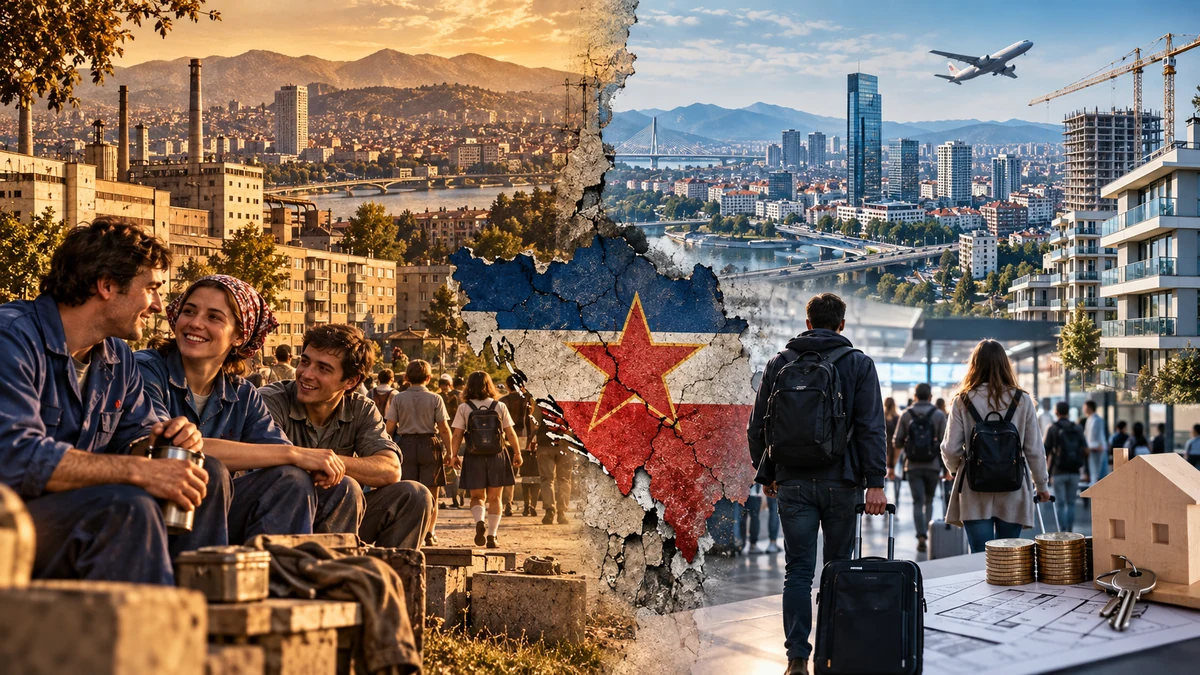
First: comparing “Yugoslavia with today” is methodologically dangerous
The question sounds simple: was life in Yugoslavia better than it is today? But it can quickly produce a misleading answer unless we specify: A comparison is meaningful only when it specifies the Yugoslav year, republic or area, social group, concrete indicator, and the later period used for comparison.
Yugoslavia in 1975 was not in the same economic situation as Yugoslavia in 1989. Slovenia in 1989 did not have the same living standard as Kosovo. Bosnia in 1995 cannot be meaningfully compared with Slovenia in 1995 as if both had passed through the same conditions. Serbia in 1993, during hyperinflation, cannot be treated as equivalent to Serbia in 2025. This article therefore does not try to manufacture a single artificial verdict such as: “Yugoslavia = 8/10, today = 6/10.” Such a number would not be history. It would be opinion. Instead, we compare individual dimensions.
The first major correction to nostalgia: the late 1980s were not Yugoslavia’s economic peak
If we use 1989 as the starting point, we are not comparing today’s system with Yugoslavia’s most successful period. We are comparing it with a country already deep in economic crisis. The World Bank later wrote that real GDP in the SFRY in 1989 was approximately where it had been in 1979.[1] That means: a decade with almost no aggregate real economic growth. Inflation, meanwhile, became extreme. International datasets show roughly 194 percent price growth for 1988 and approximately 2,700 percent for 1989 under one indicator, or around 700 percent under another measure of average inflation.[2] Different series use different methodologies.
But the basic conclusion is not controversial: by the end of the 1980s Yugoslavia was experiencing very high, increasingly hyperinflationary dynamics. Real income had already fallen sharply before the breakup. A Library of Congress country study, with research completed at the end of 1990, summarizes that between 1979 and 1985:
- productivity in the social sector fell by about 20 percent;
- real personal income of employees in the social sector fell by about 25 percent.[3]
The same source cites a 1989 estimate that the standard of living was approximately: 40 percent lower than in 1982.[3] That figure should be understood as a contemporary historical estimate, not as a universal modern quality-of-life index. But it shows something important. When someone compares: “Yugoslavia” with the present day, they must specify: which Yugoslavia? The 1970s? The early 1980s? Or 1989?
Unemployment existed — and it was extremely uneven across regions
A common simplification says: “Everyone in Yugoslavia had a job.” That is not correct. The World Bank published a regional indicator for 1978 measuring registered unemployment relative to employment in the social sector.[4] The approximate values were:
| Republic / area | Registered unemployment |
|---|---|
| Slovenia | 1.3% |
| Croatia | 5.9% |
| Bosnia and Herzegovina | 14.9% |
| Serbia | 16.5% |
| Montenegro | 16.0% |
| Macedonia | 22.3% |
| Kosovo | 28.1% |
| Yugoslavia total | 12.3% |
These are not directly comparable with modern ILO unemployment rates. The denominator and methodology were different. But the differences among republics were enormous. By 1989, the Library of Congress summarized unemployment in the social sector as close to: 20 percent.[3] So two things must be held true at the same time: employment was much more protected for part of the workforce than it is today; and unemployment was not eliminated. The security of an employed worker really was different.
The Yugoslav system was not simply a labor market with a lower or higher unemployment rate. Employment had a different institutional meaning. A study comparing later developments in Slovenia, Croatia, and Serbia describes the Yugoslav welfare system as combining universal public education, social health and pension insurance, family transfers, enterprise-linked benefits and strongly protected employment rights[5]. This does not mean a job could never disappear. It means that an employee in a socially owned enterprise had: a different bundle of rights and expectations regarding job security than in the later market system.
Paid leave and rest were not myths. Statutory labor rights were concrete as well. A United Nations report on the Yugoslav legal framework of the 1970s records a constitutional right to daily rest, weekly rest and paid annual leave. The law at the time generally provided: a minimum of 18 and a maximum of 30 working days of annual leave, with more in certain exceptional cases.[6] It also listed:
- at least 30 minutes of rest during a full working day;
- at least 12 hours of daily rest between two working days;
- at least 24 uninterrupted hours of weekly rest.[6]
Reports on successor states in the late 1990s still described many provisions concerning working time, leave, and sick pay as inherited from the Yugoslav labor system.[7] This is an important part of any comparison of job quality. But a protected job is not the same thing as a productive job.
Here we encounter the other side of the system. If an enterprise finds it difficult to dismiss surplus labor, that may preserve social stability. At the same time it can conceal low productivity, overemployment, losses and a need for subsidies. The Library of Congress reports that enterprises, under political pressure, absorbed surplus labor after some guest workers returned, contributing to declining productivity.[3] This is a classic trade-off: greater security of the individual job can mean less adaptability for the enterprise. This article therefore does not equate: job security = economic efficiency
or market flexibility = better quality of work. They are different measures. Wages: converting them into one “today’s euro” is highly misleading. Comparing a nominal wage from 1988 with a wage today is almost useless. Why? Because all of the following change:
- currency;
- inflation;
- exchange rates;
- subsidized prices;
- the structure of consumption;
- housing costs;
- the quality and availability of goods;
- and the balance between market and administered prices.
A more meaningful measure is: real income or purchasing power through time. And here the end of the 1980s was highly unstable. Historical IMF analyses show large movements in real wages during 1987–1990, closely connected with inflation and stabilization programs.[8] We therefore reject viral comparisons of the type: “a Yugoslav wage was X German marks, therefore it would equal Y euros today.” Without a price basket, such a calculation tells us very little.
The biggest social distinction: housing was not merely a market commodity
The housing system was one of the largest structural differences between Yugoslavia and today. Socialist Yugoslavia contained private ownership, socially or publicly owned housing, occupancy rights, enterprise-financed housing construction and various systems of housing contributions. An important correction: most people did not live in state-owned apartments. Private ownership of homes and apartments was widespread, especially outside large urban centers. But social housing was an important part of the urban housing system. The Slovenian case shows the scale of the change.
The OECD states that before housing privatization in Slovenia the ratio was approximately: 67% owner-occupied : 33% rental housing. After privatization in 1991–1993, it became approximately: 88% : 12% in favor of owner occupation.[9] That is an enormous change. Many holders of occupancy rights were able to buy their apartments at prices far below market value. A later OECD analysis cites an estimate that average sale prices in the Slovenian privatization were approximately: 10 percent of market value.[10] For the buyer, that was a major transfer of wealth. For the housing system, however, it had another effect: the public or non-profit rental stock shrank sharply.
Housing privatization created owners — but not equally for everyone. A similar process occurred in other successor states. UNECE describes a Serbian arrangement under which occupants of public housing could buy the apartment for: only a fraction of its market value.[11] In Bosnia, privatization was further complicated by war, refugee movements, property restitution, occupancy rights, vouchers and ethnic displacement. UN-Habitat notes that privatization of public housing and the loss of certain housing or tenancy rights made some low-income households more vulnerable.[12] So: housing privatization was an enormous material gain for many existing holders of occupancy rights; but:
the next generation did not enter the same system of allocating social apartments. This is one of the most important generational differences. Housing construction in some places collapsed during the transition. UNECE records a major decline in publicly financed housing construction in Serbia. Approximately:
- 9,000 public-sector housing units in 1991;
- 1,817 in 2002.[13]
For the broader period:
- around 250,000 dwellings completed in 1985–1990;
- around 115,439 in 1991–1995.[13]
War, sanctions, economic crisis, and institutional transition mean these figures cannot be attributed to a single cause. But the direction of change is clear: the old model of large-scale public or enterprise housing construction contracted.
Then came the wars — and ordinary economic comparison breaks down
For several successor states, the period after 1991 was not a normal economic transition. It involved:
- war;
- destruction of infrastructure;
- refugees;
- sanctions;
- loss of markets;
- broken supply chains;
- and monetary collapse.
In Croatia, the World Bank estimated that by early 1994, because of the war and the breakup of markets:
- output had fallen by about 25 percent;
- employment by about 25 percent;
- unemployment had risen from about 9 percent at the end of 1990 to about 18 percent.[14]
In Bosnia, the destruction was much greater. As documented in Who Gained After the Breakup of Yugoslavia? Ownership, Banks, Markets, Military Presence, Debt, and Political Influence, GDP by 1995 had fallen below one-third of its prewar level, while industrial production had dropped by more than 90 percent.[15] In such an environment, the question: “is a market economy better than socialism?” does not describe the actual shock. It compares a prewar system with an economy: during war or immediately after it.
How long did it take the states to return to the 1989 level? Here we obtain one of the most useful measures. EBRD real-GDP series, reproduced in international reviews, use the index: 1989 = 100. For 2008 the approximate values were:
- Slovenia: 156
- Croatia: 111
- North Macedonia: 102
- Montenegro: 92
- Bosnia and Herzegovina: 84
- Serbia: 72.[16]
This figure does not measure household welfare. It measures real economic output. But it tells us a great deal. Almost two decades after 1989: Serbia and Bosnia still had not regained their 1989 real output. Slovenia had moved far beyond it. Croatia and Macedonia had exceeded it by much smaller margins. “Transition” was therefore not one single process. If there had been one uniform consequence of the shift from Yugoslavia to market economies, the states should have followed broadly similar paths. They did not. In 2008 Slovenia = 156 relative to 1989. Serbia = 72. The gap is enormous. This means outcomes were shaped by:
- the initial level of development;
- the scale of war;
- sanctions;
- loss of markets;
- institutional quality;
- privatization;
- macroeconomic policy;
- integration with the EU;
- foreign investment;
- and many other factors.
Everything therefore cannot be attributed to one word: capitalism or socialism.
What happened to inequality?
The Yugoslav system had relatively low inequality in labor income. A study of Slovenia, Croatia, and Serbia gives a figure for the 1970s of approximately: Gini 0.21 for net personal income in the social sector.[5] For the period before 1990 it cites approximate values of:
- Croatia: 0.23
- Serbia: 0.22
- Slovenia: 0.24.[5]
These are not perfectly equivalent to today’s Gini measures of household disposable income. A direct decimal-to-decimal comparison is therefore not completely clean. But the data support the basic conclusion: income distribution was relatively compressed. After the breakup, the countries diverged in inequality. There is no single “post-Yugoslav” level of inequality today. According to the latest World Bank Poverty and Inequality Platform data, the most recent available Gini values are approximately:
- Slovenia: 24.7 (2023)
- Croatia: 30.1 (2023)
- Bosnia and Herzegovina: 30.3 (2021)
- Serbia: 32.8 (2023)
- North Macedonia: 33.5 (2019)
- Montenegro: 34.3 (2021).[17]
The years are not identical, so these should not be presented as a perfectly synchronous ranking. But the divergence is clear. Slovenia has preserved very low inequality. Other successor states developed different distributional profiles. This supports the broader finding of researchers: states emerging from the same system developed very different social regimes over the next three decades.[5] Household debt: “before and after” is not the same category.
When discussing debt, we must distinguish external sovereign debt, corporate debt, public debt and household debt. Households in Yugoslavia knew consumer credit, housing loans, installment finance and savings. But today’s system of mass mortgages, credit cards, vehicle loans, consumer loans and variable or market interest rates. is not directly comparable. We therefore will not claim: “Yugoslavs had no debt.” They did. But the financial structure of the household was different. Today’s households are more directly exposed to the financial market. In 2025 the IMF published a comparative chart for household debt relative to GDP in 2023:
- Bosnia and Herzegovina: 23.7%
- Slovenia: around 24%
- North Macedonia: around 29%
- Croatia: around 30%.[18]
This is not necessarily a sign of a lower standard of living. A mortgage can enable a household to buy a home. Credit can finance a house, a car, business activity, education and/or current consumption. But it means: a larger part of living standards is directly tied to the financial system and the household’s ability to service debt. That is a different form of security and risk from enterprise or social housing.
Emigration: Yugoslavia already knew it before the breakup
There is another myth about migration: “before the breakup nobody left.” That is not true. Yugoslavia had very large-scale labor emigration, especially to Western Europe. The World Bank estimated that in 1971 migrant workers amounted to around: 10 percent of the labor force.[4] The CIA World Factbook reported for 1986 that approximately: 5 percent of the labor force were guest workers in Western Europe.[19] Gastarbeiter emigration was therefore not a post-Yugoslav phenomenon.
But after 1990 migration acquired a completely different scale and meaning. The wars produced refugees, internally displaced persons, political migrants and later major economic migration flows. The United Nations documents hundreds of thousands of refugees and displaced people during the wars in Bosnia, Croatia, and Kosovo.[20] After the wars, migration continued primarily because of employment, higher wages, study, family reunification and the opening of European labor markets. Western Balkans: almost 4.4 million emigrants by the mid-2010s.
A World Bank / Vienna Institute analysis estimated that the emigrant stock from the six Western Balkan economies more than doubled between 1990 and 2015 and reached approximately: 4.4 million people.[21] For Bosnia and Herzegovina, Kosovo and Albania, the number of emigrants outside the region exceeded: 30 percent of the resident population.[21] This is one of the strongest reasons why economic development cannot be assessed only through GDP. If an economy grows while a large share of young and working-age people leave, the social outcome is more complicated. Remittances from abroad became an important part of the economy. In 2024, personal remittances from abroad were approximately:
- 10.6% of GDP in Bosnia and Herzegovina
- 10.3% in Montenegro
- 6.4% in Serbia
- 7.2% in Croatia
- 2.7% in North Macedonia
- 1.2% in Slovenia.[22]
This means two things at the same time. First the diaspora provides households with a major source of income. Second high dependence on remittances shows how much of the region’s economic life is tied to the work of people: outside their home country. Unemployment today: no longer the late 1980s, but large differences remain. According to ILO modelled estimates published by the World Bank, unemployment rates for 2025 were approximately:
- Slovenia: 3.2%
- Croatia: 5.0%
- Serbia: 7.1%
- Bosnia and Herzegovina: 11.0%
- North Macedonia: 12.3%
- Montenegro: 13.6%.[23][24]
These are not directly comparable with Yugoslav registered unemployment figures from the 1970s. But they show an important continuity: differences in employment opportunities across the former Yugoslav space remain large. The Western Balkans now also face labor shortages. Here the story turns again. The same states that still have relatively high unemployment can simultaneously experience: labor shortages in individual sectors. Why? Because there is a decline in the number of young people, the working-age population and the supply of certain skills. while emigration removes part of the labor force. The World Bank reported strong real wage growth across the Western Balkans in 2023–2024, partly associated with tightening labor markets.[25] In 2023, real wages in the WB6 grew on average by around:
8.4%. In the first half of 2024 around 8.3%.[25] This is an important correction to the claim that wages in the region are permanently frozen. They are not. But wage growth alone does not eliminate the problem of: people leaving.
Life expectancy: one of the clearest long-term improvements
Around 1989–1990, life expectancy in Yugoslavia was approximately: 72–73 years, depending on the series used.[26][27] Today the World Bank reports approximately for 2024:
- Slovenia: 82 years
- Croatia: 79
- Bosnia and Herzegovina: 78
- Montenegro: 78
- North Macedonia: 77
- Serbia: 76.[28][29]
This is a real long-term improvement. But carefully it cannot be attributed solely to: the breakup, capitalism, the EU and/or one government. Medical technology improved throughout Europe over the same decades. The comparison therefore tells us: people in most successor states now live longer on average than they did at the end of Yugoslavia. It does not by itself tell us: why. Yugoslavia itself had achieved major health improvements before the breakup.
This matters because we should not create propaganda in the opposite direction. Health improvement did not begin in 1991. United Nations historical data show a very large fall in infant mortality across the decades of socialist Yugoslavia.[30] For 1985–1990 the infant mortality rate was approximately: 24 per 1,000 live births.[31] That was worse than in many Western European countries, but dramatically better than in the early postwar decades. Both of the following are therefore true: Yugoslavia achieved major health and social development;
and the successor states continued to improve on many health indicators. Access to goods: today’s person lives in a world that did not exist in 1989. Quality of life also includes indicators that cannot be assessed only through wages. A person today has access to:
- mobile telephony;
- the internet;
- digital services;
- modern cars;
- low-cost air travel;
- a wider variety of food;
- international online shopping;
- more advanced medicines;
- and technological devices
that either did not exist in 1989 or were far less accessible. But this is mainly: a technological and global time effect. It would not be fair to say: “the breakup created the internet.” It would be equally unfair to ignore that material consumption today is qualitatively different because of global technological progress.
Mobility: from the Yugoslav passport to different present-day regimes
Yugoslavia had an unusually open international travel regime for a socialist country. Large numbers of people worked in Western Europe, traveled, shopped across borders and had contact with Western markets. After the breakup, conditions diverged among the states. Slovenian and Croatian citizens today, as EU citizens, have free movement of persons, the right to work in the EU under European rules and a much wider institutional space. Citizens of other successor states operate under different visa and employment regimes. Here too there is no single answer: some are more mobile today than ever before; others do not have the same status.
What about the quality of public services? Yugoslavia had a broad public network of primary and secondary education, universities, health institutions, kindergartens, the pension system and various social rights[5]. Much of this institutional core survived in the successor states. But financing and quality diverged strongly after the breakup. The claim: “everything was privatized after the breakup” is therefore incorrect. Public health and education systems remain central in all successor states. What did change includes financing, co-payments, private provision, organization and accessibility.
Social security: less uniform, more dependent on country and individual position. In Yugoslavia, a large part of social rights was directly connected: to employment in the social sector. That produced very strong protection for some. But less protection for the unemployed, rural populations, parts of the private sector and residents of less-developed regions. Today’s systems are formally structured differently. Some states have broader means-tested social assistance. Others have weaker protection. A person with a well-paid job in present-day Slovenia may live substantially better than their family did in 1989.
But a person in insecure low-paid work, paying high rent and without inherited housing, may have lost some of the security that the earlier system provided to an employed household with a social apartment. Both experiences can be true. The biggest hidden class divide: who was already “inside” at privatization?
Housing privatization illustrates a broader transition problem. If in 1991 you held a good social apartment, had occupancy rights and were able to buy it at a subsidized price. you could acquire a major asset. If you were young, a refugee, without occupancy rights and/or moved to a city later. you entered the market: at market price. The same reform could therefore greatly increase the wealth of one generation, while for the next it could: raise the entry price into the housing system. This is why a high homeownership rate today does not automatically mean: easy access to housing.
Slovenia is a good example of this housing paradox. The OECD today finds that Slovenia, because of its historical privatization, has high homeownership, low effective housing costs for many households that already own a home, but a small public rental stock, an underdeveloped private rental market and difficulties for younger households in accessing appropriate housing.[10][32]. So: high homeownership ≠ housing affordability for a new buyer.

Was the ordinary person richer after the breakup?
The answer depends on the year. 1991–1995. For a large part of the region: no. In war zones the material and human collapse was catastrophic. Late 1990s. Slovenia had already clearly recovered. Elsewhere the picture was much worse. 2008.
Slovenia had substantially exceeded its 1989 real output. Croatia and North Macedonia had exceeded it. Bosnia, Serbia, and Montenegro had not.[16] Today. All successor states operate in an economic and technological environment substantially richer than that of 1990. But major differences among them remain. For 2024 the World Bank reported nominal GDP per capita of approximately:
- Slovenia: USD 34,301
- Croatia: USD 24,050
- Serbia: USD 13,679
- Montenegro: USD 13,263
- Bosnia and Herzegovina: USD 9,359
- North Macedonia: USD 9,292.[33][34]
Nominal dollars from 2024 must not be directly compared with nominal dollars from 1989. The figures are included here to show: how far the successor states have economically diverged from one another. Was a worker more secure? If we are talking about job protection, the link between employment and housing, enterprise social rights and smaller wage differences, then some workers in the social sector had: greater institutional security. If we are talking about choice of employer, private entrepreneurship, work in international companies, mobility between EU countries and the possibility of high individual incomes, the present system is: broader. These are different forms of freedom and security.
Was housing more accessible? For a holder of occupancy rights often yes. For someone who did not obtain occupancy rights the picture is not so simple. The Yugoslav system did not guarantee a social apartment to every household. Waiting lists, employment, the enterprise, and local rules mattered. Today’s market offers more possibilities for private purchase and construction, but in many urban areas the price of housing relative to income is: a major barrier for younger people. We therefore must not confuse:
Kranj and Tržič: when macroeconomics becomes an empty factory hall. In Gorenjska, transition was not experienced as an abstract change in ownership models. The 1991 bankruptcies of Tekstilindus Kranj and BPT Tržič were major events, and by 1994 roughly 9,000 industrial jobs had been lost in the region.[37] In Tržič, more than 800 workers lost employment after BPT entered bankruptcy.[39]
Peko was still producing almost four million pairs of shoes in 1990; after privatization came a long contraction ending in bankruptcy in 2016.[38] Planika production in Kranj was not preserved; the former complex later became home to many new businesses.[40] Real estate can acquire a new economic use, but that does not restore the industrial workforce or the thousands of former jobs.
For someone who spent decades watching factory shifts and a company functioning as a centre of local life, later GDP growth does not erase the experience of closed plants. Kranj did not cease to be industrial and Tržič did not cease to have entrepreneurship, but a large part of the former textile and footwear industrial structure disappeared or fragmented. That is a social loss that a macroeconomic average alone does not capture. the low rent of an established occupant with universal accessibility of housing. Was inequality lower?
In general: yes, income distribution in the late socialist system was more compressed.[5] But another hidden distinction remains. Relatively equal wages within a republic did not mean: equal development among republics. Slovenia and Kosovo were part of the same federation, but differed greatly in productivity, incomes, employment, infrastructure and economic opportunity.[4][35]. Yugoslavia could therefore have, at the same time: relatively low personal income inequality and very large regional inequality. Do people live longer today?
Yes. That is one of the clearest answers.[28][29] But life expectancy does not measure job quality, housing prices, social cohesion, political satisfaction and/or the feeling of security. It is therefore important, but not sufficient. Are people happier? Here the answer becomes even less reliable. EBRD Life in Transition surveys show that life satisfaction changes over time and that, after the global financial crisis, dissatisfaction was high in many transition countries, while later the average gap to Western European comparison countries narrowed.[36] But the subjective response: “I am satisfied with my life” is not a direct measure of: “this economic system is better.” Satisfaction is affected by:
- age;
- health;
- family;
- expectations;
- relative position;
- politics;
- war experience;
- and memory.
Subjective data are therefore used only as a supplement.
The greatest mistake on one side: comparing the peak of the old system with the bottom of the new one
If we take: Yugoslavia in 1978 and compare it with: Serbia in 1993, we almost predetermine the answer. If we take: Yugoslavia in 1989 and compare it with: Slovenia in 2025, we again almost predetermine the answer. Both comparisons are selective. A fair comparison has to show:
- the late-socialist peak or more stable period;
- the crisis of the 1980s;
- the breakup and wars;
- the transition trough;
- the recovery;
- the present condition.
Only then can the reader see the path. The greatest mistake on the other side: attributing every improvement to the breakup. If a person today has better medicine, the internet, a newer car, a smartphone and longer life expectancy, that is not automatic proof: that the breakup of Yugoslavia improved their life. A large part of this would probably have occurred because of global technological development, medical progress, world trade and European integration, regardless of the precise state structure. Causal claims must be separated from time comparisons.
The third great mistake: attributing every loss to the market system. It is equally misleading to compress war destruction, sanctions, refugee movements, loss of the common market, bombing, hyperinflation and privatization. into one category: “capitalism.” These are different processes. Some are connected. They are not the same. This article therefore has to speak about: actual mechanisms, not ideological labels. What can we state with a high degree of confidence from the evidence?
Yugoslavia had a strong and relatively broad social system. Public health care, education, pensions, employment rights, and enterprise social benefits were important parts of the system.[5] Employment was more protected for workers in the social sector. But the country did not eliminate unemployment, and regional differences were very large.[3][4] The 1980s were not a decade of stable prosperity. The economy stagnated, real incomes fell, and inflation became extreme.[1][2][3]
Income inequality was relatively low. But regional development gaps remained large.[4][5] The housing system contained an important social or enterprise-owned segment. But not everyone received a social apartment. Housing privatization transferred very large asset gains to many holders of occupancy rights. In Slovenia, the ownership structure moved in a few years from approximately 67:33 to 88:12.[9] At the same time, the public rental stock shrank.
This later made the position of some new households more difficult.[10][12] The wars of the 1990s caused direct economic collapse in several states. Croatia and especially Bosnia experienced dramatic falls in production and employment.[14][15] Economic recovery was extremely uneven. By 2008 Slovenia’s real GDP was roughly 56 percent above its 1989 level, while Serbia remained around 28 percent below it.[16] The successor states developed very different levels of inequality.
Slovenia remains highly egalitarian, while other states show higher inequality.[17] Emigration did not begin in 1991. Gastarbeiter migration was already important in Yugoslavia.[4][19] After 1990, however, migration acquired far greater demographic significance. Across the WB6, the emigrant population reached approximately 4.4 million by the mid-2010s.[21] Diaspora remittances are now macroeconomically important in several successor states. Especially in Bosnia, Montenegro, and Serbia.[22]
Life expectancy is higher today than at the end of Yugoslavia. But this cannot simply be attributed to one political or economic system.[28][29] Today’s market offers more choice and technological possibilities. But a larger part of housing and consumer risk is borne directly by the household. There is no single evidence-based answer that “before was better” or “today is better” for everyone. The answer changes according to country, time, generation, wealth, employment, housing position and indicator.
The most honest answer to “was it better before?”
For an employed person with a secure job and an acquired occupancy right, the Yugoslav system could provide: greater economic predictability, lower housing risk, and lower income inequality. For an unemployed person in a less-developed republic in the late 1980s, Yugoslavia was not a social utopia. For a resident of Bosnia, Croatia, or Serbia during parts of the 1990s, war, sanctions, or economic collapse represented: a dramatic deterioration in living conditions. For a resident of present-day Slovenia, material standards, life expectancy, international mobility, and many consumer possibilities are: substantially higher than in 1989. For a young person without inherited housing in an expensive city, access to a home may be:
more difficult than it was for the generation that privatized former social housing. For a resident of a country with mass emigration, GDP growth can coexist with the feeling: that one must leave the country to obtain well-paid work. That is not a contradiction. It is the actual complexity of the transition. The final conclusion of this article is as follows.
The breakup of Yugoslavia did not create one uniform economic “after.” It created: several different states, several different transitions, and several different life trajectories. The old system provided more employment security, compressed income distribution, enterprise social rights and institutional housing protection for part of the population. But the end of the system was marked by stagnation, high unemployment, large regional inequality, falling real incomes and an inflationary breakdown. The new systems over time brought higher productivity in some states, greater consumer choice, private entrepreneurship, international integration, technological progress and longer life expectancy. But also more market risk for households, a smaller public housing stock, greater exposure to credit, differently higher levels of inequality and, across a large part of the region, substantial emigration. The data therefore do not support the slogan:
“everything was better in Yugoslavia.” Nor do they support the slogan: “everything became better after the breakup.” They support a less comfortable but historically more useful answer: some security was lost, some freedom and material possibilities were gained, the wars created catastrophic intermediate losses, and long-term outcomes diverged so strongly among the successor states that the former Yugoslavia cannot be assessed with a single indicator.
The comparison continues in Seven Post-Yugoslav Economies, Seven Paths: Why Did They Develop So Differently After the Breakup?, which turns to why states emerging from the same federation developed along such different paths.
Sources and further reading
- World Bank. Slovenia: From Yugoslavia to the European Union / transition analysis. Summary of the SFRY macroeconomic crisis; real output in 1989 approximately at its 1979 level. Source
- World Bank. Historical transition/macroeconomic data for Yugoslavia, including very high inflation in 1988–1990. Source
- Library of Congress, Federal Research Division. Yugoslavia: A Country Study (research completed December 1990). Sections on living standards, real income, unemployment, and debt. Source 1 Source 2
- World Bank. Historical regional indicators for Yugoslavia: employment, unemployment, migration, and regional disparities. Source
- Žarković-Rakić, J., Krstić, G., Oruč, N., & Bartlett, W. (2019). Income inequality in transition economies: A comparative analysis of Croatia, Serbia and Slovenia. Economic Annals 64(223), 39–60. Source
- United Nations. Yugoslavia — implementation of economic and social rights; constitutional/legal provisions on rest, paid leave, and working conditions. Source
- U.S. Department of State / Refworld. Former Yugoslav Republic of Macedonia, Country Report on Human Rights Practices 1998; inherited Yugoslav rules on workweek, rest, leave, and sick benefits. Source
- World Bank / IMF historical transition analysis. Real-wage and inflation dynamics in Yugoslavia, 1987–1991. Source 1 Source 2
- OECD. Housing Finance in Transition Economies. Slovenia: pre-privatization owner/rental ratio 67:33; after privatization 88:12. Source
- OECD Economic Survey: Slovenia 2020 / 2024. Privatization of public housing, high homeownership, small rental stock, and present housing-affordability problems. Source 1 Source 2
- UNECE. Trends and Progress in Housing Reforms in South Eastern Europe. Housing privatization in Serbia, Macedonia, Bosnia, and other transition states. Source
- UN-Habitat. Housing and Property Rights — Bosnia and Herzegovina, Croatia and Serbia and Montenegro. Source
- UNECE. Country Profiles on the Housing Sector — Serbia and Montenegro. Decline in public and total housing construction after 1991. Source
- World Bank. Historical Croatia reconstruction/transport assessment. Prewar income, fall in output and employment, and rise in unemployment by 1994. Source
- World Bank. Bosnia and Herzegovina: From Recovery to Sustainable Growth. Postwar collapse of GDP and industrial production. Source
- EBRD data, reproduced in FAO / transition literature. Real GDP index, 1989=100, for 2008: Slovenia 156, Croatia 111, Serbia 72, Montenegro 92, Macedonia 102, Bosnia 84. Source 1 Source 2
- World Bank Poverty and Inequality Platform / WDI. Gini index, latest available years. Source
- IMF. Bosnia and Herzegovina: Selected Issues, Country Report 25/253 (2025). Household-debt-to-GDP comparison for 2023. Source
- CIA. The World Factbook 1990 — Yugoslavia. Population, labor force, guest workers, and demographic indicators. Source
- United Nations Population Division. International Migration from Countries with Economies in Transition 1980–2000. Refugees, asylum, and displacement in former Yugoslavia. Source
- World Bank / Vienna Institute. Western Balkans Labor Market Trends 2018/2019. Emigrant stock from WB6, 1990–2015/17. Source
- World Bank, World Development Indicators. Personal remittances received as % of GDP, 2024. Source
- World Bank / ILOSTAT. Unemployment, Croatia, Serbia, Slovenia — latest modelled ILO estimate. Source
- World Bank / ILOSTAT. Unemployment, Bosnia and Herzegovina, North Macedonia, Montenegro, Serbia — latest modelled ILO estimate. Source
- World Bank. Western Balkans Regular Economic Report No. 26, Fall 2024. Real wage growth 2023–H1 2024 and labor-market tightening. Source
- World Bank. Historical health indicators for former Yugoslavia. Female life expectancy 74.5 in 1990; historical male/female series. Source
- CIA World Factbook 1990. Yugoslavia: life expectancy approximately 70 years for men / 76 for women; infant mortality 22 per 1,000. Source
- World Bank / UN Population Division. Current life expectancy: Slovenia, Croatia, Serbia. Source
- World Bank / UN Population Division. Current life expectancy: Bosnia and Herzegovina, North Macedonia, Montenegro, Serbia, Kosovo. Source
- United Nations. Historical World Population Prospects — Yugoslavia: long-term decline in infant mortality and rise in life expectancy. Source
- United Nations. Demographic trends 1985–1990: infant mortality in former Yugoslavia around 24 per 1,000. Source
- OECD. Housing market challenges and policy options — Slovenia 2024. Source
- World Bank. Current GDP per capita and macro indicators: Slovenia, Croatia, Serbia. Source
- World Bank. Current GDP per capita and macro indicators: Bosnia and Herzegovina, North Macedonia, Montenegro, Serbia. Source
- World Bank. Exploring Spatial Disparities in the Western Balkans. Historical patterns of regional inequality in Yugoslavia. Source
- EBRD. Life in Transition Survey III and survey methodology. Subjective life satisfaction and post-transition attitudes. Source 1 Source 2
- Gorenjski glas. “Three decades of the Gorenjska economy”: bankruptcies of Tekstilindus Kranj and BPT Tržič in 1991; about 9,000 industrial jobs lost in Gorenjska by 1994. Source
- Delo. “A century of shoemaking romance”: Peko produced almost four million pairs of shoes in 1990; after privatization came prolonged decline and bankruptcy in 2016. Source
- Gorenjski glas, 30 Aug 1991. More than 800 workers lost their jobs after the bankruptcy of BPT Tržič; Tržič then had the highest unemployment share in Slovenia. Source
- Gorenjski glas. “Planika bankruptcy nearing completion”: Planika production in Kranj was not preserved; about one hundred businesses later operated on the former factory site. Source