Who Gained After the Breakup of Yugoslavia? Ownership, Banks, Markets, Military Presence, Debt, and Political Influence
Who gained statehood, companies, markets, military presence or political influence after breakup — without turning later benefit into proof of prior design.
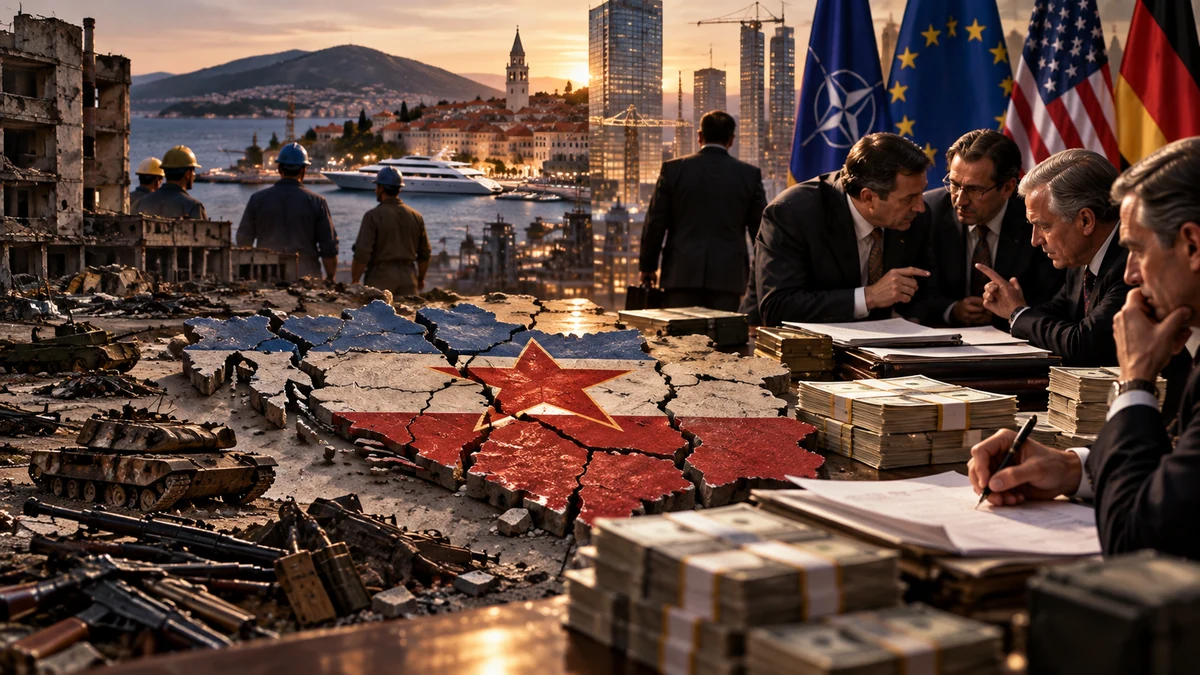
The most important boundary first: benefit is not the same as a plan
When a state breaks apart, one question almost always appears: cui bono — who benefited? That is a legitimate historical question. But it contains a dangerous trap. If an actor gains something after an event, it does not follow that: the actor caused the event for that reason. For example, a company may buy a factory after a war. That proves that it acquired the factory. It does not prove that, a decade earlier, it caused the war in order to buy it. The same applies to states, banks, military alliances, political elites, and international organizations. This article therefore separates three things:
- a documented benefit or gain in influence;
- documented political conduct during the events;
- a claim of pre-planned intent.
The third requires much stronger evidence than the first.
The first beneficiaries: republics that become states
The most direct consequence of the breakup is political. Slovenia. Croatia. Bosnia and Herzegovina. Macedonia. Later, Montenegro. Each obtained something it had not possessed as a Yugoslav republic in the full international-law sense: independent membership in international organizations; its own foreign policy; its own military or defense policy; its own central bank or monetary system; its own tax policy; its own diplomatic apparatus; and the right to conclude international treaties in its own name. This is an objective gain in political sovereignty.
But the price was not the same everywhere. Slovenia achieved independence after a short war and relatively quickly stabilized its economy. Bosnia and Herzegovina became an internationally recognized state through a war that destroyed an enormous amount of human and physical capital. Serbia retained the largest share of the former federal institutional and military infrastructure, but lost the common state, experienced sanctions and wars, and in 1999 NATO bombing as well. Therefore: statehood was a gain, but not proof that the entire process materially benefited the population of the new state. A new state also means new elites.
When a federation breaks apart, it does not merely create new flags. It creates presidencies, ministries, central banks, customs administrations, diplomatic services, security structures, state-owned enterprises, regulators, and budgets. Political elites that previously competed for power inside a federation therefore gain: an entire state institutional field of their own. In Yugoslavia there were six republican centers of power beneath the federal level. After the breakup, most of those centers became the apex of sovereign states. That is a real political transfer of power. It does not require a conspiracy theory. It is a direct consequence of constitutional change. But a new state is also a smaller market.
Economically, the picture is almost the reverse. Yugoslavia was a single economic area of around 23 million people, with a common currency, an internal market, integrated supply chains, a shared banking and payment system, and companies whose factories, suppliers, and customers were distributed across several republics. When the country breaks apart, an internal republican border becomes a state border, a customs border, a currency border, a legal border, and often a political or military front. For an economy, that is a shock.
The World Bank explicitly noted for Slovenia that the loss of markets in the other former Yugoslav republics deepened the recession of the early 1990s.[1] In Bosnia, the war brought the economy close to a standstill; by 1995 GDP had fallen to less than one-third of its pre-war level and industrial production by more than 90 percent.[2] The breakup therefore was not simply: “opening new states to capital.” First, it was: the fragmentation of a previously integrated economic space.

The market is then rebuilt differently
In the following years, two processes happen at the same time. First, the former republics begin trading with one another again. Second, their trade becomes increasingly oriented toward the European Union. This matters. The former Yugoslav market did not simply disappear. In 2008, for example, among Bosnia and Herzegovina’s largest export markets were Croatia, Serbia, and Slovenia, alongside Germany and Italy.[3] For Serbia in the same year, Bosnia and Herzegovina and Montenegro were among the largest individual export markets.[4] Croatia exported heavily to Italy, Bosnia and Herzegovina, Germany, and Slovenia.[5] Thus former economic links were partly restored. But no longer inside a single legal space.
CEFTA: partial reconstruction of the market without Yugoslavia. In 2006, a new enlarged CEFTA agreement was signed. Its purpose was to replace numerous bilateral agreements and recreate a broader free-trade area in Southeast Europe.[6] This produces an interesting historical paradox. First, the common market breaks apart. Then the states spend years negotiating customs arrangements, rules of origin, regional treaties, and harmonization in order to reassemble part of that economic space. Of course, CEFTA is not Yugoslavia. It is not a common state, a common budget, a common currency, or a common social policy. But it acknowledges an economic reality: small economies in the region need a broader market. The European Union becomes the new economic center of gravity.
In 1999, the EU launched the Stabilisation and Association Process — SAP for the Western Balkans.[7] From 2000 onward, it granted the countries of the region autonomous trade preferences that provided broad preferential access to the EU market.[8] Later came Stabilisation and Association Agreements, candidate status, accession negotiations, and, for some countries, membership. Slovenia joined the EU on 1 May 2004.[9] Croatia joined on 1 July 2013.[10] For the remaining countries, approximation to the EU became the central framework for trade policy, legislative reforms, competition policy, state aid, banking regulation, public procurement, judicial reform, and many other fields.[11] This represents a major shift in economic and regulatory gravity.
Did the EU “get the market”? In one descriptive sense: the EU became by far the most important trading partner of the Western Balkans. For 2019, the European Commission stated that the EU accounted for almost 70 percent of the Western Balkans’ total trade.[8] But the formulation: “the EU got the Yugoslav market” is too crude. Why? Because the countries of the region did not merely open their markets to the EU. They also gained preferential access to a much larger market, financial assistance, investment, the possibility of membership, and, for member states, free movement of goods, services, capital, and people. The relationship is asymmetric in size: the EU is a much larger economic bloc. But it is not a one-way flow. Integration also means political influence.
The EU does not exercise influence only through trade. A candidate for membership must satisfy political criteria, economic criteria, the EU acquis, and, for the Western Balkans, additional requirements concerning regional cooperation and good-neighborly relations.[11] The European Commission monitors the judiciary, corruption, public administration, competition, state aid, economic governance, and many other fields. This means that after the breakup of Yugoslavia, a substantial part of the reform agenda of the former republics gradually became: conditioned by the process of integration into the EU. That increased EU influence. At the same time, it is influence that domestic governments accept because they seek trade access, financial assistance, political integration, or membership.
Banks: this is where the ownership shift is most visible
If we look for a sector where ownership change can be measured very concretely, it is: banking. By the end of the first decade after 2000, a large part of the banking systems of the former Yugoslav republics was controlled by foreign banking groups. Examples for around 2008:
- Croatia: about 90% of banking assets in majority foreign-owned banks.[12][13]
- Bosnia and Herzegovina: about 92% according to one internationally comparable database; other domestic/regional reviews for the same period use around 95%.[14][15]
- Macedonia: about 69–70% of banking assets according to an internationally comparable database.[14]
- Serbia: about three-quarters of banking assets according to an internationally comparable database; domestic reporting including leasing uses about 80% of the broader financial sector in foreign ownership.[14][16]
Slovenia was an important exception. At the end of 2008, the Bank of Slovenia reported approximately: 38.2% of bank equity owned by non-residents, which meant substantially more domestic ownership than in Croatia or Bosnia.[17] So we cannot say: “it was the same everywhere.” It was not. Who were the new bank owners?
Primarily European banking groups. In Croatia in 2007, foreign ownership was dominated by Austrian and Italian banks.[13] In Bosnia around 2009, Austrian ownership was particularly strong among foreign capital.[15] In other countries of the region, Italian, Greek, French, Hungarian, Slovenian, and other banking systems also played important roles. This was a concrete benefit for the parent banks: new markets, deposits, loan portfolios, fees, and profits. But here too the picture was not one-way. New banks often brought capital, newer technology, payment systems, risk management, and access to a broader financial system. When the financial crisis of 2008 arrived, however, another side also became visible: dependence on cross-border financing and parent banks.
Croatia: an exceptionally rapid shift. The Croatian case is especially clear. In 1998, banks with majority foreign ownership controlled less than 7 percent of assets. By the end of 2001, almost 90 percent.[18] That is a dramatic ownership transformation in only a few years. The IMF later also noted that a large share of Croatian foreign direct investment was linked to privatization and the financial sector, while greenfield investment that would have created entirely new productive capacity lagged behind its potential.[19] So foreign capital did not enter only by building new factories. It often bought an existing bank, telecommunications company, industrial company, or stake in a state-owned enterprise. Serbia: a similar pattern, somewhat later.
Privatization After 2000: Where Did Social Ownership Go, and Who Acquired Serbia’s Enterprises? examined the Serbian case in detail. After 2001, cement plants, tobacco companies, the steelworks, banks, and many other companies received new owners. Part of the domestic banking structure was liquidated or restructured. By the end of the decade, foreign banks represented the main part of the financial system. The important connection with this article is this: the breakup of the state did not itself privatize Serbia. The major ownership transition came only after sanctions, wars, bombing, the fall of Milošević, and reforms after 2000. We therefore should not collapse 1991 and 2002 into a single event.
Slovenia: a former republic becomes a regional investor
Slovenia is interesting because it complicates the simple formula: the West buys the Balkans. Slovenian companies themselves became important investors in other former republics. The IMF reported that in 2003 there were about €1.1 billion of Slovenian direct investments in the countries of the former Yugoslavia, out of approximately €1.85 billion of total Slovenian investment abroad.[20] Already in 2000, about 64.5 percent of Slovenian outward FDI went to successor states of the former Yugoslavia.[21] Regional investors included Nova Ljubljanska banka, Mercator, Petrol, and other companies.[22] So Slovenian capital was not only a target of foreign acquisitions. It also became: a regional owner.
Croatian capital also crosses the new borders. The World Bank found in its analysis of regional investment flows that a large share of intra-Southeast-European investment came from Slovenia and Croatia.[22] Croatia’s Agrokor, for example, invested in Serbia and Bosnia and Herzegovina.[22] The new state borders therefore created an interesting paradox. A company that had previously expanded its sales within the same country could now become a foreign direct investor in a country that only a few years earlier had belonged to the same federation. The former internal market becomes a field of cross-border acquisitions.
This is one of the most important structural changes. In Yugoslavia, a Mercator store in another republic was not “Slovenian foreign direct investment.” After the breakup, it is. An NLB branch in Sarajevo or Belgrade becomes a foreign bank. A Croatian company in Serbia becomes a foreign investor. A Serbian company in Montenegro becomes cross-border capital. The same economic space is therefore transformed, statistically and legally, into: an international economy. This is not merely a semantic difference. It changes taxes, regulation, supervision, capital flows, and the political sensitivity of ownership. What did domestic business circles gain?
A significant share of capital also did not go to foreigners. Privatizations in Serbia, Croatia, Bosnia, Macedonia, Slovenia, and elsewhere created new domestic private owners. Some were former managers, employees, investment funds, businessmen from the 1990s, new entrepreneurs, or politically connected business networks. The outcomes vary greatly. This article therefore does not create a single category such as: “the tycoons got Yugoslavia.” In individual countries there are documented controversial takeovers, political clientelism, corruption cases, and privatizations involving irregularities. But individual cases require individual evidence. What can be said reliably at the systemic level is: the conversion of social and state ownership created a new class of private owners, domestic and foreign.
NATO: from an alliance outside Yugoslavia to a lasting security actor inside the region
Before the Yugoslav wars, NATO had no peacekeeping forces, operational bases, or permanent operational role on Yugoslav territory. In Bosnia that changed. In December 1995 NATO deployed approximately 60,000 IFOR personnel.[23] It was followed by SFOR. NATO itself describes the Bosnia operation as the first major crisis-response operation in its history.[23] SFOR operated until December 2004. The EU then assumed the main stabilization role through EUFOR Althea, while NATO retained a headquarters in Sarajevo and a role in defense reform.[23][24] That is a major institutional shift.
Kosovo: KFOR remains. KFOR entered Kosovo in June 1999. Its initial force numbered approximately 50,000 troops.[25] Its mandate is based on UN Security Council Resolution 1244 and the Kumanovo Military Technical Agreement.[25] KFOR became smaller over time. But it did not disappear. It remains in Kosovo in 2026.[25] Camp Bondsteel remains an important base for the U.S. contingent and the headquarters of KFOR Regional Command-East.[26] This is a documented: lasting U.S./NATO military presence in part of the former Yugoslav space.
Does this mean the war was fought to obtain military bases? No. From the fact that: a base exists after a war it does not automatically follow that: the war was started in order to obtain the base. Such a conclusion would require pre-war documents, plans, instructions, or other evidence of that intent. This article does not assume it. What can be stated with confidence is: a geopolitical result of the wars was a larger and longer-lasting NATO and U.S. military presence in the region. That is a result. It is not automatically a proven original motive.
Membership: part of the former Yugoslavia enters NATO. In the following decades, the security architecture changed even further. Slovenia joined NATO on 29 March 2004. Croatia on 1 April 2009. Montenegro on 5 June 2017. North Macedonia on 27 March 2020.[27] Bosnia and Herzegovina and Serbia joined the Partnership for Peace in 2006, but not NATO.[28] Thus the former single non-aligned state split into NATO member states, partner states, and different security orientations. This is one of the largest geopolitical changes after the breakup.
NATO gained operational space — while member states gained a security guarantee. Here too, both sides must be seen. For NATO, enlargement means more members, more interoperability, and greater political and military reach in Southeast Europe. For a state that joins, membership means participation in decision-making, Article 5, access to common planning, and integration into the alliance. Membership is therefore not simply: “NATO acquires a state.” It is a treaty relationship formally accepted by the member state, from which the state expects benefits of its own.
Bosnia: international influence goes further than military presence
Bosnia and Herzegovina is a special case. The Dayton Agreement did not only create the internal constitutional arrangement. It also established the Office of the High Representative — OHR. Following the 1997 Bonn meeting of the Peace Implementation Council, the High Representative’s authority came to be interpreted as allowing removal of public officials who violate Dayton and imposition of laws when domestic institutions fail to act.[29][30] This is an unusually powerful form of international political influence. The OHR has actually used these powers. The Bosnian case therefore involves more than international aid. For many years it included an element of: direct international intervention in domestic political institutions.
Was Bosnia a protectorate? Even representatives of the OHR at times used the expression “quasi-protectorate” to describe the power of the international administration.[31] But Bosnia was not a classical colony without its own constitution or elections. It had a presidency, parliament, entities, cantons, elections, courts, and domestic governments. At the same time, above them stood an international High Representative with extraordinarily strong powers. The most precise description is therefore: a hybrid of a domestic democratic system and strong international supervision. Money for reconstruction also means influence.
The OHR states that the post-war reconstruction program in Bosnia, financed by the World Bank and the European Commission, was worth approximately $5.1 billion.[30] Such aid enabled the reconstruction of infrastructure, institutions, housing, and the economy. But the aid was also linked to conditions. In 1997, the Peace Implementation Council explicitly stated that continued assistance remained conditional on compliance with the Dayton Agreement and other obligations.[29] This is a classic mechanism: money provides assistance, while conditions create influence.
Debts did not die with the state
When a state breaks apart, a very practical question arises: who pays its debts? The 2001 Agreement on Succession Issues had to regulate financial assets, liabilities, gold, accounts, international claims, diplomatic property, archives, pensions, and other matters.[32] Importantly: a large part of the external debt had already been divided or assumed through agreements with international financial institutions, the Paris Club, and the London Club.[32] The debt did not simply disappear. “Allocated debt”: debt follows the beneficiary.
The Succession Agreement distinguishes between allocated debt and other liabilities.[32] Where the final beneficiary of a loan was located in the territory of a particular successor state, the obligation generally followed that state. This matters. We cannot simply take a percentage and say: “Croatia received exactly 23% of all Yugoslav debt.” That is not how it worked. A large part of the debts was tied to specific projects, specific republics, or had already been divided with creditors under separate agreements.[32] Where do the percentages 38 : 23 : 16 : 15.5 : 7.5 apply? For the division of part of the foreign financial assets of the SFRY, the Agreement used the following shares:
- FRY: 38%
- Croatia: 23%
- Slovenia: 16%
- Bosnia and Herzegovina: 15.5%
- Macedonia: 7.5%[32]
Known financial assets included monetary gold, foreign-currency accounts in foreign banks, assets in jointly owned Yugoslav banks abroad, and other financial assets.[32] The same key also applied to some other unallocated financial items. But not to all debt without distinction. What did creditors gain?
The most precise formulation is: the breakup of the state did not extinguish their claims. The Paris Club, London Club, World Bank, IMF, EIB, and other creditors arranged the assumption of obligations with the successor states.[32] From a creditor’s perspective, the important point is that after the breakup there is still a defined debtor, a legally recognized claim, and an agreement on repayment. That is preservation of a financial position. It is not necessarily proof that the breakup as a whole was economically beneficial to the creditor.
The successor states also receive assets. Succession is not only a story about debt. Gold, foreign-currency assets, diplomatic property, claims, and other assets were also divided.[32] Therefore the formulation: “the population got the debts while foreign actors got the assets” is not consistent with the succession agreement itself. The successor states received both obligations and assets. The difficulty is that political disputes over succession lasted for a long time and that not all categories of property were distributed at the same pace. What about the international financial institutions?
After the breakup, the IMF, World Bank, and EBRD became important partners of Slovenia, Croatia, Bosnia, Macedonia, the FRY/Serbia, and other successor states. Their role differed by country and period. In some places: stabilization loans. Elsewhere: reconstruction. Elsewhere: privatization, bank rehabilitation, fiscal reform, or social programs. This gives them: significant influence over economic policy when financial assistance is tied to reform conditions. But formal decisions are still taken by domestic governments and parliaments. As in Privatization After 2000: Where Did Social Ownership Go, and Who Acquired Serbia’s Enterprises?: external conditionality is not the same as the complete absence of domestic political responsibility.
One republic performs particularly well: Slovenia
If we look at the economic outcome, Slovenia stands out. Even before the breakup it was the richest, most productive, and strongly oriented toward Western markets.[1] After the initial shock of losing Yugoslav markets, it stabilized its economy, redirected exports, became a regional investor, joined the EU in 2004, joined NATO in 2004, and entered the euro area in 2007.[9][27][33] That is a documented successful integration. But it does not follow that: Slovenia therefore caused the breakup in order to benefit economically. Such a conclusion would require different evidence.
Slovenia did not gain everything without cost either. The World Bank and OECD emphasize that the loss of Yugoslav markets after independence caused a deep initial adjustment, a fall in production, and a need for rapid trade reorientation.[1][34] Later, precisely through knowledge of the region, linguistic proximity, old business ties, and capital, Slovenia became an important investor in the former Yugoslav space.[20][22] That is a more interesting story than either: “Slovenia lost the market” or “Slovenia gained the market.” First it lost it as a domestic market. Then it recaptured part of it as a: foreign investor.
Croatia: sovereignty, tourism, the EU — and strong financial internationalization. Croatia gained state sovereignty, independent control over its state revenues, an independent foreign policy, and later membership in the EU and NATO.[10][27] Its banks, however, became almost entirely majority foreign-owned very early.[18] At the same time, Croatian companies invested in other countries of the region.[22] A single state can therefore simultaneously host a great deal of foreign capital and export capital itself. That is a normal feature of a market economy. Bosnia: the state survives, but under the strongest external institutional influence.
After the war, Bosnia and Herzegovina retained internationally recognized statehood and territorial integrity. But its political order includes entities, cantons, the Dayton Constitution, the OHR, international peacekeeping forces, and strong conditionality attached to post-war assistance.[23][29][30] Its banks became almost entirely foreign-owned.[14][15] Bosnia is therefore perhaps the clearest example of a state in which, after the breakup, both formal statehood and external institutional presence increased at the same time. That is not a contradiction. Both can exist simultaneously. Serbia: the largest part of the old federation, but a smaller geopolitical space.
Serbia, or the FRY, inherited Belgrade as the former federal capital, a large share of the military infrastructure, a significant part of the federal administration, and the largest population share of the remaining federation. But over the following decade it lost political control over the other republics, direct authority in Kosovo after 1999, and in 2006 the common state with Montenegro. After 2000, its economic policy became far more connected with the EU, IMF, World Bank, foreign-owned banks, and foreign direct investment. Thus the largest formal successor to the old federal center did not become a regional hegemon after the breakup. Its relative political space became smaller.
So who “won”?
If we look by category, there is no single answer. The new national states. They gained sovereignty, their own institutions, international legal personality, and the ability to conduct an independent foreign policy. National political elites. They gained greater direct control over the state apparatus of the new state. Domestic private capital. It gained opportunities to acquire former social and state-owned enterprises. Foreign banks and multinationals.
They gained large shares of banking systems, companies, brands, retail networks, and new markets. Slovenia and part of Croatian capital. They gained an important role as regional investors in the former common economic space. The European Union. It became the main trading partner, the central regulatory reference framework, the most important integration goal for most of the region, and a major source of financial assistance.
NATO. It gained a lasting operational role in Bosnia and Kosovo, new member states in Slovenia, Croatia, Montenegro, and North Macedonia, and a much larger security presence in Southeast Europe. International financial institutions and creditors. They retained their claims and, through financing programs, gained an important role in economic reforms. But none of these groups gained everything. Who lost?
Yugoslavia Before and After the Breakup: Wages, Work, Housing, Debt, Inequality, Emigration, and Quality of Life will examine this question in detail. But it is already clear that some of the greatest losses included human lives, homes, the common market, industrial supply chains, population through emigration, jobs, physical infrastructure, and part of the former social security framework. States that gained sovereignty often simultaneously lost a large market, population, industrial connectivity, and the political weight of a larger common state. That is why the categories winner and loser are insufficient. The same actor can gain one thing and lose another.
The biggest methodological error: turning a later result into proof of the original motive
Example: NATO gained military presence after the wars. That proves: military presence. It does not by itself prove: that NATO created the wars for that reason. European banks bought banks in the region. That proves: a change of ownership. It does not by itself prove: that the banks planned the breakup of Yugoslavia. Slovenian companies bought companies in the former republics. That proves: regional expansion of Slovenian capital. It does not prove: that Slovenian independence occurred so that NLB or Mercator could later expand their business. This distinction is the core of this article.
But the opposite error is just as serious: failing to ask who gained power after the war. If fear of conspiracy theories becomes so strong that we no longer examine ownership, banking data, military bases, trade flows, or institutions, then we lose the other half of the history. After the war, no neutral empty space remained. There were new owners, new banks, new trade regimes, new military structures, new international institutions, and new domestic business centers. These developments can be measured. And they should be measured.
What can we state with a high degree of confidence based on the evidence? The new republics gained state sovereignty. This was a direct political consequence of the breakup. Sovereignty is not the same as universal material benefit for the population. War and the loss of the common market imposed enormous costs in several states. The common Yugoslav market was fragmented. Internal economic relations became international trade and investment. Former trade links did not disappear.
By the end of the first decade, the successor states still remained important trading partners for one another.[3][4][5] CEFTA partially reconnected the regional market. But without a common state, currency, or social system.[6] The EU became the main economic center of the region. From 2000 it provided broad trade preferences; by 2019 it accounted for almost 70% of Western Balkan trade.[8] The EU has important regulatory influence. The accession process requires legal and economic institutions to adapt to EU rules.[11]
The banking sectors of most successor states became predominantly foreign-owned. Especially in Croatia, Bosnia, Macedonia, and Serbia.[12][14][15][16] Slovenia was less internationalized in banking than much of the region. At the end of 2008, approximately 38.2% of bank equity was owned by non-residents.[17] Slovenia became an important regional investor. Countries of the former Yugoslavia already accounted for the majority of its outward FDI in the early 2000s.[20][21] Regional capital was not only Slovenian.
Croatian companies were also important in some cross-border acquisitions.[22] NATO acquired a lasting operational role in the region after the wars. IFOR/SFOR in Bosnia and KFOR in Kosovo represent a qualitatively new security presence.[23][25] The existence of military presence does not automatically prove the original motive for the wars. A separate body of evidence would be required to establish such intent. Four former Yugoslav republics later became NATO members.
Slovenia, Croatia, Montenegro, and North Macedonia.[27] Bosnia acquired an unusually powerful system of international political supervision. Under the Bonn Powers, the OHR can remove officeholders and impose legislation.[29][30] Post-war aid was tied to political conditions. The PIC explicitly conditioned continued assistance on compliance with Dayton obligations.[29] Yugoslav debts did not disappear. A large part of the external debt was assumed or divided through arrangements with international creditors and successor states.[32]
The percentages 38/23/16/15.5/7.5 do not automatically represent each state’s share of every kind of debt. They were used mainly in dividing specified external financial assets and some unallocated items.[32] Successor states also received financial assets. Succession was not only a division of liabilities.[32] A benefit after an event does not by itself prove the event’s original plan. This is the central methodological safeguard of the article.
The most precise answer to the title question
Who gained after the breakup of Yugoslavia? Different actors gained in different categories. The new states: sovereignty. National elites: independent state apparatuses. Domestic private capital: ownership of former social property. Foreign corporations and banks: companies, financial systems, and new markets. Slovenian and some Croatian companies: regional business networks and ownership across former internal borders. The EU: a central economic and regulatory role. NATO: a lasting security and operational position in much of the region. International creditors: preservation of claims against the successor states. These are things that can be documented. What cannot automatically be proven is: that these actors therefore collectively organized the breakup in advance. That would be a different claim and would require a different kind of evidence.
This article examined ownership, banks, markets, the military, debt, and political influence. But the most important question for an ordinary person is still missing: was life actually better after the breakup? Not through ideology. Through data. Employment. Real wages. Housing. Household debt. Industrial production. Inequality. Emigration. Fertility. Education. Healthcare. Working hours. Leave entitlement. Job security. Access to travel and consumer goods. And, where data exist, life satisfaction. That question is examined in Yugoslavia Before and After the Breakup: Wages, Work, Housing, Debt, Inequality, Emigration, and Quality of Life.
Sources and further reading
- World Bank. Slovenia: Economic Transformation and EU Accession / transition analysis. At independence, the loss of markets in the former Yugoslavia and CMEA deepened the recession; Slovenia had been the richest and most productive part of the federation before the breakup. Source
- World Bank. Bosnia and Herzegovina: From Recovery to Sustainable Growth, post-war review. By 1995 GDP had fallen below one-third of its pre-war level and industrial production by more than 90%. Source
- World Bank WITS / UN Comtrade. Bosnia and Herzegovina Trade Summary 2008. Croatia, Serbia, and Slovenia remained among Bosnia’s largest trading partners. Source
- World Bank WITS / UN Comtrade. Serbia Trade Summary 2008. Bosnia and Herzegovina and Montenegro were two of Serbia’s largest individual export markets. Source
- World Bank WITS / UN Comtrade. Croatia Trade Summary 2008. Italy, Bosnia and Herzegovina, Germany, and Slovenia were among Croatia’s leading export markets. Source
- CEFTA. Agreement on Amendment of and Accession to the Central European Free Trade Agreement — CEFTA 2006. Primary regional trade agreement replacing a network of bilateral agreements. Source
- European Commission. Stabilisation and Association Process glossary/history. SAP was launched in 1999 as the framework for EU relations with the Western Balkans. Source
- European Commission, DG Trade. EU trade relations with the Western Balkans. Since 2000 the EU has granted autonomous trade preferences; in 2019 the EU accounted for almost 70% of total Western Balkan trade. Source 1 Source 2
- Government of Slovenia / EU. Slovenia has been an EU member since 1 May 2004 and a member of the euro area since 1 January 2007. Source 1 Source 2
- European Commission / ECB. Croatia became an EU member on 1 July 2013. Source 1 Source 2
- European Commission. Conditions for EU membership and economic accession criteria. The Western Balkans have additional regional-cooperation obligations alongside the Copenhagen criteria; the Commission monitors adoption and implementation of the acquis and market reforms. Source 1 Source 2
- European Central Bank working paper. Cross-border banking and the international transmission of financial distress during the crisis of 2007-2008. Reports about 90% of Croatian banking assets in foreign ownership in 2008. Source
- Croatian National Bank. Annual Report 2007. Majority foreign-owned banks controlled 90.4% of banking assets; Austrian and Italian capital predominated. Source
- IMF Working Paper. Foreign Banks, internationally comparable database: 2008 — BiH about 92%, Croatia 90%, Macedonia 69%, Serbia and Montenegro about 75% of banking assets foreign-owned. Definitions can differ somewhat from national central-bank statistics. Source
- World Bank / Central Bank of Bosnia and Herzegovina. Post-war financial review: around 2008–2009 foreign banks held about 95% of banking-system assets; Austrian capital accounted for the largest share of foreign capital. Source
- National Bank of Serbia. Financial Stability Report 2008. Domestic statistics show the dominant role of foreign-owned institutions; approximately 80% of combined banking and leasing assets were foreign-owned. Source
- Bank of Slovenia. Annual Report 2008. At the end of 2008, 38.2% of Slovenian bank equity was owned by non-residents; majority foreign ownership was substantially less dominant than in Croatia or BiH. Source
- IMF / Croatian National Bank. Croatia Selected Issues 2002. Share of assets of majority foreign-owned banks: 6.7% in 1998, 84.1% in 2000, 89.3% in 2001. Source
- IMF. Republic of Croatia: Selected Issues, 2007. A large part of FDI was associated with privatization and the financial sector, while greenfield FDI lagged behind potential. Source
- IMF / Bank of Slovenia. Slovenia Statistical Appendix, 2005. At the end of 2003, about €1.101 billion of €1.849 billion in Slovenian outward FDI was invested in countries of the former Yugoslavia. Source
- OECD. Investment Policy Reviews: Slovenia 2002. In 2000, 64.5% of Slovenian outward FDI was in other former Yugoslav states. Source
- World Bank. Regional FDI analysis for South-East Europe. A large share of intra-regional investment came from Slovenia and Croatia; NLB, Mercator, Petrol, and Croatia’s Agrokor are cited as examples of regional investors. Source
- NATO. Peace support operations in Bosnia and Herzegovina (1995–2004). IFOR was an approximately 60,000-strong force; NATO describes it as its first major crisis-response operation, later followed by SFOR. Source
- NATO. Istanbul Summit Communiqué 2004. After SFOR, the EU assumed the main stabilization mission, while NATO retained a headquarters in Sarajevo and a role in defense reform. Source
- NATO. NATO’s role in Kosovo. KFOR entered on 12 June 1999, initially about 50,000 personnel; its mandate rests on UNSCR 1244 and the Kumanovo Agreement. The mission remains active in 2026. Source
- U.S. Army / NATO KFOR. Camp Bondsteel is a base for U.S. forces and the headquarters of Regional Command-East within KFOR. Source
- NATO. Member countries / enlargement history. Slovenia 2004, Croatia 2009, Montenegro 2017, North Macedonia 2020. Source
- NATO. Partnership for Peace records. Bosnia and Herzegovina, Montenegro, and Serbia joined the program in December 2006; Montenegro later became a member. Source
- Office of the High Representative. PIC — Bonn Conclusions, December 1997. The PIC strengthened the High Representative’s implementation role, tied international assistance to compliance with Dayton obligations, and supported continued international military presence. Source 1 Source 2
- Office of the High Representative. Mandate. Under the Bonn conclusions the High Representative can remove officials who violate Dayton and impose laws when domestic legislative bodies fail to act; the post-war reconstruction program was worth about $5.1 billion. Source
- Office of the High Representative. Christian Schwarz-Schilling, “Bosnia’s Way Forward.” The OHR itself described the post-war system in one period as a “quasi-protectorate” and explained the Bonn Powers. Source
- Agreement on Succession Issues of the Former SFRY, 29 June 2001, Annex C. Primary legal source for financial assets and liabilities. It distinguishes allocated and unallocated debt; records already completed arrangements with the IMF, World Bank, Paris Club, and London Club; and divides known foreign financial assets in the proportions BiH 15.5%, Croatia 23%, Macedonia 7.5%, Slovenia 16%, FRY 38%. Source
- European Commission. Slovenia joins the euro area, 1 January 2007. Source
- OECD. Raising competitiveness and long-term growth of the Slovenian economy, 2015. After the initial loss of Yugoslav markets, Slovenia redirected production toward Europe and remained an important supplier of goods and capital in the Balkans. Source