5 October 2000: Elections, Otpor, Foreign Assistance, and the Fall of Slobodan Milošević
Elections, parallel vote counting, Kolubara, Otpor and foreign assistance: how 5 October 2000 became the end of Milošević’s rule.
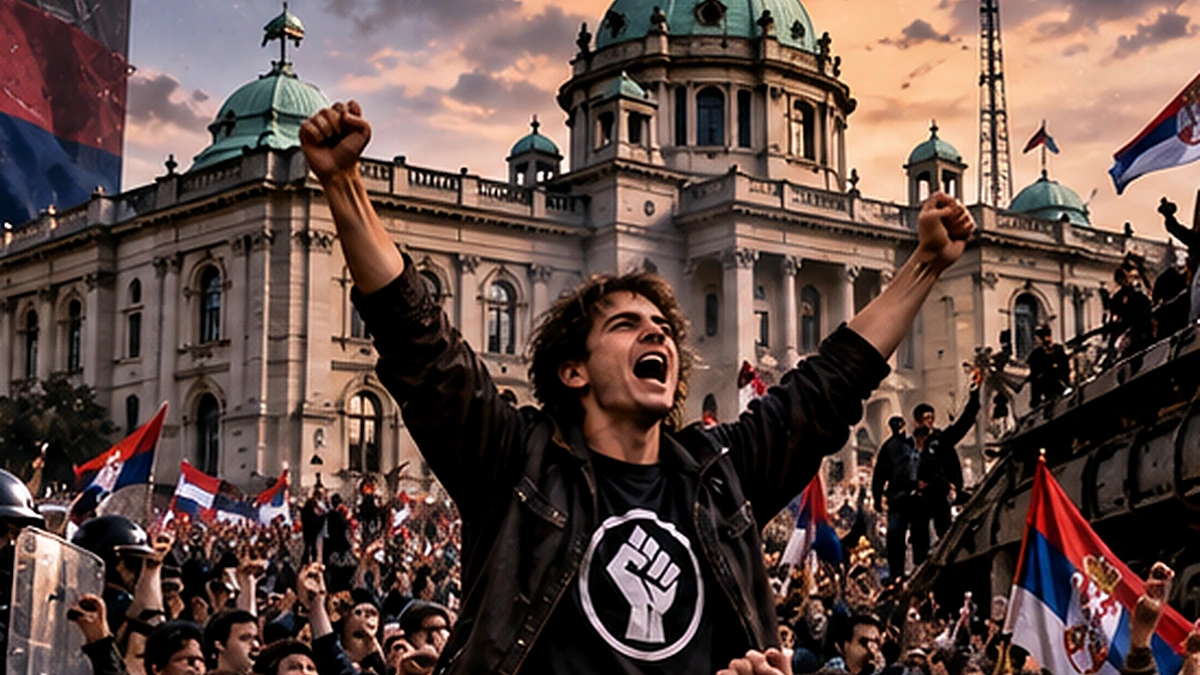
One year after the bombing
By autumn 2000, the Federal Republic of Yugoslavia had lost almost everything that had once constituted Yugoslav power. Slovenia and Croatia were independent. Bosnia was divided under the Dayton framework. Kosovo was under UN administration and KFOR security control. Montenegro under Milo Đukanović was pursuing an increasingly independent policy and challenging Belgrade over the character of the federation itself. Serbia was living with: international sanctions, infrastructure damaged by the 1999 bombing, a weak economy, political killings and disappearances, repression of the media, and a government that still controlled important parts of the police, state institutions, and national television.[1][2]
Milošević had survived: the wars in Croatia and Bosnia, Dayton, the protests of 1996–1997, the Kosovo war, 78 days of NATO bombing, and an ICTY indictment. In summer 2000 it still appeared possible that he might survive another election.
The constitution changes only months before the election
On 6 July 2000 the Federal Assembly adopted constitutional amendments. The president of the FRY would no longer be chosen by the federal parliament, but directly by voters. The presidency was reorganized as a four-year mandate with the possibility of re-election. The method of electing the federal Chamber of Republics was also changed.[1] OSCE/ODIHR later noted that the amendments were: adopted within hours, without broad public debate, and without the consent of Montenegro’s government.[1]
The Montenegrin government declared the changes illegitimate or unconstitutional and boycotted the federal elections.[1] This means that even the institutional basis of the September election was politically contested. There was another important point. Under the previous arrangement, Milošević’s term was expected to expire the following year. Instead of waiting, he called an early direct presidential election. It was a major political gamble.
The opposition had a problem it had carried for a decade
Milošević’s opponents were not weak only because the government repressed them. They were also divided. Opposition politicians differed over: personal rivalries, ideology, relations with the West, nationalism, Kosovo, Montenegro, and the future of Yugoslavia. Milošević had repeatedly survived during the 1990s partly because his opponents failed to present a unified alternative. That changed in 2000. Eighteen political parties joined in the coalition: Democratic Opposition of Serbia — DOS.[3] But one question remained: who would be the presidential candidate? Why Vojislav Koštunica?
The selection of Vojislav Koštunica was strategically important. He was not the sort of candidate whom the Milošević propaganda system could easily present as: Washington’s man, a supporter of NATO, or someone seeking to punish Serbia. Koštunica was: a nationally oriented Serbian politician, a critic of NATO’s bombing, a critic of the Hague Tribunal, and at the same time an opponent of Milošević’s authoritarian rule. U.S.-funded public-opinion research shown to opposition politicians in Budapest in 1999 suggested that Koštunica had far lower negative ratings than better-known opposition leaders such as Zoran Đinđić and Vuk Drašković.[3] Koštunica personally rejected U.S. financing for his Democratic Party of Serbia.
After the events he said he had not accepted U.S. support and believed it was unnecessary.[3] That does not mean his campaign received no indirect benefit from a broader infrastructure Western funders had helped build around: DOS, independent media, NGOs, polling, election monitoring, and Otpor’s mobilization network.[3][4] That distinction matters.
Otpor: a fist without a conventional leader
Otpor emerged in 1998 as a student movement opposing growing repression at the university and in public life. Its symbol: a black clenched fist. Its political advantage: it was not a normal political party. It did not have a single president whom the government could destroy politically. Its network was: young, decentralized, easy to replicate, and able to use humor and street theater against authority.[5][6] Otpor activists organized: stickers, graffiti, concerts, symbolic actions, mockery of the government, voter-turnout campaigns, and eventually the mass slogan: “He’s finished!” — Gotov je! The aim was not to write a detailed blueprint for the future state. The aim was to reduce the political question to one issue: should Milošević stay or go?
Repression did not stop Otpor from growing. The government took Otpor seriously. Human Rights Watch documented by spring 2000: mass short-term arrests, interrogations, beatings of individual activists, police harassment, and official propaganda branding the movement terrorist or foreign-controlled.[7][8] By September the climate was harsher. OSCE/ODIHR cited the Belgrade Centre for Human Rights as reporting that roughly 2,500 political activists had been detained since May, with particular pressure on: Otpor, the “It Is Time” voter-mobilization campaign, and CeSID, which was preparing to monitor the election.[1]
Human Rights Watch also reported hundreds of detained Otpor members and overwhelming pro-government media bias before the vote.[9] But repression could have the opposite political effect. Every student arrested over a sticker or piece of graffiti could become another example of a government frightened by political mockery. State media were not neutral.
RTS was a central political instrument of the government. In its pre-election analysis, OSCE/ODIHR cited independent monitoring indicating that roughly: 70 percent of politically significant news coverage on RTS was devoted to Milošević, the government, and the ruling coalition, without critical scrutiny. Parties outside the governing coalition received roughly: 9 percent of the time.[1] When Koštunica was mentioned, coverage was often negative.[1] But the government did not have a total information monopoly. There were: B2-92, local radio and television, opposition newspapers, municipal media networks in towns won by the opposition in 1996, satellite broadcasting, the internet, and person-to-person distribution.[2][10] Serbia in 2000 was not a completely sealed information system. That incompleteness mattered.
Western assistance: it was not a secret
This is where precision is essential. The United States and European governments did assist the opposition, independent media, and civil society. As early as January 1999 the U.S. State Department publicly said that millions of dollars were being directed to: democratization programs, independent media, NGOs, and institutions supporting democratic opposition forces.[11] After the NATO bombing, support increased. Programs were implemented through: USAID, the National Democratic Institute — NDI, the International Republican Institute — IRI, the National Endowment for Democracy — NED, and other organizations.[3][12] This is not a Milošević-era conspiracy claim. It is documented U.S. policy.
How much money? The numbers vary because sources count different periods and different programs. After Milošević’s fall, the Washington Post reported congressional allocations of approximately: $10 million for fiscal year 1999 and $31 million for fiscal year 2000 for direct democracy-support efforts.[3] Other contemporary accounts gave figures around: $77 million for a broader multi-year U.S. democratization effort in Serbia.[13] Congressional policy reviews also refer to larger packages of proposed and appropriated assistance, where one must distinguish: money actually spent before the election, money authorized but not yet spent,
humanitarian programs, aid to Montenegro, and post-Milošević assistance.[14] It would therefore be misleading to take one figure and write: “this is how much America paid for the revolution.” The programs were not one single fund for one single purpose. But the essential point is clear: politically significant assistance ran into tens of millions of dollars. What did the assistance actually finance?
Not just posters. Western support helped fund: independent media; political training for opposition parties; public-opinion research; campaign strategy; NGOs; election observation; parallel vote counting; communications equipment; and Otpor’s organizational network.[3][4][12] IRI reported in its 2000 annual report that it had helped train more than 15,000 opposition election-board members and assisted in designing a parallel vote-tabulation system.[12] IRI also supported Otpor’s get-out-the-vote efforts.[12] In March 2000 it financed travel for roughly two dozen Otpor activists to a seminar in Budapest where retired U.S. Army Colonel Robert Helvey taught strategic nonviolent resistance based in part on the work of Gene Sharp.[3] This matters. But: training in strategic nonviolent resistance is not the same thing as: military training for a coup. Stickers, spray paint, and focus groups.
U.S. assistance reached even apparently mundane things. The Washington Post documented funding for: thousands of spray cans, millions of stickers, public-opinion polling, focus groups, and training in political communications.[3] The slogan: “Gotov je!” therefore received outside logistical support. But the slogan worked only because a large part of Serbia’s population understood and accepted its message. Here lies the main limitation of theories that attempt to derive the outcome directly from funding. An outside donor can pay for: paper, radio, a survey, a seminar, a telephone, a bus, or an observer. It cannot automatically manufacture: millions of dissatisfied voters, a strike in the energy sector, or a police officer’s decision not to shoot into a crowd.
Did the CIA run Otpor? This article does not have enough evidence to make that claim. What is documented is: open U.S. government assistance, funding through USAID and NED, NDI and IRI programs, American political advisers, pollsters, and training in nonviolent organizing.[3][11][12] The Washington Post later reported that some American participants believed the CIA was active around the margins of the process, but they did not know exactly what it was doing and did not describe it as the leading force.[3] That is not enough to conclude: the CIA organized 5 October. Such a conclusion would require a different documentary chain:
orders, operational plans, funding records tied to command, or evidence of direct control. The material reviewed for this article does not provide such a chain. The article therefore stays with what can be shown: substantial foreign political and organizational support — yes; proof of direct foreign command of the mass uprising — no. The U.S. side did not conceal its objective either.
American policy was not neutral in the sense that: Washington did not care who won. In March 2000, Madeleine Albright publicly spoke about helping the Serbian opposition unite, supporting independent media, and expecting democratic change.[15] After 5 October, the U.S. State Department openly acknowledged that American support for democratic forces had contributed to the change.[16] A later official U.S. historical review stated that American diplomacy and targeted assistance helped the democratic transition, while also emphasizing the decisive role played by the people of Serbia themselves.[17] A significant conclusion follows: the United States wanted Milošević to be defeated politically and actively assisted forces trying to achieve that outcome. There is no need to hide this. There is also no need to turn it into proof of claims that the sources do not establish.
24 September: an election in a system that was not level
OSCE/ODIHR was denied permission to enter the country and therefore could not deploy a conventional observation mission.[1] That limitation must be stated clearly. Using domestic and other reliable sources, it nevertheless concluded that the election process was: fundamentally flawed and far from minimum standards of transparent and free elections.[1] Problems included: government control of election commissions; strong state-media bias; opaque voter lists; obstruction of observers; detention of activists; and reports of multiple voting and ballot-box stuffing.[1] CeSID did not receive official accreditation. Its offices were also targeted by police actions before the vote.[1][18] Despite this, the opposition created a parallel system for monitoring and collecting results. That would become decisive after polls closed.
The first official story: Koštunica leads, but has less than 50 percent. After the vote, the Federal Electoral Commission announced a result in which: Vojislav Koštunica was first, Milošević was second, but Koštunica was said not to have won the required absolute majority. A second round would therefore be held on 8 October.[19] OSCE/ODIHR said on 26 September that the result had been announced in an exceptionally non-transparent manner and demanded publication of results from individual polling stations.[19] Independent and opposition parallel counts claimed: Koštunica had already exceeded 50 percent in the first round.[19]
That was the core dispute. The opposition was not protesting because it believed Koštunica had more votes than Milošević. Even the authorities admitted he did. The dispute was: did he have enough votes to win in the first round? How many votes did Koštunica actually receive?
After Milošević lost power, revised official figures were published. According to the Federal Statistical Office, Koštunica received: 2,470,304 votes — 50.24 percent. Milošević received: 1,826,799 — 37.15 percent.[20] Koštunica therefore cleared the first-round threshold only narrowly according to the final official count. That is exactly why the counting dispute mattered so much. A few tenths of a percentage point separated: an immediate victory from a second round that the opposition refused to recognize as legitimate. Parallel vote tabulation: boring technique becomes political weapon.
One of the most important strategic changes in 2000 was that the opposition did not simply wait for the central election commission. Trained representatives at polling stations collected copies of local result sheets. These were: gathered, compared, and totaled independently of the official system.[12] Parallel tabulation does not change a ballot. But it changes the information structure. If the central commission publishes figures sharply inconsistent with thousands of signed local protocols, the opposition can point to: where the discrepancy allegedly occurred. That is politically much stronger than: “we think they stole the election.” Milošević: the opposition is foreign financed.
On 2 October Milošević addressed the country on television and accused the opposition of serving NATO and foreign money. He spoke of: foreign financial backing, strikes, unrest, and the danger of losing state sovereignty.[21] Part of that claim rested on fact: foreign funding did exist. But he converted that fact into a much broader political conclusion: if the opposition received outside support, its electoral result could not be an authentic expression of domestic political will. That step is not demonstrated by the fact of funding alone. Funding tells us something about: campaign capacity, organizational resources, and the interests of foreign states. It does not by itself tell us: how a particular citizen voted or why a miner joined a strike.
The opposition answers with a general strike
On 29 September the opposition begins a campaign of: strikes, civil disobedience, blockades, and demonstrations.[22] Tens of thousands turn out in different cities. Kragujevac: around 60,000. Novi Sad and Kraljevo: tens of thousands.[22] But the initial “general strike” was incomplete. Belgrade continued functioning. Shops stayed open. Transport continued. The government had not yet fallen. Then came Kolubara.
Kolubara: electricity becomes political power
The Kolubara mining basin supplied crucial lignite to Serbian thermal power plants. When the miners joined the strike, the protest was no longer merely: student, party-political, or urban. It reached directly into the country’s energy system. On 4 October riot police moved into the mine area to break the strike.[23] The miners appealed for support. Roughly: 25,000 supporters arrived.[23] The police withdrew or large numbers of officers decided not to escalate the confrontation.[23] This may have been more important than the image of the burning parliament the following day. Why? Because the government saw clearly for the first time: the order still existed, but the ability to enforce it could no longer be assumed.
A state depends on people who obey orders. This is a basic insight of nonviolent strategy. A president does not personally: run a power station; mine coal; drive buses; print newspapers; control every road; command every police officer directly; or stand behind every soldier. Political authority exists while enough people: obey, work, implement, transmit information, and accept the legitimacy of commands. Otpor’s strategy explicitly targeted these: pillars of the regime.[5][24] Kolubara showed that one of them had begun to fail.
October: the Constitutional Court deepens the crisis. Immediately before the mass march on Belgrade, the Federal Constitutional Court issued an extraordinary decision. It first annulled part of the electoral procedure. The court’s president, Milutin Srdić, then said the ruling meant: the September presidential election should effectively be rerun from the beginning and the planned second round on 8 October would not take place.[25] Under that interpretation Milošević could remain president until the end of his previous term. For the opposition this was not a compromise. It was an attempt: to reset an election it believed it had already won. Political tension reached its peak.
5 October: convoys toward Belgrade
From across Serbia, people began moving toward the capital in: buses, cars, trucks, tractors, and heavy work vehicles. Some police roadblocks were removed or broken through. In Belgrade: hundreds of thousands of people gathered. Contemporary estimates vary — around half a million, 700,000, or more.[26][27] The exact figure is not the essential point. This was no longer an ordinary opposition rally. The city filled with people who had come from: Čačak, Kraljevo, Kragujevac, Kolubara, and many other parts of Serbia. Why “Bulldozer Revolution”?
One of the most recognizable symbols of the day became a heavy construction vehicle pushing toward the RTS complex. Hence the name: Bulldozer Revolution. But the event was fundamentally a mass civilian mobilization, not a conventional military coup. There were: clashes with police, tear gas, entry into the federal parliament, fire and destruction inside the parliament building, entry into RTS, and damage to state property.[26] So the phrase: “an entirely nonviolent day” is not literally correct. A more precise description is: the broader opposition strategy was predominantly nonviolent, while the climax of 5 October also included violent incidents and substantial property damage. Why did the police not suppress the protest?
Because the coercive apparatus was no longer functioning as a unified structure. Police initially used tear gas and tried to block entry into the parliament.[28] But later: some officers stopped resisting; some withdrew; some mixed with the crowd; and key units did not launch the large-scale violent crackdown that would have been needed to retake control.[24][27] USIP later summarized that important parts of the police and military refused or declined to carry out orders to shoot at demonstrators.[24] This is one of the decisive points. A crowd can seize a building. A regime falls only when it is no longer clear who will retake that building on its behalf.
The army stays on the sidelines. The Yugoslav Army possessed enough firepower to make 5 October look very different. It did not become the regime’s principal instrument for mass repression. After the political break, Chief of the General Staff Nebojša Pavković publicly said the military would respect the will of the people.[29] Koštunica also met with the military leadership on 6 October. For understanding Milošević’s fall, this is more important than whether some legal argument remained available to him on paper. A political leader stays in power only if the most important institutions of the state: continue carrying out his decisions. By the evening of 5 October, that could no longer be assumed. RTS falls almost at the same time as parliament.
When protesters took over RTS, another pillar of the government collapsed. For years television had served as the main central filter of political reality. Its symbolic role was immense. The previous day the state could still say: the opposition is a minority; Milošević remains president; institutions are functioning. By the evening of 5 October, television images showed: the parliament in protesters’ hands; police withdrawing; the center of Belgrade filled with crowds; and Koštunica presenting himself as the elected president. Once the information monopoly broke, the regime’s ability to sustain its own account of events also weakened sharply.
The Constitutional Court changes direction again. The institutional chaos is especially visible in the Federal Constitutional Court. On 4 and 5 October its decision appeared to point toward annulling or rerunning the presidential election.[25] On 6 October, however, the court confirmed: Koštunica had been elected in the first round on 24 September.[29] This is highly significant. A formal institution that before the mass uprising appeared to be part of the mechanism extending the dispute accepted the opposition interpretation after the regime’s political collapse. Institutional legitimacy and real political power became intertwined.

Milošević concedes on 6 October
The day after the protests, Milošević met Koštunica. That same day he publicly conceded defeat and congratulated him.[30] Koštunica was sworn in as President of the Federal Republic of Yugoslavia on 7 October.[30] Milošević did not leave Serbia. He did not go into exile. He did not disappear. He said he would remain politically active as president of the Socialist Party of Serbia.[30] This matters. 5 October did not instantly erase every structure of the old system. Many: police officers, officials, security personnel, company directors, judges, business actors, and political networks remained where they were. The top of the regime changed. The state was not rebuilt overnight. Was the election result actually stolen?
The most careful answer is: the electoral process was so opaque and unequal that the initial official count could not simply be taken on trust. OSCE/ODIHR was unable to observe directly in-country because the government denied access.[1] It nevertheless documented: systemic opportunities for manipulation; the exclusion of opposition representatives; obstruction of CeSID; reports of irregularities; and an extremely biased media environment.[1][19] Parallel counts gave Koštunica more than 50 percent.[19] The revised official result after 5 October gave him: 50.24 percent.[20] It is therefore difficult to defend the proposition that the second-round requirement was an entirely uncontested technical consequence of the vote totals.
But the revised result also reveals something uncomfortable. Koštunica did not receive 70 or 80 percent. According to the final official result he cleared the first-round threshold: narrowly. That means the technical integrity of counting was crucial. If one changes slightly: the number of registered voters, the number of valid ballots, results from disputed polling stations, or treatment of ballots from Kosovo and Montenegro, the answer to: first round or second round can change. This article therefore separates two propositions: Milošević clearly lost to Koštunica, and the precise 50-percent threshold was the subject of a real and politically decisive dispute. Montenegro and Kosovo further complicate the picture.
These were federal elections. But Montenegro’s government boycotted them and did not assist in organizing them because it regarded the July constitutional changes as illegitimate.[1] In Kosovo, most of the Albanian population was outside an effective Belgrade electoral system and voting occurred under the unusual conditions created by UNMIK administration.[1] OSCE specifically warned about: the potential manipulation of votes from Kosovo and the unusual situation in Montenegro.[1] The 2000 federal result was therefore not a simple nationwide plebiscite of all FRY residents under equal conditions. It was above all a decisive political confrontation within Serbia — with federal constitutional consequences.
Was 5 October a coup d’état? If by coup we mean: a small group of military or security elites seizes power without an electoral mandate, 5 October fits poorly. Before the uprising there had been: a presidential election; an opposition candidate who received more votes than the incumbent; parallel vote counting; mass strikes; several days of civil disobedience; and hundreds of thousands of protesters.[19][23][26] The security services did not themselves seize political office. Instead:
key parts of the apparatus decided they would no longer defend the government with sufficient force. But the phrase: “an ordinary peaceful transfer of power after an election” is too clean as well. Parliament and RTS were physically occupied. Pressure from the crowd was direct. Institutions broke or changed direction under that pressure. The most descriptive formulation is: an electoral rupture that, through mass civil mobilization, turned into the collapse of the regime. Was it a Western-executed regime change?
The evidence supports the first part of some versions of that claim: Western governments wanted Milošević’s political defeat. They financed democratic organizations, media, opposition infrastructure, and Otpor. American advisers assisted polling, campaign strategy, election monitoring, and nonviolent organizing.[3][11][12][15] Those are facts. But the phrase: “Western-executed” implies something more: that domestic political action was essentially the implementation of an external operational plan. That would require different evidence. The sources reviewed for this article demonstrate major external assistance. They do not establish a chain of foreign command that explains: millions of votes; the Kolubara strike; tens of thousands of people breaking through roadblocks; or police and military structures declining to suppress the crowds.
The most accurate reconstruction is therefore: a domestic political uprising with substantial foreign material, organizational, and political support. That does not minimize foreign influence. It measures it more precisely. Would Milošević have fallen without foreign assistance?
History cannot test that counterfactual experimentally. There are serious arguments on both sides. Activists and Western organizers later emphasized that: polling data; organizational training; parallel vote tabulation; media support; and material infrastructure were highly important.[3][12] Some Otpor representatives said Milošević’s fall would have been harder and probably more dangerous without U.S. assistance.[3] At the same time, the domestic basis for the uprising was clear: wars; sanctions; economic stagnation; the NATO bombing; loss of effective control over Kosovo; repression; corruption; and exhaustion among large parts of the population.[2][24] Therefore: “without the United States, Milošević definitely would not have fallen” is not an established historical fact. Nor is: “foreign assistance had almost no role.” That also fails against the record.
Otpor was not the same thing as DOS. This distinction matters. DOS was: a coalition of political parties seeking to take state power through elections. Otpor was: a social-political movement focused on mobilizing people against Milošević’s regime.[5] Their interests converged in 2000. They were not the same organization. Otpor did not formally become the government on 6 October. DOS did not share Otpor’s decentralized activist model. Later events would also show that former allies quickly disagreed over: reform, privatization, the Hague Tribunal, security services, and relations between Koštunica and Đinđić. Unity against Milošević was not the same thing as unity about what should follow.
December confirms that 5 October was not just a one-day street result
On 23 December 2000 parliamentary elections were held in Serbia under substantially different conditions. This time OSCE/ODIHR deployed a standard observation mission. Its final assessment was that the election marked major progress and was largely consistent with international democratic standards.[31] DOS received roughly: 65 percent of the vote and 176 of 250 seats.[31] The Socialist Party of Serbia won: 37 seats. The Serbian Radical Party: 23. The Party of Serbian Unity:
14.[31] This result matters for interpreting 5 October. Even after Milošević had already been removed from the top of government and the election was run in a much more transparent environment, DOS won a very large majority. That does not prove every detail of the September election was clean. It does show that there was a broad domestic political base for changing the government. Zoran Đinđić becomes Prime Minister of Serbia.
After the December DOS victory, political change reached the republican level. Zoran Đinđić became Prime Minister of Serbia in January 2001. This begins the next phase of the story. Koštunica and Đinđić had been allies in removing Milošević. They did not share the same political philosophy. Koštunica was: more legally conservative, more reserved toward the West, more skeptical of rapid reforms, and strongly critical of the ICTY. Đinđić favored: faster institutional and economic reforms, more rapid integration with Western political and financial structures, and more pragmatic cooperation with outside institutions. The conflict temporarily hidden by anti-Milošević unity would soon reappear.
What can be stated with a high degree of confidence? Milošević’s government constrained political competition before the election. Media repression, pressure on opposition groups and NGOs, harassment of Otpor, and severe state-media bias are well documented.[1][2][7][9] OSCE did not directly observe the September election inside Yugoslavia. The government denied access; OSCE’s assessment relied on other credible sources.[1] The electoral system offered substantial opportunities for manipulation.
This included commission control, voter lists, observer access, and centralized counting.[1] Koštunica received more votes than Milošević in every relevant count. The central dispute concerned whether Koštunica crossed the 50-percent first-round threshold.[19] The revised official result gave him 50.24 percent. Milošević received 37.15 percent.[20] DOS was a coalition of 18 parties. Opposition unity was one of the major changes in 2000.[3]
Koštunica was not simply a pro-American candidate. He criticized NATO and the ICTY and personally rejected direct U.S. support for his party.[3] Western financial and organizational assistance was real. USAID, NDI, IRI, NED, and others supported democracy organizations, media, election monitoring, and Otpor.[3][11][12] Otpor received organizational and material assistance from abroad. Including training in strategic nonviolent resistance and voter-turnout campaigns.[3][12]
That does not prove direct foreign operational command of the protests. The reviewed sources do not establish such a chain. The Kolubara strike was a major turning point. Police failed or declined to break the strike after thousands of supporters arrived.[23] Hundreds of thousands gathered in Belgrade on 5 October. Precise crowd estimates vary.[26][27] The day was not literally completely nonviolent.
There were clashes, fires, and damage to parliament and RTS.[26][28] Key police and military structures did not carry out a mass crackdown. That was decisive for the government’s collapse.[24][29] Milošević conceded on 6 October. Koštunica was sworn in on 7 October.[30] The December parliamentary election confirmed broad political support for change. DOS won 176 of 250 seats under substantially more transparent election conditions.[31]
What was 5 October?
If we use only one word, part of the history disappears. A revolution? Yes, in the sense of a sudden collapse of a regime under the pressure of mass mobilization. An electoral revolution? Yes, because the core dispute concerned recognition of an election result. A nonviolent revolution? Predominantly in strategic terms, but not without physical clashes and destruction. A regime change aided by the West? Yes, if that means Western governments deliberately and materially supported actors seeking Milošević’s political defeat. A Western operation that created the uprising from outside? The reviewed evidence is not sufficient for that stronger claim. The fullest account requires all these elements to be examined together. Why did the regime fall specifically in 2000?
Because enough things happened at the same time. The opposition unified. It selected a candidate who was harder to discredit. Civil society had a national network. Independent media still existed. Foreign assistance increased technical and organizational capacity. Parallel vote counting reduced the central commission’s ability to remain the only source of truth about the result. Miners struck at the energy core of the state. People from outside Belgrade came to the capital in mass numbers. Police did not choose mass shooting. The army did not take over the streets. Within hours it became clear: the state still had a president, but no longer possessed a unified mechanism capable of enforcing his authority. That is the moment at which power stops being merely a legal title.
But Milošević’s fall does not yet answer the question: who got Yugoslavia? For many citizens, 5 October meant: the end of repression, opening the country, the possibility of freer elections, the end of political isolation, and hope for more normal life. For Western governments, it meant: the removal of the man associated with nearly all the major Balkan crises of the 1990s, and an opportunity to integrate Serbia into European and international institutions. For the new political elite, however, it also meant: taking over a state with an extremely weak economy, damaged infrastructure, sanctions, old debts, state and socially owned enterprises, banks in distress, and powerful informal links between politics, security services, and business. The next question in the series is therefore: what happens to property after the revolution? Who buys companies?
What does “market reform” mean? What happens to workers? What happens to socially owned property? What happens to banks? And did privatization mean modernization, a sell-off — or different things in different companies? That question leads into Privatization After 2000: Where Did Social Ownership Go, and Who Acquired Serbia’s Enterprises?
Sources and further reading
- OSCE/ODIHR. Elections in the Federal Republic of Yugoslavia, 24 September 2000 — Preliminary Findings and Conclusions. Primary institutional assessment of the pre-election environment and electoral process. It explicitly states that OSCE/ODIHR was denied entry for an observation mission and documents constitutional changes, Montenegro’s boycott, media bias, repression, voter-list problems, and opportunities for manipulation. Source
- Human Rights Watch. Curtailing Political Dissent: Serbia's Campaign of Violence and Harassment Against Government Critics, April 2000. Documents repression of opposition actors, media, NGOs, students, and critics of the government. Source
- Michael Dobbs, Washington Post. “U.S. Advice Guided Milosevic Opposition,” 11 December 2000. Detailed post-event reconstruction of U.S. financing, polling, opposition strategy, Otpor training, and Koštunica’s relationship to U.S. assistance. Used as documented journalism rather than as a neutral government record. Source
- Valerie J. Bunce & Sharon L. Wolchik. “Defeating a Dictator at the Polls and in the Streets,” in Defeating Authoritarian Leaders in Postcommunist Countries, Cambridge University Press. Academic analysis of opposition unity, civil society, election monitoring, and international assistance. Source
- United States Institute of Peace. Whither the Bulldozer? Nonviolent Revolution and the Transition to Democracy in Serbia, 2001. Analysis of Otpor’s nonviolent strategy, civil mobilization, and the breakdown of obedience inside security institutions. Source
- United States Institute of Peace. Strategic Nonviolent Resistance Key to Serbia's Revolution, PeaceWatch, December 2000. Contemporary presentation of Otpor methods and activist testimony. Source
- Human Rights Watch. “Harassment Escalates Against Serbia Government Critics,” 26 April 2000. Documents violence and pressure against opposition groups, media, and Otpor. Source
- Human Rights Watch. “Escalating Repression in Serbia,” June 2000. Documents hundreds of arrests of Otpor activists and official propaganda portraying the movement as terrorist. Source
- Human Rights Watch. “Serbia: Elections Not Free and Fair,” 14 September 2000. Pre-election documentation of detentions, unequal media access, and government control of election commissions. Source
- Human Rights Watch. Curtailing Political Dissent — Suppression of Independent Journalism. Documents Serbia’s public-information law, financial pressure on independent media, the seizure of B92, and the survival of local opposition media networks. Source
- U.S. Department of State. “U.S. Support For Democratization In Serbia,” 13 January 1999. Primary U.S. source openly acknowledging multimillion-dollar support for democratization, independent media, and NGOs supporting democratic opposition. Source
- International Republican Institute. 2000 Annual Report. IRI reports support for Otpor, voter-turnout campaigns, training of more than 15,000 opposition polling-board members, and development of parallel vote tabulation. Source
- RFE/RL. “U.S. Democratization Program,” 28 September 2000. Contemporary reporting on a broader U.S. program often summarized at about $77 million; used only to explain why different total figures appear in public debate. Source
- Congressional Research Service. Serbia: Current Issues and U.S. Policy, 2000/2001. Documents U.S. legislation, proposed and appropriated democracy assistance, and sanctions policy. Source
- Madeleine K. Albright / U.S. Department of State. “Building a Europe Whole and Free,” 7 March 2000. Primary source for public U.S. policy supporting opposition unity and independent media. Source
- Madeleine K. Albright / USAID Democracy Conference, 30 November 2000. Primary source acknowledging U.S. assistance to opposition forces and domestic election monitors while emphasizing the role of Serbia’s population. Source
- U.S. Department of State, historical review. Retrospective institutional account stating that U.S. diplomacy and targeted assistance contributed to the 2000 political change while emphasizing domestic agency. Source
- National Democratic Institute. Serbia 2000 Election Watch. Documents pressure on CeSID, confiscation of equipment, and wider pre-election repression. Source
- OSCE/ODIHR. “Yugoslav election results must be published in detail,” 26 September 2000. Contemporary source on the initial official count, the planned runoff, and parallel counts suggesting a first-round Koštunica victory. Source
- Vreme / Federal Statistical Office, Elections 2000. Reproduction of the final official result: Koštunica 2,470,304 votes or 50.24%; Milošević 1,826,799 or 37.15%. Source
- RFE/RL. “Milosevic Addresses The Country,” 2 October 2000. Contemporary account of Milošević’s speech connecting the opposition with foreign financing and NATO. Source
- RFE/RL Newsline, 3 October 2000. Documents the general strike/civil-disobedience campaign and mass protests in several Serbian cities. Source
- RFE/RL Newsline, 5 October 2000. Documents Kolubara: police deployment, roughly 25,000 supporters arriving, and the police retreat. Source
- United States Institute of Peace. Whither the Bulldozer? Used also for analysis of collapsing pillars of the regime and refusal to implement repressive orders within parts of the police and military. Source
- RFE/RL. “Yugoslavia: High Court Ruling Voids Presidential Elections” and “Chief Justice Tells RFE/RL The Election Is Void,” 4–5 October 2000. Contemporary documentation of the Federal Constitutional Court’s unusual sequence of rulings. Source 1 Source 2
- RFE/RL. “Yugoslavia: Analysis — Serbia's Swift Revolution,” 6 October 2000. Contemporary reconstruction of the mass mobilization of 5 October and the collapse of power. Source
- Joshua A. Tucker. “Enough! Electoral Fraud, Collective Action Problems, and Post-Communist Colored Revolutions.” Perspectives on Politics, 2007. Academic analysis of electoral fraud, collective action, and protest-size estimates. Source
- RFE/RL Newsline, 5 October 2000, and later regional chronologies. Police used tear gas; protesters entered parliament and RTS, where fire and destruction occurred. Source
- RFE/RL Newsline, 9 October 2000. The Federal Constitutional Court confirmed Koštunica’s first-round victory on 6 October; the military leadership said it would respect the voters’ will. Source
- RFE/RL. “Yugoslavia: Kostunica To Be Sworn In As President,” 7 October 2000. Milošević conceded on 6 October and congratulated Koštunica; Koštunica was sworn in the next day. Source
- OSCE/ODIHR. Serbia, Parliamentary Elections, 23 December 2000: Final Report. The December election marked major progress and was largely consistent with international standards; DOS received 2,404,758 votes and 176 of 250 seats. Source