Depleted Uranium After 1999: What NATO Used, What UNEP Found, and What We Actually Know About Health Risk
What NATO used, what UNEP found on the ground, and what health research actually says about the risks of depleted uranium.
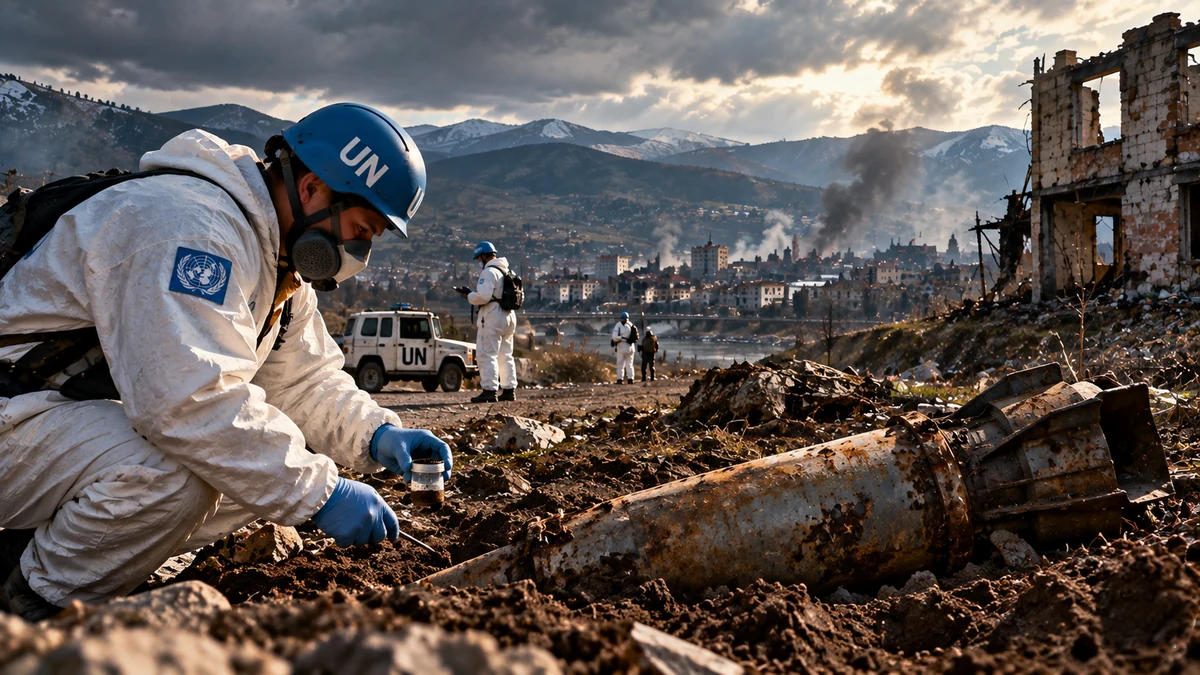
First: what exactly is depleted uranium?
Depleted uranium — DU — is a by-product of uranium enrichment. Natural uranium contains several isotopes. During enrichment, the fraction of uranium-235 is increased in material intended for reactors or other uses. The material left over contains less uranium-235. It is therefore: less radioactive than natural uranium, but not non-radioactive.[1] WHO describes DU as having roughly 60 percent of the radioactivity of natural uranium.[1] Its principal military value, however, is not its radioactivity. It is extremely dense. That makes it effective as a material for: armor-piercing ammunition, and in some cases armor itself. When a penetrator strikes a hard target, part of it can: fragment, burn, oxidize, and form very fine particles. At that point, the health question changes.
Why can DU be dangerous if it is less radioactive than natural uranium?
Because DU involves two different types of hazard: chemical toxicity as a heavy metal and internal radiological exposure. Outside the body, DU’s alpha radiation is relatively weakly penetrating. But if fine particles enter the body through: inhalation, ingestion, or a wound, the situation changes.[1][2] WHO notes that only a small proportion of ingested uranium is absorbed into the bloodstream. For inhalation, the most important factors are: particle size and chemical solubility.[2] More soluble compounds enter the bloodstream faster. The kidneys then become the principal organ at risk from chemical toxicity.[1][2] Less soluble particles can remain in the lungs for longer periods. They may create less immediate chemical exposure but a longer period of internal radiological exposure. The question is therefore not: “Is DU radioactive or chemically toxic?” It is both. The relevant issue is the actual dose and route of exposure.
The person at greatest risk is not necessarily someone living ten kilometers away. The highest potential exposure applies to people who were: very close to a hard-target impact; inside or near a damaged vehicle shortly after it was hit; breathing aerosol or smoke; carrying wounds containing DU fragments; or handling penetrators and ammunition debris after the war.[1][2] WHO’s Kosovo assessment specifically noted that soldiers directly present at attack sites were far more likely to have been exposed to metallic uranium and oxide dust than the general population.[3] For an average resident, the more important question is: does DU remain in surface soil, become resuspended as dust, or migrate into groundwater, food, or drinking water? That is why UNEP went into the field after the war.
How much DU was used in Kosovo?
In 2000 NATO informed the United Nations that it had used approximately: 31,000 30-mm depleted-uranium rounds during Operation Allied Force.[4] They were used primarily by U.S. A-10 aircraft, whose GAU-8 cannon is designed to attack armored vehicles. In 2001 NATO publicly stated that most of the ammunition had been used in western Kosovo: between Peć/Peja and Prizren, with a high concentration around Đakovica/Gjakova.[5] Each penetrator contained about 300 grams of DU.[6]
Multiplying roughly 30,000–31,000 rounds by about 300 grams gives an order of magnitude of: about 9 tonnes of DU.[6] That is a useful figure. But it should not be interpreted as: nine tonnes of radioactive dust evenly spread over Kosovo. A large proportion of penetrators: remained intact, embedded in the ground, missed hard targets, or remained as larger fragments. Only part of the material aerosolized when striking hard targets. locations — but UNEP did not inspect all of them.
NATO provided UNEP with data for 112 sites in Kosovo where DU ammunition was believed to have been used.[7] In November 2000 UNEP conducted detailed field investigations at 11 locations. The sites were selected on the basis of: reported quantity of DU use, proximity to population, environmental characteristics, and field safety.[7] At those sites the team collected roughly: 340–350 samples of soil, water, vegetation, dust, and ammunition remnants.[7][8] This is an important limitation. UNEP did not conduct a centimeter-by-centimeter survey of all of Kosovo. It carried out a targeted field investigation of selected relevant sites. What did UNEP actually find?
The answer was not: nothing. At eight of the eleven locations, investigators found: slightly elevated local radiation at impact points, or DU ammunition remnants, including penetrators and sabot fragments.[7] At some sites, intact or partially intact DU penetrators were still: on the surface, or close to it, more than a year after the war.[7] UNEP therefore recommended: searching for and removing penetrators; restricting access to confirmed contaminated micro-sites; informing local populations; safe handling of recovered material; and continued monitoring of water and the environment.[7][9] These are serious precautionary recommendations. If the hazard had been entirely imaginary, such measures would not have been necessary. What did UNEP not find?
It did not find evidence of: widespread surface contamination throughout Kosovo.[9][10] Contamination was generally localized in the immediate vicinity of impact points. On the basis of those measurements, WHO assessed the probability of health effects for the general population as: very low, except where people might have direct contact with impact sites or where DU could migrate in meaningful quantities into: groundwater, the food chain, or drinking water.[11] This is very different from saying: “DU is completely safe.” The more accurate statement is: measured contamination was localized and generally low, so expected risk to most of the population was low, while particular sites required cleanup and precaution.

Serbia and Montenegro: the problem was not confined to Kosovo
After the first Kosovo assessment, UNEP conducted an additional mission in Serbia and Montenegro in 2001. It examined: five targeted sites in Serbia, one in Montenegro, and one struck military vehicle.[12] UNEP confirmed: widespread but low-level local DU contamination at five of the six inspected sites.[13] It also documented important longer-term issues: penetrators corrode; particles can become resuspended in air; and future migration into groundwater is possible.[12][13] UNEP therefore again recommended: monitoring, cleanup, public information, and long-term surveillance of water.[12] The issue was therefore not exclusively “Kosovo-related.” DU had also been used in southern Serbia and at one site in Montenegro.
How many rounds were used outside Kosovo? The data are less precise than the approximately 31,000-round Kosovo figure. Scientific studies derived from UNEP investigations estimate that approximately: 3,000 to 5,000 additional DU rounds were fired at targets in Serbia.[14] One targeted site is documented in Montenegro. This article therefore does not manufacture a single absolutely precise number for the whole FRY where the source record does not justify one. The safest formulation is: around 31,000 rounds in Kosovo, plus several thousand additional rounds in southern Serbia and limited use in Montenegro. What happens to DU in soil?
This was one of UNEP’s important findings. An intact penetrator is not stable forever. It corrodes. Later Balkan studies found that DU penetrators buried in soil gradually lose mass.[15] That means: uranium oxides and other compounds can migrate into the surrounding soil. Under unfavorable hydrogeological conditions, part of the material may reach: groundwater. This was not a major problem at every site. But it was not purely theoretical either. UNEP later documented DU in groundwater at a contaminated site in Bosnia and again recommended alternative water sources and monitoring where contamination was confirmed.[15] So: “there was no regional catastrophe” does not mean “there was no local environmental problem.” Plutonium in samples: another story that became larger than the measurement.
In 2001 UNEP also reported traces of plutonium and uranium-236 in some DU samples. That produced new headlines. But isotopic analyses showed that the amounts were very small. UNEP concluded that the finding made only a minor difference to the overall radiological assessment and did not constitute grounds for immediate alarm.[3] In some soil samples, plutonium could also be explained by historical global fallout from atmospheric nuclear testing during the 1960s.[16] The claim: “DU ammunition was full of plutonium” is therefore not an accurate scientific description. A better formulation is: trace isotopic impurities were detected in some samples, but at levels that did not substantially alter the risk assessment.
The “Balkan syndrome”
Around 2000 European media began using the expression: Balkan syndrome. The trigger was a series of cases involving: leukemias, lymphomas, and other cancers among soldiers who had served in Bosnia and Kosovo. The issue received especially strong political attention in Italy. The concern was understandable. Military personnel may have been: at impact sites; near damaged armored vehicles; and in contact with contaminated dust. Their potential exposure could therefore be significantly higher than that of an average civilian resident. A number of epidemiological studies followed. What did studies of European veterans show?
The results did not confirm a simple story of a DU-caused cancer epidemic. A large Italian cohort including more than 71,000 veterans of Bosnia and Kosovo showed: lower overall mortality than the general population, and lower or comparable cancer mortality relative to military controls.[17] Another Italian analysis of soldiers deployed to Bosnia and Kosovo likewise did not show a general increase in cancer incidence.[18] A Danish cohort of Balkan veterans did not confirm an excess of leukemia or testicular cancer.[19] A later systematic review and meta-analysis of several European cohorts found: that overall cancer incidence was generally not higher than expected,
although certain individual cancer types in particular cohorts produced statistical signals that were not consistent across countries.[20] This matters. If ordinary Balkan DU exposure produced a large, general carcinogenic effect, one would expect a more consistent epidemiological pattern. So far, there is not one. But “no demonstrated increase” is not the same as “proven zero risk”.
Epidemiological studies have limitations. Veterans tend to be: younger, healthier than the general population, and very differently exposed. This is the known healthy soldier effect. In addition, early studies often lacked: individual measurements of DU exposure; precise information on who was present at which impact site; or sufficiently long follow-up for cancers with long latency periods.[21] The scientific conclusion is therefore not: risk is absolutely zero. It is: there is currently no consistent epidemiological evidence of increased overall cancer risk caused by Balkan DU exposure. That is more cautious. And more accurate.
What does WHO say today?
WHO’s current DU information also relies on the later UNSCEAR assessment from 2018. Its conclusion is that, given the available studies and their methodological limitations, there is no convincing evidence for an association between DU exposure and clinical outcomes, including cancer or congenital malformations.[22] This is one of the strongest current international scientific summaries. But the wording matters: no convincing evidence. Not: it is biologically impossible for DU to cause harm. Uranium is a heavy metal. Sufficient internal exposure has known chemical and radiological hazards. The controversy is primarily about: the doses actually received in realistic Balkan exposure scenarios and whether an epidemiological effect can be detected.
What about Kosovo itself?
One of the more interesting recent studies, published in 2020, examined hematological malignancies in Kosovo from 1995 to 2015. The authors reported: increasing incidence after the war; and greater increases in some regions with higher densities of DU use.[23] That is a relevant signal. It should not be ignored. But the authors themselves did not conclude that they had proved causation. They explicitly stated that the findings: require further investigation and do not permit a definitive causal conclusion linking DU to the rise in hematological malignancies.[23] Why? Because geographic correlation between more DU and more disease does not remove other possible factors: age structure; changes in disease registration; diagnostic capacity; migration; other wartime contaminants; smoking; viruses; economic change; and other environmental exposures. This is a classic epidemiological problem.
What about Serbia and post-1999 cancer increases?
Claims also exist in Serbia that after the bombing there was an increase in: leukemia, lymphoma, solid tumors, or overall cancer incidence. But proving that DU specifically caused such an increase requires more than demonstrating: cancer rates later rose. One would need: geographic linkage to DU sites; individual or at least strong exposure estimates; appropriate control populations; adjustment for smoking, aging, and diagnostic changes; long-term follow-up; and a coherent biological pattern. Robust population studies of that kind remain limited for Serbia. This article therefore does not infer: NATO DU caused Serbia’s cancer increase from national cancer trends alone. That would be a stronger conclusion than the current evidence supports.
Italian court judgments and compensation: legal standards are not epidemiological standards
In Italy, numerous veterans brought cases seeking: compensation, recognition of occupational illness, and victim-of-duty status. In some cases courts recognized: a causal or contributory link, or applied a legal presumption in favor of soldiers who had served in hazardous environments.[24] That is important and should not be ignored. But an individual legal decision is not equivalent to: population-level epidemiological proof that DU causes a specific cancer. Italian case law itself remains complex. In 2024 and 2025 administrative courts were still debating:
whether a soldier must prove actual causation, whether legislation creates a presumption in the soldier’s favor, and how much weight should be given to international epidemiological evidence.[25] It is therefore possible for both of the following to be true: a veteran may be entitled to compensation under a legal evidentiary standard; and the scientific literature may still not establish a general causal cancer effect of DU in Balkan cohorts. In 2018 an Italian parliamentary commission also triggered controversy.
An Italian parliamentary commission in 2018 sharply criticized military authorities and argued that exposure to DU and other hazardous factors had contributed to soldiers’ illnesses. That did not end the scientific debate. One expert whose work was cited publicly denied that his research demonstrated a simple causal relationship: DU → cancer.[26] This is a useful example of the difference between: a political-investigative conclusion and epidemiological proof. Both may be relevant. They are not the same thing.
The biggest mistake: talking only about radioactivity
In public debate, the word: uranium is so powerful that everything else can disappear. But in the case of DU, chemical toxicity is at least as important as its radioactivity.[1][2] If someone inhales a sufficiently large amount of a soluble uranium compound, the main acute problem may be: the kidneys. If someone inhales poorly soluble fine oxide particles, these may remain in the lungs for a long time and create: longer-term internal radiological exposure.[2] If a penetrator remains buried and slowly corrodes, the issue becomes: local soil contamination and potentially water contamination. The slogan: “DU is only weakly radioactive, therefore it is harmless” is not scientifically sound. Neither is: “DU is nuclear weaponry, therefore it must cause a mass cancer epidemic.”
Is depleted uranium a nuclear weapon? Not in the ordinary legal or technical sense. DU ammunition does not produce a nuclear explosion. Its effect comes from: penetrator density, kinetic energy, and material behavior on impact. But it does contain radioactive material. The description: “a conventional kinetic weapon containing a radioactive and chemically toxic material” is more accurate than either: “a nuclear bomb” or “an ordinary harmless piece of metal.”
What is the fairest scientific conclusion?
Based on the evidence available today, several points can be stated. DU creates real localized environmental contamination. At impact sites investigators found: penetrators; fragments; uranium oxides; and measurable isotopic traces.[7][12] Direct or intensive exposure is medically relevant. Therefore: cleanup, removal of penetrators, protective equipment, public information, and water monitoring are sensible and scientifically justified measures.[7][12] What has not been established with sufficiently strong data is: that Balkan DU use caused a widespread cancer epidemic in the general population or among veterans.[20][22] That is a much narrower conclusion. And that limitation matters.
What can be stated with high confidence?
NATO used approximately 31,000 DU rounds in Kosovo. Primarily through A-10 aircraft.[4][5] This represented roughly nine tonnes of DU penetrator material. The estimate follows from roughly 300 grams per penetrator.[6] DU was also used in southern Serbia and Montenegro. UNEP inspected five sites in Serbia and one in Montenegro.[12][13] UNEP found real localized contamination.
Ammunition remnants and elevated local measurements were documented at impact sites.[7] UNEP did not find widespread regional contamination across Kosovo. Contamination was generally localized around impact points.[9][10] Penetrators corrode and can contribute to long-term soil or water contamination. That is why long-term monitoring remains reasonable.[12][15] WHO does not treat DU as harmless material. It is a heavy metal with both radiological and chemical toxicity.[1][2]
The highest individual risk involves direct exposure. Especially inhalation of impact aerosol, wounds, and direct handling of ammunition remnants.[2][3] International epidemiological studies of veterans have not shown a consistent general increase in cancer. This applies across several European cohorts.[17][18][19][20] WHO/UNSCEAR do not currently find convincing evidence linking DU to cancer or congenital malformations.
While acknowledging methodological limitations in the available research.[22] Individual studies in Kosovo have reported possible epidemiological signals. But they do not themselves establish causation.[23] Italian compensation judgments exist. But the legal evidentiary standard in an individual case is not the same as population epidemiological proof.[24][25] Local risk and a broad epidemic are different questions. The former is documented. The latter has not been convincingly demonstrated. What remains open?
The main open question is not: did DU remain in the environment? It did. Nor: can a sufficiently large internal dose be harmful? It can. The genuinely open question is: how many people actually received medically significant doses, and can any resulting effect today be detected statistically and separated from all other wartime, environmental, and lifestyle factors? For now the answer is: precaution is justified for individuals with high or direct exposure; for populations as a whole, the data do not show a large, consistent effect. That is not the same as saying: “nothing happened.” And it is not the same as saying: “a DU-caused cancer epidemic has been proven.”
The war of 1999 damaged much of Serbia’s infrastructure and removed Belgrade’s effective control over Kosovo. But Milošević remained in power for more than another year. The next major turning point came on 5 October 2000. Elections. Protests. Strikes. The Kolubara mine. The DOS opposition. The role of NGOs. Western financial support for the opposition. Otpor. Police units deciding they would no longer defend the regime at any cost. And a question that remains interpreted in Serbia in two very different ways: was 5 October a popular democratic revolution, or a Western-supported regime change? That question continues in 5 October 2000: Elections, Otpor, Foreign Assistance, and the Fall of Slobodan Milošević.
Sources and further reading
- World Health Organization. “Depleted uranium — Radiation and health.” Current WHO overview: DU is a by-product of enrichment and roughly 60% as radioactive as natural uranium; it has both radiological and chemical toxicity. WHO also references the UNSCEAR 2018 assessment. Source
- WHO. Depleted uranium: sources, exposure and health effects, 2001. Foundational technical review of exposure pathways, absorption, renal chemical toxicity, and internal radiation exposure. Source
- WHO Regional Office for Europe. Report of the WHO Depleted Uranium Mission to Kosovo, 2001. Concludes that soldiers directly at attack sites were the population most likely to inhale DU dust; general-population exposure was much less likely. Source
- United Nations / UNEP. “NATO confirms to United Nations use of depleted uranium during Kosovo conflict,” 22 March 2000. NATO reported approximately 31,000 DU rounds used in Operation Allied Force. Source
- NATO. Briefing on Depleted Uranium, 10 January 2001. NATO gives the figure of roughly 31,000 rounds in Kosovo, used mostly in the western part of the province and around Đakovica. Source
- Di Lella et al. / IAEA-linked analysis. Isotopic analysis of samples from Kosovo. Reports approximately 30,000 rounds, about nine tonnes of DU, and roughly 300 grams per penetrator. Source
- UNEP / United Nations. “Depleted Uranium Sites in Kosovo Detailed by UNEP,” 11 January 2001. 112 NATO-identified locations; UNEP inspected 11 and collected roughly 340 samples; eight had elevated local readings or DU remnants. Source
- Sansone et al. “Radioecological survey at selected sites hit by depleted uranium ammunitions during the 1999 Kosovo conflict.” Science of the Total Environment 281 (2001). Field and laboratory results from the UNEP mission. Source
- UNEP. Depleted Uranium in Kosovo: Post-Conflict Environmental Assessment, 2001. Primary environmental field assessment: localized contamination, residual penetrators, and recommendations for cleanup, access restrictions, and monitoring. Source
- Durante et al. “Depleted uranium residual radiological risk assessment for Kosovo sites.” Finds no evidence of widespread DU contamination across Kosovo based on UNEP measurements. Source
- WHO. “WHO makes Recommendations on Depleted Uranium and Health in New Monograph,” 26 April 2001. Local contamination within tens of meters of impact points and low expected general-population risk under measured conditions, except for direct contact or meaningful migration into food or water. Source
- UNEP. Depleted Uranium in Serbia and Montenegro — Post-Conflict Environmental Assessment, 2002. Survey of five Serbian sites, one Montenegrin site, and one military vehicle; findings on corrosion, airborne particles, and possible groundwater migration. Source
- United Nations / UNEP. “UNEP confirms low-level DU contamination in Serbia and Montenegro,” 27 March 2002. Low-level local contamination confirmed at five of six inspected sites; precautionary monitoring and cleanup recommended. Source
- Actinide analysis of a depleted uranium penetrator from a 1999 target site in southern Serbia. Estimates approximately 3,000–5,000 additional DU rounds fired at targets in Serbia. Source
- UNEP. Later Balkan DU findings: penetrator corrosion, cases of migration toward groundwater, and recommendations for continued monitoring and alternative water supplies where contamination is confirmed. Source
- Danesi et al. Isotopic analysis of uranium and plutonium in Kosovo samples; trace plutonium in some soils was also consistent with historic global weapons-test fallout and contributed little to total radiological risk. Source
- Capocaccia et al. “Mortality in Italian veterans deployed in Bosnia-Herzegovina and Kosovo.” European Journal of Public Health 26(4), 2016. 71,144 veterans; no excess overall or cancer mortality. Source
- Peragallo et al. “Cancer surveillance in Italian army peacekeeping troops deployed in Bosnia and Kosovo, 1996–2007.” Overall cancer incidence was not elevated; individual excesses were interpreted cautiously. Source
- Storm et al. “Depleted uranium and cancer in Danish Balkan veterans deployed 1992–2001.” No confirmed excess of leukemia or testicular cancer; overall incidence was not increased. Source
- Cancer incidence among NATO peacekeeping forces in Bosnia and Kosovo: systematic review and meta-analysis, 2022. Overall cancer incidence was below expected levels; individual signals were heterogeneous and did not form a clear DU-specific pattern. Source
- Review of epidemiological studies of cancer risk among Gulf War and Balkans veterans, 2008. Notes the absence of strong individual exposure estimates and the young age of several cohorts for long-latency diseases at the time of early follow-up. Source
- WHO / UNSCEAR 2018 summary. WHO states that UNSCEAR did not find convincing evidence linking DU exposure to any cancer type or congenital malformations on the basis of available studies. Source
- Latifi-Pupovci et al. “Incidence of haematological malignancies in Kosovo — A post ‘uranium war’ concern.” PLoS One, 2020. Reports increased hematological malignancies and a regional signal in more exposed areas; the authors emphasize that causation is not established. Source
- Italian court/administrative jurisprudence on DU exposure. Individual judgments have granted compensation or applied presumptions favoring soldiers who served in contaminated operational environments. Source 1 Source 2
- Consiglio di Stato, 2025. Illustrates ongoing legal disagreement over causation standards and expressly notes that international epidemiological literature does not establish a definitive overall cancer excess among Balkan peacekeepers. Source
- ANSA. “Uranium caused cancer — probe,” 7 February 2018. Summarizes strong conclusions of the Italian parliamentary inquiry while also reporting an expert’s objection that his work did not prove a simple DU-to-cancer causal chain. Source