Who Owned the Factory? Yugoslav Workers’ Self-Management
How social ownership, workers’ councils and the market worked, and how much real power an ordinary worker had under Yugoslav self-management.
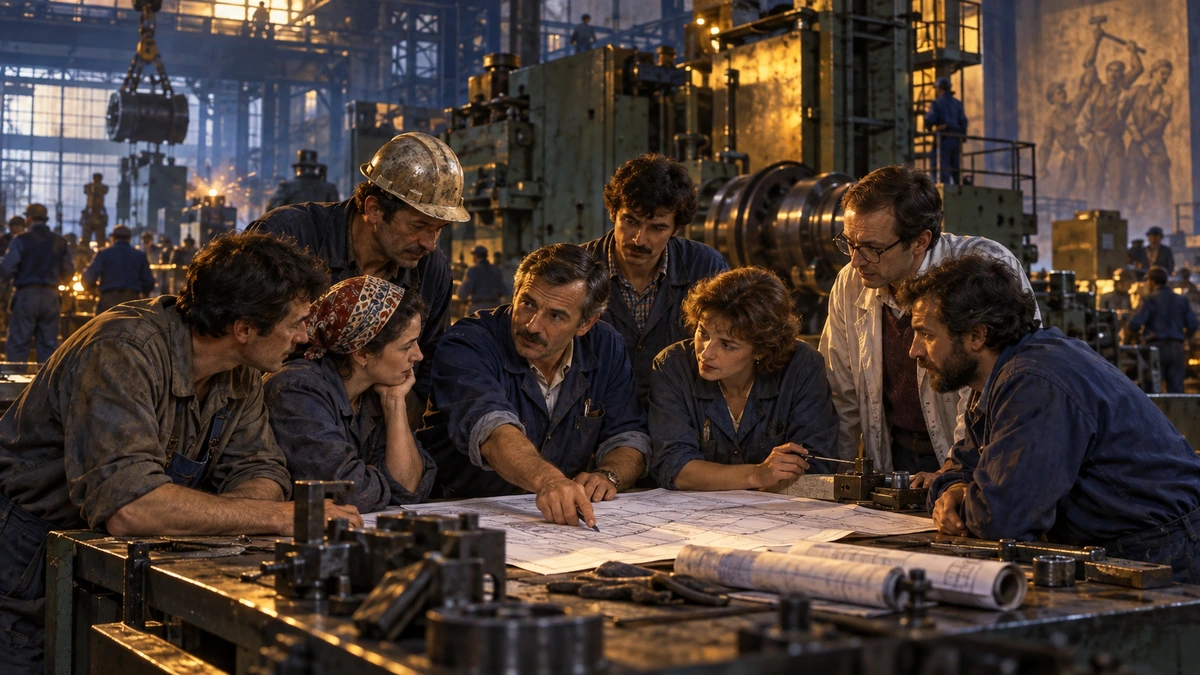
A factory that was neither state-owned nor private
If we ask today who owns a company, we expect a fairly simple answer. An individual. A family. Shareholders. A fund. The state. In socialist Yugoslavia, the answer was different. A large part of the economy was based on social ownership.
This did not simply mean that the factory belonged to the state. After moving away from the Soviet model, the Yugoslav legal and economic system insisted precisely on the distinction between state ownership and social ownership. The means of production were supposed to belong to society as a whole, while the workers in an enterprise were supposed to have the right to manage them, decide on business matters, and participate in the distribution of the income created.[1][2] This was one of the most unusual property arrangements of the twentieth century. The worker did not possess a share that could be sold. The director was not the owner of the company.
The state did not formally treat the enterprise as a classic state-owned corporation. At the same time, none of these actors could simply take a machine, a piece of land, or a factory and treat it as private property. The system was trying to answer a major question of socialist politics: Is it possible to abolish the private capitalist without simply replacing him with a state bureaucracy? The Yugoslav answer was called workers’ self-management.
Why did Yugoslavia choose its own path at all?
The first postwar Yugoslavia looked far more similar to the Soviet model than it did later. After 1945, the state nationalized a large part of the economy, introduced central planning, and built heavy industry on the model of other socialist countries. The break came in 1948. The conflict between Tito and Stalin and Yugoslavia’s expulsion from the Cominform did not mean only foreign-policy isolation. The Yugoslav leadership also had to differentiate itself ideologically from the system from which it had just been excluded.
In the following years, a process of decentralization began. The idea was both political and economic: power was to be gradually shifted downward — from the central state to enterprises, municipalities, and other forms of local decision-making. Workers’ self-management was supposed to be a socialist alternative both to Soviet centralism and to the private capitalist enterprise.[3][4] In 1950, the basic law that introduced workers’ councils into the economy was adopted. Experimental workers’ councils had existed even before that, but 1950 is usually regarded as the institutional starting point of Yugoslav self-management.[3][5] The system then never stopped changing.
That is important. “Yugoslav self-management” was not a single finished system completed in 1950 and then left unchanged for forty years. The state repeatedly reformed it, expanded it, decentralized it, and reorganized it. In that sense, Yugoslavia was a large social experiment in constant becoming.
What did the workers’ council actually do?
The core of the system was the workers’ council. In an enterprise, workers elected representatives who took part in decision-making on important business questions. Across different periods and reforms, specific powers changed, but the basic idea remained similar: enterprises were not supposed to be run by distant ministries; key decisions were supposed to be made by people connected to the working collective. Workers’ councils decided or participated in deciding on:
- the company’s business policy,
- production and development plans,
- investments,
- the use of created income,
- criteria for personal incomes,
- the organization of work,
- the appointment or selection of management structures,
- connections with other enterprises.
In theory, the director was also responsible to self-management bodies and did not hold the position of a private owner.[2][5] This is an important difference from the classic capitalist enterprise. In a capitalist company, a worker generally sells labor to the company, while the final managerial right belongs to the owner of capital or to the owner’s representatives. The Yugoslav system wanted to reverse that relationship. Capital was not supposed to have an owner who, by virtue of ownership, decided over the labor of others. Workers, as a collective, were supposed to manage the means that belonged to society.
What did “social ownership” mean?
This is perhaps the hardest part of the Yugoslav system to understand. The 1974 Constitution was very clear on this point: social means were not the property of the state, an enterprise, a group of workers, or an individual. No one was allowed to acquire property rights over means that were defined as socially owned.[1] Workers had the right to use and manage those means. But they did not own them privately.
If a factory created a surplus, that surplus therefore could not be treated in the same way as the profit of a private firm, which the owner simply takes away. Part of the generated income went to personal incomes, part to investment and the development of the enterprise, and part through various contribution systems to broader social needs. In theory, the message was simple: the factory belongs to society, and it is managed by those who work in it. But within that formula lay one of the system’s biggest problems. If no one is the classical owner of capital, who is ultimately responsible when capital is used badly? Who bears the loss? Who has the right to say no to an investment? Who ensures that an enterprise does not spend today what it will need tomorrow? These questions followed Yugoslavia until its end.[6]
Self-management did not mean abolishing the market
A common image of a socialist economy is that the state determines how much of something will be produced, to whom it will be sold, and at what price. Yugoslavia gradually moved quite far from that model. Enterprises sold products on the market. They competed for customers. They imported and exported. They signed contracts. They cooperated with western and eastern markets and with countries of the non-aligned world. After the economic reforms of 1965, the role of the market was strengthened further, central control reduced, and enterprises were given greater autonomy in conducting business and integrating into the international economy.[7][8]
That is why the Yugoslav model was often described as market socialism. This was not a free market in today’s sense. The state still set important rules, social plans still existed, the credit system still had a political and developmental function, and many prices and capital flows were not completely free. But the Yugoslav enterprise was much more autonomous than the typical enterprise in a centrally planned socialist state. That combination was the model’s special feature: social ownership + workers’ management + market + planning. Not pure capitalism. Not a Soviet planned economy. Something else. What did the worker decide about his or her income?
In the self-managed enterprise, the distribution of created income was also important. Workers and their bodies participated in deciding how much of the disposable income would be allocated to personal incomes and how much would remain for development, investment, and other purposes. This created a strong sense that the enterprise’s result did not belong to someone outside the company. If the company performed well, employees could expect higher personal incomes or improvements in the common standard. If it performed badly, the collective had a direct reason to worry. Theoretically, this was one of the system’s key advantages. The worker was not supposed to be merely a cost to the enterprise. The worker was also supposed to be a participant in managing the result of labor.
But again, a conflict appeared between the present and the future. If the working collective decides on the distribution of income, it has a natural incentive to allocate more to current personal incomes. Yet the enterprise also needs investment for long-term competitiveness. Economic literature on Yugoslavia therefore discussed extensively whether a self-managed enterprise created sufficiently strong incentives for capital accumulation and long-term investment.[6][9] This was not only a theoretical problem. In an economy undergoing rapid technological development, today’s higher wage can become tomorrow’s obsolete production line.
Did the ordinary worker really have power?
Here we have to distinguish the constitution from the factory gate. On paper, workers’ rights to decide were very broad. In practice, the picture was more complicated. Directors, engineers, economists, and other specialists had more information about business operations than the ordinary worker. They understood balance sheets, contracts, export markets, banking relations, and technological requirements.
That gave them real influence. Studies of self-management found that professional management often shaped the proposals on which the workers’ council then decided. Because of their information and expertise, the director and expert services could in practice exercise an influence comparable to or greater than that of the formally highest self-management bodies.[10] The structure of participation was not fully egalitarian either. A study of political participation in four Yugoslav republics found that the more educated and higher-positioned employees were disproportionately active in workers’ councils. Membership in the League of Communists was also an important factor in broader political participation.[11]
So it is not precise to say: “Workers directly ran the factories.” A more precise formulation is: workers had institutionalized rights of participation and decision-making, but actual power inside enterprises was not evenly distributed. That distinction is crucial. Self-management was not merely propaganda. Workers’ councils existed, elections existed, discussions existed, and large numbers of people participated in these structures over decades. But the formal right to vote does not mean that everyone has the same quantity of information, confidence, political connections, or actual influence. Where was the Party in all of this?
Yugoslavia was a self-managed society, but it was not a multi-party political democracy. That contradiction is important. The 1974 Constitution defined the League of Communists of Yugoslavia as the leading ideological and political force of socialist society.[1] So a worker in a factory could participate in a workers’ council, discuss investments and income distribution, and vote on many questions, while at the state level not being able to choose between competing political parties in the modern multi-party sense.
Self-management democracy and political monopoly existed at the same time. The Party structure also had influence inside enterprises. But that influence was not necessarily the same as a direct order from a ministry. The Yugoslav system was much more decentralized and negotiated than the simple image of a totally centralized socialist state suggests. That is precisely why real local participation could exist within it, while at the same time a political boundary existed that could not be crossed. That duality is one of the key features of the Yugoslav experience.
The reform of 1965: more market, more autonomy — and more risk
The economic reform of 1965 was one of the most important moments in the Yugoslav model. The purpose of the reforms was to increase efficiency, strengthen market signals, reduce direct state control, and give enterprises greater economic autonomy.[7] But more market also means a larger difference between the successful and the unsuccessful. Companies in more developed areas, close to western markets and with a stronger technological position, were better able to use the new opportunities than companies in the less developed parts of the federation.
Slovenia and Croatia were economically more strongly connected to Western Europe. The less developed republics and Kosovo had a different economic structure and different developmental problems. Decentralization therefore increased not only enterprise autonomy, but also the importance of republic-level and regional economic interests. This later becomes very important for understanding Yugoslavia. A system that wanted to transfer power downward also had to answer the question of how to hold together the economy of a country in which developmental differences were very large.

The 1970s: self-management moves even deeper
The 1974 Constitution and then the 1976 Associated Labour Act decentralized the system even further. The basic unit became the Basic Organization of Associated Labour — commonly known by the acronym TOZD, or in English-language literature BOAL. The idea was simple. A large factory could be too large for thousands of workers to participate meaningfully in everyday decision-making. The enterprise was therefore supposed to be divided into smaller economically measurable units in which workers could more easily understand the results of their work and actually participate in management.[12] These units then linked together into larger work organizations. Decisions between them were supposed to rest on self-management agreements, social compacts, and negotiation. On paper, this was a radical democratization of the economy.
But the price was exceptional complexity. A large company could become a network of more autonomous units, councils, delegates, agreements, and mutual internal settlements. In its analysis of the system, the World Bank found that such an arrangement could lead to lengthy negotiations and slow decision-making. Later analyses also pointed to enterprise fragmentation and unclear responsibility for capital.[12][13] Yugoslavia thus encountered a paradox: the more it tried to disperse power, the more coordination the system required. Self-management extended beyond the factory as well.
The Yugoslav idea was not limited to production. Self-management principles also spread into local communities and public services. Healthcare, education, culture, social activities, and other spheres developed various forms of self-managing interest communities. Local government too was organized around municipalities, delegations, and local communities. The idea was that society should not be governed only by a distant state administration, but that people, through work organizations and local communities, should participate in deciding issues that directly affected their lives.[1][4] For the ordinary person, this meant a rather different idea of the enterprise and the community. The enterprise was not just the place you arrived at six or seven in the morning and left after eight hours. It was often an important social center.
It built housing. It organized holidays. It supported sports clubs. It financed cultural activities. It provided scholarships. It took part in local infrastructure. This intertwining of the workplace and social life helps explain why the collapse of a large enterprise after the breakup of Yugoslavia meant much more than the loss of production for many towns. What disappeared was an institution around which part of local life had been organized.
Successful companies were not small socialist workshops
When people imagine self-management, they may picture a small factory in which a few dozen workers gather and vote on production. But the Yugoslav economy also created large, technologically advanced, and internationally active enterprises. Energoinvest from Sarajevo operated on many foreign markets and connected industry, engineering, and technology. Companies from Slovenia, Croatia, Serbia, Bosnia and Herzegovina, and other republics exported to Western Europe, the Soviet Union, the non-aligned world, and elsewhere.
Research on large Yugoslav enterprises shows that self-management did not necessarily mean rejecting modern management. Some companies used Western business methods and even outside consultants while preserving the formal system of workers’ participation.[14] This is important for understanding the model. Yugoslavia was not trying to build an economy without directors, economists, engineers, and business knowledge. It was trying to build an economy in which professional management would not be the same thing as ownership of capital.
Where did the system fail?
Self-management had real strengths. It gave workers an institutional voice. It reduced direct central state management of enterprises. It increased local and enterprise autonomy. It allowed the development of a relatively open market socialism. But it also had serious problems. Responsibility for capital was unclear. Because capital had no classical owner, it was harder to determine who ultimately carried responsibility for the long-term value of the enterprise. Enterprises wanted to protect employment. This was socially understandable, but it could also mean overemployment and slower adjustment when productivity declined.
Investments were not always efficient. Banks, enterprises, municipalities, and republics were politically and economically intertwined. Credit was not always directed only where investment was most productive.[6][13] Professional cadres had an informational advantage. The worker had a vote, but the director and the economic office often had the information. The system became administratively complex. Especially after the reforms of the 1970s, the multiplication of TOZDs, agreements, delegations, and coordination created a new bureaucracy — precisely the one decentralization was supposed to reduce.[12][15]
Macroeconomic coordination became more difficult. Greater autonomy for enterprises and republics weakened the federation’s capacity to conduct a unified economic policy. Already in the 1970s, the World Bank pointed to the conflict between broad decentralization and effective macroeconomic coordination.[7] This does not mean that self-management caused all of Yugoslavia’s later problems. But it does mean that a model creating great local autonomy simultaneously produced problems of coordination, responsibility, and economic balance.
Was the worker an owner?
No. That is important to say clearly. The Yugoslav worker was not the owner of a share in the factory in today’s sense. He or she could not sell a “share.” When leaving the enterprise, the worker did not take away a part of its capital. Nor did his or her children inherit that share. But neither was the state the classical owner. And the director was not the owner.
The worker’s right was above all a right of management, participation in decision-making, and a share in income on the basis of labor. This is essential for the later story of privatization. When socially owned enterprises acquired concrete owners in the 1990s, this was not merely an ordinary sale of state property. The very legal logic of property changed. Something that previously, by definition, belonged neither to the state nor to a private person now had to be given a new legally defined owner. That opens a large question: Who had the moral and economic right to become the owner of capital created over decades by generations of employees? The workers? The state? Pension funds? The citizens? New private investors? Foreign capital? The answer to that question, after the breakup of Yugoslavia, determined the fate of a vast part of former social property. We will return to that later in the series.
Why could a person feel more connected to the enterprise? If the enterprise was not simply an investor’s property, the relationship of the employee to the company could also be different. It was not necessarily ideal. People complained about directors, bureaucracy, wages, and unfairness just as they do everywhere else. But the company was presented as something collective. The worker had a formal right to ask where the created income was going. He or she could participate in electing the council. Through representatives, he or she could influence business decisions. The enterprise often financed part of social life.
That is why the expression “our firm” did not always mean only a place of employment. It could also contain a sense of collective belonging. Of course, that feeling did not exist equally strongly for everyone or at all times. But without it, it is hard to understand scenes from the late 1980s and 1990s in which workers defended enterprises in times of crisis, went on strike over their losses, or after privatization felt that something had been taken from them that had previously been theirs in some sense. Legally, they were not owners. But socially, for decades, they had been taught that they were self-managers of social capital. That is an important difference.
An experiment that cannot be reduced to a slogan
Yugoslav self-management can easily be reduced today to one of two slogans. The first says: “Workers ran the factories themselves and the system worked.” The second says: “It was all just a communist performance and the Party decided everything.” Both miss the point. Self-management was a real institutional system. Workers’ councils existed. Workers participated. Enterprises had far greater economic autonomy than in most Soviet-bloc countries. Social ownership was legally different from classical state ownership. The Yugoslav economy used the market and was deeply integrated into international trade.
But the limits were also real. The Party retained a political monopoly. Professional and managerial elites had disproportionate influence. Regional interests kept growing stronger. The decision-making system could become slow and complicated. The question of responsibility for capital was never fully solved. So the Yugoslav model was something much harder either to dismiss or to celebrate as a whole. It was an attempt to give a person at the workplace more power over work without the state giving up the socialist social order. In some respects, it went further than almost any other socialist country. In others, it remained limited by the same political structure out of which it emerged. Why does this matter for the rest of our story?
Because without understanding social ownership, we cannot understand the breakup of Yugoslavia either. We cannot understand privatization. We cannot understand why the question “whose factory is it?” became so important after 1990. We cannot understand why workers often experienced the sale of an enterprise differently from how employees today would experience the sale of a private corporation. And we cannot understand the economic crisis of the 1980s. Self-management helped build a system in which an ordinary person could feel that the enterprise was not merely the place where he or she sold time. But the same system had problems with investment, responsibility for capital, coordination, and regional differences. In a period of economic growth, these contradictions were easier to manage.
When growth stalled, they became dangerous. The next part therefore takes a step back and looks at the other great particularity of Yugoslavia: how a socialist state became one of the leading countries of the Non-Aligned Movement — and why its position between East and West gave it such unusual economic and political freedom for decades.
Sources and further reading
- Constitution of the Socialist Federal Republic of Yugoslavia (1974). Especially the basic principles and Articles 10–14 and 98–109. Source
- International Monetary Fund. “Postwar Developments in Money and Banking in Yugoslavia.” IMF Staff Papers, 1970. Description of the decentralized economy, social ownership, workers’ councils, and directors’ accountability to workers’ councils. Source
- Singleton, Fred. “The beginnings of self-management.” In: A Short History of the Yugoslav Peoples. Cambridge University Press. Originally 1985. Source
- Contemporary European History. “Participation and Volunteering in Liberal and Socialist Democracies: Female Volunteer Firefighters in the Central European Borderlands during the Cold War.” Cambridge University Press, 2026. Historical overview of decentralization and the introduction of self-management in 1950. Source
- Workers' Self-government in Yugoslav Industry. World Politics. Documents the basic law of 1950 and the structure of workers’ councils, management boards, and directors. Source
- Uvalić, Milica. Investment and Property Rights in Yugoslavia: The Long Transition to a Market Economy. Cambridge University Press, 1992. Source
- World Bank. Yugoslavia: Self-Management Socialism and the Challenges of Development, Report No. 1615a-YU, 1978/1979. Development of the system, the 1965 reform, decentralization, and problems of macroeconomic coordination. Source
- Singleton, Fred. “The 1960s – a decade of reform.” In: A Short History of the Yugoslav Peoples. Cambridge University Press. Source
- Estrin, Saul. Self-Management: Economic Theory and Yugoslav Practice. Cambridge University Press. Source
- Yusuf, Shahid. Understanding Self-Management in Yugoslavia. World Bank, Domestic Finance Studies No. 44, 1977. Empirical review of the actual role of directors, expert management, and workers’ councils. Source
- Verba, Sidney & Shabad, Goldie. “Workers' Councils and Political Stratification: The Yugoslav Experience.” American Political Science Review 72(1), 1978, 80–95. Source
- World Bank. Yugoslavia: Adjustment Policies and Development Perspectives, Report No. 4519-YU, 1983. Description of the BOAL/TOZD system and the purpose of decentralization after the 1974 constitution. Source
- World Bank. Yugoslavia — Economic Memorandum / self-management and planning materials. Review of BOALs, social ownership, self-management agreements, and coordination problems. Source
- Nationalities Papers. “A Nonaligned Business World: The Global Socialist Enterprise between Self-Management and Transnational Capitalism.” Cambridge University Press. Cases of Energoinvest, Pelagonija, international competition, and the use of modern management. Source
- Nationalities Papers. “Provincial, Proletarian, and Multinational: The Antibureaucratic Revolution in Late 1980s Priboj, Serbia.” Discusses the practical effects of the reforms of the 1970s, bureaucratization, and the experience of the self-managed enterprise. Source