The Yugoslavia People Still Remember
What do the data support about memories of work, school, healthcare, housing and social security in Yugoslavia — and where does nostalgia need correction?
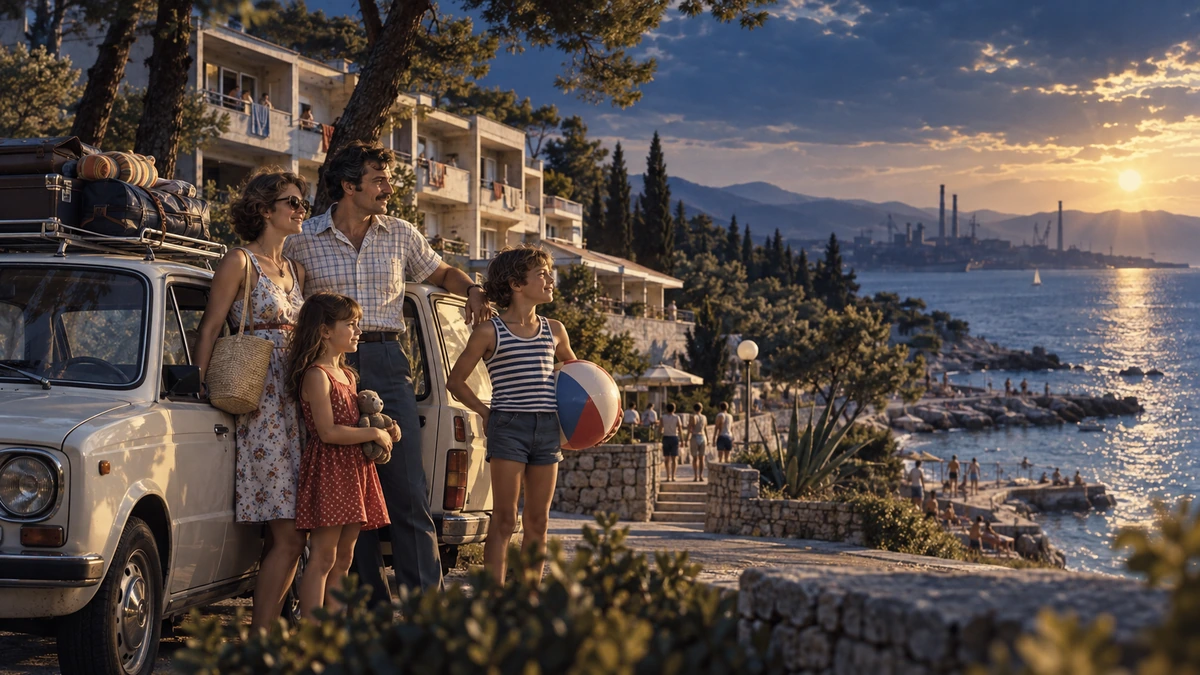
What remains when a country disappears?
When you ask people who spent their youth in Yugoslavia what life was like back then, they often do not begin with Tito, the Party, the constitution, or geopolitics. They remember their first job. An apartment. Their first car. The sea. A workers’ holiday resort. A school that was within reach even for the child of a worker or a peasant. The local health center. Neighbors. Childhood spent outside the apartment. And the feeling that after school there would be work, and after work there would be a realistic chance to build a home and a family.
Today, such memories are often dismissed with a single word: nostalgia. Of course nostalgia exists. People often remember their youth more warmly than the years that came later. Memory selects, emphasizes, and forgets. In addition, Yugoslavia was not the same experience for everyone. Life in Slovenia was not the same as life in Kosovo, Macedonia, or the poorer rural parts of Bosnia and Herzegovina. The position of an urban professional, an industrial worker, a peasant, an unemployed young person, or a political opponent of the system was not the same either.
But that still does not settle the question. What if part of the memory of Yugoslavia is not merely nostalgia for youth? What if there is also a material basis for the feeling that, for a large part of the population, the world was socially safer, more predictable, and oriented toward the gradual improvement of living conditions? That can be examined. Not in order to turn Yugoslavia into a lost paradise. And not in order to ignore political repression, economic mistakes, regional inequalities, or the crisis of the 1980s. But because a country cannot be understood only through its politicians, generals, and ideologies. We first have to understand the lives of the people who lived in it.
Within a single generation, the way of life changed profoundly
Postwar Yugoslavia began as a war-ravaged and predominantly agrarian country. For 1953, the World Bank reported that the agricultural population made up roughly 61 percent of Yugoslavia’s population. By the 1981 census, that share had fallen to roughly 19 percent.[1] Behind those figures lies a process that is difficult to feel from today’s distance. Millions of people left the traditional agrarian world and entered industry, construction, transport, public services, and the wider service sector. Cities grew. Factories, roads, electric networks, schools, health centers, and housing estates were built.
The statistical overview of the Federal Statistical Office shows that the number of employed workers increased from around 1.17 million in 1947 to approximately 6.50 million in 1985. Over the same period, the number of employed women increased from about 337,000 to 2.45 million.[2] That does not mean development was smooth or free of serious problems. But it does mean that one generation could, within its own lifetime, experience a transition from a world in which a large share of the population was tied to agriculture and modest living conditions to an industrial and far more urbanized society. That sense of direction is crucial to understanding later memory. For much of the postwar period, people could observe their material world changing.
A job was more than a monthly wage
Work was one of the pillars of the Yugoslav social system. A workplace did not mean only a personal income. It was often linked to social and health insurance, workplace housing funds, meals, holiday bonuses, vacations, education, recreation, and other forms of collective standard of living. The 1974 Constitution of the SFRY guaranteed the right to work, material security during temporary unemployment, and strong legal protection of employment. It also established a regular workweek of no more than 42 hours and a minimum of 18 working days of paid annual leave.[3] At the same time, it is important not to turn this into a myth about a country without unemployment.
For 1981, the World Bank reported major regional differences. The ratio of registered job seekers to the estimated labor force was approximately 1.4 percent in Slovenia, around 17 percent in Kosovo, around 17.4 percent in Macedonia, and about 8.6 percent for Yugoslavia as a whole.[1] So the statement “everyone in Yugoslavia got a job” is not precise enough. But the opposite claim — that job security was merely a later myth — does not hold either. For a person already employed in the social sector, losing a job was legally and structurally far more difficult than in a more flexible labor market. And this is where one of the differences between statistics and lived experience begins.
It is not the same thing to live in a system where unemployment is possible, or to live in a system where one expects every day that losing a job could threaten one’s housing, healthcare, and entire life plan. What modernization means can be seen in a single kitchen.
Large economic words are abstract. Everyday life is more tangible. In 1968, about 25 percent of Yugoslav households had a refrigerator. By 1983, around 82 percent did. A washing machine was present in around 11 percent of households in 1968, and around 61 percent in 1983. A passenger car was present in about 8 percent of households in 1968, and in about 35 percent by 1983.[2] These are not merely objects.
A refrigerator changes the way food is bought and stored. A washing machine drastically reduces the amount of physically demanding household labor. A car changes the distance between home, work, relatives, and holidays. For younger generations, such things are taken for granted. For the generation that acquired them for the first time, they were very concrete proof that life was improving. Here too, differences were large. Slovenian households were generally better equipped than the Yugoslav average. But the direction of change at the federal level was unambiguous: goods that had been a privilege after the war became part of mass consumption within a few decades.[4]
Housing was not just real estate
Yugoslavia built housing intensively for decades. The model was not a simple system in which “the state gave everyone an apartment.” There was a combination of private construction, socially owned apartments, occupancy rights, workplace housing funds, and more favorable loans for building or purchasing housing. For the period 1953–1985, the Federal Statistical Office reported approximately 3.5 million completed dwellings. Around 1.3 million were built with social funds, and around 2.3 million with citizens’ own funds.[2] More important than the number alone is the change in living conditions.
Average dwelling size increased from about 41 m² in 1951 to about 62 m² in 1984. Average floor space per person increased from 8.7 to 17.9 m². Around 36 percent of dwellings had electricity in 1951; by 1984, nearly 96 percent did. The share of dwellings with piped water rose from roughly 34 to 69 percent between 1971 and 1984, and the share with a bathroom from roughly 25 to 54 percent.[2] But this system had another side as well.
In 1983, around 921,000 requests for apartments or housing loans were pending with organizations and communities responsible for allocation, and only roughly one fifth were resolved. Waiting lists and unequal access were therefore very real.[2] So it is important to say both things. The housing system improved living conditions for millions of people and treated housing as a social question. At the same time, housing was not an unlimited good, and access to it was not automatic or always fair.
School as a path upward
One of the least disputed achievements of postwar modernization was education. Using Yugoslav census data, the World Bank found that the share of illiterate people fell from roughly 25 percent of the population in 1953 to 4.9 percent in 1981. Among young people aged 10 to 19, it fell in the same period from 12.2 to 1.1 percent.[1] That is a major social shift. The expansion of primary, secondary, and higher education meant that the child of a peasant or an unskilled worker was no longer automatically tied to the life path of his or her parents.
Such a child could become a technician, nurse, teacher, engineer, or doctor. This does not mean the society was free of privilege, personal connections, or political influence. Educational levels also differed considerably between republics. But it does mean something important for family memory: for a large part of the population, education became a real instrument of social mobility. So when someone says they “had the opportunity to study,” that is not necessarily just a sentimental assessment. For a large part of the postwar generation, the broadening of access to education was a historically measurable process.
The doctor was getting closer
A similar shift took place in healthcare. Federal statistical data show that in 1952 there were about 2,565 inhabitants per doctor, while by 1983 that number had fallen to around 509. In 1983, Yugoslavia had nearly 37,000 doctors and about 128,000 hospital beds.[2] The result is also visible in broader demographic indicators. For Yugoslavia, the World Bank reported an increase in life expectancy from around 63 years in 1960 to around 70 years in 1980. Infant mortality in the same period fell from around 92 to 33 deaths per 1,000 live births.[5]
Of course, these outcomes cannot be attributed to the healthcare system alone. Life expectancy is also shaped by nutrition, housing conditions, hygiene, education, infrastructure, and overall economic development. But that is precisely the point. Yugoslav modernization was not only a matter of rising industrial production. It changed the broader human environment. And here too, regional differences matter. Healthcare infrastructure and access to doctors were not the same in Ljubljana, Zagreb, Belgrade, and in remote rural areas of the less developed republics. Progress was substantial, but equality was not perfect.
The sea was not only for the rich
On family photographs from Yugoslavia, the Adriatic appears again and again. A tent. A trailer. A Fićo. A bus. A workers’ holiday resort. Children on the beach.
Paid annual leave was introduced as early as 1946. Over the following decades, the rights connected to it expanded, and in 1965 a holiday allowance was introduced as well. Trade unions, enterprises, and other organizations developed a network of workers’ and holiday homes, together with subsidized options for transport and accommodation.[6] Research on Yugoslav social tourism shows that workers’ holiday resorts were not reserved only for managers or the best-paid employees. They were used by workers of different qualification levels, family members, retirees, and other eligible groups.[6]
The scale of domestic tourism grew sharply over the decades. Historical tourism statistics indicate roughly 4.3 million domestic tourist arrivals in 1960, 7.1 million in 1970, and around 11.7 million in 1980.[7] That does not mean every Yugoslav went to the seaside every single year. But it does mean that holidays were built into a system of rights and social infrastructure for a much broader part of the working population. So the memory “we could go to the sea” is not necessarily just an idealized image. For many families, it described a real change in their standard of living.

Yugoslavia was not the Soviet Union
Yugoslavia was a socialist state, but after the split with Stalin in 1948, its everyday life did not resemble the systems of the Soviet bloc. The country developed a self-managed economic model, pursued a policy of non-alignment, and gradually allowed its citizens considerable mobility across western borders. Many Yugoslavs traveled to Italy, Austria, and other West European countries. Many also worked there. Gastarbeiter migration reveals the dual nature of the Yugoslav story. On the one hand, the possibility of working abroad was proof of the country’s relative openness. On the other hand, the mass departure of workers to the West showed that the domestic economy could not provide equally well-paid work and equal opportunities for everyone. So the gastarbeiter phenomenon is neither proof of total success nor proof of total failure. It is part of Yugoslavia’s contradiction.
Another Yugoslavia also existed
Nothing above erases the political nature of the state. The SFRY was not a multi-party liberal democracy. The League of Communists held a political monopoly, and the political sphere had clear limits. There was political repression, censorship, privilege, and the persecution of individuals whom the authorities, in different periods, considered dangerous. Goli Otok remains the best-known symbol of that side of the state.
Likewise, the economic system was not free of major weaknesses. Investment was not always rational. Enterprises were not always efficient. Regional disparities were large. Debt became an increasingly important problem during the 1970s, and more and more people from some parts of the country sought work abroad. So Yugoslavia does not need to be beautified in order to understand why many people remember it positively. Two things can be true at the same time. A state can limit political freedoms. And that same state can, within a few decades, dramatically improve the material and social conditions of life for millions of people. History is under no obligation to be simple.
The 1980s: when the sense of progress began to crack
Memories of Yugoslavia often become less idyllic once the story reaches the 1980s. After Tito’s death in 1980, the problems did not emerge from nowhere. External debt, inefficiencies, inflation, regional imbalances, and employment problems had already existed. But during the 1980s they became increasingly difficult to contain. Real purchasing power declined. Inflation rose. Investment fell. Enterprise problems became more visible. Housing construction also began to decline after 1980. For 1984, the Federal Statistical Office reported roughly a 32 percent fall in the physical volume of construction activity compared with 1980.[2] But for the person at home, macroeconomic crisis was not a statistical table.
It was more expensive shopping. Waiting. Shortages of some goods. Inflation. Declining real income. Increasing difficulty in solving the housing question. Uncertainty. And something even more important: a generation that had spent decades mostly watching living standards rise began to feel that the future was no longer necessarily better than the present. That is when politics begins to change as well. When growth is large enough, inequalities are easier to tolerate.
When the economy begins to contract, the questions become sharper: Who pays? Who gains? Why does one republic have more than another? Who is responsible for the debt? Who is responsible for unemployment? Who is responsible for inflation? At that point, economic crisis begins to intertwine with political and national crisis. But that is the story of the next parts of the series.
What do people actually miss?
When someone says today: “We lived better in Yugoslavia,” there are two responses that are too simple. The first says: Of course. Yugoslavia was better. The second says: No, it wasn’t. You were just young. Neither is enough. Yugoslavia existed for almost half a century. It included six republics, two autonomous provinces, and areas with very different levels of development. The experience of 1965 was not the same as the experience of 1988. Life in Slovenia was not the same as life in Kosovo. And yet the data still show something important.
The generational memory of social progress did not arise from nothing. Employment increased dramatically over a few decades. Millions of people left agrarian life. Millions of dwellings were built. Electricity, piped water, and bathrooms spread into households that had lacked them. Illiteracy fell sharply. Health indicators improved. Paid leave became part of workers’ rights. Social tourism brought holidays within reach of broader parts of the population. The material equipment of the average household changed profoundly within a single generation.
That does not prove that Yugoslavia was better in every respect. But it does prove something else: the feeling that life was improving had a real material basis. And perhaps what many people miss today is not the political system as such. They do not miss the Party meeting. They do not miss political repression. They miss a package of life expectations: that work would exist; that with work it would be possible to build a home; that a child could go to school regardless of parental wealth; that illness would not become a financial catastrophe; that a holiday would not be a privilege; and that there would be a reasonable chance that children would one day live better than their parents.
The country did not disappear only on the map
This is the starting point of our series. When we speak about the breakup of Yugoslavia, we will not speak only about flags, politicians, armies, and borders. Beneath the political map there existed a shared economic and social space. Enterprises. Factories. Supply chains. Housing funds. Pension and healthcare systems. Jobs. Socially owned property. Schools. Family and friendship ties. And above all, the expectations of millions of people about what their future would look like. When Yugoslavia broke apart, it was not only that new states appeared.
The common market was broken up. Economic links were severed. Enterprises received new owners or collapsed. Social property passed through processes of privatization in the years that followed. New monetary, tax, ownership, and social systems emerged. Some people and institutions gained from these processes. Others lost much of the security on which their earlier life had rested. We will come to the question of who gained. But before that, we have to understand what existed before the breakup. That is why this series does not begin with war.
It does not begin with NATO. It does not begin with Milošević or Tuđman. It does not even begin with Slovenian independence. It begins with the ordinary person. With his or her job. Apartment. School. Holiday. Family. And with a conviction that, for part of the postwar generation, was for a long time almost self-evident: that tomorrow might be at least a little better than today. The next question is therefore logical: What kind of system created this society in the first place — and what did Yugoslav workers’ self-management actually mean in practice?
Sources and further reading
- World Bank. Yugoslavia: Adjustment Policies and Development Perspectives, Report No. 4519-YU. 1983. Source
- Federal Statistical Office of the SFRY. Jugoslavija 1945–1985: statistički prikaz. Belgrade, 1986. Bibliographic record: Official historical publication list of the Federal Statistical Office, which also lists Jugoslavija 1945–1985: Source 1 Source 2
- Constitution of the Socialist Federal Republic of Yugoslavia (1974), especially Articles 159–163. Slovene transcription: Yugoslav report to the UN on the right to rest and paid leave: Source 1 Source 2
- Repe, Božo et al. / Institute of Contemporary History. Kam ploveš standard? Življenjska raven in socializem. Razpoznavanja 36. The table on the equipment of Slovenian and Yugoslav households is based on statistical yearbooks and household consumption surveys. Source
- World Bank. World Development Report 1982. World Development Indicators: Yugoslavia — life expectancy and infant mortality. Source
- Šuligoj, M. et al. “Characterization of workers’ specific summer holiday practices in the Yugoslav socialist socio-economic context.” 2023. See also: Duda, I. and Stanić, I., “Iza vrata radničkih odmarališta”, Historijski zbornik. Source 1 Source 2
- Tourism Urbanization in Croatia. The Cases of Poreč in Istria and Makarska in Dalmatia. Historical data on domestic and foreign tourism in Yugoslavia. Source