Asato Mā Sadgamaya
Three famous lines from the Bṛhadāraṇyaka Upaniṣad are now a universal prayer for truth, light, and immortality. What do they actually mean in their original Pavamāna ritual context?
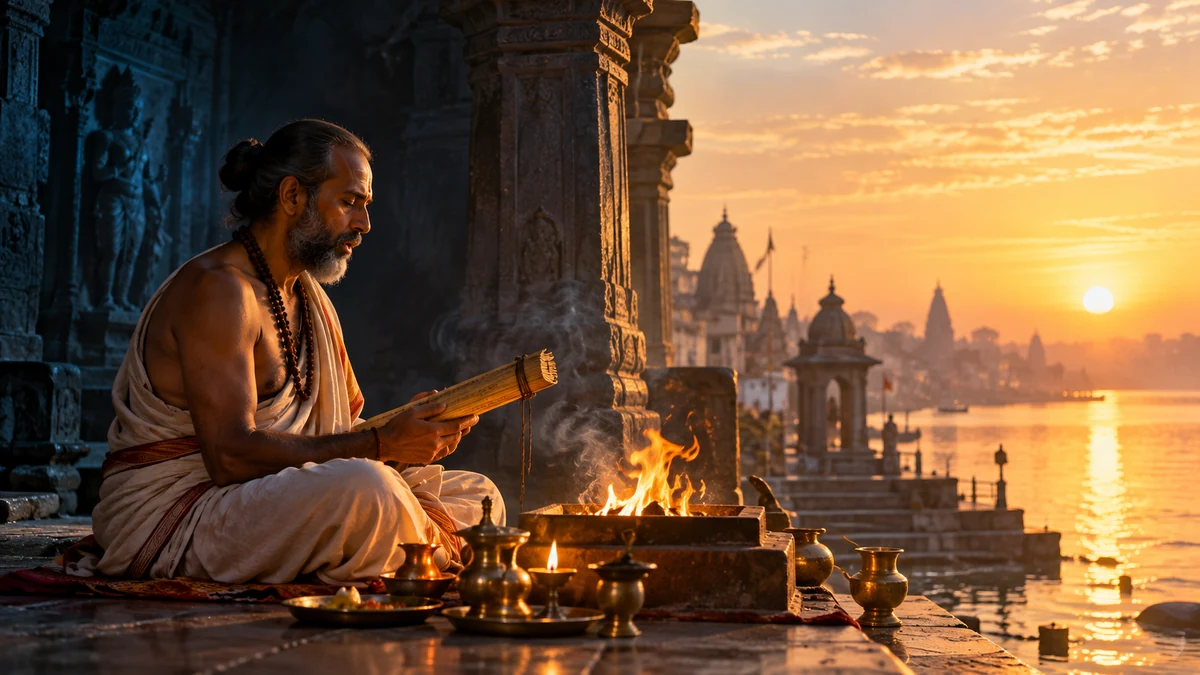
Few Sanskrit lines are as recognizable today as asato mā sad gamaya, tamaso mā jyotir gamaya, mṛtyor māmṛtaṃ gamaya. They are heard in temples, satsangs, yoga studios, meditation groups, and interfaith gatherings. Most often they are translated: “Lead me from the unreal to the Real, from darkness to light, from death to immortality.” That rendering has become almost universal. Yet the history of these three lines is richer than the slogan into which they gradually evolved. In Bṛhadāraṇyaka Upaniṣad 1.3.28 they are not presented as a free-standing philosophical poem. They appear within an old ritual instruction, and the text itself then explains what its contrasting pairs mean. [1][2][3]
The three lines have a home
The Bṛhadāraṇyaka Upaniṣad belongs among the oldest Upaniṣads and is associated with the White, or Śukla, Yajurveda and the Śatapatha Brāhmaṇa. Precise dating is difficult because these works are layered texts composed and transmitted over long periods. It is therefore safer to speak of one of the oldest Upaniṣadic strata than to assign the mantra a deceptively exact date. [4][7]
In 1.3.28 the setting is surprisingly concrete. The text speaks of the Pavamāna chants. When the prastotṛ, one of the Vedic singers, begins the Sāman, the sacrificer is to recite three formulas:
Original text and translation
Devanāgarī — *Bṛhadāraṇyaka Upaniṣad* 1.3.28: असतो मा सद्गमय । तमसो मा ज्योतिर्गमय । मृत्योर्मामृतं गमय ॥ [1]
IAST transliteration: asato mā sad gamaya tamaso mā jyotir gamaya mṛtyor māmṛtaṃ gamaya
English translation: Lead me from the unreal to the real. Lead me from darkness to light. Lead me from death to immortality.
In the main rendering we translate asat/sat as “unreal/real” so that the three petitions remain distinct. The next section explains the wider semantic range of the pair and the way the passage itself connects it with death and immortality. [1][5][6]
Grammatically the construction is personal. Mā here means “me,” while gamaya is the appeal “lead me,” “bring me,” or “cause me to go.” [3][9]
In modern liturgical and meditative practice the three lines are often framed by an opening Om and a closing Om śāntiḥ śāntiḥ śāntiḥ. This expanded recitational form is now very common, but the Om … śāntiḥ frame is not part of the same three formulas as they stand in Bṛhadāraṇyaka Upaniṣad 1.3.28. [1][3][9]
What does *asat* mean?
The first line already carries the greatest semantic openness. Depending on context, asat and sat can be rendered as non-being and being, unreal and real, or falsehood and truth. Later Vedāntic tradition strongly emphasized a movement from the apparent or transient toward the Real, from ignorance toward knowledge of Brahman. This is the background of the now familiar “from the unreal to the Real.” [5][6]
At the same time, the Bṛhadāraṇyaka Upaniṣad gives its own explanation here. Immediately after the first line it connects asat in this context with death and sat with immortality. It then explains darkness similarly as death and light as immortality, while the third line states the movement from death to immortality directly. [1]
For that reason the main translation retains “unreal → real” as a clear and traditionally familiar rendering, while this section shows that the meaning is not exhausted by a single dictionary pair. Within the passage, the three petitions illuminate one another: reality, light, and immortality become three images of movement from a limited condition toward its transcendence.
Three petitions, one movement
Once the textual gloss is taken seriously, the structure of the mantra becomes even more compact. These are not three entirely separate wishes. The first, second, and third lines are three images of one transition.
Unreal → real. Darkness → light. Death → immortality.
The source text explicitly draws the first two pairs toward the third. Darkness is not merely lack of information, nor light only intellectual clarity. Within this ritual world, both are connected to the boundary between mortality and the overcoming of death. [1][2]
This structure helps explain why the mantra later became so open to new interpretations. Read ethically, it can describe movement from wrong conduct toward truth. Read epistemologically, darkness can become ignorance and light knowledge. Advaita can read it as movement from false identification with the transient toward realization of the unchanging Self or Brahman. In modern meditative contexts, the same words can become a prayer for clarity, inner orientation, or courage before death. [5][6][8] These interpretations are not necessarily mutually exclusive, but they are not all equally old.

From ritual to philosophy
The Upaniṣadic texts themselves stand at a remarkable threshold between the Vedic ritual world and an increasingly explicit philosophical investigation of the human being, death, ātman, and Brahman. The Bṛhadāraṇyaka remains deeply embedded in ritual inheritance while also containing some of the most influential reflections on the Self and ultimate reality in Indian philosophy. [4][5]
Later Vedāntic interpretation of the mantra is therefore not simply an arbitrary appropriation of an old ritual formula. The broader text genuinely contains themes that make such philosophical expansion possible. Śaṅkara’s commentarial tradition reads movement from darkness to light as movement from ignorance toward knowledge and a higher condition. [6] In later Advaita it is therefore natural for sat to become associated with reality or Brahman, tamas with avidyā, and immortality with liberation from false identification with what is transient.
Historically, however, the sequence matters. First there is a Vedic-Upaniṣadic text in a ritual setting that supplies its own gloss. Then come centuries of interpretation in which the same formula becomes part of different philosophical and spiritual systems. Reversing this order creates the impression that every later interpretation was already literally contained in the original three lines.
How the mantra became universal
Perhaps precisely because the three formulas do not name a specific deity, they are highly portable. They speak in the first person and use three nearly universal pairs of opposites: asat and sat, darkness and light, death and immortality. This allows them to be recited within very different theological frameworks, and also in settings where religious language is used more loosely. [3][8][9]
In modern yoga the mantra often appears as a free-standing invocation or closing prayer. It may be set to music, repeated as kirtan, framed by Om and the threefold śāntiḥ, translated into the plural, or detached entirely from the historical Pavamāna rite. [8][9] This does not necessarily make its modern use “wrong.” Traditions continually reinterpret their inherited words. What matters is not to present the contemporary form as an unchanged recording of the original practice.
This is also why Asato Mā Sadgamaya has survived far beyond its original ritual setting. Its grammar is simple, its images are powerful, and its goal is not sealed inside a single dogmatic definition. A person asks to be led from one condition toward another — from a state that must be surpassed toward one perceived as higher.
A prayer for transition
The mantra can therefore be read on two levels at once. Historically, it belongs to a specific Vedic ritual setting, and its own textual explanation closely binds asat, darkness, and death to their opposite in immortality. Philosophically, its openness allowed new meanings to enter these three lines over the centuries: truth, knowledge, Brahman, liberation, the light of consciousness.
Its durability also comes from the form itself: the same appeal is repeated three times so that the speaker does not remain where he or she is. Each line describes a transition, but each gives that transition a different image.
This is not merely a slogan of optimism. In its oldest preserved context, it is a prayer about a boundary that the human being cannot simply cross by force — and so asks to be led.
Sources and further reading
- Sacred Texts of Hinduism — Sanskrit text, Bṛhadāraṇyaka Upaniṣad 1.3.28. Source
- Max Müller, The Upanishads, Part II, Sacred Books of the East XV — Bṛhadāraṇyaka Upaniṣad. Source
- SlokaSandra — Pavamāna / Asato Mā Sad Gamaya, Bṛhadāraṇyaka Upaniṣad 1.3.28. Source
- Patrick Olivelle, The Early Upaniṣads: Annotated Text and Translation, Oxford University Press, 1998.
- Sarvepalli Radhakrishnan, The Principal Upanishads, 1953.
- Swami Madhavananda, Brihadaranyaka Upanishad with the Commentary of Śaṅkarācārya, Advaita Ashrama.
- Encyclopaedia Iranica — “Sacred Books of the East.” Source
- Christopher Key Chapple, “Yoga and the Light,” Religions 10 (2019). Source
- Asivana Yoga — “Asato Ma Sadgamaya: Meaning, Translation, Pronunciation, and How to Chant.” Source