Kali Yuga: What Do Hindu Sources Actually Teach?
Kali Yuga is not named after the goddess Kālī. This article traces the four yugas from early metaphors and the Mahābhārata to the Purāṇic 432,000-year chronology, the 3102 BCE epoch, Kalki, and modern shorter reinterpretations.
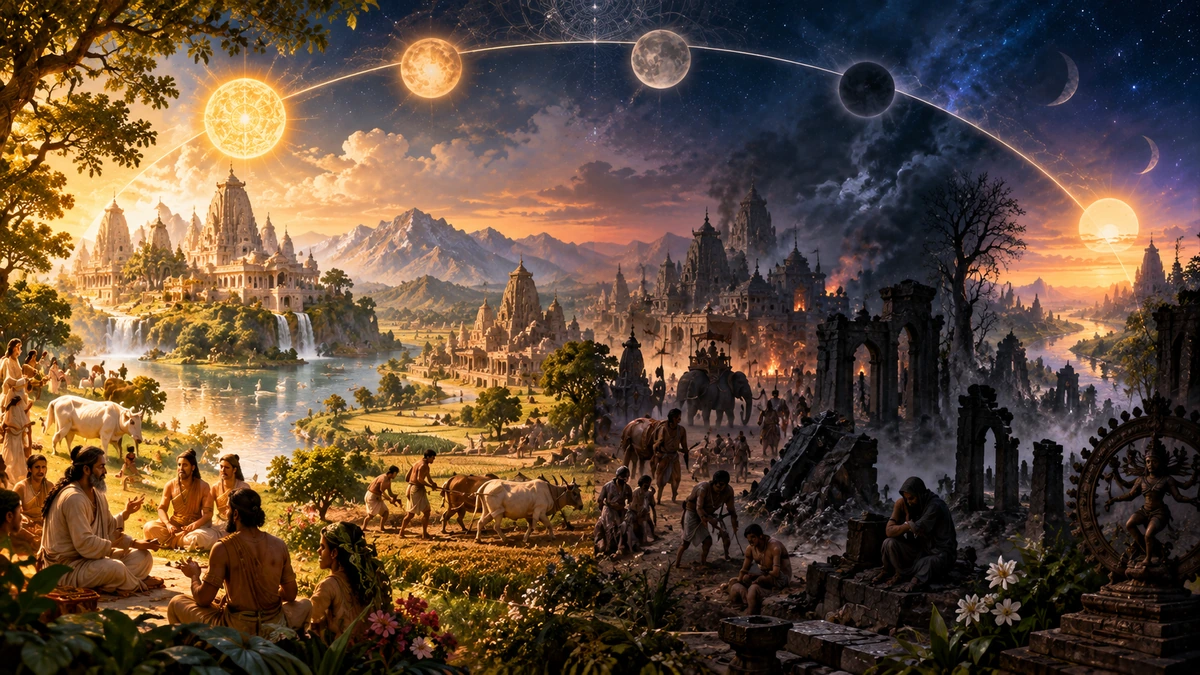
The expression Kali Yuga is now often used as a universal label for civilizational decline, moral chaos, or the imminent end of a cycle. Classical Hindu sources are both more precise and more diverse. Kali is the fourth of four yugas — Kṛta or Satya, Tretā, Dvāpara, and Kali — but the meaning, duration, and role of these ages developed across the textual tradition.
The word Kali itself also causes confusion. Kali (कलि) in Kali Yuga is not the same Sanskrit word as the goddess Kālī (काली). Kali is associated with the losing throw in a dice game and with ideas of quarrel, discord, and an unfavorable outcome. The names of the four yugas are therefore linked from an early stage to a descending 4 : 3 : 2 : 1 pattern.
In the mature Purāṇic and astronomical system, the four ages together comprise 12,000 divine years. Kṛta lasts 4,800, Tretā 3,600, Dvāpara 2,400, and Kali 1,200 divine years; when a divine year is reckoned as 360 human years, Kali Yuga lasts 432,000 human years, while the full caturyuga or mahāyuga lasts 4,320,000 years. This is the classical long chronology used in later Purāṇic and astronomical literature.
This article therefore does not treat Kali Yuga as a single sentence from ‘Hinduism.’ It follows the development of the idea through different sources: early metaphors, the Manusmṛti, the Mahābhārata, the Viṣṇu Purāṇa, the Bhāgavata Purāṇa, astronomical chronology, and modern reinterpretations. The aim is to explain what the individual sources actually teach and where they differ.
From the word yuga to the early metaphor of four ages
Sanskrit yuga means a period, age, or span of time. In later Hindu cosmology it designates four successive world ages. With kali, however, a linguistic distinction matters: Kali (कलि) in Kali Yuga has short vowels and appears in Sanskrit lexicons as the name of the lowest dice throw, as quarrel or discord, and as the fourth age. Kālī (काली), with long vowels, is the name of the goddess. Ordinary Roman spelling often writes both as ‘Kali,’ creating the false impression that the age is named after the goddess Kālī.
Because of the origin of the names, the classical yuga scheme is closely linked to numerical decline. Kṛta represents the successful or best outcome, Tretā and Dvāpara intermediate stages, and Kali the worst. This scale was later transferred to the idea that dharma — order, duty, proper conduct, and social-moral stability — progressively diminishes through the four ages.
The four terms did not necessarily begin as names for million-year periods of world history. Scholarship on the early history of the yugas points to older associations with dice and metaphorical descriptions of fortune or activity. The Aitareya Brāhmaṇa uses the sequence Kali–Dvāpara–Tretā–Kṛta for a person who lies down, rises, and finally walks: movement toward Kṛta is movement from inactivity toward successful action.
A similar pattern remains in Manusmṛti 9.301–302, where the king himself is compared with the yugas: asleep he is Kali; awake, Dvāpara; preparing to act, Tretā; actively moving, Kṛta. This shows that yuga vocabulary could function politically and morally, not only as a calendar of cosmic history.
The classical fourfold cycle and 12,000 divine years
In the Manusmṛti and relevant layers of the Mahābhārata we find the recognizable sequence Kṛta/Satya → Tretā → Dvāpara → Kali. Kṛta or Satya is the ideal opening age; Kali is the final and most weakened one. Modern scholarship therefore treats these texts as among the earliest surviving witnesses to the developing Brahmanical theory of four yugas, even though individual motifs and terms are older.
The system need not have appeared all at once in a single finished form. The Mahābhārata is a layered text, and its discussions of time and yuga do not always match later Purāṇic cosmology exactly. The mature system now often presented as one timeless doctrine is the result of textual development and later systematization.
One of the system’s most powerful images is dharma as a being standing on four legs. In Kṛta or Satya Yuga all four remain; in Tretā one is lost, in Dvāpara two, and in Kali only one survives. The Manusmṛti says righteousness declines by a quarter in successive ages, while the Mahābhārata and Bhāgavata Purāṇa develop closely related imagery.
The Bhāgavata Purāṇa describes the four legs of dharma as truthfulness, mercy, austerity, and charity. Other passages vary the list slightly, but the underlying logic remains: the quality of the age is expressed through a 4 : 3 : 2 : 1 ratio. The numerical pattern is therefore not merely calendrical; it is also moral symbolism.
Manusmṛti 1.69–71 gives the classical ratio of durations. Kṛta has 4,000 years of its central period plus 400 years of dawn and 400 of twilight; Tretā has 3,000 + 300 + 300; Dvāpara 2,000 + 200 + 200; Kali 1,000 + 100 + 100. The total is 12,000 years: 4,800 + 3,600 + 2,400 + 1,200.
In the later standard reckoning these are years of the gods. The Sūrya Siddhānta states the conversion explicitly and renders the full caturyuga as 4,320,000 solar or human years. The moral scale 4 : 3 : 2 : 1 is thus combined with astronomically large spans of time.

432,000 years, the beginning of Kali Yuga and 3102 BCE
Kali contains 1,200 divine years in this system: 1,000 years of the core age, a 100-year opening transition, and a 100-year closing transition. When one divine year is reckoned as 360 human or solar years, 1,200 × 360 yields 432,000 years. The same logic produces 864,000 years for Dvāpara, 1,296,000 for Tretā, and 1,728,000 for Kṛta.
The full fourfold age therefore lasts 4,320,000 years. Purāṇic cosmology then groups such caturyugas into still larger cycles — manvantaras and kalpas. In the classical long chronology, Kali Yuga is not a short interval of a few centuries but the smallest component of an immense cosmological timescale.
Later Vaiṣṇava sources connect the beginning of the present Kali Yuga with Kṛṣṇa’s departure from the world. Bhāgavata Purāṇa 12.2.33 says the influence of Kali began on the very day Kṛṣṇa departed; the Viṣṇu Purāṇa likewise links Kali’s onset with his departure. The age is thus woven into the sacred history of Kṛṣṇa, the Pāṇḍavas, and King Parīkṣit.
The picture in the Mahābhārata itself is more complex. Some passages place the great war at the transition between Dvāpara and Kali, while others speak of Kali as already arriving or imminent. The equation ‘Mahābhārata war = exact start of Kali Yuga’ is therefore not equally explicit across every layer of the epic; later tradition systematized the connection more fully.
The date most commonly given today for the traditional start of Kali Yuga is 3102 BCE. This date is closely tied to Indian astronomical chronology. In the fifth century CE, Āryabhaṭa used a reckoning in which 3,600 years of the current Kali had elapsed by his epoch, giving astronomical chronology a stable computational point.
The history of the date is therefore more complex than saying ‘a scripture gives 3102 BCE.’ Purāṇic narrative links Kali with Kṛṣṇa’s departure, while astronomers converted the mythic-chronological framework into a mathematical era. The religious and astronomical layers subsequently became tightly joined in classical Indian chronology.
The Mahābhārata and Viṣṇu Purāṇa: society, rule and the erosion of dharma
In the Vana Parva, the sage Mārkaṇḍeya describes Kali as a time when lifespan, knowledge, bodily strength, and moral discipline contract. Social hierarchies are reversed, trust declines, greed and anger grow, and the outward appearance of learning or piety can replace actual conduct. It is a powerful image of a world in which the expected order is turned upside down.
These passages are not simply a list of natural disasters. Much of the description concerns rulers, learning, family relations, trust, ritual, and social structure. Kali is therefore also a moral-political language for experiencing the collapse of order, not merely an astronomical unit of time.
The Viṣṇu Purāṇa develops the picture of Kali Yuga with a strong emphasis on rulers and social organization. Book IV, chapter 24 describes short-lived and violent rulers, burdensome taxation, wealth becoming a measure of status, the weakening of ritual distinctions, and populations seeking refuge under political and economic pressure.
Book VI adds a broader account of declining ritual discipline, traditional rules, and social order. Within the text itself, this is a normative picture of distance from a Brahmanical ideal of dharma. That is why many lines can sound strikingly contemporary: they concern wealth, power, appearance, and loss of trust, while their original frame remains the religious-social world of the Purāṇic authors and redactors.
The Bhāgavata Purāṇa: the psychology of Kali and its spiritual advantage
The Bhāgavata Purāṇa describes a decline in truthfulness, purity, tolerance, compassion, lifespan, bodily strength, and memory. It also portrays Kali in psychological language: deception, falsehood, lethargy, violence, grief, confusion, fear, and poverty become characteristic features of the age.
A particularly interesting passage, 12.3.27–30, interprets the yugas through the predominance of different guṇas, or qualities of consciousness and behavior. Kṛta is associated with sattva and delight in knowledge and austerity; Kali with confusion, violence, and ignorance. The yuga is therefore not only a point on a calendar but also a pattern of human and social condition.
If we extract only the passages of decline, we get an incomplete picture. Viṣṇu Purāṇa VI.2 surprisingly praises Kali because, in this age, comparatively accessible devotion to Viṣṇu is said to yield great spiritual fruit. The text presents this as a special concession in a period when more demanding ritual and ascetic disciplines are harder to sustain.
The Bhāgavata Purāṇa 12.3.51 makes a similar point: Kali is an ‘ocean of faults,’ yet it has one great quality — kīrtana, chanting or praising Kṛṣṇa’s name, is presented as a direct path to liberation. Manusmṛti 1.86 likewise assigns different principal practices to different ages and associates Kali with giving. Classical sources therefore portray Kali not only as punishment but as an age of a different, simplified spiritual path.

Kalki and the larger cycle of the yugas
At the end of Kali Yuga, several Purāṇic texts expect Kalki, a future manifestation of Viṣṇu. The Viṣṇu Purāṇa places him in the village of Śambhala and assigns him the restoration of dharma after a period of violence and disorder. The Bhāgavata Purāṇa likewise links the close of Kali with the renewal of order and the reappearance of Kṛta or Satya Yuga.
The crucial feature of the model is cyclicality. The end of Kali is not the final end of time but a transition into a new Kṛta. Classical yuga cosmology is therefore not linear apocalypse in the sense of a once-for-all termination of history; world order declines, passes through crisis, and is renewed in another cycle.
The four yugas together form a caturyuga or mahāyuga. In the classical reckoning it lasts 4,320,000 human years. Purāṇic cosmology then groups many such cycles into a manvantara, while one thousand mahāyugas form a day of Brahmā or kalpa, lasting 4.32 billion years; Brahmā’s night is equally long.
This enormous scale explains why Kali in the classical system is not primarily a prediction of an age that must end within a few decades. If the standard Purāṇic duration and the 3102 BCE epoch are used, the present Kali Yuga is still very early in its 432,000-year span.

Differences between traditions and the modern shorter chronology
No. The expression ‘Hindu sources’ covers texts from different periods, genres, and theological settings. Early vocabulary connected with dice and fortune is not yet the full Purāṇic cosmology; the Manusmṛti uses yugas both cosmologically and politically; the Mahābhārata contains multiple layers and conceptions of time; the Purāṇas expand the system into vast genealogies and cosmology; astronomical works convert it into mathematical eras.
It is therefore better to speak of a family of connected traditions than of one sentence that remained unchanged from the beginning. Ludo Rocher emphasized the layered character and difficult dating of the Purāṇas, while Luis González-Reimann has shown how the later fully developed yuga theory is sometimes projected backward onto the whole Mahābhārata.
In modern times, an influential alternative interpretation appeared. Sri Yukteswar Giri, in The Holy Science, linked the four yugas to an approximately 24,000-year astronomical cycle and introduced a descending and an ascending half. In his system, humanity has already left Kali and entered an ascending Dvāpara Yuga.
This model became widely known through Paramahansa Yogananda and modern spiritual movements, but it is not the same as the classical Purāṇic chronology of a 4,320,000-year mahāyuga. It is a later reinterpretation of traditional terminology. Thus the claim ‘Hindu sources say Kali Yuga has already ended’ combines two distinct levels: the classical Purāṇic scheme and Yukteswar’s modern restructuring.
Conclusion: what the Hindu sources actually teach
Taken together, the major textual layers yield a much clearer picture. Kali Yuga is the fourth and morally weakest age in a cycle of four yugas; its name is associated with the losing dice throw and is not the name of the goddess Kālī. The classical Purāṇic-astronomical system assigns it 1,200 divine or 432,000 human years, while later tradition links the present age with Kṛṣṇa’s departure and the calendrical epoch of 3102 BCE.
Yet the same tradition does not portray Kali only as darkness. Texts use it as an image of moral, political, and psychological decline, while also assigning it especially accessible forms of spiritual practice. At its end comes not eternal catastrophe but Kalki, the renewal of dharma, and a new Kṛta Yuga. Modern 24,000-year models in which Kali has already ended are important later reinterpretations, not an identical form of the classical Purāṇic reckoning.
Sources and further reading
- Cologne Digital Sanskrit Lexicon. Classical Sanskrit lexica for *kali*: losing dice throw, quarrel/discord, and the fourth yuga; distinct from the goddess Kālī.
- González-Reimann, L. (2014). ‘The Yugas: Their Importance in India and their Use by Western Intellectuals and Esoteric and New Age Writers.’ *Religion Compass* 8(12).
- González-Reimann, L. ‘On the Early History of the Brahmanical Yugas.’ In *At the Shores of the Sky*. Brill, 2020.
- González-Reimann, L. *The Mahābhārata and the Yugas: India’s Great Epic Poem and the Hindu System of World Ages*. Peter Lang, 2002.
- *Manusmṛti* 1.64–86, G. Bühler translation: divine time, durations of the four yugas, and changing duties by age.
- *Manusmṛti* 9.301–302, G. Bühler translation: the king compared to Kali, Dvāpara, Tretā, and Kṛta according to his activity.
- *Mahābhārata*, Vana Parva, section 188, K. M. Ganguli translation: yuga imagery and moral proportions.
- *Mahābhārata*, Vana Parva, section 189, K. M. Ganguli translation: Mārkaṇḍeya’s extended description of Kali and the return of Kṛta.
- *Mahābhārata* Sanskrit text, Book 3, chapter 188.
- *Mahābhārata* Sanskrit text, Book 3, chapter 189.
- Wilson, H. H. (trans.). *Viṣṇu Purāṇa*, Book VI, chapter 1: four ages and characteristics of Kali.
- Wilson, H. H. (trans.). *Viṣṇu Purāṇa*, Book VI, chapter 2: the redeeming/spiritually accessible qualities attributed to Kali.
- Wilson, H. H. (trans.). *Viṣṇu Purāṇa*, Book IV, chapter 24: future rulers, Kali, Kalki, and return of Kṛta.
- Wilson, H. H. (trans.). *The Viṣṇu Purāṇa* (1840), title and edition record.
- *Śrīmad-Bhāgavatam* 1.17.25: dharma standing on one remaining leg and Kali as quarrel/deceit personified.
- *Śrīmad-Bhāgavatam*, Canto 12, chapter 2: symptoms of Kali, Kṛṣṇa’s departure, duration, and return of Kṛta.
- *Śrīmad-Bhāgavatam* 12.2.33: Kali’s onset associated with Kṛṣṇa’s departure.
- *Śrīmad-Bhāgavatam* 12.2.34: after the celestial duration of Kali, Kṛta manifests again.
- *Śrīmad-Bhāgavatam* 12.3.18: four supports/legs of dharma in Kṛta.
- *Śrīmad-Bhāgavatam* 12.3.27: Kṛta described through predominance of sattva, knowledge, and austerity.
- *Śrīmad-Bhāgavatam* 12.3.30: Kali described through deceit, violence, confusion, fear, and poverty.
- *Śrīmad-Bhāgavatam* 12.3.51: Kali as an ‘ocean of faults’ with kīrtana presented as its great spiritual advantage.
- Burgess, E. (trans.). *Translation of the Sûrya-Siddhânta*, chapter 1: 12,000 divine years and 4,320,000 solar years for the fourfold age.
- *Sūrya Siddhānta* 1.15–17, Sanskrit and English: the 4:3:2:1 duration scheme with dawns and twilights.
- Ramasubramanian, K. *The Astronomy of Āryabhaṭa*: Āryabhaṭīya 3.10 and the epoch when 3,600 Kali years had elapsed.
- Fleet, J. F. (1911). ‘The Kaliyuga Era of B.C. 3102.’ *Journal of the Royal Asiatic Society* 43(2): 479–496.
- González-Reimann, L. (2009). ‘Cosmic Cycles, Cosmology, and Cosmography’: history of the yuga numbers and astronomical chronology.
- Rocher, L. *The Purāṇas*. A History of Indian Literature II.3. Harrassowitz, 1986: textual diversity, transmission, and dating problems.
- Oxford Centre for Hindu Studies, *The Bhagavata Purana Project*: academic project and overview of the text’s importance and structure.
- Swami Sri Yukteswar Giri, *The Holy Science*: modern 24,000-year ascending/descending yuga model.
- Paramahansa Yogananda, *Autobiography of a Yogi*, chapter 16 note: popularization of Sri Yukteswar’s shorter ascending/descending yuga chronology.
- H. P. Blavatsky, *Collected Writings*, vol. V: modern Theosophical reception of the classical Hindu yuga numbers.
- *Bhāgavata Purāṇa*, Canto 12 complete English text/PDF: broader context for chapters 2–3.
- *Viṣṇu Purāṇa*, Book IV chapter 24, alternate searchable edition: Kali’s duration, Kalki, and renewal of Kṛta.