Constellations and the Zodiac in the Bible: Direct Texts and Later Readings
Job names the Pleiades, Orion, and the enigmatic Mazzaroth; 2 Kings 23 mentions mazzalot; Isaiah knows star-gazers. How much zodiac is actually in the Bible — and where do later astro-theological reconstructions begin?
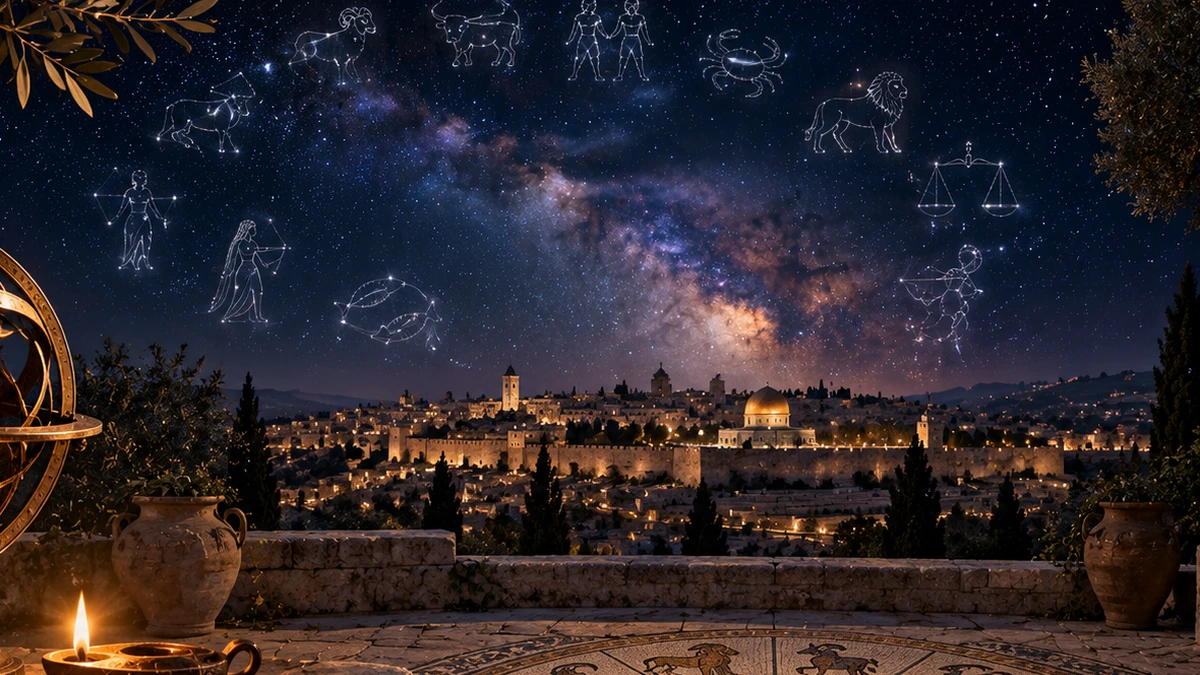
The Bible knows stars, the Sun, the Moon, the host of heaven, and several names for stellar groups. Job mentions Kimah, Kesil, Ayish, and the enigmatic Mazzaroth; 2 Kings 23:5 speaks of mazzalot alongside the Sun, Moon, and all the host of heaven. These passages have often supported a much stronger claim: that the Bible contains the full twelvefold zodiac and even a hidden gospel story encoded in the constellations.
The first part of that claim has some real basis, but it requires precise language. Biblical writers lived in cultures that observed the sky, named stellar patterns, used celestial cycles for calendars, and knew astral cults and divination from the heavens. That is not yet the same as proving that every celestial passage is technical astrology or that modern zodiac signs are encoded in the text.
The second claim — that the twelve signs from Virgo to Leo have told the Christian gospel since primeval times — belongs chiefly to a later interpretive tradition, especially developed in the nineteenth century by Joseph A. Seiss and E. W. Bullinger. Psalm 19 and Job 38 became major starting points, but neither text itself supplies such a map.
This article therefore separates five things often merged in popular literature: sky observation, constellations, zodiac, astrology, and astral worship. Only then can we ask what the Bible states directly, what is a plausible historical reconstruction, and what belongs to later symbolic interpretation.
What are we comparing: concepts and the direct biblical map
First, five concepts that must not be collapsed into one another Sky observation. Tracking the Sun, Moon, stars, seasons, and cycles. What a biblical example would show: Knowledge of the visible sky; not necessarily astrology.
Constellation / stellar group. A recognized named pattern or group of stars. What a biblical example would show: A culturally named celestial pattern.
Zodiac. The band around the ecliptic, commonly organized into twelve signs. What a biblical example would show: A technical zodiac requires more than a star reference or the number twelve.
Astrology. Reading celestial positions as signs for events, character, or fate. What a biblical example would show: A divinatory or predictive function, not merely a calendar.
Astral worship. Religious worship of the Sun, Moon, stars, or celestial beings. What a biblical example would show: Cultic use of the sky; not the same as a horoscope.
This distinction governs the whole audit. 2 Kings 23 can document astral cult, Job 38 named star regions, Genesis 1 calendrical functions of the lights, and Isaiah 47 celestial divination — without any one example proving all the other categories.
| Text | Celestial element | Safest conclusion |
|---|---|---|
| Gen 1:14–18 | Sun, Moon, lights for signs, appointed times, days, and years. | The calendrical and ordering function of the sky is explicit; a horoscope is not. |
| Job 9:9; 38:31–33; Amos 5:8 | Kimah, Kesil, Ayish/Ash, Mazzaroth. | The Bible knows named stellar groups; not every identification is equally secure. |
| 2 Kgs 23:5 | Sun, Moon, mazzalot, and all the host of heaven. | Cultic astral practice existed in Judah and is suppressed in the Josianic reform narrative. |
| Deut 4:19; 17:3 | Sun, Moon, all the host of heaven. | Astral worship is known and prohibited. |
| Isa 47:13 | Heaven-scanners, star-gazers, monthly prognosticators. | The text knows astrological/divinatory practice and mocks it in its polemic against Babylon. |
| Gen 37:9 | Sun, Moon, and eleven stars. | Celestial bodies function as family dream symbols; the zodiac is not stated. |
| Matt 2:1–12 | Magi and a star. | The narrative presupposes a world in which a celestial sign can be read politically/religiously; the physical identification of the star remains open. |
| Rev 12:1–6 | Woman, Sun, Moon, twelve stars, dragon. | Celestial-apocalyptic symbolism is explicit; zodiacal comparison is possible but not identical with an explicit identification as Virgo. |
A direct-text map: where is the sky actually present in the Bible? The map already rules out two extremes. “The Bible knows no astronomical sky” is false; so is the jump from named star groups to a fully encoded zodiacal gospel.
Kimah, Kesil, Ayish, Mazzaroth and mazzalot
Kimah and Kesil: Pleiades and Orion are the strongest identifications Job 9:9 and 38:31 and Amos 5:8 pair Kimah and Kesil. A long translation tradition identifies Kimah with the Pleiades and Kesil with Orion. Ancient Greek renderings and later Jewish tradition help stabilize these identifications even though the Hebrew etymologies remain imperfectly transparent.
This is a significant positive result: the Hebrew Bible does not speak only of anonymous “stars” but of recognizable named stellar patterns. In Job they appear within a speech about divine rule over cosmic order; in Amos the maker of Pleiades and Orion becomes an argument for divine sovereignty.
Ayish or Ash: the “Bear” is plausible, not absolutely certain Job 9:9 mentions Ash, while Job 38:32 has Ayish with her children. Many modern translations choose the Bear or Great Bear and its “cubs,” but the JPS itself notes that the Hebrew meaning is uncertain.
This is a model case for calibrated confidence. The text almost certainly points to a known celestial pattern, but a modern constellation label cannot by itself prove that biblical authors used exactly the same catalogue and boundaries as later Greco-Roman astronomy.
Mazzaroth in Job 38:32: zodiac, one constellation, or seasonal stations? The most famous word in this debate is מַזָּרוֹת — Mazzaroth. Job 38:32 asks whether a human can bring Mazzaroth out “in its season.” The contemporary JPS note on Sefaria cautiously calls it evidently a constellation. Older and modern literature propose a wider range: zodiacal signs, seasonal constellations, celestial “stations,” or another astronomical grouping.
Mazzaroth may therefore stand close to zodiacal vocabulary, but translating it straightaway as “the twelve signs of the zodiac” settles more than the text itself settles. The context — Pleiades, Orion, Ayish, and the “laws of heaven” — is plainly astronomical-cosmological, not a complete technical handbook of astrology.
Mazzalot in 2 Kings 23:5: the strongest direct candidate for a zodiacal group The second key term is מַזָּלוֹת — mazzalot in 2 Kings 23:5. Josiah removes priests who burned incense to Baal, the Sun, the Moon, mazzalot, and all the host of heaven. Translation tradition varies among “planets,” “constellations,” and “zodiac/zodiacal signs.” Comparative philology has also connected the term with Mesopotamian vocabulary for stellar stations or positions.
For this article this is therefore the strongest biblical candidate for an organized set of celestial signs or stations that may be zodiacal. Yet “probably zodiacal/constellational vocabulary” is still different from a text that names and explains all twelve signs.
Why 2 Kings 23 does not prove that the Bible teaches astrology The context of 2 Kings 23 is reform, not instruction in the correct use of the heavens. The narrative says cultic practices involving the Sun, Moon, mazzalot, and the host of heaven were performed in Judah and that Josiah removed them. Historically, it matters that the biblical author knows astral cult inside the Judean environment.
Yet the literary function blocks the reverse inference. The presence of mazzalot in the Bible does not mean the Bible endorses zodiacal worship or horoscopes. The practice is mentioned in order to condemn it. Deuteronomy 4:19 and 17:3 likewise prohibit worship of the Sun, Moon, and host of heaven.
Signs, astrology and poetic sky in the Hebrew Bible
Genesis 1:14: “for signs and seasons” is not automatically a horoscope In Genesis 1:14 the heavenly lights are set “for signs, appointed times, days, and years.” The word for sign is broad and does not by itself mean astrological prediction. Calendrical and temporal functions are explicitly named in the same sentence.
In the wider ancient Near East celestial phenomena could certainly function as omens in divination. But Genesis 1 makes the lights created and functional, not sovereign deities. The verse is therefore highly relevant to cultural astronomy and calendrics, far less decisive as evidence for natal astrology.
The Bible also knows astrology directly: Isaiah 47 Isaiah 47:13 is one of the clearest texts where the issue is more than astronomical observation. In a polemic against Babylon it mentions those who scan the heavens, gaze at the stars, and announce month by month what is coming. Functionally this is very close to astrology or celestial divination.
But the rhetorical point is mockery of their inability to save Babylon from the announced disaster. The accurate formulation is therefore “the Bible knows astrologers and astrological practice,” not “the Bible validates them as a reliable form of revelation.”
Isaiah 13 and the “Orions”: poetic plural is not a zodiac catalogue Isaiah 13:10 speaks of the stars of heaven and their kesilim — a plural of the word associated with Orion. Translations therefore vary between “constellations” and older, more literal renderings such as “Orions.” The context is cosmic darkening in an oracle against Babylon.
The passage is valuable because it shows how kesil can function as a broader poetic term for prominent stellar figures. It is not a zodiac list. Apocalyptic poetry uses the sky as a stage for political and theological judgment.
Joseph’s dream: Sun, Moon, and eleven stars are not a hidden zodiac In Genesis 37:9 Joseph dreams that the Sun, Moon, and eleven stars bow to him. The story itself interprets the dream in family terms: father, mother, and brothers. This is an unusually strong internal control because the symbols do not need to be guessed — the narrative decodes them.
Later tradition may connect twelve with tribes, months, or zodiac signs, but this scene has eleven stars and names no zodiacal figures. Its primary function is family and royal dream symbolism.
Psalm 19: the heavens “speak,” but they do not supply a twelve-part gospel Psalm 19 says the heavens declare God’s glory and then focuses on the Sun running its course. The poem became a major foundation for later Christian claims that much more specific revelation could be read in the stars.
But the psalm itself does not name zodiac signs, give their order, or connect Virgo, Leo, Scorpio, and the other figures to the life of a coming Messiah. Its claim is broader: the created heavens witness to the Creator. Moving from creation theology to a detailed “gospel in the stars” requires additional sources that the psalm does not provide.
The Magi, the star and Revelation 12
The Magi and the star: the New Testament enters a world of astral signs Matthew 2 tells of magoi from the east who see a star associated with the birth of the “king of the Jews.” In Greco-Roman and Near Eastern environments, linking major births and political events with celestial signs is well attested, so an astral or astrological context for the story is difficult to exclude.
Much less certain is what the star was. Proposals include a comet, conjunction, nova/supernova, and a literary-theological sign; modern debate remains open. This article therefore does not use any particular astronomical reconstruction as a demonstrated identification.
The narrative direction also matters: the Magi begin with a celestial sign, but Matthew then brings them into contact with Jewish Scripture and Bethlehem. The story is more complex than either slogan “Matthew endorses astrology” or “Matthew rejects it.”
Revelation 12: woman, Sun, Moon, and twelve stars Revelation 12 offers the densest New Testament celestial tableau: a woman clothed with the Sun, the Moon beneath her feet, a crown of twelve stars, and a dragon confronting her. In a Hellenistic environment the image can also be compared with astral and mythological compositions.
Yet historical-literary readings commonly associate the woman with Israel, the eschatological people of God, or a combination of Israel and the church. Schreiber, for example, stresses a new eschatological beginning in Israel while also allowing that readers could hear echoes of Hellenistic myths.
The link twelve stars ↔ zodiac therefore remains a possible symbolic layer, not the sole or explicit meaning. The text never says “this is Virgo in the zodiac,” just as the dragon is not automatically one single astronomical constellation.
Second Temple Judaism, synagogues and zodiacal allegories
Second Temple Judaism: astrology really did exist in Jewish settings It is equally important not to overcorrect. The claim that astrology was always and everywhere alien to Judaism does not fit the whole corpus. Qumran texts including 4Q186 and other early Jewish materials show interest in astrology, physiognomy, calendrical systems, and celestial knowledge.
Ben-Dov and Sanders therefore speak of “ancient Jewish sciences,” while Charlesworth stresses astrological material in the Talmud, Pseudepigrapha, Dead Sea Scrolls, and later synagogues. This is historically important — but much of the evidence is later than many books of the Hebrew Bible and cannot simply be projected back into Mosaic or early Israelite periods.
Zodiacs in synagogues: strong evidence for late-antique Jewish use, not a secret code in Torah Several late-antique Palestinian synagogues — including Hammath Tiberias, Beth Alpha, Na‘aran, and Sepphoris — contain mosaic zodiac cycles. Jodi Magness notes the recurring composition of Helios, the twelve signs, and the four seasons; at En Gedi a Hebrew inscription even lists the zodiac signs.
This is strong evidence that some Jewish communities in late antiquity appropriated and transformed zodiacal iconography. But the mosaics date centuries after most biblical books. They demonstrate later Jewish reception of the zodiac, not that Genesis already encoded the same visual program.
Philo and Josephus: biblical twelves could acquire zodiacal meaning Later Jewish and Hellenistic interpretation matters because it shows how biblical groups of twelve could be cosmologized after the fact. Charlesworth notes that Philo links the twelve stones of the priestly breastpiece with the twelve animals of the zodiac, while Josephus associates the twelve temple loaves with “the circle of the zodiac and the year.”
This is genuine reception history and should not be erased. It is methodologically different, however, from saying “the twelve tribes originally meant the twelve signs.” That stronger claim would require an earlier textual bridge, not merely a later allegorical interpretation.

Do the twelve tribes mean the twelve zodiac signs?
The twelve tribes, twelve months, and twelve zodiac signs form an obvious numerical parallel. Later Jewish and Christian interpreters could and did exploit such correspondences, especially in Hellenistic cosmological readings.
But 12 = 12 is not enough to establish historical origin. To argue that every tribe was originally one sign, we would need an early and stable mapping: the same tribe consistently linked to the same sign across independent sources, with associations demonstrably ancient rather than assembled from later emblems or poetic images. No such unified early map is stated directly in the Bible.
“Gospel in the stars”: modern reconstruction, not ancient testimony
Joseph A. Seiss developed a system in 1882 in The Gospel in the Stars in which the zodiac and its associated figures tell the story of redemption. E. W. Bullinger continued the same line in The Witness of the Stars, using star names, figures, and the sequence of signs to construct a prophecy of the Messiah, his suffering, and victory.
These books are important for the history of modern Christian reception of the zodiac. They are not by themselves evidence that such a system existed in ancient Israel. Their reconstructions combine Greek, Arabic, Latin, Egyptian, and supposedly older star names into a single sequence; the methodological danger is that late traditions become evidence for a hypothetical primeval celestial language.
Seiss and Bullinger should therefore be read like other large nineteenth-century comparative systems: they can preserve interesting connections and reception history, but every etymology, date of a star name, and direction of transmission needs independent verification.
From ancient Israelite sky to Late Antiquity: what changes over time
What comparative history of science tells us about Israel’s sky Jeffrey L. Cooley’s Poetic Astronomy in the Ancient Near East stresses that Israelite literature did not emerge in a vacuum. Mesopotamian and Ugaritic cultures possessed developed celestial traditions, while Israelite texts repeatedly integrate the Sun, Moon, and stars into their own theology as parts of Yahweh’s cosmic order.
This supports a middle course between two extremes. We do not need to claim that every biblical star is merely metaphor without astronomical knowledge. Nor do we need to reduce the whole biblical symbolic world to a disguised Babylonian zodiac. Cultural contact, borrowed vocabulary, and theological transformation form a more realistic historical model.
From the Bible to late antiquity: the evidence changes over time
| Period / source | What we actually have | What must not be projected backward |
|---|---|---|
| Hebrew Bible | Named stellar groups, mazzarot/mazzalot, astral cult, calendrical cycles, critique of celestial divination. | A complete late-antique zodiacal iconographic system. |
| Second Temple period | More developed apocalyptic, calendrical, and some astrological texts. | The assumption that all of this already existed unchanged in the earliest Torah layers. |
| Philo / Josephus | Zodiacal allegories of biblical twelves. | Proof that these allegories were the original meaning of biblical objects. |
| Late-antique synagogues | Physical zodiac cycles, Helios, seasons, Hebrew names of signs. | Proof that the same visual program existed in Iron Age Judah. |
| Seiss / Bullinger, 19th c. | A systematic Christian “gospel in the stars.” | Ancient testimony that the gospel was originally encoded in the zodiac. |
What survives the review?
| Claim | Assessment | Why |
|---|---|---|
| The Bible knows named constellations/stellar groups. | YES | Pleiades/Kimah and Orion/Kesil are strongly supported; Ayish is plausible but less certain. |
| Mazzaroth in Job definitely means the twelve signs of the zodiac. | TOO STRONG | An astronomical grouping is likely; the precise meaning is disputed. |
| Mazzalot in 2 Kgs 23:5 may be zodiacal terminology. | YES, WITH RESERVATION | It is one of the strongest candidates, but translations and etymology are not completely uniform. |
| The Bible documents astral cult. | YES | 2 Kings 23 and prohibitions of worshiping the host of heaven clearly presuppose it. |
| The Bible knows celestial divination/astrology. | YES | Isaiah 47 describes Babylonian star-gazers and monthly prognosticators. |
| The Bible endorses natal astrology. | NOT DEMONSTRATED | Key direct texts are often polemical or concern calendrics/symbolism. |
| Revelation 12 is a literal depiction of Virgo. | NOT DEMONSTRATED | A zodiacal layer is possible, but Israel/apocalyptic and Hellenistic-mythic readings are also textually grounded. |
| The twelve tribes were originally the twelve zodiac signs. | NOT DEMONSTRATED | Later allegories exist; an original biblical equation is not given. |
| The gospel was written in the stars before the Bible. | NOT DEMONSTRATED | The Seiss/Bullinger system is a modern reconstruction without a sufficiently early unified witness. |
| Late-antique Jews used zodiacal iconography. | YES | Synagogue mosaics and other sources directly document it. |
Three levels of evidence and conclusion
A practical THY-REALITY rule: three grades of astral evidence A — direct. Job names Kimah/Kesil; 2 Kgs 23 names mazzalot; Isa 47 describes star-gazers. How to use it: We may state that the motif or practice occurs in the text.
B — historically plausible. Mazzalot belongs to zodiacal/constellational vocabulary; Matt 2 reflects a world of celestial divination. How to use it: Present as a probable interpretation and name alternatives.
C — later reconstruction. Each tribe = one sign; Virgo = Mary; the whole gospel = an original zodiac code. How to use it: Treat as reception history or hypothesis, not as primary biblical data.
Most errors occur when Grade C evidence is presented as Grade A. THY-REALITY should therefore always display the earliest source, the exact word or image, and the chronological distance to the interpretation.
Conclusion: the Bible has a real celestial layer — but not one hidden zodiac handbook After the audit, something stronger than “there is no zodiac in the Bible” remains, but something much more cautious than “the Bible is a zodiacal book.” The biblical world knows named stellar groups, seasonal skies, laws of heaven, astral cults, and celestial prediction. It probably also knows terminology touching zodiacal or constellational “stations.”
Yet the texts deploy these motifs differently: for calendars, poetry, dreams, creation theology, polemic against worship of the heavens, apocalyptic symbolism, and the narrative of a sign. Only later Jewish and Christian writers build more explicit zodiacal allegories from this material.
The safest conclusion is therefore: the sky genuinely belongs to the Bible’s symbolic and historical world; a complete “gospel in the stars” is a later interpretive construction that cannot simply be attributed to the original biblical authors.
Sources and further reading
- Sefaria / JPS — Job 38:31–33 — Hebrew text and translation of Kimah, Kesil, Mazzaroth, and Ayish; JPS notes uncertainty around Mazzaroth/Ayish.
- Sefaria / JPS — Job 9:9 — Ash, Kesil, Kimah, and “chambers of the south”; useful direct-text control for named celestial groups.
- Sefaria / JPS — Amos 5:8 — Kimah and Kesil within a hymn to the creator of the heavens.
- Sefaria — 2 Kings 23:5 — Direct Hebrew occurrence of mazzalot in the context of Josiah’s suppression of astral cult.
- Sefaria — Deuteronomy 4:19 — Prohibition against being drawn to worship the Sun, Moon, stars, and host of heaven.
- Sefaria — Genesis 1:14 — Heavenly lights for signs, appointed times, days, and years; primary-text control for calendrical function.
- Sefaria — Isaiah 47:13 — “Scanners of heaven,” star-gazers, and monthly prognosticators in the anti-Babylon polemic.
- Sefaria — Isaiah 13:10 — Stars of heaven and kesilim in cosmic judgment imagery.
- Sefaria — Genesis 37:9 — Joseph’s dream of Sun, Moon, and eleven stars; narrative itself provides the family-symbol interpretation.
- Bible Gateway — Psalm 19 (NRSVUE) — Primary-text control for “the heavens declare” and the solar course, often used by later gospel-in-the-stars writers.
- Bible Gateway — Revelation 12 (NRSVUE) — Primary-text control for the woman clothed with the Sun, Moon under her feet, crown of twelve stars, and dragon.
- Jeffrey L. Cooley — Poetic Astronomy in the Ancient Near East (Penn State University Press / JSTOR, 2013) — Major study of Mesopotamian, Ugaritic, and Israelite celestial knowledge in literature.
- Jewish Encyclopedia — Astronomy — Historical lexicographic survey of Mazzarot/Mazzalot, Kesil, Kimah, and other biblical celestial terms; valuable but older scholarship and therefore used cautiously.
- Jewish Encyclopedia — Pleiades — Translation history and Jewish tradition connecting Kimah with the Pleiades.
- Jewish Encyclopedia — Orion — Historical discussion of Kesil/Orion in Job, Amos, and Isaiah; older scholarship used as reception/lexical history.
- Jonathan Ben-Dov and Seth Sanders (eds.) — Ancient Jewish Sciences and the History of Knowledge in Second Temple Literature (NYU Press / JSTOR, 2014) — Astronomy, astrology, calendrics, and physiognomy in early Jewish texts.
- James H. Charlesworth — “Jewish Astrology in the Talmud, Pseudepigrapha, The Dead Sea Scrolls, and Early Palestinian Synagogues,” Harvard Theological Review — Evidence for astrology and zodiac reception in Jewish contexts.
- Jodi Magness — “Helios and the Zodiac Cycle in Ancient Palestinian Synagogues” — Archaeological discussion of repeated zodiac cycles in Palestinian synagogues.
- Stefan Schreiber — “Die Sternenfrau und ihre Kinder (Offb 12),” New Testament Studies 53 (2007) — Revelation 12 as eschatological Israel with possible Hellenistic mythic resonances.
- Clare K. Rothschild — “De stella magorum,” New Testament Studies 70 (2024/online 2025) — Recent example of continuing scholarly debate over the Magi star, traditions, chronology, and astronomical proposals.
- Joseph Augustus Seiss — The Gospel in the Stars (1882) — Primary source for the nineteenth-century Christian “gospel in the stars” system.
- E. W. Bullinger — The Witness of the Stars — Primary source for the later systematic claim that the constellations witness to Christian prophetic/redemptive truth.