Is Hinduism polytheistic or monotheistic? Brahman, Īśvara, devas, and different Hindu theologies
Hinduism recognizes many deities, but also Brahman, one supreme Lord, and non-dual reality. What do polytheism, monotheism, and monism actually mean across different Hindu traditions?
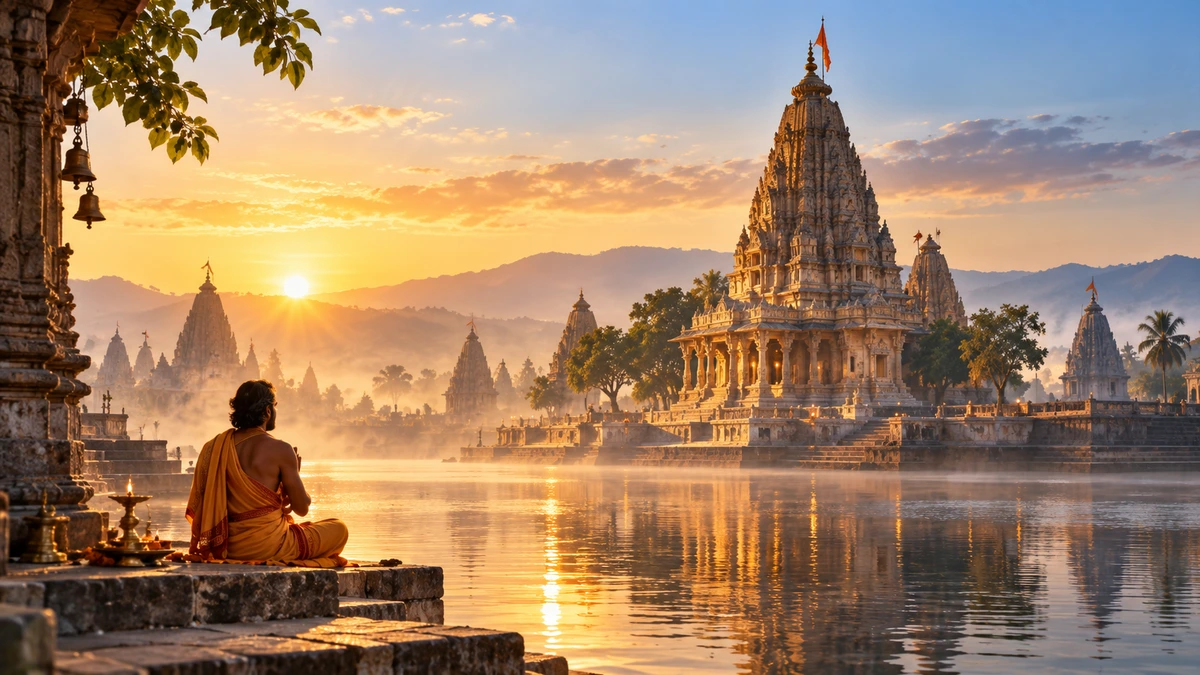
The question of whether Hinduism is polytheistic or monotheistic seems simple only as long as we look from a distance at temples, images, and the names of many deities. Śiva, Viṣṇu, Kṛṣṇa, Rāma, Devī, Kālī, Durgā, Lakṣmī, Sarasvatī, Gaṇeśa, Sūrya, and many others can create the impression of a religion with a large pantheon of separate gods. Yet the same religious world also contains texts that speak of one, of a reality “without a second,” of Brahman as the ground of everything, and of one supreme Lord on whom other divine forms depend. [1][2][6][7]
Both quick answers — “Hinduism is polytheistic” and “Hinduism is monotheistic” — therefore miss part of the picture. Hinduism is not a single theological system but a large family of historical traditions. In different periods and schools we find ritual plurality of deities, the elevation of one deity above others, monotheistic forms of bhakti, panentheistic models, metaphysical monism, and radical non-dualism. Sometimes these models exclude one another; at other times they coexist within the same tradition. [6][7][8][9][13][14]
The key is therefore not counting statues or names. More important is what a particular tradition means when it speaks of a deva, what Īśvara means, what Brahman is, and whether different divine forms are understood as independent gods, subordinate deities, manifestations of one reality, or different faces of a personal supreme God.
Brahman is not Brahmā
The first confusion already arises with two almost identically written words. Brahman in Upaniṣadic and Vedāntic philosophies means the ground or highest reality. Brahmā, by contrast, is a personal deity traditionally associated with creation. If the two are conflated, Brahman quickly becomes merely one more name in a long list of Hindu gods, which is theologically misleading. [7][9]
Brahman itself is also not understood in the same way in every school. Advaita Vedānta understands it at the highest level as non-dual reality that transcends empirical multiplicity. At the level of the world and religious practice it also speaks of Īśvara, the personal Lord, but its final metaphysical analysis does not place two independent highest realities — God and the world — side by side. [9][10]
Rāmānuja’s Viśiṣṭādvaita moves in a different direction. Brahman is personal and identified with Viṣṇu or Nārāyaṇa; the world and individual souls are real but inseparably dependent on him. Madhva’s Dvaita sharpens the distinction further: Viṣṇu is the supreme God, while souls and the world are genuinely distinct from him. Even within Vedānta, then, “one God” does not mean one single metaphysics. [7][8][13]
Vedas and Upaniṣads: many gods, language of “the one”
The earliest Vedic religion unquestionably knows a plurality of devas. Hymns address Indra, Agni, Varuṇa, Mitra, Soma, Uṣas, and other deities, and ritual may be directed toward a specific divine recipient. If we looked only at this level, the term polytheism would be entirely understandable. Yet the Ṛgveda also contains passages that complicate such a picture. [1]
The best known is verse 1.164.46. It names Indra, Mitra, Varuṇa, Agni, Garutmat, Yama, and Mātariśvan, and then states ekaṃ sat viprā bahudhā vadanti — the sages or poets call “the one” in different ways. [1] In modern times this verse has often become a slogan of religious pluralism, but historically it should not be turned into proof that the entire Ṛgveda is already a developed monotheistic system. It does, however, show something important: a plurality of divine names is not necessarily always presented as a plurality of wholly unrelated highest realities.
For part of the Vedic world, historians of religion have therefore used the term henotheism or kathenotheism: an individual deity may be worshipped as supreme within a particular hymn without the existence of others being denied. This too is a modern analytical label, but it captures the fluidity of Vedic religious language better than a simple choice between “one” and “many.”
In the Upaniṣads the question of unity moves to an even deeper level. Chāndogya Upaniṣad 6.2.1 speaks of sat, being or reality, which before the manifestation of the world was “one, alone, without a second” — ekam eva advitīyam. [2] This is not simply a declaration that one personal God exists and other deities do not. The issue is what the deepest ground of all multiplicity is. Vedānta will develop different answers from such passages: Advaita will emphasize non-dual Brahman, Viśiṣṭādvaita the personal Brahman in whom the world and the multiplicity of beings are real and dependent, and Dvaita a genuine distinction between God, souls, and the world. [7][9][10][13]
That is why, in the case of Advaita, the term monism is often more precise than monotheism. Monotheism primarily asks how many supreme gods exist; monism asks how many highest realities exist. Those are not exactly the same question.
Bhagavadgītā: plurality within a theological hierarchy
The Bhagavadgītā is especially interesting for this discussion because it combines, within the same text, a plurality of religious practice with a clear theological hierarchy. In 4.11 Kṛṣṇa says that he responds to people according to the way they approach him and that people follow his path in different ways. [3]
In 7.21 he speaks of a worshipper who wishes to worship a particular divine form and says that he himself makes that person’s faith in that form steady. [4] Yet plurality here does not mean that all deities are presented as completely independent and mutually equal supreme gods. In 9.23 Kṛṣṇa says that even those who faithfully worship other devas in a certain sense worship him, although not in the properly understood way. [5]
Such a structure is difficult to describe with the word polytheism alone. Other devas exist and are actual objects of worship, but they are included within a theology in which Kṛṣṇa occupies the supreme position. At the ritual level the picture is plural; at the level of supreme authority it can be monotheistic or inclusivistically monotheistic. Different Vedāntic traditions will interpret the same verses differently, so even a shared canonical text does not erase theological diversity.

Viṣṇu, Śiva, and Devī as the supreme reality
In bhakti traditions the question is often posed much more directly. Śrī Vaiṣṇavism identifies Viṣṇu or Nārāyaṇa with supreme Brahman. The Stanford Encyclopedia of Philosophy therefore discusses the Śrī Vaiṣṇavas precisely in connection with monotheism: for Rāmānuja, Brahman is the personal supreme Lord, while other deities are not competing highest gods of the same rank. [8]
A similar pattern appears in different Śaiva traditions, where Śiva is supreme. In non-dual Kashmir Śaivism, Śiva is the highest reality manifesting as the world through his śakti; the world is therefore not something wholly separate from the divine but a real manifestation of it. [11]
Śākta traditions can assign the same supreme position to Devī or Śakti. This is not merely a later interpretation by modern scholars. In the Devī Māhātmya, Devī is called the Īśvarī of all moving and unmoving things, “the sole support of the world,” and “the seed of the universe,” while the text says that the universe is filled by her. [15] In such a theological framework, the Divine Mother is not one goddess among many equal rivals but can occupy the place of supreme reality on which other divine forms depend or through which they are understood. [12][15]
If monotheism is defined broadly enough as belief in one supreme personal God on whom other divine beings depend or of whom they are manifestations, important parts of Vaiṣṇavism, Śaivism, and Śāktism can therefore be described as Hindu forms of monotheism. Gavin Flood cautions, however, that this is not simply a copy of the Abrahamic model: the relation between the supreme deity, the cosmos, and other divine forms is often structured differently in Hindu theologies from a doctrine of creation out of nothing. [6]
Many images on an altar do not necessarily mean many supreme gods
The Smārta tradition makes especially clear why counting divine images is not enough to understand theology. In pañcāyatana pūjā, several central divine forms — usually Śiva, Viṣṇu, Devī, Sūrya, and Gaṇeśa — are worshipped together, while an individual may have a chosen form or iṣṭa-devatā. Within an Advaita-oriented Smārta understanding, these forms are not necessarily competing supreme gods but different approaches to Brahman or to saguṇa Brahman, divine reality with attributes. [14]
Five images on one altar can therefore mean five objects of worship at the ritual level but one highest reality at the metaphysical level. Yet this model too should not be turned into a universal Hindu answer. Traditions that understand Viṣṇu, Śiva, or Devī as the unique supreme personal reality do not necessarily treat their deities as wholly interchangeable symbols. [8][13][14]
The same caution is needed with the word deva. If it is automatically translated as “God” in the sense of the one supreme God of a monotheistic religion and the names are then simply counted, the answer has already been determined in advance. In different Hindu theologies, devas can be heavenly beings, bearers of cosmic functions, objects of worship, personal divine forms, or expressions of one supreme reality. In some traditions they are subordinate to one supreme Lord; in others the chosen divine form itself is identified with Brahman. Recognizing many devas therefore does not by itself tell us how many highest divine principles a school accepts. [6][7][8][13][14]
An analogy with angels is sometimes used as an explanation, but it can only be partial. Some monotheistic Hindu theologies do indeed place other deities in a position functionally subordinate to the supreme God, but devas are not simply the Hindu equivalent of Christian or Islamic angels. Their histories, ritual roles, and ontological interpretations belong to Indian traditions in their own right.
One and many are not always opposites
The question therefore has no one-word answer. In Vedic hymns and ritual we find genuine plurality of deities, but also early statements that connect several names with “the one.” The Upaniṣads develop radical language about one reality without a second. Advaita translates this into non-dual Brahman. Śrī Vaiṣṇavism and Dvaita speak of one supreme personal God. Kashmir Śaivism understands the highest reality as Śiva, while Śākta traditions can assign that position to Devī. [1][2][6][7][8][9][11][13][15]
The statement “Hindus believe in many gods” therefore describes only part of the picture. The opposite statement, “Hinduism is really only monotheism,” would be equally narrow because it would erase Vedic and popular plurality, differences among sampradāyas, and different metaphysical systems. It is more precise to speak of a very old tension — and often also a connection — between unity and plurality.
In some traditions the plurality of divine forms is a way in which people approach one divine ground. In others there is a clear hierarchy of one supreme God and other devas. Elsewhere the core is a non-dual reality for which the very question “how many gods?” does not reach the level at which the tradition places its deepest answer. And in earlier or popular contexts plurality can be more direct, making the term polytheism entirely meaningful.
The most accurate answer therefore depends on the question. Hinduism knows many deities and people actually worship them. But not all Hindu traditions understand those deities as several independent supreme gods. Hinduism also contains powerful traditions of one supreme personal God, as well as traditions of one highest reality that transcends the simple opposition between one God and many beings. [6][7][8][9][13][14][15]
It is therefore more useful to ask not “how many gods does Hinduism have?” but what relationship a particular tradition establishes between highest reality, the supreme Lord, and the many divine forms. Only then does it become clear why the same religious civilization can contain a multitude of temples, names, and images while also containing texts that speak of one, of one without a second, or of one supreme divine source of multiplicity.
The famous Vedic statement about “the one” that the sages call by many names does not need to be turned into a slogan in order to matter. By itself it already reveals a question that will accompany Indian religious thought for millennia: how to think about the real plurality of experience without thereby losing the possibility of a deeper unity behind it. [1]
Sources and further reading
- Ṛgveda 1.164.46, Sanskrit text and H. H. Wilson translation, Wisdomlib. Source
- Chāndogya Upaniṣad 6.2.1, Sanskrit and English translation, Wisdomlib. Source
- Bhagavadgītā 4.11, translations and classical commentaries, IIT Kanpur Gita Supersite. Source
- Bhagavadgītā 7.21, translations and classical commentaries, IIT Kanpur Gita Supersite. Source
- Bhagavadgītā 9.23, translations, IIT Kanpur Gita Supersite. Source
- Gavin Flood, Hindu Monotheism, Cambridge Elements in Religion and Monotheism (Cambridge University Press, 2020). Source
- Stanford Encyclopedia of Philosophy, “God and Other Ultimates.” Source
- Stanford Encyclopedia of Philosophy, “Monotheism,” §7.3, “The Shri Vaishnavas and Monotheism.” Source
- Stanford Encyclopedia of Philosophy, “Śaṅkara.” Source
- Jessica Frazier, “Monism in Indian philosophy: the coherence, complexity, and connectivity of reality in Śaṃkara's arguments for Brahman,” Religious Studies 58 (2022). Source
- Swami Medhananda, Karma and Rebirth in Hinduism, Cambridge Elements, discussion of Vedānta and Kashmir Śaivism. Source
- Peter Harvey, Buddhism and Monotheism, Cambridge Elements excerpt, discussion of Brahman, Śiva, Viṣṇu and Devī in later Hindu traditions. Source
- Madhva / Dvaita support: Internet Encyclopedia of Philosophy, “Madhva”; and Religious Studies discussion of Mādhva Vedānta identifying Brahman with supreme Viṣṇu. Source 1 Source 2
- Smārta / pañcāyatana support: Oxford History of Hinduism excerpt on Smārta domestic worship of five deities, with supplementary overview. Source 1 Source 2
- Devī Māhātmya, chapter 11 (Nārāyaṇī Stuti / Ambikā), English translation reproduced by the Internet Sacred Text Archive: Devī as Īśvarī of all moving and unmoving things, sole support and seed of the universe. Source