Kalava: The Red Sacred Thread in Hindu Ritual Tradition
Kalava or mauli is a simple ritual thread with a long history of protection, blessing and binding. The sources reveal older Vedic antecedents, regional variation, the King Bali mantra, and an important distinction between kalava and rakhi.
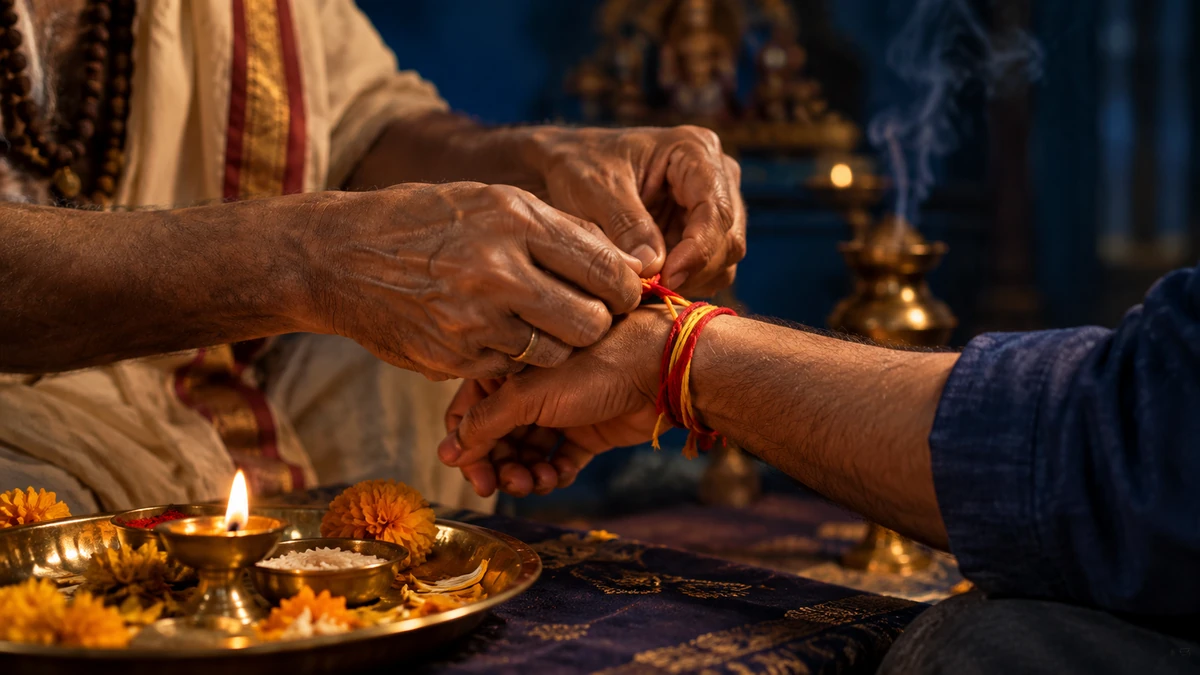
On the wrist it can look like an ordinary red or red-and-yellow string. In Hindu ritual practice, however, the same gesture can carry several meanings: protection, blessing, participation in a rite, remembrance of a vow, or the marking of a person or object as part of sacred action. Common modern names include kalava/kalawa, mauli, rakṣā-sūtra and kautuka, while other names occur across regions, communities and ritual manuals.
The greatest mistake would be to turn one contemporary custom into one single ancient story. Vedic and later Sanskrit sources certainly know protective cords, amulets and ritual binding, but the modern kalava cannot simply be traced without interruption to one verse. It is historically safer to speak of a long family of related practices of binding, protection, consecration and ritual marking that changed over centuries.
The rules are not identical everywhere either. Red and yellow are common rather than universal; right versus left wrist varies with gender, marital status, region or ritual lineage; the number of turns and knots also differs. What the internet often presents as one 'Vedic rule' may in fact be a regional or family convention.
This article therefore neither searches for hidden physics nor explains the tradition away. The more interesting question is: what can texts, ritual studies and living practice actually show about this thread — and where do later interpretation, local custom and religious belief begin?
One thread, several names: kalava, mauli, rakṣā-sūtra and kautuka
In contemporary North Indian usage, kalava/kalawa and mauli are especially widespread names. Rakṣā-sūtra literally means a protective thread or cord, while Sanskrit ritual sources also use terms such as kautuka and pratisara. The words overlap in different sources, but they are not necessarily perfect synonyms in every historical context.
| Term | Safest description | Note |
|---|---|---|
| Kalava / kalawa | A widely used modern name for a ritual wrist thread. | Often red or red-and-yellow; regional usage varies. |
| Mauli | A modern name often used for the same ritual thread. | Classical Sanskrit mauli means head, top, crown or diadem; use for the wrist thread is a later ritual usage of the name. |
| Rakṣā-sūtra | 'Thread of protection.' | Emphasises a protective or blessing function. |
| Kautuka / pratisara | Older ritual terms for a cord, bond or protective object. | Meaning and material depend on the specific text and rite. |
The word mauli is worth clarifying because popular websites frequently offer a simplified etymology. Monier-Williams gives classical meanings such as head, top, crown, diadem and top-knot. Thus claims that the word literally means 'above all' or directly means 'sacred thread' are not the most precise dictionary account. This does not erase the word's present ritual meaning; it simply shows that modern ritual usage and basic lexical history are different questions.
A cautious definition: kalava is today a ritual thread, often red or red-and-yellow, tied to a wrist or ritual object in many Hindu settings as a sign of blessing, protection, participation or consecration.
Older layers: protective bonds in Vedic ritual culture
Protective cords and amulets have deep roots in South Asian ritual history. Atharvaveda 2.11 addresses a pratisara as a protective or counter-acting amulet and associates it with repelling harmful ritual action or sorcery. William Dwight Whitney's old English edition explicitly describes the hymn's ritual use with the binding-on of an amulet. This is strong evidence for an ancient tradition of fastening a protective object — but not yet proof that today's red-and-yellow kalava is an unchanged copy of that object.
Jan Gonda's work on Vedic ritual shows that terms for bonds, cords and protective objects appear in several domestic and transitional rites. Ṛgveda 10.85, a wedding hymn, likewise contains imagery of colour, binding and the removal of harmful influence; Gonda connects it with a red-and-black cord in a wedding context. Yet caution is essential: the early verse is an antecedent within a broader symbolism of binding, not a simple birth certificate for the modern kalava.
Between the early texts and contemporary practice lie more than two millennia of ritual development: gṛhya rites, temple traditions, regional weddings, Vaiṣṇava and Śaiva practices, household pūjās and modern popular religion. The stronger historical claim is therefore continuity of a motif — consecrated or protective binding — rather than one unchanged artefact from the Ṛgveda to the present.
The antiquity of a motif is not the same as an unchanged form. Vedic sources attest ancient protective and ritual bonds; the modern kalava is best understood as a later form with multiple regional genealogies.
What does the thread actually do in a ritual?
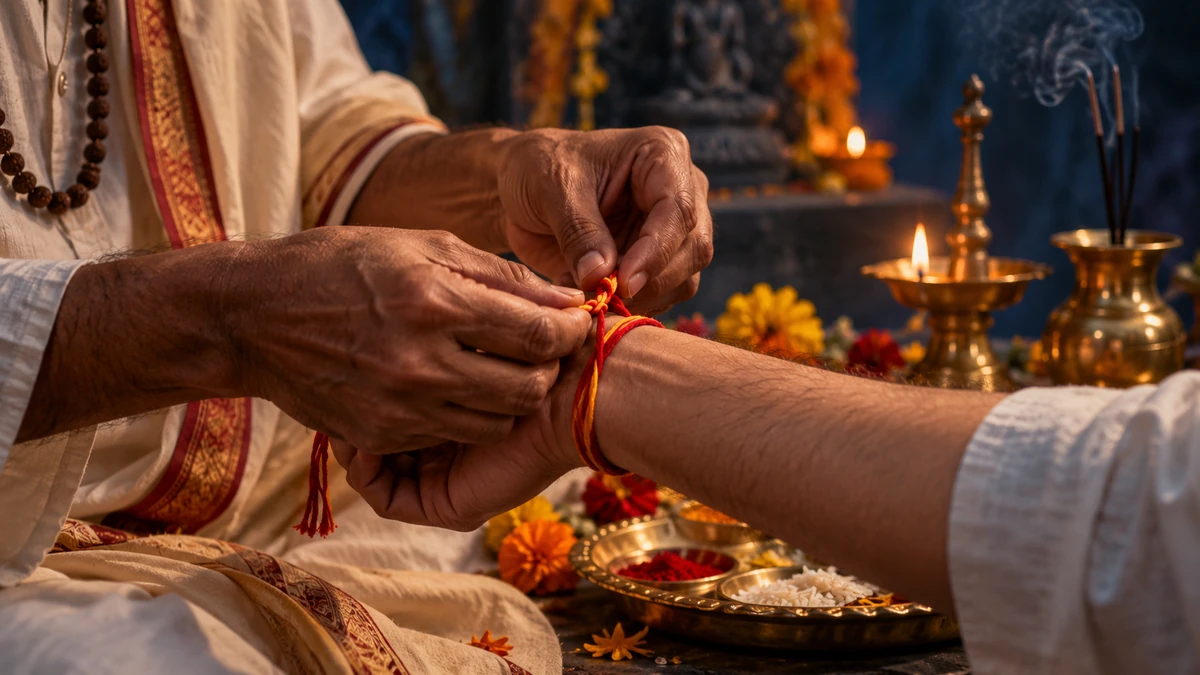
In lived ritual, kalava is above all an act of binding, not merely an object. In household or temple pūjā, a priest or elder may tie it to a participant at the beginning or end of a rite. Comparable cords are also fastened around vessels, posts, a kalaśa, wedding objects or other items brought into the ritual field. Studies of Smārta pūjā and Śaiva festival manuals reveal this broader grammar: a cord can mark, protect or ritually hold together a person, object and ritual purpose.
This helps explain the frequent connection with saṅkalpa, the formal ritual intention that specifies who performs a rite, when, where and for what purpose. Kalava is not tied at exactly the same point in every tradition, so it should not be universalised as the 'signature of saṅkalpa'. Yet in many contemporary settings it works as a visible remainder of an invisible act: after the rite ends, a participant carries something that recalls their inclusion in it.
Religious language also commonly describes the thread as protective and as carrying blessing. That claim should be presented in the tradition's own categories: a practitioner may understand the consecrated cord as rakṣā, protection received through deity, mantra, priest and rite. A historian of religion must simultaneously distinguish between what the practice means to participants and an empirical claim that cotton thread itself physically prevents illness or misfortune.
The thread matters not only because of its material. Its religious value is created by context: who ties it, in which rite, with which mantra, intention and interpretation.
Red, yellow, right, left: custom is not one universal law
The most recognisable modern form is a twisted red-and-yellow cotton cord, although orange, saffron, monochrome and other forms also occur. Asia InCH's encyclopedia of intangible cultural heritage documents the manufacture of these threads in India and their use on wrists and ritual objects. Smarthistory likewise places red wrist threads within a broader field of sacred textile practices across Hindu communities.
A common rule says that the thread is tied to the right wrist of men and the left wrist of women; other contemporary instructions distinguish married from unmarried women. Ethnographic and ritual sources, however, show enough variation that such formulas should not be presented as a universal Hindu law. South Indian wedding traditions, for example, have their own forms of kāppu/kankanam/kautuka and distinct sequences of binding.
| Common modern claim | What can safely be said |
|---|---|
| 'It is always red and yellow.' | Red and red-yellow are very common, but other colours and materials also occur. |
| 'Men always wear it right, women always left.' | This is a widespread convention, not a rule of every community and rite. |
| 'There are always three strands or seven knots.' | The number of strands, turns and knots varies by tradition. |
| 'It must be worn until it falls off by itself.' | This is a widespread modern practice, but duration and removal are not identical everywhere. |
The same caution applies to colour symbolism. Red is often associated with auspiciousness, life, power or śakti in Hindu ritual, while yellow can be linked with auspiciousness, turmeric and particular divine or wedding contexts. But assigning one fixed meaning to every strand across all of India would turn a plural tradition into a single code that the evidence does not support.
Regional variation is not a defect in the tradition. It is part of its history: the same ritual gesture can be interpreted somewhat differently by different communities.
The King Bali mantra: the text is real, the stories around it vary
The best-known mantra now recited when tying a protective thread is: yena baddho balī rājā dānavendro mahābalaḥ / tena tvām abhibadhnāmi rakṣe mā cala mā cala. The verse is indeed found in Bhaviṣya Purāṇa 4.137.20. Its basic sense is that with the bond by which the mighty King Bali was bound, the recipient is likewise bound; the protection is asked to remain firm.
The verb bandh-, 'to bind', is important. Bali is the one who was bound, and the efficacy of that bond becomes the model for a new protective binding. Modern retellings often add the Vāmana-Viṣṇu story, Lakṣmī, Bali's hospitality or another explanation for why the thread was tied. These legends are an important part of living tradition, but they are not all equally present in the verse itself.
This is a good example of how ritual works through layers. There is a liturgical text, there are broader Purāṇic myths of Bali and Vāmana, there are regional narratives, and there are family explanations children hear during worship. Separating these layers does not impoverish the tradition; it lets us see how meaning accumulated around a short mantra over time.
Textually verifiable: the Bali mantra exists. Interpretively variable: how a community connects it to Lakṣmī, Vāmana, Raksha Bandhan or a particular family story.
Kalava is not the same as rakhi — although the traditions touch
Because both practices involve wrist thread and protection, kalava and rakhi are often merged into one. It is useful to preserve a distinction. Kalava or rakṣā-sūtra is a broader ritual category that may appear in pūjā, weddings, temple festivals or other ceremonies. Rakhi today is primarily the object and gesture of Raksha Bandhan, where a sibling bond or a symbolically created brother-sister relationship is central.
McKim Marriott's ethnography of the North Indian village of Kishan Garhi is especially revealing. In the mid-twentieth century, on the same festive day he described two neighbouring ritual streams: Brahman household priests tied protective threads to their patrons, while sisters expressed their relationship with brothers through a local festival custom. Marriott even observed some sisters beginning to use more decorative factory-made strings of the priestly type.
This does not prove one single linear history for every form of Raksha Bandhan, but it shows why present-day categories do not always map neatly onto the past. Protective thread, priestly blessing, sibling relation and festive commodity could overlap differently in different places. It is therefore inaccurate to say either 'kalava is simply rakhi' or 'the two have no historical connection'.
The most useful distinction: kalava/rakṣā-sūtra = a broader ritual protective cord; rakhi = today primarily the festive and sibling form of a protective bond.
Why such a small object survives: material memory of ritual
A ritual thread is an extremely simple object: fibre, colour, knot and body. Precisely for that reason it works well as a carrier of meaning. The rite ends, the fire goes out, the mantra falls silent and people leave — but the thread remains on the wrist. In material religion, such objects can function as a portable memory of an event: something spoken, blessed or promised takes a physical form that can be worn.
The knot has another obvious power: it makes a bond visible. The word bandhana means binding or bond; in ritual language, physical binding can mirror a social or religious bond. At a wedding, a protective rite or Raksha Bandhan, a material object can therefore refer at once to protection, belonging, obligation, memory and relationship.
This does not mean that every community gives it the same symbolism. One family may emphasise divine blessing, another a vow, another the relationship with a family priest, another a wedding rite. Yet a shared logic remains intelligible: an abstract relationship is tied to the body. That embodiment helps explain how such an inexpensive and simple object can carry substantial cultural weight.
Kalava is a useful example of how religion does not live only in ideas and texts. It also lives in touch, colour, knot, body and memory.
What can be said without mystification — or dismissing the tradition
Contemporary articles about kalava sometimes add biomedical explanations: that pressure at the wrist directly regulates particular organs, that coloured fibres measurably alter an 'energy field', or that the cord itself prevents disease. In the classical and academic sources reviewed for this article, such modern physiological explanations are not the basis of the traditional ritual description. They should therefore not be presented as ancient science unless independent empirical evidence supports them.
That does not make the rite 'empty'. Its documented cultural functions are already rich: it marks participation, carries blessing, expresses protection, connects a person to a rite, may mark a wedding or festival, and preserves relationships between people. A religious practitioner may add metaphysical belief; historical analysis need only state clearly when it is describing belief and when it is making a measurable claim about the world.
Kalava is therefore a good test of the evidential discipline THY-REALITY applies elsewhere. There is no need to choose between two extremes: 'every traditional explanation is scientifically proven' or 'if there is no biomedical mechanism, the ritual has no meaning'. Between them lies the more interesting terrain of history, symbolism, community and lived belief.
Conclusion: the red sacred thread is not one object with one explanation. It is a knot of ancient protective symbolism, regional ritual, mantra, embodied memory and relationship — rich enough that it does not need invented science to make it meaningful.
Sources and further reading
- Gonda, Jan (1980). Vedic Ritual: The Non-Solemn Rites. Handbuch der Orientalistik II.4.1. Leiden/Köln: Brill. Especially the discussion of protective and ritual cords.
- Gonda, Jan (1975). Selected Studies, Vol. II: Sanskrit Word Studies. Leiden: Brill. Discussion of ritual cords and the wedding context around Ṛgveda 10.85.
- Atharva-Veda Saṃhitā 2.11, Whitney translation: protective amulet / pratisara and its ritual binding.
- Ṛgveda 10.85.28, wedding hymn; primary-text witness for colour/binding imagery used in later ritual-historical discussion.
- Bhaviṣya Purāṇa 4.137.20: yena baddho balī rājā... protective-binding mantra associated with Bali.
- Monier-Williams Sanskrit-English Dictionary, entry mauli: head, top, crown, diadem, top-knot and related meanings.
- Bühnemann, Gudrun (1988). Pūjā: A Study in Smārta Ritual. Vienna: Institut für Indologie, Universität Wien.
- Bühnemann, Gudrun — publications list confirming Pūjā: A Study in Smārta Ritual (1988), Publications of the De Nobili Research Library 15.
- Davis, Richard H. (2009/2010). A Priest's Guide for the Great Festival: Aghoraśiva's Mahotsavavidhi. Oxford University Press.
- Nishimura, Yuko (1996). “South Indian Wedding Rituals: A Comparison of Gender Hierarchy.” Anthropos 91(4/6), 411–423.
- Asia InCH — Mauli / Kautuka / Kalawa: Sacred Cotton Thread. Intangible-cultural-heritage documentation of material, production and ritual use.
- Smarthistory, “Connected to the cosmos: sacred textiles”: sacred threads as material religious practice in South Asia.
- Marriott, McKim, ed. (1955). Village India: Studies in the Little Community. American Anthropological Association. Kishan Garhi discussion of charm tying and Saluno/Raksha Bandhan practices.
- Journal of Ritual Studies 17(2) (2003), comparative ritual-cognition field report including Raksha Bandhan as a special-instrument ritual.
- Flood, Gavin, ed. (2020). The Oxford History of Hinduism: Hindu Practice. Oxford University Press.
- Australian Council of Hindu Clergy, Vivāha Prayoga: contemporary ritual manual example of kāṅkana-dhāraṇam and the Bali protective-thread mantra.