Why Do Early Texts Repeat So Much? — Error, Mnemonic Technique, or a Way of Thinking?
Anyone reading early Buddhist sutras from beginning to end for the first time may quickly experience a strange sensation. The same sentence appears again. Then again. Then one word changes and almost the entire paragraph begins anew.

Anyone reading early Buddhist sutras from beginning to end for the first time may quickly experience a strange sensation. The same sentence appears again. Then again. Then one word changes and almost the entire paragraph begins anew. Five aggregates may mean five nearly parallel explanations. Six sense bases may mean six repetitions of the same structure. When several lists are combined, long sequences of almost identical formulations can result. A modern reader therefore quickly asks: Why did they not simply write “the same applies to all the remaining cases”? The answer begins with a very important historical fact. The earliest Buddhist sutras were not created primarily for silent reading from a book. They arose and were transmitted in a culture of listening, memorization, and recitation. In such an environment, repetition is not necessarily redundant wording; it can function as a technology of the text.
The Book Was Not the Original Medium
Today a text exists outside us: on a page, a phone, or a computer. If we forget something, we look back. If the structure is complex, we make a table. If something repeats, we use “etc.” In an oral environment, the situation is different. A text exists above all because people know it and can reproduce it. If no one remembers it anymore, it disappears. It therefore has to be shaped so that it can be memorized, accurately recalled, taught to others, recited, and checked. Research on early Buddhist texts identifies repetition, numbered lists, formulaic language, and rhythmic structure precisely as important features connected with long oral transmission.
A formula reduces the amount of new material. Imagine a long discourse in which every sentence is completely unique. Each new sentence requires a new act of memory. Now imagine a discourse built from structures that keep returning. Once a person has learned the basic formula, the next repetition does not require memorizing an entirely new paragraph. What must mainly be remembered is which formula comes next and what changes within it. If the same analysis is applied to the eye, ear, nose, tongue, body, and mind, the basic wording can remain almost identical. Only the key element changes.
Repetition is not random redundancy. Early Buddhist prose does not look as though reciters were simply getting lost in repetition. On the contrary, the structure is often highly precise. The same expressions occur in the same places. Words are substituted according to a clear pattern. Entire paragraphs recur with a single alteration. In a detailed analysis of one longer sutra from the Dīgha Nikāya, Mark Allon found that almost 87 percent of the text could be described as different kinds of measurable repetition at the primary level. This does not mean that 87 percent of the entire early canon is repetitive. It shows, however, how extraordinarily important repetitive architecture can be within an individual early text.
Text as a Construction Made from Building Blocks
A very useful way to think about early sutra prose is as language built from standardized textual units. There are formulas for the arrival of a visitor, greeting the Buddha, sitting to one side, asking a question, ethical conduct, meditative states, the jhānas, the brahmavihāras, different stages of knowledge, and liberation. The same or very closely related formulations can appear in many different suttas. Early texts are therefore not composed only of unique, unrepeatable sentences. A large part of their language belongs to a shared formulaic repertoire.
Was everything memorized word for word? This is where an important scholarly debate begins. Mark Allon argues that highly structured prose, formulaic expression, repetition, and rhythmic features strongly indicate texts designed for memorization and relatively faithful transmission as fixed texts. Alexander Wynne has likewise defended a model of comparatively fixed oral transmission and pointed out that collective recitation is difficult to reconcile with great freedom to improvise anew on every occasion. But this is not the only model. Some scholars have compared Buddhist formulaic style with other oral traditions and have allowed greater scope for creative composition and adaptation. In more recent work, Eviatar Shulman has again strongly emphasized the possibility that early “speakers” or bhāṇakas used formulas not only to reproduce completely fixed texts but also for conservative retelling and adaptation of material.
The safest formulation is therefore: the transmission was strongly formulaic and conservative, but the exact degree of textual fixedness is not definitively settled for every period and every kind of material.
Group Recitation Encourages Standardization
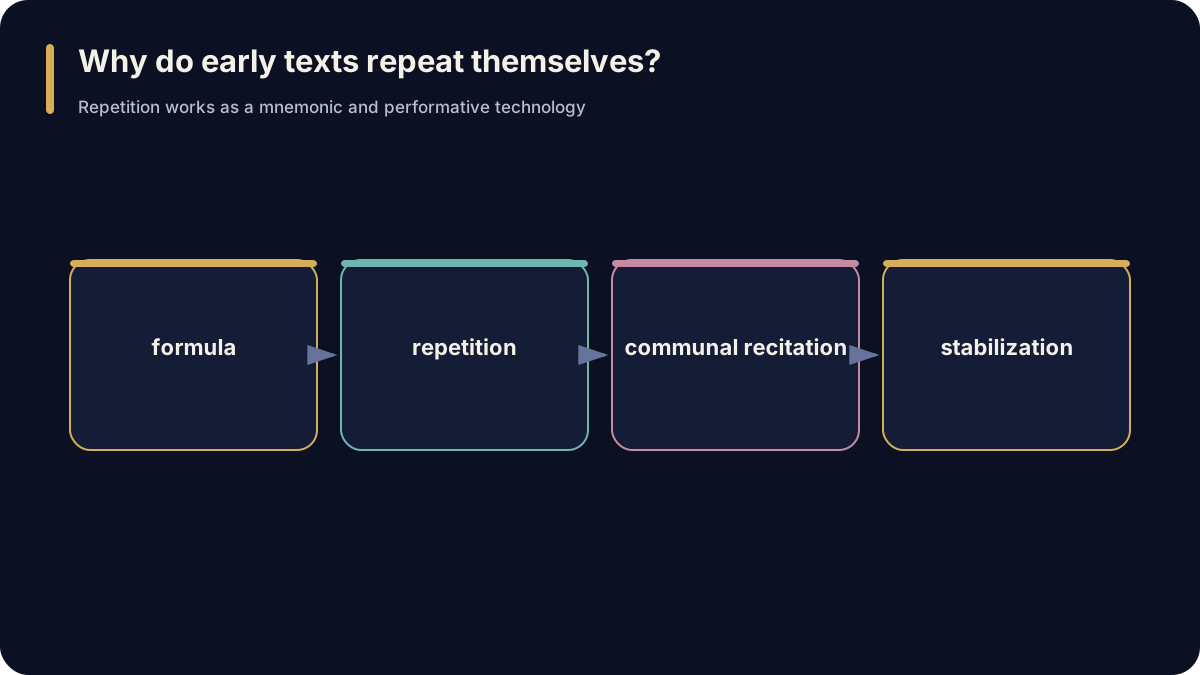
There is a strong practical reason for a model of fairly stable transmission. If one person recites a text, that person can change something without the alteration being immediately obvious. If several people recite the same text together, there has to be enough shared agreement about sequence, wording, formulas, and structure. Early Buddhism used collective recitation as an important means of preserving the Dhamma, and repetition and ordered lists were extremely useful for this kind of transmission. This does not guarantee complete immutability. It does, however, greatly reduce the room for completely free individual improvisation.
Who were the bhāṇakas? The term bhāṇaka appears in the history of Buddhist transmission. It is usually translated as reciter, speaker, or transmitter of texts. Later Theravāda tradition associates reciters with particular textual collections, so specialists in individual Nikāyas are often discussed. For the earliest period, however, greater caution is required. Recent research warns that the precise historical function of the bhāṇakas was not as simple as that of human recording devices preserving an already finalized canon. The term may include people who recited, taught, explained, and perhaps also participated in shaping texts. It is therefore safer to speak of specialized bearers and performers of the textual tradition, rather than automatically assuming an identical system of Nikāya-specific reciters for every early period.
Why so many numbers? Buddhist literature is full of lists: three roots of the unwholesome, Four Noble Truths, four satipaṭṭhānas, four brahmavihāras, five aggregates, five hindrances, six sense bases, seven factors of awakening, eight factors of the path. Such structures clearly have a doctrinal function. But they also serve memory extremely well. If we know there should be five elements, we notice more quickly when one is missing. If a collection is organized by numerical categories, the sequence itself assists recall. Numbers are therefore not only a philosophical system. They can also be a mnemonic framework.
The Aṅguttara Nikāya is almost an architecture of memory. This is especially obvious in the Aṅguttara Nikāya and related numerically organized collections. Material is arranged according to the number of elements: ones, twos, threes, fours, and onward. Such organization gives an enormous amount of teaching a clear internal structure. Not every discourse was necessarily created originally to fit a particular number. But numerical organization became an extraordinarily effective means of arranging and transmitting material.
Repetition Is Not Only an Aid to Memory
If repetition had only a mnemonic function, we would miss much of its effect. Imagine: “Form is impermanent.” “Feeling is impermanent.” “Perception is impermanent.” “Formations are impermanent.” “Consciousness is impermanent.” A modern textbook could shorten all of this to “all five aggregates are impermanent.” Informationally, that is more efficient. Psychologically, it is not necessarily the same. In the full repetition, each element is brought forward separately. Form. Feeling. Perception. Formations. Consciousness. The text guides the listener’s attention through the entire list.
The oral equivalent of a table. We can understand this as a predecessor of the modern table. Today we could place the five aggregates in rows and the three characteristics in columns. At a glance, we would immediately see the system. An oral culture has no visual table. It has to linearize it. Every combination has to be spoken. Repetition therefore allows a multidimensional structure to become a sequence of sentences. What appears redundant on the page can be a very clear system when heard.
Repetition as meditative direction of attention. This opens another possibility. If a person hears the same analysis applied in succession to the eye, ear, nose, tongue, body, and mind, the person does not receive only one abstract rule. Attention moves systematically through every domain. The same is true of the aggregates, hindrances, or factors of awakening. Allon notes that beyond mnemonic value, such features could also have psychological, contemplative, and even meditative effects on people who memorized and recited the texts. That possibility deserves to be taken seriously. We do not, however, need to claim that every repetition was consciously created as a distinct meditation technique.
Sound is part of the text. Oral literature is not only meaning. Rhythm, sound, phrase length, recurring phonetic structures, and the placement of pauses also matter. Allon points out that parts of early Buddhist prose even have metrical or near-metrical qualities that may have assisted recitation. Such features create another kind of checking mechanism. If part of a formula drops out, the recitation may no longer “sound” right. Rhythm therefore supports memory.
Repetition gives the teaching solemnity. Repetition also has a cultural effect. Religious language often uses recurring formulas because they create a sense of stability, weight, authority, ritual quality, and community. Once listeners know the formula, they can anticipate what comes next. They may even know how to recite it together with others. The text is no longer merely the spontaneous speech of an individual. It becomes the language of a tradition.
A standard formula can become a sign of authority. If a particular doctrine is always expressed in similar language, the formula itself becomes recognizable. The listener knows: this is how this teaching is expressed. That reduces terminological instability. At the same time, it creates a sense of continuity across different teachers, places, and generations. Standardization therefore has an institutional function in addition to its mnemonic one.
Why does the same paragraph appear in several suttas? Because a formula did not necessarily belong to only one discourse. If a tradition already had an established way of describing a jhāna, a brahmavihāra, or liberation, it was efficient to use the same formulation wherever it was needed. Several sutras can therefore contain almost identical longer passages. In modern literature this might look unoriginal. In an oral tradition, standardized language is an advantage.
But Formulas Can Also Change Texts
Here a paradox appears. What helps preserve a text can also change it. If a reciter knows a standard formula extremely well, it can be added at a point where it was not previously present. A text can thus expand precisely because the tradition knows its formulas so well. Anālayo’s comparison of the Aṭṭhakavagga and the Udāna shows cases in which explanatory or commentarial material probably became part of the canonical text gradually during oral transmission. Formulas therefore stabilize texts, but they can also expand them.
A commentary can become part of the base text. Imagine a difficult verse. A teacher recites it and then explains it. The students remember both. After several generations, the boundary between the text and the explanation of the text may no longer be entirely clear. The explanation can begin to be recited together with the basic material. No forger is required for this process. The normal operation of oral teaching and memory is enough.
Changes are not necessarily only mistakes. Nor do all differences between texts arise from poor memory. A reciting or editorial community can deliberately add an explanation, harmonize terminology, expand a parallel list, adapt a narrative, or insert a well-known formula. Allon explicitly addresses the problem of intentional changes within a tradition that at the same time sought to preserve fixed material. This is an important safeguard. “Change” does not always mean “error.” It can mean historical development of the text.
Why, Then, Do Different Traditions Remain So Similar?
Because transmission was evidently not completely free composition after all. Pāli, Chinese, Sanskrit, and Gāndhārī parallels often preserve so much shared material that a strongly conservative transmission must lie behind them. Yet the differences show that conservatism did not mean complete freezing. The combination of stability and variation is one of the main characteristics of early Buddhist transmission.
A longer version is not automatically later. When comparing two versions, it is very tempting to use a simple rule: the shorter one is older, while the longer one was expanded later. Sometimes that is true. But not always. A text can also become shorter during transmission. A paragraph may drop out. A reciter may skip it. A written copyist may use an abbreviation. An editor may remove redundancy. Length alone therefore does not tell us the direction of development.
Shorter is not automatically more original either. If a Chinese parallel contains fewer repetitions than a Pāli version, that fact alone does not allow us to conclude that the Chinese version is older. Nor does the reverse follow. Comparative textual analysis has to consider the structure of the whole discourse, other parallels, terminology, the logic of the paragraphs, how a particular transmission handles repetition elsewhere, and the possibility of omission or expansion. This is why reconstructing textual history is far more difficult than applying the rule “the shortest text wins.”
Some repetitions may remain open to expansion. Even more interesting is the problem of repeated sequences that seem almost open-ended. Rupert Gethin has observed that some peyyāla sections display a structure in which new members could be added according to the same pattern; he suggests that such sections may have gradually crystallized after a period of somewhat more flexible composition and adaptation. At the same time, he emphasizes that the model of early Buddhist oral transmission remains complex and incompletely resolved. This is an important counterexample to a stricter model of a completely fixed text.
What is peyyāla? In the Pāli written tradition the term peyyāla, or abbreviated forms of it, appears frequently. It indicates that a familiar repeated formulation is to be supplied or repeated according to an already known pattern. In practice it can function rather like “and so on” or “repeat the formula above with the following elements.” The Pali Text Society describes it as a device for reducing or replacing repetition in the writing of texts where the fully written-out form would occupy a great deal of space.
Peyyāla does not prove that the oral text already used “etc.” Caution is needed here. When we see peyyāla in a manuscript, it is easy to assume that this is how the text had always been recited. Not necessarily. A written abbreviation tells us reliably how a written tradition managed long repetitions. It is much harder to prove whether the earliest oral reciters always spoke the repetition in full at the same point or whether they too used some strategies of abbreviation. We therefore should not present peyyāla as direct evidence for the earliest oral practice.
Writing Changes the Economics of Repetition
In an oral environment, redundancy can help memory. In a manuscript, it has a cost: more palm leaves or birch bark, more ink, more space, and more labor by the copyist. It is therefore understandable that written cultures develop signs for shortening repeated passages. The transition from oral to written medium is thus not merely a technical change. It also changes the optimal form of a text.
Modern translations do the same. Translators today also often shorten repetitions. Instead of six almost identical paragraphs, they may write “the same applies to the remaining five senses.” This is convenient for the reader. But if we compare such a translation with an edition that writes all repetitions out in full, we may get the impression that the two texts differ greatly in length. Sometimes the difference is primarily editorial. When studying the structure of an early text, it is therefore important to know whether repetitions have been abbreviated in the edition being used.
Repetition reveals categories. Repetition is also important for understanding doctrine. If the same analysis systematically moves through the five aggregates, we see that they are conceived as a connected set. If the same model moves through the six sense bases, we see the structure of a theory of perception. If it is repeated for the four brahmavihāras, we see their parallel character. Repetition therefore reveals the taxonomy of early Buddhist thought.
The text forces us not to skip anything. A modern reader likes to generalize. “I understand — impermanence applies to all the aggregates.” The early repetitive text forces us to proceed through form, feeling, perception, formations, and consciousness. Every element has to be stated. Such systematic treatment can function pedagogically. Nothing remains merely implicit.
Information was not the only purpose. Here lies one reason early Buddhist literature can sometimes frustrate the modern reader. Today we often read a text primarily to learn something new. Once we understand an idea, we want to move on. But an early religious text can serve several purposes at once: memorization, teaching, recitation, ritual, contemplation, reinforcement of doctrine, and the creation of a shared identity. In such an environment, a sentence we have already heard is not necessarily superfluous.
An early text is not a poorly edited modern essay. This may be the most important shift in perspective. If we judge an early sutra as a modern essay, it is full of unnecessary repetition. If we understand it as an oral text, collectively transmitted and often recited, the same feature becomes highly functional. Repetition helps stabilize form, organize lists, guide attention, create rhythm, support group recitation, and preserve the teaching. Yet the same system can also generate new layers over time.
Oral Transmission Is Therefore Neither a Recording nor Chaos
Perhaps the safest final picture lies somewhere between two caricatures. The first says: every sentence was transmitted word for word for centuries without a single change. The second says: reciters more or less improvised a new version every time. Historical evidence better supports something more complex. There were powerful forces of standardization: memorization, formulas, collective recitation, institutional transmission. But there were also changes: omissions, additions, harmonizations, explanations, new combinations of formulaic material. Different recensions stabilized over time at somewhat different points.
When we read repetition, we are reading the history of transmission. Long sequences of nearly identical sentences are therefore not merely an obstacle for the modern reader. They are a remnant of the technology by which a community transmitted an enormous body of text for centuries. Behind them we can almost see a teacher, a reciter, a group of monks, a student learning the next formula, and a community checking whether the sequence is correct. In a world without a printing press, server, cloud, or audio recording, voice, memory, formula, rhythm, and community were the principal carriers of text.
Why, Then, Do the Sutras Repeat So Much?
Because they were not created primarily for our way of reading. Repetition helped memorization. It supported recitation. It standardized doctrinal formulations. It organized long lists. It linearized structures that today we might display in a table. It emphasized individual elements. It gave language rhythm and authority. It may also have assisted contemplation. At the same time, it created conditions in which standard formulas could expand, contract, and adapt over time. Repetition is therefore evidence neither of complete textual immutability nor of unreliable transmission. It is evidence of a different mode of textual existence. For convenience, a modern reader can skip many repetitions. But if we skip all of them, we lose an important part of the history. Repetition tells us not only what a sutra teaches. It also tells us:
how it could live in human memory long enough for us to be able to read it today.
Sources and Literature
Primary Texts and Reference Editions
- SuttaCentral — comparative corpus of the Nikāyas, early texts, and parallels; Āgama and transmission data are checked against specialist comparative scholarship.
Research and Verification Literature
- Allon, Mark. Style and Function: A Study of the Dominant Stylistic Features of the Prose Portions of Pāli Canonical Sutta Texts and Their Mnemonic Function. Tokyo: International Institute for Buddhist Studies, 1997.
- Allon, Mark. The Composition and Transmission of Early Buddhist Texts with Specific Reference to Sutras. Hamburg Buddhist Studies 17. projektverlag, 2021.
- Anālayo, Bhikkhu. Early Buddhist Oral Tradition: Textual Formation and Transmission. Wisdom Publications, 2022. ISBN 978-1-61429-827-4.
- Shulman, Eviatar. Visions of the Buddha: Creative Dimensions of Early Buddhist Scripture. Oxford University Press, 2021.
- Gethin, Rupert. “Playing with Formulas.” Indo-Iranian Journal 68.1 (2025): 35–56. DOI 10.1163/15728536-06801004.
- Rhys Davids, T. W., and William Stede. The Pali Text Society’s Pali-English Dictionary. London: Pali Text Society, 1921–1925; later reprints. Entry: peyyāla.
Note: verification sources are part of the editorial apparatus. Where the original edition used during reconstruction was not preserved, a standard reference edition is not presented as the article’s presumed original source.