Dīgha Nikāya — Why Are Some of the Buddha’s Discourses So Long?
If we opened the Pāli Canon without a map, we could quickly get the impression that all Buddhist suttas are roughly the same kind of text. They are not. Some are a few paragraphs long. Others run for several pages.
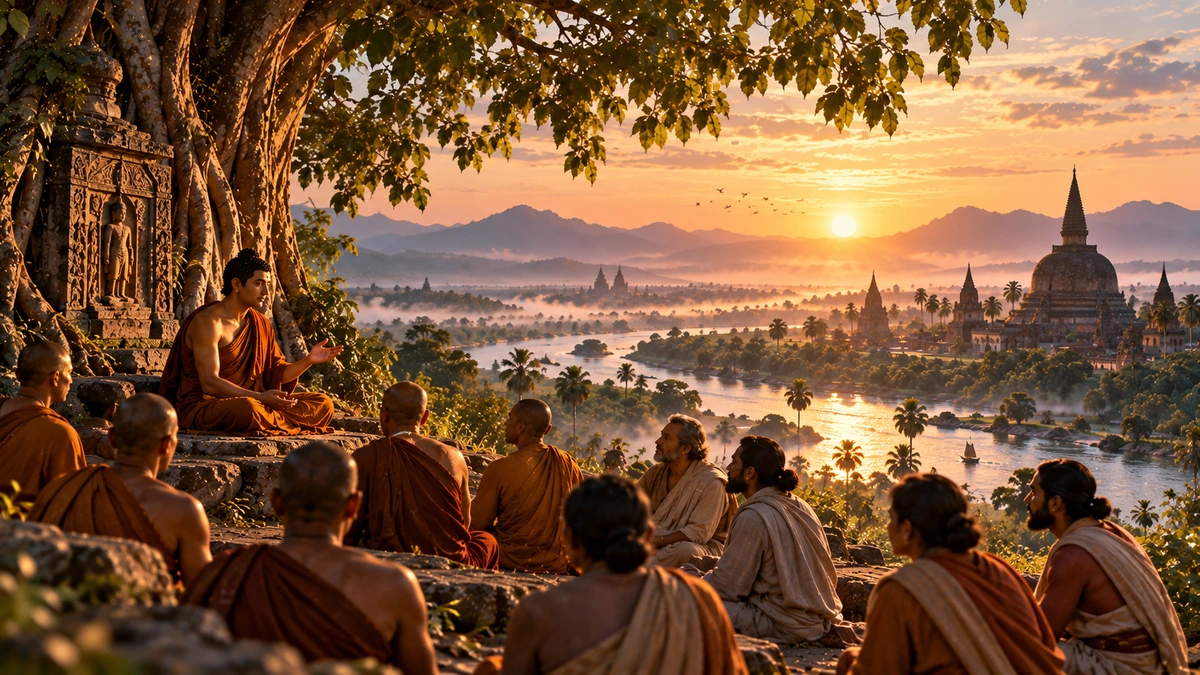
If we opened the Pāli Canon without a map, we could quickly get the impression that all Buddhist suttas are roughly the same kind of text. They are not. Some are a few paragraphs long. Others run for several pages. Some are almost small books. The first great collection of the Sutta Piṭaka is therefore called the Dīgha Nikāya — the Collection of Long Discourses. The Pāli collection contains 34 suttas, divided into three major sections: Sīlakkhandha-vagga — 13 discourses, Mahā-vagga — 10 discourses, Pāṭika-vagga — 11 discourses. But caution is already needed here. “Long discourses” does not merely mean discourses with many words. The Dīgha Nikāya has its own distinctive character. In it we find:
large doctrinal summaries, debates with other teachers, discussions of society and government, cosmology, mythological narratives, meditation instructions, the story of the Buddha’s death, and texts clearly designed as broad and impressive presentations of the Dhamma. The Dīgha Nikāya is therefore almost a showcase of early Buddhism.
What does Dīgha Nikāya mean?
In Pāli: dīgha — long; nikāya — collection or group. Most simply: Collection of Long Discourses. A parallel early collection in the Chinese canon is called the Dīrgha Āgama. This is the Sanskrit or northern Indian equivalent of the term. But one point is extremely important: the Dīrgha Āgama is not a translation of the Pāli Dīgha Nikāya. It is a related collection from another line of transmission. This will be one of the most important keys for understanding the early Buddhist canons.
Why are some discourses so long in the first place? Part of the reason is very practical. Oral tradition often relies on repetition, standardized formulas, lists, and repeated versions of the same structure. What looks long and repetitive in a modern book could function in an oral culture as an aid to memory. But that is not the whole answer. The Dīgha Nikāya also contains discourses clearly designed as large-scale presentations of a Buddhist worldview — not merely meditation instructions for a single disciple, but debates, public presentations, extended narratives, and in some cases almost Buddhist manifestos.
The first division: Sīlakkhandha-vagga
The first 13 discourses form the Sīlakkhandha-vagga — the division on moral conduct or ethical aggregates. Many of these texts share a common structure. First: ethical conduct. Then restraint of the senses. Contentment. Mindfulness. Meditative concentration. And finally: higher knowledges and liberation. This is one of the most systematic presentations of the path in early Buddhism.
Brahmajāla Sutta — the net of views. The first discourse of the entire collection is the Brahmajāla Sutta — DN 1. The title means something like The Net of Brahmā or The Supreme Net. The discourse is famous above all for its catalogue of 62 views: an eternal world, a finite world, an infinite world, different theories of the soul, postmortem existence, non-existence, and the origin of the world. The text systematically classifies these views and shows how they arise from experience, reasoning, memory, meditative states, and clinging. The point is not only “everyone else is wrong.” More important is how a person becomes trapped in a view. This will later be highly important for Mahāyāna critiques of all fixed conceptual positions.
Sāmaññaphala Sutta — what is the fruit of the contemplative life? DN 2 — Sāmaññaphala Sutta is one of the most important discourses on the entire path. King Ajātasattu asks: What does a person actually gain from the contemplative life? It is almost the perfect question. Why would someone leave home, wealth, social position, and comfort? The Buddha answers gradually. First come visible fruits: freedom from a master, simplicity, ethical life. Then restraint of the senses, mindfulness, contentment, overcoming the hindrances, jhānas, various knowledges, and finally liberation. If we wanted a single early text showing the classical graduated Buddhist path, DN 2 would be one of the best candidates.
The first thirteen discourses are also polemical. Much of the first division consists of conversations with brahmins, ascetics, other teachers, kings, and social elites. Early Buddhism did not arise in a vacuum. It competed with brahmanical traditions, Jains, materialists, skeptics, fatalists, and various ascetic movements. The Dīgha Nikāya therefore also preserves something of the intellectual marketplace of northern India.
Ambaṭṭha Sutta and the question of social status. DN 3 — Ambaṭṭha Sutta is important for its discussion of lineage, brahmin superiority, and social status. The text sharply challenges the idea that birth by itself makes a person spiritually superior. This does not mean that early Buddhism automatically develops a modern theory of social equality. But it very clearly refuses to measure spiritual value solely by birth. We already encountered the same motif in the final chapter of the Dhammapada.
Soṇadaṇḍa Sutta — what actually makes a brahmin? DN 4 goes even more directly to the same question. What makes a person a true brahmin? Lineage? Appearance? Knowledge of the Vedas? Or ethical conduct and wisdom? The sutta shifts the center of gravity from birth toward character and knowledge.
Kūṭadanta Sutta — sacrifice without slaughter. DN 5 contains an unusual discussion of sacrifice. Instead of a bloody ritual, it presents a model in which social unrest is reduced by supporting farmers, merchants, and workers, and by just administration. This is one of the most interesting political-economic passages in the early suttas. The discourse ultimately redirects sacrifice away from killing animals toward ethical and spiritual giving. This is a characteristic Buddhist move: not merely prohibiting an old concept, but transforming it.
Mahāli, Jāliya, Kassapasīhanāda ... The first division then continues with different questions: is the soul the same as the body, what do meditative powers mean, what is true asceticism, how do we distinguish superficial attainments from liberation? In many of these discourses the same basic pattern appears: someone arrives with a question, and the Buddha redirects it from metaphysics, status, ritual, or miracles toward practice and liberation.
Tevijja Sutta — the path to Brahmā. DN 13 — Tevijja Sutta is especially interesting. Two young brahmins argue about which path truly leads to union with Brahmā. The Buddha asks them: have their teachers actually seen Brahmā? No. Have the teachers of their teachers seen him? No. This produces the famous critique: people claim to know the way to someone whom none of them has seen. But the Buddha does not stop at ridicule. He offers his own path: the cultivation of goodwill, compassion, appreciative joy, and equanimity — the brahmavihāras. The old concept is thus taken over and redefined in Buddhist terms.
The second division: Mahā-vagga
The next ten discourses form the Mahā-vagga — the Great Division. Here we find some of the most famous suttas in the entire canon.
Mahāpadāna Sutta — Buddhas of the past. DN 14 speaks about previous Buddhas. For the development of Buddhist thought it is important that Gautama is not the only Buddha in cosmic history: there were earlier Buddhas, and there will be future Buddhas as well. The historical teacher is thereby placed within a cosmic pattern of Buddhahood. This will later become extremely important for Mahāyāna.
Mahānidāna Sutta — dependent origination. DN 15 — Mahānidāna Sutta is one of the major texts on paṭiccasamuppāda — dependent origination. Ānanda says that the teaching seems quite clear to him. The Buddha warns him: do not speak that way. Dependent origination is deep and difficult to understand. A large analysis follows of the mutual conditioning of consciousness, name-and-form, contact, feeling, craving, clinging, and becoming. This is one of the key texts for understanding that Buddhist analysis does not seek a first cause, but a network of conditions.
Mahāparinibbāna Sutta. DN 16 has already been treated separately. It narrates the final journey, death, Dhamma and Vinaya, relics, and the transition from a living teacher into tradition. The very length of DN 16 shows why the Dīgha Nikāya is not merely a collection of doctrinal lectures. It is also Buddhist memory.
Mahāsudassana Sutta. DN 17 continues the motif of Kusinārā. The Buddha tells the story of the great king Mahāsudassana. It is a magnificent story of wealth, power, kingship, and finally impermanence. Even the greatest kingdom and the greatest wealth come to an end: anicca appears again.
Janavasabha and Mahāgovinda. Some discourses in the second division are much more mythological and cosmological. They feature deities, Brahmās, previous lives, and heavenly worlds. This is an important correction to the modern image of early Buddhism as nothing but rational psychology without mythology. It is not. The early canon contains a rich cosmology and supernatural narrative.
Mahāsatipaṭṭhāna Sutta. DN 22 is an expanded version of the Satipaṭṭhāna Sutta we already examined as MN 10. Its main distinctive feature is a greatly expanded section on the four noble truths. This is a good example of the same or related textual core appearing in different collections. We should not imagine that every discourse existed in only one completely frozen form.
The third division: Pāṭika-vagga
The final 11 discourses form the Pāṭika-vagga. This division is even more diverse. Here we find polemics, cosmology, social theories, instructions for laypeople, and large catalogues of teachings.
Pāṭika Sutta. DN 24 contains a polemic concerning miracles, ascetic claims, and other teachers. The tone is quite sharp. It reminds us that early Buddhist literature is not always calm and neutral. It is also competitive religious literature.
Udumbarika Sutta. DN 25 deals with ascetic practice. The Buddha does not reject asceticism merely because it is difficult. The question is: does it lead to a reduction of greed, hatred, and delusion? The same Buddhist criterion appears again: not spectacle, but result.
Cakkavatti-Sīhanāda Sutta — the decline of society. DN 26 is one of the most interesting social texts. It describes how society begins to decline when a ruler fails to provide for the poor. From poverty comes theft; then punishment, violence, lying, and social disintegration. The connection is strikingly clear: economic distress → crime → violence → moral decline. The text then incorporates all of this into a vast cyclical cosmology of human decline and renewed growth. Political analysis and mythology are strongly intertwined here.
Aggañña Sutta — a Buddhist story of the origin of society. DN 27 — Aggañña Sutta is one of the most famous texts on society, caste, and the origin of royal authority. A brahmanical idea says that brahmins come from Brahmā’s mouth. The sutta almost satirically reverses this. Human beings are born from wombs. Social groups arise through actions, occupations, and historical processes. The people choose a king to maintain order. This is almost a contract theory of the origin of government — not in the modern sense, but pronounced enough for DN 27 to have become an important text in the history of political thought.
Sampasādanīya Sutta. DN 28 contains a powerful praise of the Buddha. Sāriputta expresses extraordinary confidence in his teacher. The Buddha then asks him, interestingly: do you know all Buddhas of the past? No. All Buddhas of the future? No. Do you even know my mind completely? No. How, then, can you speak so strongly? Sāriputta grounds his confidence in the structure of the Dhamma that he has understood. This is a sophisticated discussion of trust and the justification of trust.
Lakkhaṇa Sutta — the 32 marks of a great man. DN 30 speaks of the 32 bodily marks of a mahāpuruṣa — a great man. These ideas will later become very important for Buddha iconography, legendary biography, and the idea of the cakravartin. This is a good example of how the Dīgha Nikāya contains material quite different from the four noble truths or meditation on breathing.
Sigālovāda Sutta — ethics for laypeople. DN 31 — Sigālovāda Sutta is one of the most important early texts for lay life. It deals with relationships between parents and children, teachers and students, spouses, friends, employers and workers, laypeople and religious teachers. It is therefore sometimes called “the layperson’s Vinaya.” That is somewhat simplified, but it conveys the text’s significance well. Buddhism here is not only monastery and meditation. It is also social ethics.
Āṭānāṭiya Sutta — protection and the supernatural world. DN 32 is a protective text. It includes yakkhas, supernatural beings, and protective formulas. This is another important correction to the image of early Buddhism as a completely secular philosophy. Ritual and protective elements are not necessarily only late additions. Some are already present in a very early canonical environment.
Saṅgīti and Dasuttara — manuals of memory. The final two discourses, DN 33 — Saṅgīti Sutta and DN 34 — Dasuttara Sutta, are almost encyclopedic. They organize teachings into ones, twos, threes, fours, and so on. This is almost a perfect demonstration of oral culture. Why arrange teachings in numerical lists? Because they are easier to recite, verify, and remember. These discourses are also very important for understanding how early teachings gradually gave rise to the more systematic mātikā — a matrix or list of categories, which would later matter in the development of Abhidhamma.
The Dīgha Nikāya is therefore extremely diverse. In summary, it is not merely a collection of “the Buddha’s longest lectures.” It contains doctrine, ethics, politics, religious polemic, cosmology, myth, meditation, ritual, biography, social theory, and mnemonic organization. It is almost a microcosm of early Buddhism.
Why is there a parallel Dīrgha Āgama?
Because early Buddhism did not have only one line of transmission. The Pāli Dīgha Nikāya is preserved in the Theravāda tradition. The Chinese Dīrgha Āgama, however, derives from another early school transmission, usually associated with the Dharmaguptaka. The two collections share much material, but they are not identical — a fact crucial for comparative history.
The Dīrgha Āgama is not “a Chinese translation of the DN.” If it were merely a translation of the same collection, we would expect the same number of discourses, the same order, and the same textual boundaries. We do not have that. The Chinese Dīrgha Āgama contains a differently organized collection. Many individual discourses have clear Pāli parallels. Others are differently shaped, differently arranged, or have no direct equivalent in the DN. This suggests that the idea of a collection of long discourses formed early, but individual schools did not preserve exactly the same anthology.
What can comparison tell us?
If the same basic discourse exists in Pāli and in a Chinese Āgama, but comes from different school traditions, it is very likely that the core of the discourse is older than their separation. This is one of the main methods in historical research on early Buddhism. We are not asking “which present-day tradition possesses the one original book,” but what is shared across independent lines of transmission. Shared layers are often the best candidates for earlier material.
But even a parallel is not proof of a transcript. If two traditions have a similar discourse, that still does not mean these are the Buddha’s verbatim words. It means the discourse, or its basic structure, must have been old enough to exist before the transmission lines separated. That is a strong historical argument. It is not an audio recording.
Why is the Dīgha Nikāya important for orientation? Because from now on everything will be easier to place. When we encounter DN 1, DN 2, DN 16, DN 22, DN 31, these will no longer be random numbers. We will know that they are parts of one large collection with its own editorial character. Later we will do the same for the Majjhima Nikāya, Saṁyutta Nikāya, Aṅguttara Nikāya, and Khuddaka Nikāya. Only then will we really see the map of the early Buddhist canon.
Is the Dīgha Nikāya the oldest collection?
We cannot simply claim that. Some individual parts of the DN may be very old. Others show expansion, systematization, mythological elaboration, and editorial work. It is very likely that the collection as a whole did not arise all at once. As with the Dhammapada: the age of individual material is not the same as the age of the final collection. This will matter especially in a future article on the historical criticism of the suttas.
Length can also be a sign of redaction. A longer text is not necessarily older or more authentic. Sometimes the reverse may be true. A basic discourse core can over time acquire an introduction, additional lists, explanations, repetitions, and mythological frames. We saw this in comparing MN 10 and DN 22. We should therefore never infer in the Dīgha Nikāya that longer = older.
Conclusion
The Dīgha Nikāya contains only 34 discourses. That is few compared with some other Nikāyas. But each of these discourses can be a large world. Within the collection we find 62 philosophical views, an entire graduated path of monastic life, critique of caste status, a vision of nonviolent sacrifice, dependent origination, the Buddha’s death, cosmology, social decline, the origin of government, lay ethics, protective rituals, and almost encyclopedic lists of Dhamma. The label “Collection of Long Discourses” therefore somewhat understates its significance. The Dīgha Nikāya is one of the great libraries of the early Buddhist world in miniature. But length alone does not mean depth. The next collection will show a very different editorial ideal.
Not the grand public discourse, but medium-length teachings, often much more direct, practical, and psychologically detailed. Majjhima Nikāya — why are its 152 middle-length discourses, for many readers, the best entry into early Buddhism?
Sources and further reading
Primary texts and reference editions
- SuttaCentral: Dīgha Nikāya (DN), translation by Bhikkhu Sujato.
Research and verification literature
- SuttaCentral. Early Buddhist texts, translations, and parallels. For English Pāli translations, principally Bhikkhu Sujato. Dynamic digital corpus; cite individual text IDs where possible.
Note: verification sources are part of the editorial apparatus. Where the originally used edition was not preserved during reconstruction, a standard reference edition is not presented as the presumed original source of the article.