Aṅguttara Nikāya — Why Did Early Buddhism Organize Its Teachings by Numbers?
If the Dīgha Nikāya is organized around long discourses, the Majjhima around middle-length ones, and the Saṁyutta around thematic connections, the *Aṅguttara Nikāya* is built on an almost mathematical principle. One thing.

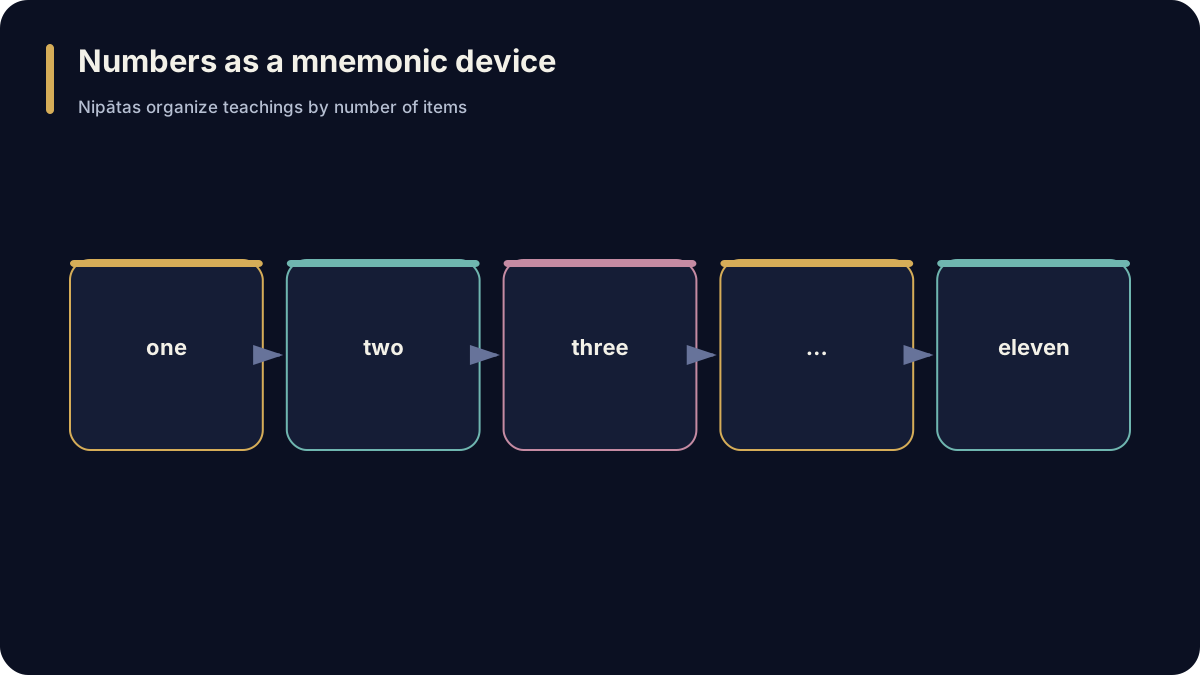
If the Dīgha Nikāya is organized around long discourses, the Majjhima around middle-length ones, and the Saṁyutta around thematic connections, the Aṅguttara Nikāya is built on an almost mathematical principle. One thing. Two things. Three. Four. Five. And so on up to eleven. The Pāli name Aṅguttara Nikāya means roughly the Collection of Numerically Increasing Discourses. Its basic idea is simple. Discourses are organized according to how many elements a teaching contains. If a discourse treats one thing, it belongs in the Eka-nipāta — Book of Ones. If two: the Duka-nipāta — Book of Twos. If three: the Tika-nipāta — Book of Threes. And so on up to the Ekādasaka-nipāta — Book of Elevens. This is one of the most obviously mnemonic structures in the entire Pāli Canon.
How Many Suttas Does the Aṅguttara Nikāya Contain?
The answer is not completely uniform. Depending on the edition and method of counting, figures such as 2,308, 2,344, 8,777, or the traditional 9,557 appear. The difference arises mainly because many discourses are short, formulaic, grouped into series, or preserved in abbreviated form. The same pattern can therefore be counted as one textual series or as several separate suttas. In this series we will therefore not present any one number as absolute. The stable architecture is the 11 nipātas.
The Eleven Books
- Eka-nipāta — Ones
- Duka-nipāta — Twos
- Tika-nipāta — Threes
- Catukka-nipāta — Fours
- Pañcaka-nipāta — Fives
- Chakka-nipāta — Sixes
- Sattaka-nipāta — Sevens
- Aṭṭhaka-nipāta — Eights
- Navaka-nipāta — Nines
- Dasaka-nipāta — Tens
- Ekādasaka-nipāta — Elevens
This is an ancient indexing system. If a student hears “five things...”, they already know in which part of the collection to look for them.
Numbers as a Technology of Memory
Early Buddhism lived for a long time primarily through oral transmission. Numerical lists are extremely effective. If you know there are five factors and can name only four, you immediately know something is missing. It is a simple memory check. That is why so many early Buddhist teachings are organized as threes, fours, fives, sevens, and eights. The number is a mental hook.
But the Aṅguttara is not merely a catalog. It contains more than dry lists. We find dialogues, short stories, ethical instructions, advice to laypeople, warnings to monks, conditions for success, conditions for decline, good and bad friends, teachers, family relationships, wealth, meditation, karma, and awakening. It is one of the most practical collections in the entire canon.
One thing. The Eka-nipāta contains very short units. One quality. One factor. One problem. One phenomenon. Such texts can function almost like Buddhist micro-aphorisms. They often warn that even a single quality of mind can produce great benefit or great harm.
Twos. The Duka-nipāta is a natural environment for contrasts: good and bad, diligence and heedlessness, wisdom and ignorance, two kinds of person, two conditions. The pair is one of the simplest didactic structures.
Threes. Here, one text is especially important for this series: AN 3.65 — Kālāma Sutta. In some editions it is numbered differently, so with AN it is often useful to include the sutta name or PTS reference as well. The Kālāma Sutta uses a very important triad: greed, hatred, delusion. And their opposites: non-greed, non-hatred, non-delusion. We can now see why the discourse is editorially placed precisely in the Book of Threes.
AN 3.65 in its wider setting. The Kālāma Sutta is therefore not an isolated manifesto of skepticism. It is part of a collection of short, practical discourses on conduct, character, consequences, and the cultivation of wholesome qualities. Its question — what leads to harm and what to welfare? — is highly characteristic of the Aṅguttara.
Fours. The Catukka-nipāta is extraordinarily rich. Buddhism contains many important sets of four: the Four Noble Truths, four brahmavihāras, four right efforts, four ways of answering questions, four kinds of people, four kinds of happiness. This makes the section highly varied.
Four ways of answering. AN preserves an early scheme according to which a question should be answered directly, analyzed, answered with a counter-question, or set aside. This is important for understanding the Buddha’s method: not every question is of the same kind, and therefore the answer is not always of the same type.
AN 4.61 — meaningful use of wealth. The Pattakamma Sutta is highly important for early Buddhist views of material life. It speaks of wealth acquired through work, effort, and in a proper way. Such wealth is used for one’s own welfare, for parents and family, employees and friends, protection against misfortune, social obligations, and gifts to worthy practitioners. This is not a teaching that “material wealth is bad in itself.” The question is how it is acquired and how it is used.
AN 4.62 — four kinds of happiness for a householder. The Anana Sutta distinguishes four kinds of happiness: the happiness of possession, the happiness of enjoying wealth, the happiness of being free from debt, and the happiness of blamelessness. The text judges the last as far greater than the first three. This is a characteristic Aṅguttara structure. The material dimension is not denied. It is placed within an ethical framework.
Fives. Five is an exceptionally important number in early Buddhism. Five aggregates. Five hindrances. Five spiritual faculties. Five powers. And many other practical sets of five. The Pañcaka-nipāta therefore functions as a convenient manual for self-examination.
The five hindrances. Sensual desire. Aversion. Sloth and torpor. Restlessness and remorse. Doubt. We have already encountered these five in other collections. The Aṅguttara can present them as a very clear checklist for practice. That is the advantage of numerical organization.
Sixes. The Chakka-nipāta contains many sixfold structures. They are often connected with the six sense fields, six kinds of response, six qualities of a practitioner, and other practical classifications. The collection again shows that the number is primarily an organizational key.
Sevens. At the number seven, of course, the seven factors of awakening are important. Mindfulness. Investigation of Dhamma. Energy. Rapture. Tranquility. Concentration. Equanimity. But the Sattaka-nipāta also contains other sets of seven: conditions for stability, conditions for decline, qualities of people and communities.
Seven conditions against decline. Here we encounter motifs familiar from the Mahāparinibbāna Sutta: meeting frequently, harmony, respect for rules, respect for elders. Such teachings show how the same tradition could live both in a large narrative DN discourse and in a short numerical AN formula.
Eights. The Aṭṭhaka-nipāta contains many eightfold structures. The best-known Buddhist example is of course the Noble Eightfold Path. But the numerical collection includes many other sets of eight as well.
The eight worldly conditions. Gain and loss, fame and disrepute, praise and blame, pleasure and pain. These four pairs form a very practical map of the fluctuations of the world. The aim of practice is not that loss or blame should never occur, but that the mind should not be completely dependent on these changes.
AN 8.54 — Dīghajāṇu Sutta. This is one of the most important discourses for laypeople. Dīghajāṇu asks what leads to welfare and happiness in this life and in the future. For this life the sutta lists diligent effort in one’s work, protection of properly acquired wealth, good friendship, and a balanced way of living. For future welfare: confidence, ethical conduct, generosity, and wisdom. It is a highly practical teaching. But it is not a modern business handbook; it is an ancient Indian ethic of the householder.
Nines. The Navaka-nipāta is somewhat less intuitive to a modern reader. But it contains various ninefold structures: meditative stages, kinds of people, ways of abandoning, and combinations of familiar teachings. This shows that numerical collections were not built only around the numbers that are most famous today.
Tens. The Dasaka-nipāta allows larger systematic lists. Here we can find ten qualities, ten courses of action, ten factors, ten questions, ten forms of development. At this point the collection already strongly resembles a mnemonic encyclopedia.
Elevens. The final book, the Ekādasaka-nipāta, contains sets of eleven. Especially interesting are chains in which one positive quality naturally conditions the next. For example: ethics → absence of remorse → gladness → rapture → tranquility → happiness → concentration → insight. Here the numerical list becomes almost a model of a causal path.
Number is not sacred metaphysics. This is an important safeguard. Three things are not connected merely because there are three of them. Four things are not necessarily one deep cosmic quaternity. Numerical structure is primarily a tool for classification, teaching, and memory. The same problem can be divided differently in another context. We will therefore not mystify the numbers.
The Aṅguttara and Laypeople
One striking feature of the collection is the enormous amount of material addressed to householders, families, merchants, donors, women, men, and rulers. The questions are highly concrete. How should wealth be preserved? How should it be used? Who is a true friend? What leads to decline? How does one live in a balanced way? How does one build a good future? This is an important correction to the idea that early Buddhism equals only monastic meditation.
Good friendship. The Aṅguttara repeatedly emphasizes kalyāṇamittatā — good friendship. This is an important corrective to the modern slogan “check for yourself”: early Buddhism simultaneously emphasizes who you associate with. The people around us influence views, habits, ethics, and practice.
A teacher is judged over time. The Aṅguttara also often describes how to recognize a good person, a good teacher, a mature practitioner. Not merely by speech, charisma, or status, but by conduct, response to criticism, absence of greed, and absence of harmfulness. This connects well with the Kālāma Sutta.
Monastic self-examination. Another part of the collection is addressed directly to the Saṅgha. What happens when a person is corrected for a fault? Do they become angry? Attack the one who corrected them? Look for excuses? Or do they examine themselves? Such discourses reveal a highly practical side of monastic life.
Why do the same teachings appear everywhere? Because DN, MN, SN, and AN are not four completely isolated books. The same teaching can exist as a long discourse, a middle-length dialogue, a thematic formula, or a numerical list. It makes more sense to understand them as four different editorial views onto a large shared current of oral tradition.
Ekottara Āgama
The related collection in the Chinese canon is the Ekottara Āgama — T 125. Ekottara means roughly increasing by one. So the basic organizational idea is the same. Here too teachings are classified numerically. But T 125 is not a translation of the Pāli Aṅguttara Nikāya. It is a related collection from another line of transmission.
Translation and redaction. The surviving Chinese collection is associated with Dharmanandi in 384 CE and with later redaction or editing under Gautama Saṅghadeva around 398. But its textual history is complex. Research also indicates the possibility of later additions and editorial interventions in the Chinese environment.
Which school did it belong to? Here we must be especially cautious. Links have been proposed with the Sarvāstivāda, Mahāsāṃghika, and Dharmaguptaka schools. Today Mahāsāṃghika is one frequently proposed hypothesis. But the question is not definitively settled. We will therefore use the formulation: the school affiliation of the surviving Ekottara Āgama remains uncertain. This is historically more honest than saying “T 125 is the collection of school X.”
Why Do AN and EA Differ So Much?
Because the numerical principle of organization is evidently old, but the contents of the individual numerical books were not completely frozen. Many discourses in one collection have no direct parallel in the other. Scholars note that the difference between the Pāli and Chinese numerical collections is considerably greater than in some other Nikāya–Āgama pairs. This means that the organizational principle is old, while the final anthologies developed separately.
What does this tell us about the formation of the canon? There was probably a large pool of short teachings, lists, dialogues, formulas, and similes. Different communities combined them, classified them, and organized them numerically in different ways. Again, this is the picture of a living tradition, not of one final book that had already been frozen at the beginning.
The Aṅguttara and Everyday Life
Perhaps this is the collection’s greatest distinctive feature. Very often it does not ask “What is the most abstract truth?” but rather: What do you do? What do you cultivate? What do you fail to notice? Who do you associate with? How do you use wealth? How do you react to criticism? What habits do you repeat? This is Buddhism at the level of everyday practice.
This series has already encountered the Aṅguttara. Most obviously in AN 3.65 — Kālāma Sutta. Its number is now no longer merely a technical reference. It tells us: Book of Threes. And when we encounter AN 4.x, AN 7.x, or AN 8.x in the future, we will already know what numerical architecture stands behind the text.
Conclusion
The Aṅguttara Nikāya is an enormous collection organized by a very simple principle: one, two, three, four, five, six, seven, eight, nine, ten, eleven. Yet from that emerges an entire world of ethics, meditation, family relationships, monastic discipline, material life, friendship, karmic teachings, and awakening. The numbers are not a mystical secret. They are a technology of memory. And for precisely that reason the Aṅguttara preserves a very direct view into the oral architecture of early Buddhism. The next collection will be the hardest of all to describe. The Khuddaka Nikāya is not organized according to one single logic. It is almost a library within a library. Dhammapada. Udāna. Itivuttaka. Sutta Nipāta. Theragāthā. Therīgāthā. Jātakas. And a number of other very different works.
Khuddaka Nikāya — Why Is the “Minor Collection” Actually the Most Diverse Library in the Pāli Canon?
Sources and Literature
Primary Texts and Reference Editions
- SuttaCentral: Aṅguttara Nikāya (AN), translation by Bhikkhu Sujato.
Research and Verification Literature
- SuttaCentral. Early Buddhist texts, translations, and parallels. For English Pāli translations, principally Bhikkhu Sujato. Dynamic digital corpus; cite individual text IDs where possible.
Note: verification sources are part of the editorial apparatus. Where the original edition used during reconstruction was not preserved, a standard reference edition is not presented as the article’s presumed original source.