Saṁyutta Nikāya — How Early Buddhism Organized Thousands of Short Discourses into a Thematic Network
If the Dīgha Nikāya is a collection of long discourses and the Majjhima Nikāya a collection of middle-length dialogues, the *Saṁyutta Nikāya* is organized according to a different principle. Not primarily by length, but by **connections**. The Pāli word **saṁyutta** means something like connected, joined, or bound together.
If the Dīgha Nikāya is a collection of long discourses and the Majjhima Nikāya a collection of middle-length dialogues, the Saṁyutta Nikāya is organized according to a different principle. Not primarily by length, but by connections. The Pāli word saṁyutta means something like connected, joined, or bound together. The name of the collection can therefore be translated as the Connected Discourses or, more literally, the Collection of Thematically Connected Discourses. It is one of the largest collections of early Buddhism. Yet a difficulty appears with the very first basic fact. How many discourses does it actually contain? That depends on how they are counted. In one modern system there are 2,889. Bhikkhu Bodhi counts 2,904 in his arrangement.
Traditional commentarial counting can reach 7,762. The difference arises mainly because many discourses survive in highly abbreviated form, and because an editor may count the same sequence of repeated formulas either as one block or as several separate suttas. The number of individual discourses is therefore not the most stable way to describe the collection. A much more stable architecture is 5 major vaggas and 56 saṁyuttas.
Five Major Divisions
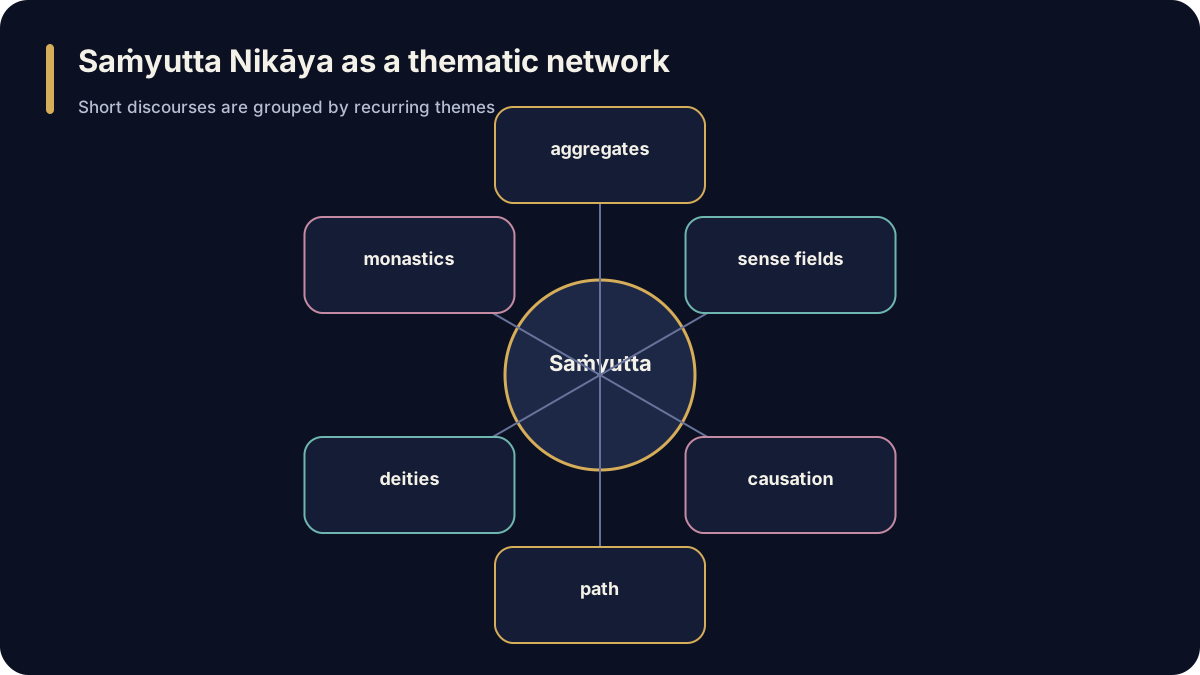
The Saṁyutta Nikāya is divided into Sagātha-vagga — SN 1–11 Nidāna-vagga — SN 12–21 Khandha-vagga — SN 22–34 Saḷāyatana-vagga — SN 35–44 Mahā-vagga — SN 45–56. Each major vagga contains several saṁyuttas — groups of discourses linked by a theme, a person, a class of beings, or a particular teaching. Thus SN 12 — Nidāna-saṁyutta is the great group on dependent arising. SN 22 — Khandha-saṁyutta concerns the five aggregates. SN 35 — Saḷāyatana-saṁyutta the six sense fields. SN 36 — Vedanā-saṁyutta feelings. SN 45 — Magga-saṁyutta the Noble Eightfold Path. SN 47 — Satipaṭṭhāna-saṁyutta the four establishments of mindfulness. SN 54 — Ānāpāna-saṁyutta mindfulness of breathing.
SN 56 — Sacca-saṁyutta concerns the Four Noble Truths. This is the essential logic of the collection. If you want to investigate one topic, you often do not look for a single large discourse. You open its thematic cluster.
Almost a data network of early Buddhism. In the Majjhima, a single sutta may contain a long story, several interlocutors, similes, an argument, and meditation instructions. The Saṁyutta often does something different. It presents the same teaching repeatedly, in very short formulas, with different interlocutors, in different situations, and with slightly different emphases. For the modern reader this can sometimes feel monotonous. For historical research, however, it is extraordinarily valuable. If the same formula recurs stably across different texts, we can observe what remained especially stable in transmission.
Why Is There So Much Repetition?
Because this is an oral architecture. For example: form is impermanent. Feeling is impermanent. Perception is impermanent. Volitional formations are impermanent. Consciousness is impermanent. Then the same structure for dukkha, non-self, arising, and cessation. A modern editor would write: “and the same applies to the other aggregates.” Oral culture often did the opposite. It repeated the whole pattern. This supports rhythm, memorization, group recitation, and the combinatorial expansion of the teaching. That is why the number of “suttas” can vary so dramatically depending on the method of counting.
A Complete Map of the 56 Saṁyuttas
Sagātha-vagga — SN 1–11.
- Devatā-saṁyutta — devas
- Devaputta-saṁyutta — sons of devas, or young deities
- Kosala-saṁyutta — King Pasenadi and Kosala
- Māra-saṁyutta — Māra
- Bhikkhunī-saṁyutta — Buddhist nuns
- Brahmā-saṁyutta — Brahmās
- Brāhmaṇa-saṁyutta — brahmins
- Vaṅgīsa-saṁyutta — the monk Vaṅgīsa
- Vana-saṁyutta — the forest
- Yakkha-saṁyutta — yakkhas
- Sakka-saṁyutta — Sakka
Nidāna-vagga — SN 12–21.
12. Nidāna-saṁyutta — dependent arising
13. Abhisamaya-saṁyutta — breakthrough or direct realization
14. Dhātu-saṁyutta — elements
15. Anamatagga-saṁyutta — saṃsāra with no discernible beginning
16. Kassapa-saṁyutta — Mahākassapa
17. Lābhasakkāra-saṁyutta — gain, honor, and fame
18. Rāhula-saṁyutta — Rāhula
19. Lakkhaṇa-saṁyutta — Lakkhaṇa and visions of karmic consequences
20. Opamma-saṁyutta — similes
21. Bhikkhu-saṁyutta — monks
Khandha-vagga — SN 22–34.
22. Khandha-saṁyutta — the five aggregates
23. Rādha-saṁyutta — Rādha
24. Diṭṭhi-saṁyutta — views
25. Okkantika-saṁyutta — entry, or breakthrough into certainty
26. Uppāda-saṁyutta — arising
27. Kilesa-saṁyutta — mental defilements
28. Sāriputta-saṁyutta — Sāriputta
29. Nāga-saṁyutta — nāgas
30. Supaṇṇa-saṁyutta — supaṇṇas
31. Gandhabbakāya-saṁyutta — gandhabbas
32. Valāhaka-saṁyutta — cloud deities
33. Vacchagotta-saṁyutta — Vacchagotta
34. Samādhi-saṁyutta — concentration
Saḷāyatana-vagga — SN 35–44.
35. Saḷāyatana-saṁyutta — the six sense fields
36. Vedanā-saṁyutta — feelings
37. Mātugāma-saṁyutta — women
38. Jambukhādaka-saṁyutta — Jambukhādaka
39. Sāmaṇḍaka-saṁyutta — Sāmaṇḍaka
40. Moggallāna-saṁyutta — Mahāmoggallāna
41. Citta-saṁyutta — the lay follower Citta
42. Gāmani-saṁyutta — village headmen
43. Asaṅkhata-saṁyutta — the unconditioned
44. Avyākata-saṁyutta — unanswered questions
Mahā-vagga — SN 45–56.
45. Magga-saṁyutta — the Noble Eightfold Path
46. Bojjhaṅga-saṁyutta — the seven factors of awakening
47. Satipaṭṭhāna-saṁyutta — the four establishments of mindfulness
48. Indriya-saṁyutta — spiritual faculties
49. Sammappadhāna-saṁyutta — right efforts
50. Bala-saṁyutta — powers
51. Iddhipāda-saṁyutta — bases of spiritual power
52. Anuruddha-saṁyutta — Anuruddha
53. Jhāna-saṁyutta — jhānas
54. Ānāpāna-saṁyutta — mindfulness of breathing
55. Sotāpatti-saṁyutta — stream-entry
56. Sacca-saṁyutta — the Four Noble Truths
This is the framework of the entire collection. Sagātha-vagga — a world of verses, gods, and persons. The first eleven saṁyuttas are quite different in literary character from the large technical blocks that follow. Here we find much poetry, short dialogues, mythology, and personal encounters. In SN 1 the Buddha converses with devas. SN 1.1 already asks: How does one cross the flood? The answer is paradoxical: not by standing still, and not by violently pushing ahead. It is a typical short Saṁyutta text: only a few lines, but with a wide interpretive space.
Māra. SN 4 gathers discourses involving Māra. Māra can appear as a cosmic tempter, a symbol of death, or the voice of fear, desire, doubt, and attachment. His power is often broken simply when the practitioner recognizes him.
The nuns. SN 5 Bhikkhunī-saṁyutta is important for the history of women’s voices in Buddhism. Māra tries to confuse different nuns. They answer him with an understanding of non-self, impermanence, the body, and identification. These are not merely stories about women. In the dialogues, the nuns themselves are teachers of the Dhamma.
Gods without ultimate authority. In SN 6 Brahmā-saṁyutta, Brahmās appear. But Buddhist cosmology does not place them above impermanence, conditionality, or karma. Some even hold mistaken ideas about their own eternity and must be corrected by the Buddha. This is an important pattern in early Buddhism: gods exist within the cosmos, not above it.
SN 12 — The Heart of Dependent Arising
The Nidāna-saṁyutta is one of the most important doctrinal blocks in the entire canon. Again and again it returns to paṭiccasamuppāda — dependent arising. Ignorance. Volitional formations. Consciousness. Name-and-form. Sense fields. Contact. Feeling. Craving. Clinging. Becoming. Birth. Aging and death. But the collection shows that this is not merely one rigid formula. The chain can be analyzed from different links, forward, backward, through arising, and through cessation. Dependent arising is therefore better understood as a method for analyzing conditions, not merely as a sequence for recitation.
Instead of “who?” ask “under what conditions?” Some discourses in SN 12 show a characteristic Buddhist redirection. The question Who feels? may already presuppose some enduring being. The more analytically important question is With what as a condition does feeling arise? This connects dependent arising with non-self.
SN 15 — saṃsāra with no discernible beginning. The Anamatagga-saṁyutta uses very powerful images. Saṃsāra is so long that its beginning cannot be found. The tears shed over losses in countless lives are greater than the oceans. Countless times we have lost mother, father, child, and loved ones. This is not cosmology for the sake of curiosity. Its purpose is to arouse disenchantment with the endless repetition of saṃsāra.
SN 22 — The Aggregates
The Khandha-saṁyutta is one of the central corpora for understanding non-self. Form. Feeling. Perception. Volitional formations. Consciousness. Again and again: they are impermanent, subject to change, and unfit for identification as this is mine, this I am, this is my self. It is also here that we find SN 22.59 — Anattalakkhaṇa Sutta. A discourse we previously read as a standalone text can now be seen in its thematic environment.
The aggregates are not five parts of a hidden soul. SN 22 shows very clearly that the five aggregates are not five components of a true self. They are domains of experience that a person can appropriate, use to construct identity, and cling to. The teaching does not search for a sixth, hidden aggregate — the real me. It investigates the very process of identification.
SN 23 — small questions, a large theme. The Rādha-saṁyutta is a good example of the Saṁyutta method. Rādha asks: What is a being? What is Māra? What is impermanent? What is dukkha? What is non-self? The answers repeatedly circle around the aggregates and clinging. Several discourses in this group also have clear parallels in the Saṃyukta Āgama, nicely illustrating a shared old layer of transmission.
SN 35 — A Laboratory of Sense Experience
The Saḷāyatana-saṁyutta is one of the largest analytical blocks. Six internal fields: eye, ear, nose, tongue, body, mind. Six external fields: forms, sounds, odors, tastes, touches, mental phenomena. From their meeting arise consciousness, contact, feeling, and then the possibility of craving or insight.
The Fire Sermon. In SN 35.28 Ādittapariyāya Sutta, everything is “burning.” The eye. Forms. Eye-consciousness. Contact. Feelings. But the fire is not physical. It is passion, aversion, delusion, birth, aging, death, and dukkha. The image is clear: sense experience can ignite into clinging.
SN 36 — the two arrows. The Vedanā-saṁyutta analyzes pleasant, unpleasant, and neutral feelings. The famous image of the two arrows distinguishes the first pain, which may simply occur, from the second: resistance, mental anguish, fear, and the story we add to it. This is one of the most practical early Buddhist analyses of suffering.
SN 41 — the learned lay follower Citta. The Citta-saṁyutta is important because Citta is a layperson. Yet he participates in highly demanding doctrinal discussions. This prevents an overly simple picture in which monks equal deep teaching and laypeople equal only giving. The early Buddhist world was more complex.
SN 43 — the unconditioned. The Asaṅkhata-saṁyutta is important for its different descriptions of the unconditioned. This matters for understanding nibbāna: if conditioned formations arise because of conditions, nibbāna is described precisely through the contrast asaṅkhata — unconditioned.
SN 44 — unanswered questions. Here the problems appear again: Is the world eternal? What happens to the Tathāgata after death? Does he exist? Does he not exist? This allows comparison with MN 63 and MN 72. The Saṁyutta thus shows us the same problem in multiple textual environments.
Mahā-vagga — Almost an Encyclopedia of the Path
The final twelve saṁyuttas form a highly systematic block of factors of the path. SN 45 — the Eightfold Path SN 46 — the seven factors of awakening SN 47 — satipaṭṭhāna SN 48 — faculties SN 49 — right efforts SN 50 — powers SN 51 — bases of spiritual power SN 52 — Anuruddha SN 53 — jhānas SN 54 — mindfulness of breathing SN 55 — stream-entry SN 56 — the Four Noble Truths. Here early Buddhism almost reveals its technical architecture of practice.
SN 47 — Satipaṭṭhāna is not only MN 10. This is an important lesson. If we read only MN 10 or DN 22, we may get the impression that satipaṭṭhāna is tied mainly to one large systematic discourse. But there is an entire Satipaṭṭhāna-saṁyutta. This means that the practice lived in numerous shorter formulas and contexts.
SN 54 — breathing is not only MN 118. The same applies to ānāpānasati. MN 118 is a major systematization. SN 54 preserves an entire cluster of shorter discourses. For historical analysis, it matters that a large systematic text may be one editorial form of a broader traditional unit of practice.
SN 55 — stream-entry. The Sotāpatti-saṁyutta treats the first irreversible stage of awakening. Recurring themes include confidence in the Buddha, Dhamma, and Saṅgha, and ethical conduct. Early Buddhism therefore does not know only the binary of ordinary person versus arahant. There are stages of the path.
SN 56 — the Four Noble Truths. The collection ends with the Sacca-saṁyutta. And it is precisely here that we find SN 56.11 — Dhammacakkappavattana Sutta. The first great discourse in this series is therefore only one unit within a large group on the Four Noble Truths. Here we also find the famous discourse on the siṃsapā leaves: the Buddha compares a handful of leaves in his hand with all the leaves in the forest. He says that he knows far more than he has taught. He taught what leads to disenchantment, cessation, peace, awakening, and nibbāna. And then he states the Four Noble Truths again. This is almost an editorial manifesto of the collection itself:
the teaching is not an encyclopedia of everything that exists; it is directed toward liberation.
Saṃyukta Āgama — Another Great Thematic Collection
The principal Chinese relative is the Saṃyukta Āgama — T 99. Its surviving Chinese version contains 1,362 sūtras. It is associated with Sarvāstivāda transmission. The Chinese translation is connected with Guṇabhadra and the mid-fifth century. Sanskrit fragments and individual Tibetan parallels also survive. Here too, this is not a Chinese translation of the Pāli Saṁyutta Nikāya, but a related collection from another line of transmission.
Its order also has a history. In the case of T 99, it is especially important that the present Chinese sequence is not necessarily identical with the original Indian arrangement. By comparing other sources, especially structures preserved in the Yogācārabhūmi, scholars have reconstructed a different possible ordering of the groups. This is an important lesson: even when we possess “one collection,” its present order need not have remained unchanged since the earliest phase.
Why is comparison between SN and SĀ so valuable? Because the discourses are often short. If two independent transmissions preserve the same question, the same core answer, a similar sequence, and the same formula, we can observe with considerable precision what is shared and what was added editorially. For example, SN 1.23 has parallels in both the principal and another Chinese Saṃyukta transmission. Such parallels do not prove the Buddha’s exact historical words. They demonstrate something else: that the core of the text was already widespread before the final divergence of the transmission lines.
Is the Saṁyutta the Oldest Collection?
We will not claim that. But it contains a great deal of short, formulaic material preserved in multiple parallels. Such texts are often especially useful when searching for older layers of transmission. Yet the rule still holds here: short does not automatically mean old.
Repetition is a feature, not a flaw. The Saṁyutta must be read as a product of oral culture. Repetition is not merely redundant ballast. It enables memorization, rhythm, control of transmission, and recombination. Modern translations therefore often abbreviate repetitions. For textual history, however, those very repetitions can be extremely important.
What does the collection tell us about the formation of early teaching? Perhaps this: early Buddhism did not arise as one large book. More likely, short discourses, formulas, lists, similes, dialogues, and thematic modules circulated. These were later arranged into nikāyas and āgamas. The Saṁyutta displays this modularity more clearly than almost any other collection.
Our project so far is already inside the Saṁyutta. We have already examined SN 22.59 — Anattalakkhaṇa Sutta and SN 56.11 — Dhammacakkappavattana Sutta. Other themes in our project have their own major thematic homes: dependent arising → SN 12 aggregates → SN 22 senses → SN 35 feelings → SN 36 path → SN 45 factors of awakening → SN 46 satipaṭṭhāna → SN 47 breathing → SN 54 stream-entry → SN 55 Four Noble Truths → SN 56. Individual suttas are no longer isolated islands. We can see the network.
Conclusion
The Saṁyutta Nikāya is an enormous collection. But its strength lies less in large individual discourses than in connection. Five vaggas. 56 saṁyuttas. Thousands of short texts, depending on how they are counted. The same teaching in several versions. The same concept in different situations. Dependent arising. Aggregates. Senses. Feelings. The path. Mindfulness. Breathing. Awakening. Noble Truths. If the Dīgha is a great hall, the Majjhima a classroom, then the Saṁyutta is a network of archival drawers. Open one, and inside you find dozens of perspectives on the same problem. The next collection is organized according to yet another principle. One thing. Two things. Three things. Four. And so on, all the way to eleven.
Aṅguttara Nikāya — Why Did Early Buddhism Organize Its Teachings by Numbers?
Sources and Literature
Primary Texts and Reference Editions
- Bodhi, Bhikkhu, trans. The Connected Discourses of the Buddha: A New Translation of the Saṃyutta Nikāya. Wisdom Publications, 2000.
- SuttaCentral: Saṁyutta Nikāya (SN), translation by Bhikkhu Sujato.
Research and Verification Literature
- Bodhi, Bhikkhu, trans. The Connected Discourses of the Buddha: A New Translation of the Saṃyutta Nikāya. Wisdom Publications, 2000.
- SuttaCentral. Early Buddhist texts, translations, and parallels. For English Pāli translations, principally Bhikkhu Sujato. Dynamic digital corpus; cite individual text IDs where possible.
Note: verification sources are part of the editorial apparatus. Where the original edition used during reconstruction was not preserved, a standard reference edition is not presented as the article’s presumed original source.