How Did Content Change Between Oral and Written Transmission? — What Happens When Speech Becomes Manuscript
Imagine a very simple story. The Buddha speaks. His disciples memorize his words. Several generations recite them accurately. One day the community writes them down. From that moment on, we have a text and the history of its change comes to an end.

Imagine a very simple story. The Buddha speaks. His disciples memorize his words. Several generations recite them accurately. One day the community writes them down. From that moment on, we have a text and the history of its change comes to an end. This picture is intuitive. But it is almost certainly too simple. For centuries, early Buddhist literature lived primarily in a world of listening, memorizing, teaching, and reciting. During that period it could be extraordinarily conservative without being completely unchanging. When writing appeared, changes did not stop. What changed above all were the mechanisms through which change could occur.
A reciter can omit or expand something. A scribe can skip a line. An editor can insert a familiar formula into a new context. A translator has to carry an expression into another language. An old Middle Indic formulation can be Sanskritized. Commentary can become part of the base text. A long repetition can be abbreviated, and an abbreviated version can later be expanded again. We therefore cannot divide the history of Buddhist sutras into two simple periods: first an unstable oral tradition, then a stable written text. Reality is much more interesting.
Oral Does Not Mean Unreliable
Let us begin with one of the most common misconceptions. If a text was not written down, that does not mean that every storyteller freely changed it. Early Buddhist sutras are strongly formulaic. They use repeated paragraphs, numbered lists, rhythmic structures, and standardized textual building blocks. There are also good reasons to think that collective recitation exerted strong pressure toward standardization: if several people recite the same text together, it has to be stable enough for everyone to know what comes next. Mark Allon therefore understands early sutras primarily as texts shaped for memorization and fairly faithful transmission, even though comparison of surviving versions also clearly shows that communities changed them over time. Oral transmission was therefore not chaos. But neither was it an audio recording.
Written does not mean unchanging. The opposite misconception is equally problematic. Once a text is written down, it is not frozen. In the ancient world there was no single central digital document from which everyone produced perfectly identical copies. There was a manuscript. When it deteriorated, it had to be copied. Then came a copy of the copy. Then a new copy of that copy. Each such moment is another point of transmission. A scribe can omit something. Write the same passage twice. Substitute a similar character. Correct an unusual form because it looks wrong. Restore a damaged section from memory. Or compare the text with another copy and consciously amend it. Writing therefore does not remove the human factor. It only changes its form.
The move from voice to manuscript was not a switch. Nor should we imagine one single moment when the Buddhist tradition was completely oral until a particular year and completely written the next day. By Aśoka’s period in the third century BCE at the latest, we possess unambiguous monumental inscriptions, while the oldest Buddhist manuscripts surviving today are generally later. Between those two facts lies considerable room for different uses of writing. One community may have written down certain material while continuing to transmit it authoritatively through recitation. Elsewhere the same text may still have existed primarily in human memory. Oral and written media were therefore not two completely separate eras. For a long time they could exist side by side.
What Happened in Sri Lanka?
Theravāda tradition reports that the Tipiṭaka was written down in Sri Lanka during the reign of King Vaṭṭagāmaṇi, conventionally placed in the late first century BCE. Later chronicles connect the event with the danger that political turmoil, famine, and the deaths of trained reciters might threaten oral transmission. Historically, however, caution is necessary. We do not possess a manuscript contemporary with the event. We know the story from later Theravāda sources. It is therefore safer to say that Theravāda tradition places the first writing down of its canonical corpus around the first century BCE.
Moreover, this was not the writing down of one universal “Buddhist canon.” By that time, different early Buddhist schools were already transmitting related but non-identical canonical collections. The Pāli Tipiṭaka is one of these early school traditions — exceptionally important because it is the only extensive canonical collection in an Indian language to have survived almost in its entirety.
Writing did not abolish memorization. Even if we accept the traditional dating of the writing down, it does not follow that from that point onward no one needed memory anymore. Buddhist recitation, memorization, and oral teaching continued. The manuscript did not replace the human bearer of the text. It became an additional layer of security. This matters because the same text could now develop in two connected systems: recitation and manuscripts. Written and oral traditions could correct each other. They could also preserve different versions.
We do not possess the original Sri Lankan manuscripts. Even if the Pāli canon was indeed written down in the first century BCE, the original copies did not survive. Palm leaves have a limited lifespan, especially in a tropical environment. Texts had to be recopied again and again. Today’s printed edition of the Tipiṭaka is therefore not the direct physical descendant of one manuscript that could be placed next to a hypothetical copy from Vaṭṭagāmaṇi’s time and compared line by line. A long manuscript history lies between them. This does not mean that everything changed dramatically. There are arguments that the Pāli discourses were already fairly stable doctrinally by the first century BCE. But “fairly stable” and “completely unchanged” remain two different claims.
A manuscript is a witness, not a birth certificate. In historical research it is useful to understand a manuscript as a textual witness. If we find a manuscript from 100 CE, we can say with great confidence that this or a closely related version of the text existed no later than that date. But the physical age of the manuscript alone cannot tell us when the sutra was first composed, how many centuries it had previously circulated orally, whether older lost versions existed, or whether another community at the same time knew a different version. A manuscript gives us a firm historical point. It does not automatically give us the beginning of the story.
Gāndhāra Changed the Picture
The discovery of Gāndhāran Buddhist manuscripts was especially important. They are written mostly on birch bark, in the Gāndhārī language and Kharoṣṭhī script. We now know a substantial corpus of such manuscripts dating approximately from the first century BCE to the third century CE. They are the oldest currently known surviving Buddhist manuscripts and the oldest surviving manuscripts from South Asia. But their significance is even greater. They showed that early Buddhist literature was never limited to the two languages most often associated today with canonical texts — Pāli and Sanskrit.
Buddhist literature was multilingual from an early period. Gāndhārī was an important Middle Indic language of the northwest. Buddhist texts also circulated in other Middle Indic forms; later, different corpora used Buddhist Hybrid Sanskrit and more classical Sanskrit. Large amounts of Indian Buddhist literature were then translated into Chinese and Tibetan. This radically changes our picture of an “original.” There is not necessarily one Pāli volume from which all other versions were made. We have numerous descendants of older textual traditions. Some are more closely related to one another. Others are more distant. Some original Indian texts were lost and survive only in translation.
Gāndhārī and early China. Gāndhāran manuscripts are also important because they help us understand the early transmission of Buddhism toward Central and East Asia. Linguistic evidence indicates that at least some early Chinese Buddhist translations were made from Gāndhārī or related northwestern Indian exemplars, not necessarily from classical Sanskrit. But this cannot be generalized to the entire Chinese canon. Chinese translations were produced over many centuries and from different Indian linguistic environments. Each individual text therefore requires its own history of transmission.
Translation Is Never Perfectly Transparent
Languages do not have perfectly identical semantic boundaries. An Indian term may have several meanings. A translator has to choose a Chinese word. That word may emphasize only one part of the original meaning. Another translator chooses a different option. A third transliterates the term instead of translating it. Some distinctions may disappear in the new language. Elsewhere new ones may arise. Chinese Āgamas are therefore not direct photographic copies of lost Indian manuscripts. They are translations that carry older Indian textual traditions through another important historical layer.
A difference between two translations is therefore not automatically an older Indian difference. If a Pāli and a Chinese parallel differ, several possibilities exist. Their Indian exemplars may already have been different. The translator may have abbreviated something. A difficult term may have been understood differently. The Indian exemplar may have used another word. A change may have arisen later in Chinese transmission. Comparative philology is therefore not merely the counting of differences. For each difference it has to ask at which stage of transmission it most likely arose.
What Can Change?
When we compare parallel early Buddhist sutras, we find almost an entire catalogue of textual development. One version contains an episode absent from another. The order of events changes. A list contains a different number of items. Information is arranged differently. The name of a place or person changes. An entire passage is shorter. Elsewhere it is expanded. A teaching is placed in a different narrative frame. The formulation changes while the basic doctrine remains the same. Difference within extensive similarity is in fact the normal condition of early Buddhist texts.
Omission. One of the simplest mechanisms is loss. In oral transmission, a reciter can skip part of a formula. In written copying, something similar happens with the eye. If two lines have similar endings, a scribe’s gaze can jump from the first directly to the second and omit everything in between. The text is now shorter. After several generations, this shorter version can be completely standard in a particular manuscript branch.
Addition. The reverse also happens. A text can grow. A familiar formula is inserted into a new position. A narrative receives a new scene. A list is systematically completed. A brief explanation is expanded. An addition may be unconscious. It may also be entirely deliberate. A community may consider the new version clearer or more consistent with another authoritative text.
When commentary becomes sutra. A particularly interesting mechanism is the gradual incorporation of commentary into the base text. Imagine an old verse that listeners find difficult to understand. The reciter speaks it and then adds an explanation. The next generation learns both. Over time, the boundary between the old verse and the established explanation may no longer be entirely clear. Comparative research has shown concrete cases where precisely such a gradual incorporation of explanatory material into canonical text is highly probable. No forger is required. A long history of teaching is enough.
Narrative can grow differently from doctrine. It is also important that not all parts of a sutra necessarily change at the same rate. Scholars have long observed the possibility that doctrinal formulas are often more conservative, while narrative framing can be more easily expanded and adapted: place, participants, dramatic arrival, political context, prior conversation, the listeners’ reaction. Such elements may offer more room for narrative development. But this is not an absolute rule. Doctrinal wording can change as well.
The Sāmaññaphala family as a warning. An excellent example is the textual family of the Sāmaññaphala Sutta/Śrāmaṇyaphala Sūtra. Several related versions survive in Pāli, Gāndhārī, Sanskrit, and Chinese and Tibetan translations. Their basic relationship is obvious. But their narrative development differs. Most strikingly, comparative analysis suggests that the most complex and developed narrative version is preserved precisely in a Gāndhāran manuscript from around the second century CE — the oldest material witness among the compared versions. This destroys a very attractive but dangerous rule: the more developed version must be younger. Not necessarily.
The oldest manuscript does not necessarily contain the oldest reading. Imagine two textual branches. The first begins expanding very early and by 100 CE has developed a considerably enlarged form. By chance, a manuscript from that time survives. The second branch remains somewhat more conservative, but all of its early manuscripts perish. Its oldest surviving copy is only from the year 900. Physically, the first manuscript is eight hundred years older. Yet in a particular paragraph the second may preserve an older form of the text. Philology must therefore never use the rule older object = older version in every detail.
A younger manuscript can transmit an extremely old text. This is especially important for the Pāli canon. Physically surviving Pāli manuscripts are much younger than the earliest Gāndhāran fragments. Comparative studies nevertheless show that large amounts of their textual material belong to much older shared Buddhist traditions. The material age of a copy and the historical age of its content are therefore always two separate things.
Harmonization
Some changes can arise precisely from a desire for greater correctness. Imagine one sutra using a slightly different formula from ten related texts. A reciter or editor knows the standard version well. The unusual formulation is changed to fit the others more closely. The result is a more elegant and systematic text. Yet that very elegance may be later. In historical texts, irregularity can sometimes preserve an older layer, while complete consistency is the result of editorial “cleaning.”
Lists can be standardized. The same applies to numerical doctrinal schemes. Buddhist teaching today often looks extraordinarily orderly: four of this, five of that, seven of another, eight of the next. Many such schemes are very old. Yet comparative texts sometimes show that the number, order, or formulation of items was not always identical everywhere. One version can gradually become standard. When we see it centuries later, its orderliness can seem almost self-evident. The history may have been considerably more uneven.
A text can change collections. Even something that is not a sentence of the sutra itself can change: its location. A related discourse may appear in one collection in one tradition and elsewhere in another. The order of sutras differs. Cycles are assembled differently. Some texts are included in the Vinaya in one tradition and in a sutra collection elsewhere. This matters because arrangement already creates meaning. A discourse placed among meditation texts is read differently from the same discourse placed in a narrative cycle about a particular disciple. Canonization is not only storage. It is also editorial organization.
Linguistic change is not only translation. Sanskritization is a special area. Much early Buddhist literature originally circulated in Middle Indic linguistic forms. Over time, in some traditions these forms moved closer to Sanskrit. But this is not always a simple process of Prakrit text → someone translates it once into Sanskrit. Buddhist Hybrid Sanskrit shows different stages of gradual Sanskritization of older Middle Indic linguistic material. Even later scribes could further adjust older forms in manuscripts toward Sanskrit norms. The linguistic history of a text can therefore be multi-stage.
But not every difference should be blamed on Sanskritization. This is another important safeguard. Comparative Gāndhāran examples show that significant narrative and structural differences among sutras were already present during a period when oral transmission remained crucial. We therefore cannot explain every difference between Pāli and Sanskrit traditions as the result of later translation or Sanskritization. Many variants are older. They already belong to different textual branches.
School Divisions Create Textual Families
As the early Buddhist community branches into different nikāyas or schools, textual transmission also becomes more branched. Each community can preserve its own Vinaya, sutra collection, doctrinal lists, terminology, and editorial peculiarities. As long as communities remain in frequent contact, they can influence one another. When great geographical distances separate them, their textual histories increasingly develop independently. We thus obtain something comparable to a family tree. Not a perfectly straight tree — traditions can also exchange material — but branched enough for us to speak of textual lineages.
Writing paradoxically preserves diversity. This is one of the most interesting consequences of writing. A manuscript stabilizes a particular version. If two communities write down two versions of the same discourse, writing does not erase the difference. It preserves both. Centuries later an archaeologist may pull from the ground a version whose existence was previously unknown. Writing therefore does two apparently opposite things. It helps stabilize text. And it helps preserve evidence of textual diversity.
Manuscripts are not merely containers for words. Their materiality matters as well. A text requires a writing surface, ink, a scribe, time, space, storage, and an institution that protects it. Birch bark survives differently from palm leaf. A dry climate differs from a tropical one. A cave differs from a monastic library. What has physically survived is therefore not necessarily a representative sample of everything that once existed. Archaeology always sees the effects of climate, material, and chance as well.
The oldest thing we find is not necessarily the most important thing that existed. This is especially important in Gāndhāra. Gāndhāran manuscripts are the oldest surviving material Buddhist witnesses known today. But that does not mean that Gāndhāran Buddhism was the oldest form of Buddhism or that all other traditions are younger. It means primarily that under these historical and material conditions, exceptionally old manuscript material survived into our time. Equally old literature may have existed elsewhere on material that simply did not survive.
A manuscript can serve different functions. Nor should all manuscripts be treated as the same kind of book. A manuscript may be intended for study, recitation, teaching, storage, donation, or religious deposition. Some Gāndhāran manuscripts were even placed in containers and deposited in antiquity, which itself shows that a material text could have a religious function, not only a practical library function. The purpose of a manuscript can affect its form. An experienced reciter may need only an abbreviated version. A student may need more explanation. A ritual copy may have a very different role.
Written tradition develops abbreviations. Long repetition that is useful in oral recitation requires material and time in a manuscript. Written traditions therefore develop ways to shorten repeated portions. In Pāli manuscripts we find peyyāla and related signs indicating that a known structure should be completed according to a pattern. This is a good example of how a change of medium alters the economics of text. An oral system often benefits from full repetition. A written system can benefit from abbreviation.
But an abbreviated version can later be expanded again. Here too, history is not one-way. A scribe may write an abbreviation. A later editor may expand it again in a printed edition. Another tradition may expand it slightly differently. New differences arise. Comparative research draws attention precisely to processes of contraction and re-expansion in which a later expansion is not necessarily identical to what had once been abbreviated. Textual transmission is therefore more like an ecosystem than a copying machine.
Canonization Does Not Stop History
The word canon sounds final, as though a door can be closed and everything thereafter fixed. Canonization can indeed restrict which works a community accepts as normative. But texts still have to be copied, recited, translated, commented on, edited, and later printed. Even a closed canon therefore still requires a history of transmission.
Printing brings the next major change. Many centuries later, printing makes it possible to produce large numbers of nearly identical copies. Some types of scribal error decline dramatically. But a new question appears: Which manuscript version will we print? If an editor selects one local tradition, its peculiarities can suddenly acquire much broader authority. Printing therefore strongly standardizes. And standardization always also means selection.
Critical editions try to read history backward. Modern textual criticism can do something an ancient local community often could not: compare many different witnesses. Pāli manuscripts. Gāndhāran fragments. Sanskrit texts. Chinese translations. Tibetan translations. Sometimes different Vinayas. A researcher then tries to determine which variants are most likely older, which later, and which arose independently. But a critical edition is not a time machine. It is the best scholarly reconstruction based on available evidence.
There is no magic rule for the “original.” Textual criticism has no single algorithm by which the shortest version is always oldest, the longest late, Pāli original, Sanskrit late, a Chinese translation less useful, or the oldest manuscript always the best version. Every one of these rules can fail in a specific case. Researchers therefore combine language, structure, different parallels, manuscript history, doctrinal development, narrative logic, and characteristic habits of a particular transmission line. No single criterion is sufficient.
What changed the most? There is no single answer. In some texts, the largest changes are narrative. In others, linguistic. In one case length changes substantially; elsewhere sequence changes. In some texts the doctrinal core is strikingly stable. Elsewhere different traditions systematized the same theme in somewhat different ways. Every sutra has its own history. “How much did Buddhist texts change?” is therefore not a question with one numerical answer.
But continuity is equally real. After all these differences, we could gain the false impression that if so much changed, early sutras are historically almost useless. Comparative material shows the opposite. Despite centuries of transmission through different communities, languages, countries, and media, many parallel sutras preserve a surprisingly similar basic structure and doctrinal core. Early transmission was broadly conservative, even though it was certainly not completely unchanging. This is probably the most important balancing point in the entire article.
Differences are not evidence of failure. If two surviving sutras differ, we do not have to choose one and declare the other “corrupt.” A difference can be historical data. If three traditions agree on one paragraph and a fourth has an addition, we can begin to investigate where the addition arose. If two traditions have one sequence and two another, we have evidence of an earlier split. If only one uses a particular terminology, this may indicate local systematization. Variation is therefore an invaluable research tool.
Descendants help us reconstruct an ancestor. This is the paradox. We would prefer one perfect original. But we do not have it. We have descendants. Precisely because descendants differ somewhat from one another, we can investigate what was probably inherited from a common ancestor and what is distinctive to an individual branch. If only one tradition had survived, it would be much harder to know which elements were broadly early and which merely local. Diversity, which at first looks like an obstacle, is therefore one of our best routes into older layers.
Oral and Written Are Not Enemies
It is therefore useful to abandon one final simplification: oral = unreliable and written = reliable. An oral community can develop extremely strict systems of memorization. A scribe can make an error. Collective recitation can stabilize a formulation remarkably well. A manuscript can preserve a local anomaly. A reciter can add a standard paragraph. A scribe can omit it. Writing can save a text when reciters die. Oral tradition can preserve a text for centuries where every manuscript perishes. Both media have their strengths. And both have their histories of change.
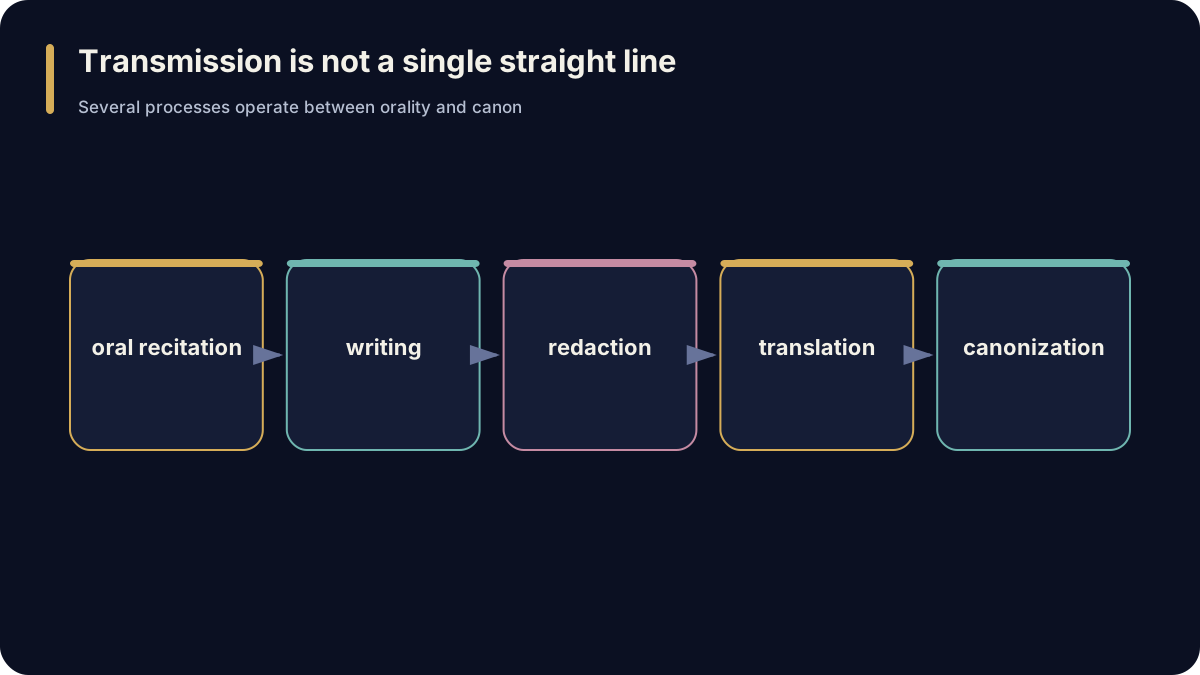
Speech becomes tradition. We can therefore imagine the history of a sutra as a long chain: teaching, oral formulation, memorization, collective recitation, arrangement into a collection, local version, school recension, manuscript, new copy, linguistic adaptation, translation, commentary, critical edition, print, digital text. At every stage two forces operate: preserve and adapt. Without the first, the text would disappear. Without the second, it would have far greater difficulty surviving changes of language, place, audience, and medium.
A sutra is therefore not always one object through time. When we say Satipaṭṭhāna Sutta, Sāmaññaphala Sutta, or Mahāparinibbāna Sutta, we may imagine one book traveling through the centuries. Historically, however, it is often better to speak of a textual tradition — a family of versions. Some are lost. Some survive only as fragments. Some only in translation. One becomes standard in one school. Another in another. A third is discovered by archaeologists after two thousand years.
What, then, is the original? The question suddenly becomes very difficult. Is the original the Buddha’s actual discourse? The disciples’ first formulation? The first standardized version for recitation? The common ancestor of all surviving parallels? The first version incorporated into a particular collection? The first written copy? For a text that grew and was edited within an oral community, there may never have been one single moment equivalent to “the author finished the manuscript,” as we expect with a modern book. The original may be less an object than a stage in a process.
This does not mean there is no history behind the text. Caution has its limits too. Collective transmission does not imply that everything was invented later. An old formula may come from a real teacher. The core of a dialogue may derive from a historical encounter. A central teaching may come from a very early period. The text may then have acquired over several generations the form in which we know it today. We therefore need to distinguish a historical core from a final literary form. Both can belong to the same sutra.
When speech becomes manuscript. What really changed when speech became written text? Memory received external support. A text could outlive an individual reciter. Comparing different copies became easier. But new types of scribal error, new editorial possibilities, and new strategies of abbreviation also appeared. Individual local versions could become physical objects and survive as separate branches. Writing therefore did not end the history of sutras. It helped make part of that history visible to us today.
Stability and change belong to the same story. If early Buddhist sutras had changed without restraint, we would not now find such a large shared core across different schools and languages. If they had never changed, however, we could not explain variants, new narrative layers, linguistic adaptation, translations, and different canonical arrangements. The surviving literature shows both: strong conservatism and genuine historical development. This is not a contradiction. It is how traditions survive.
Text as a living chain. A sutra today is therefore neither a completely new text nor a fossil untouched for two thousand years. It is the result of a long chain of people: reciters, teachers, monks, nuns, editors, scribes, translators, donors, librarians, philologists, and today also digital editors. Every generation received something, tried to preserve it, and in doing so inevitably left at least a small trace. The question “Did sutras change during transmission?” is therefore no longer the most interesting one. Of course they did. The more important question is: What changed, what remained stable, and how can we tell the difference? It is precisely the relationship between these forces that allows us to reconstruct the history of a Buddhist text. And this is why differences among surviving traditions do not necessarily carry us farther from their origins.
Sometimes the differences are precisely what show us the way back.
Sources and Literature
Primary Texts and Reference Editions
- SuttaCentral — comparative corpus of the Nikāyas, early texts, and parallels; Āgama and transmission data are checked against specialist comparative scholarship.
Research and Verification Literature
- Allon, Mark. The Composition and Transmission of Early Buddhist Texts with Specific Reference to Sutras. Hamburg Buddhist Studies 17. projektverlag, 2021.
- Anālayo, Bhikkhu. Early Buddhist Oral Tradition: Textual Formation and Transmission. Wisdom Publications, 2022. ISBN 978-1-61429-827-4.
- Shulman, Eviatar. Visions of the Buddha: Creative Dimensions of Early Buddhist Scripture. Oxford University Press, 2021.
Note: verification sources are part of the editorial apparatus. Where the original edition used during reconstruction was not preserved, a standard reference edition is not presented as the article’s presumed original source.