Prometheus: Fire, Knowledge and Rebellion Against Authority
Prometheus as the giver of fire, knowledge and humanity’s creative capacity — and as a symbol of the person who places conscience, responsibility and freedom before authority’s bare demand for obedience.
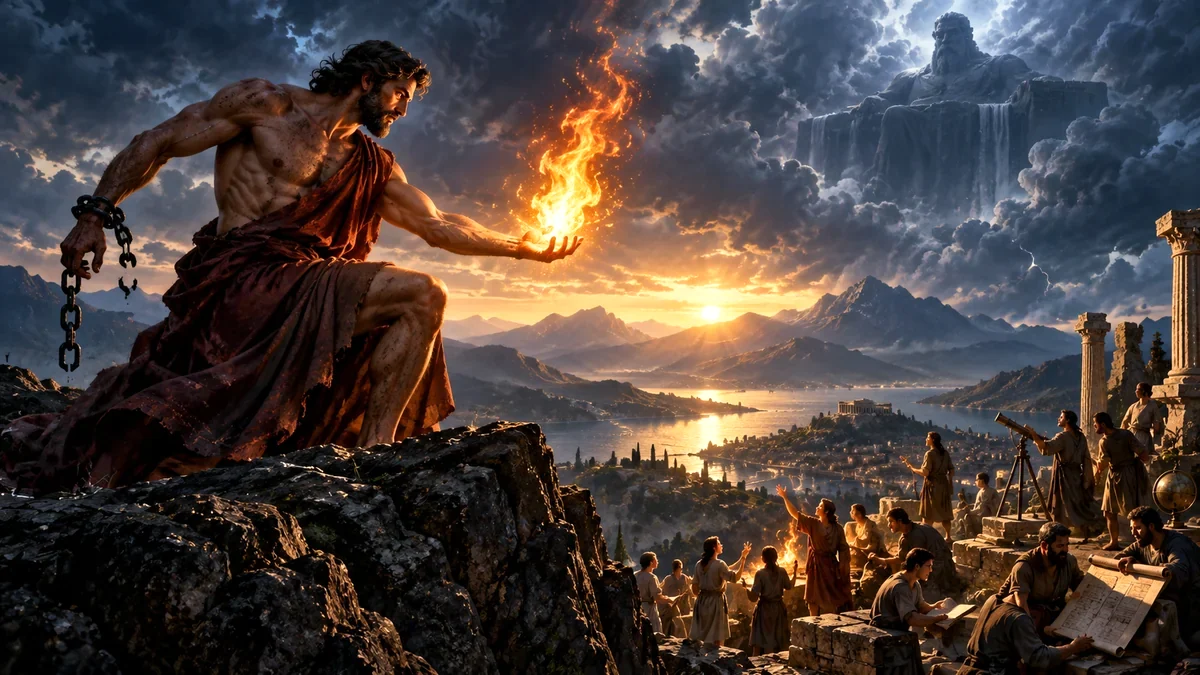
Prometheus is one of those mythic figures whose story has long exceeded the boundaries of an ancient tale. A Titan associated with foresight and cunning, he brings fire to human beings, defies the will of Zeus and accepts a terrible punishment. In Hesiod the story is bound to the conflict between gods and mortals; in Aeschylus, Prometheus becomes even more clearly a benefactor of humanity, whose gift of fire opens the way to arts, crafts, calculation, writing, medicine and other forms of knowledge.
For me, Prometheus is the ultimate rebel and bearer of knowledge. In him I see ideas that THY-REALITY treats separately elsewhere: Natural Law, personal responsibility, inner monarchy, external anarchy, refusal of blind obedience, and the conviction that knowledge belongs to human beings so they can become more self-governing — not so they can become masters over others.
That, however, is an authorial philosophical interpretation, not a claim that ancient Greeks were already teaching a modern political theory. The ancient sources differ. Hesiod’s Prometheus is a cunning trickster whose acts bring consequences; Aeschylus makes him a far more heroic defender of humanity; in Plato’s Protagoras, fire and technical wisdom rescue human beings from helplessness, but life together still requires justice and social restraint.
That plurality is part of his power. Prometheus does not teach that every rebellion is good or that suffering proves truth. He poses the harder question: what does a person do when authority forbids something while conscience says the act is just and beneficial to others? The myth does not supply a simple political program. It dramatizes the price of knowledge, disobedience and responsibility — and that is why it remains alive.
The story in brief: stolen fire, punishment and release
In Hesiod’s Theogony, Prometheus appears as the clever and cunning son of Iapetus. In the dispute at Mecone he tries to outwit Zeus over the division of a sacrifice; Zeus then withholds fire from human beings, and Prometheus steals it back, carrying it hidden in a hollow fennel stalk. In Works and Days, the theft of fire is directly linked to Zeus’s anger and the story of Pandora. This is the older, more ambivalent layer of the myth: Prometheus helps humanity, but his deception opens a chain of consequences.
The punishment is brutal. Prometheus is fastened to a mountain or rock while an eagle tears at his liver each day, the organ growing back because he is immortal. Pseudo-Apollodorus later tells that Heracles frees him by killing the eagle. The basic story already contains three axes that later become symbolically powerful: a gift to humanity, disobedience to superior authority, and the price paid by the person who consciously takes responsibility for the act.
Fire is more than flame: technology, reason and the power to create
The strongest development of the myth appears in Prometheus Bound. There fire is not merely a tool for warmth or cooking. At the opening it is described as the source or seed of the arts. Prometheus later lists what he enabled human beings to do: build dwellings, understand seasons and the sky, use numbers, write, domesticate animals, sail, heal and work metals. In this version, fire becomes a symbol of the whole human sphere of techne — the capacity to understand the world and deliberately transform it.
A similar shift appears in Plato’s Protagoras. Because Epimetheus leaves humanity defenseless when distributing natural abilities, Prometheus steals fire and technical wisdom associated with Hephaestus and Athena. Human beings thereby gain the means to survive and create. Plato adds an important qualification: technology alone does not create a community; justice and the ability to live with others are also required. Knowledge can liberate, but without responsibility the power knowledge provides can become another form of danger.
Why Prometheus is the ultimate rebel
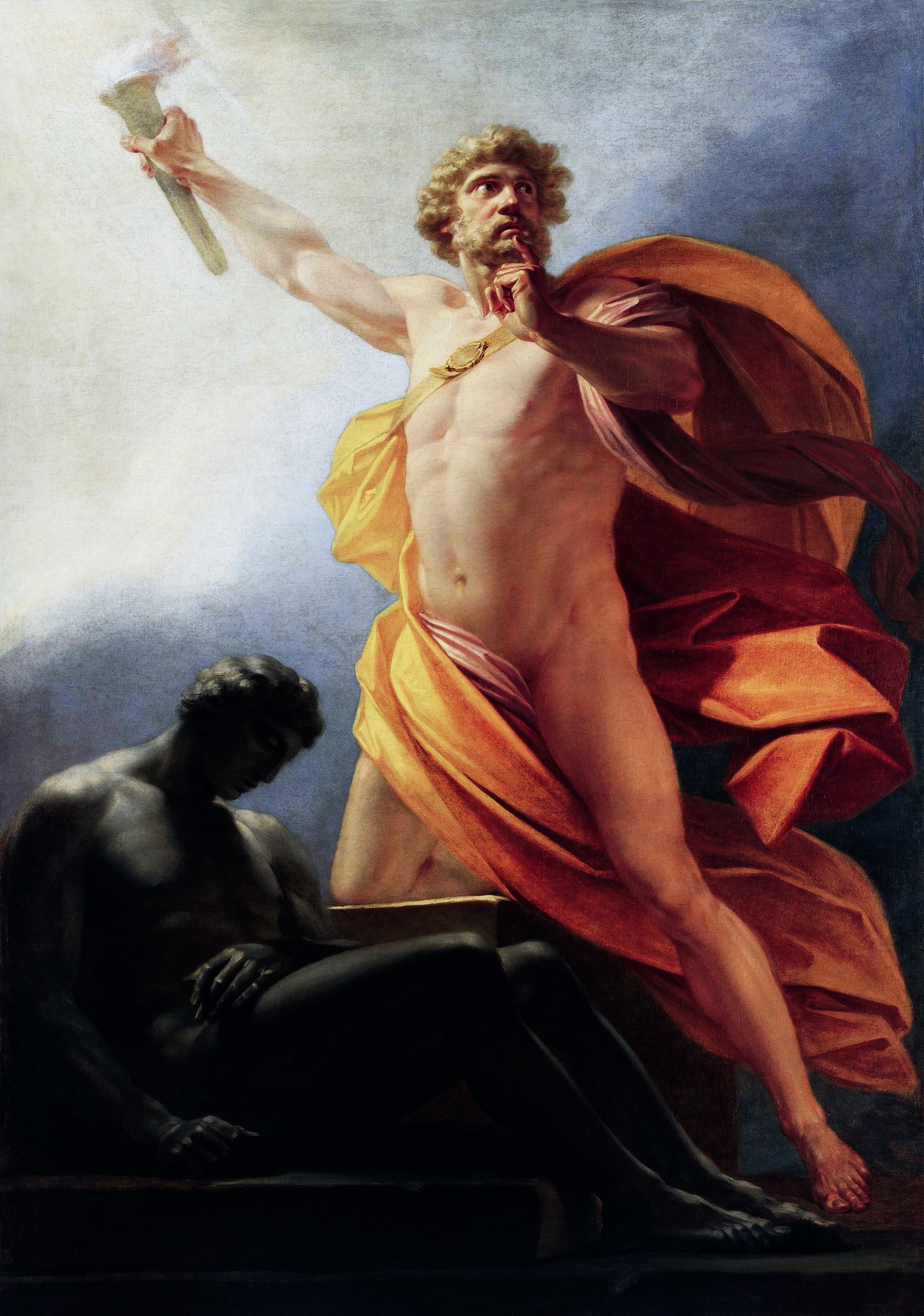
Prometheus’s rebellion is distinctive because, in its strongest literary form, it is not a revolt for prestige or a bid to sit on Zeus’s throne. Aeschylus presents him as someone who consciously takes the side of the weaker party. Authority demands that he submit and learn to endure Zeus’s sovereignty; he refuses to disown the act by which humanity was enabled to advance. That is one reason he became, across later centuries, an archetype of resistance to arbitrary power.
In my reading, the decisive distinction is between resistance to injustice and rebellion as an identity. Prometheus matters not because he says no to anyone above him, but because his no is joined to a yes: yes to knowledge, creation, human dignity and the future. This also guards against romanticizing revolt. If rebellion serves nothing beyond replacing one master with another, the Promethean symbol has lost its core.
Natural Law: power and moral right are not the same thing
Here the myth touches a question THY-REALITY treats under Natural Law: does the fact that someone has the power to command and punish automatically create a moral right to obedience? In the myth Zeus is unquestionably stronger. He can order chains, send the eagle and demand submission. Prometheus’s posture nevertheless opens the possibility that the moral judgment of an act is distinct from the hierarchy of the person issuing the command.
This is not a historical claim about the one “true meaning” of Greek religion, but a modern philosophical use of the myth. Natural Law, in this framework, means that an order is not automatically good because it is legal or comes from a higher office. The individual must consider consequences, the rights of others, proportionality and personal responsibility. Prometheus therefore does not replace moral judgment; he symbolizes the moment when a person can no longer escape it by saying: “I was only obeying.”
Inner monarchy: first learn to govern yourself
Prometheus also represents inner monarchy to me. The phrase does not mean that a person should become hard, isolated or free of doubt. It means that final responsibility for one’s conduct is located within: reason must judge, conscience must set limits, and the will must carry consequences. A person who cannot govern fear, anger, greed or the need to belong may be formally free and still be very easy to direct.
In that sense, Promethean fire is also the inner fire of understanding. Knowledge expands possibilities, but every new possibility also expands responsibility. A sovereign person is therefore not someone to whom nobody may say anything; it is someone able to distinguish advice from command, cooperation from submission, personal desire from moral obligation. Self-government is the opposite of impulsiveness, not a license for arbitrary conduct.
External anarchy: cooperation without an assumed master
The other half of the same idea is external anarchy in the sense used by this project: the absence of an assumed right of one human being to rule another. It does not mean the absence of order, rules, contracts, expertise, common institutions or procedures for resolving disputes. It means only that every external authority should be able to answer where its legitimacy comes from and where its limits lie.
Prometheus symbolizes that question for me because before Zeus he does not deny the reality of Zeus’s power; he denies that power is the final argument. This is not a call for violence against the state or any other institution. It is a call for intellectual and moral independence: test the rule, judge the command, and do not hand over responsibility merely because a uniform, a title, a majority or a tradition stands before you. Freedom without responsibility can dissolve into chaos; responsibility without freedom can become orderly submission.
The warning in the myth: the path of the sovereign person can be costly
Prometheus’s story is also a warning. A person who does not outsource conscience to a group or authority can lose comfort, status, belonging and, in extreme historical conditions, safety. The myth concentrates that cost into the image of the eternal rock and eagle. If few people are willing to think, take responsibility and defend one another’s space for freedom, the burden on each individual is greater and coercive structures are harder to limit.
But it does not follow that isolation proves correctness or that martyrdom is the goal. In one important tradition Prometheus does not free himself: Heracles frees him. This opens the other half of sovereignty — a free person does not need a master, but still needs other free people. Knowledge is transmitted, courage is strengthened in relationships, and institutions can be restrained only when enough people understand the difference between legitimate cooperation and blind obedience.

Why Prometheus still matters to a person who wants to remain free
Prometheus remains important because he joins together things often separated: knowledge, freedom and the cost of responsibility. Fire without wisdom can burn. Freedom without inner discipline can become a new dependency. Rebellion without a moral measure can merely create a new ruler. His story is therefore not a recipe but a test: what will we do with the power we gain when we understand something?
For me, his answer is the core of the sovereign person: learn; think with your own mind; do not confuse authority with truth; do not claim for yourself a right you refuse to another; do not hand moral responsibility to a system; and when knowledge can reduce unnecessary human dependence, do not guard it as a privilege. That is my Promethean reading — not the only possible interpretation of the ancient myth, but the reason Prometheus has become for me a central image of inner monarchy, external anarchy, and the person who tries to remain free without seeking to rule others.
Sources and further reading
- Hesiod — Theogony, lines 507–616 (Prometheus cycle), Perseus Digital Library
- Hesiod — Works and Days, lines 42–105 (fire, Zeus and Pandora), Perseus Digital Library
- Aeschylus — Prometheus Bound, opening scene, Perseus Digital Library
- Aeschylus — Prometheus Bound, lines 436 onward: gifts of knowledge and arts
- Plato — Protagoras 320c–322d, Prometheus myth, Perseus / Scaife
- Stanford Encyclopedia of Philosophy — Protagoras, section on the Prometheus myth
- Pseudo-Apollodorus — Library 1.7.1, Prometheus, fire and punishment
- Pseudo-Apollodorus — Library 2.5.11, Heracles frees Prometheus
- Diodorus Siculus — Library of History 4.15.2, Heracles and Prometheus
- William Smith — Dictionary of Greek and Roman Biography and Mythology: Prometheus
- Percy Bysshe Shelley — Prometheus Unbound (1820), Project Gutenberg
- Stanford Encyclopedia of Philosophy — Positive and Negative Liberty