Nephilim, sons of God and 1 Enoch
Genesis 6 gives only four enigmatic verses. 1 Enoch expands them into a story of Watchers, giants, and forbidden knowledge. What belongs to the original text and what to later interpretation?
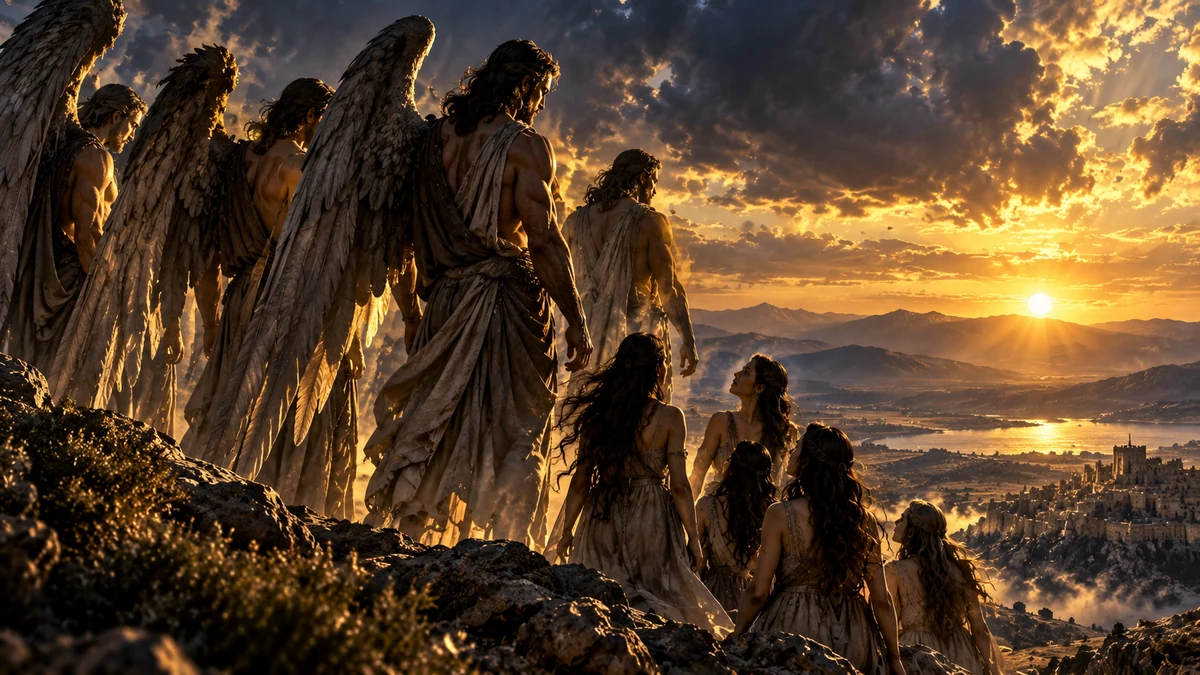
Genesis 6:1–4 is one of the shortest yet most expansive passages in the Hebrew Bible. In only four verses it introduces the “sons of God,” human women, the enigmatic Nephilim, and “the heroes that were of old, warriors of renown.” The text does not explain who the sons are, what the word Nephilim precisely means, or how directly they are related to the children of the unusual unions. That compression opened the passage to radically different interpretations.
The most influential ancient expansion of the scene is 1 Enoch, especially its oldest major unit, the Book of the Watchers. There the brief Genesis episode becomes a large narrative: heavenly Watchers descend to earth, take women, violent giants are born, forbidden knowledge is transmitted to humanity, and the Watchers are punished. This is not simply Genesis retold at greater length; it is an early Jewish interpretation that explains the spread of violence and corruption before the flood.
The topic therefore requires three levels to be kept separate. First is what Genesis itself actually says. Second is what Second Temple texts, above all 1 Enoch, Jubilees, and related traditions, add to it. Third are much later interpretations, ranging from human rulers and Sethite descendants to modern stories about ancient aliens, genetic experiments, and archaeologically demonstrated races of giants.
This article does not attempt to settle the metaphysical question of whether heavenly beings 'really existed.' It tests something more accessible: what the earliest texts say, how the tradition developed, how old 1 Enoch is, what the Qumran manuscripts demonstrate, and where ancient interpretation ends and modern mythology begins.
Four verses of Genesis — and many gaps
Genesis 6:1–4 describes a time when humanity is multiplying. The “sons of God” see human women, take them as wives, and the text then mentions the Nephilim and ancient heroes. In its present form the passage stands immediately before the description of increasing human wickedness and the decision to send the flood. Yet nowhere in those four verses does Genesis use the word “angels,” name Watchers, mention Mount Hermon, list their leaders, or speak of metallurgy, astrology, or magic.
Nor is the sentence about the Nephilim as grammatically simple as popular retellings often imply. The text says that the Nephilim were on earth in those days — and also afterward — when the sons of God went in to human women. It is natural to associate them with the offspring of those unions, but Genesis does not write a direct equation, “the children of these unions = the Nephilim.” 1 Enoch later makes the connection much more explicit.
From the outset, then, the short biblical core must be distinguished from the tradition that interprets it. Much of what modern readers spontaneously associate with Genesis 6 actually comes from 1 Enoch or from even later interpretation.
Who are the “sons of God”?
The Hebrew expression bene ha-elohim has its closest biblical parallels in Job 1:6; 2:1; and 38:7, where it refers to beings of the heavenly council. For that reason, historical-philological readings often understand Genesis 6 as referring to heavenly or divine beings rather than ordinary human males. This also fits the broader ancient Near Eastern language of divine families and celestial assemblies.
Yet this was never the only interpretation. Jewish and Christian interpreters also developed readings in which the figures are powerful human rulers, nobles, or descendants of Seth who marry women from another lineage. The Sethite interpretation became especially influential in later Christianity because it avoided the idea of sexual relations between heavenly beings and humans.
The passage therefore has a genuine history of interpretation, but the options do not all have the same lexical support. If the question is how the expression is used elsewhere in the Hebrew Bible, heavenly beings are a strong candidate. If the question is how later interpreters understood it, the field becomes much wider. Those are different questions.
Nephilim are not simply a synonym for “proven giants”
The Hebrew word nephilim occurs only in Genesis 6:4 and Numbers 13:33 in the Hebrew Bible. Its etymology is not securely resolved. A common connection with the root n-f-l, “to fall,” is attractive but does not produce one uncontested meaning. For that reason many modern translations simply transliterate the word as Nephilim.
The Greek Septuagint associated the term with gigantes, which strongly shaped later giant traditions. Numbers 13:33 connects the Nephilim with the Anakim and with rhetoric of enormous stature: the frightened scouts say that they looked like grasshoppers by comparison. But that sentence belongs to a fearful reconnaissance report designed to emphasize the danger of the land; it is not an independent archaeological description of a biological population.
It is therefore reasonable to say that ancient tradition associated the Nephilim with extraordinary, terrifying, giant-like beings. It is not methodologically sound to infer from the word alone a precise height, genetics, or historical population that archaeology should then be expected to recover.
1 Enoch: four verses become the Watchers myth
The Book of the Watchers, 1 Enoch 1–36, develops Genesis 6 into a highly detailed narrative. Two hundred Watchers, led by Shemihazah, swear an oath and descend on Mount Hermon. They take women, giants are born from the unions, and the giants become violent and voracious. Another strand of the story especially emphasizes Asael/Azazel and the transmission of forbidden knowledge: weapon-making and adornment, magical practices, work with plants, and forms of celestial divination.
This distinction matters. Genesis 6 does not say that the “sons of God” transferred technology to humanity. That is an Enochic expansion. In the Book of the Watchers the violation is not only a sexual crossing of the heavenly-human boundary but also a transmission of knowledge thought to belong to the heavenly order and which, in improper hands, intensifies violence, seduction, and disorder.
The Enochic story goes further still. The Watchers are bound and await judgment, while their giant offspring die. Their spirits then become an explanation for continuing demonic activity on earth. A short episode in Genesis thus becomes a broad theory of antediluvian violence, illicit knowledge, and evil spirits.
How old is 1 Enoch?
1 Enoch is not a single book written at one moment, nor is it a work that historical scholarship can demonstrate was authored by the antediluvian Enoch of Genesis. It is a collection of apocalyptic works from different periods linked by the figure of Enoch. The Book of the Watchers is among the oldest components and is commonly placed in the third or early second century BCE, while some traditions within it may be older.
The crucial material evidence comes from Qumran. The Aramaic manuscript 4Q201, one of the Enoch manuscripts from Cave 4, is palaeographically dated to roughly 200–150 BCE. Enochic literature therefore unquestionably existed before Christianity. The Qumran fragments also correct the old impression that 1 Enoch is merely a late Ethiopian book: the complete text is best preserved in Ge'ez, but important sections have much earlier Aramaic witnesses.
A manuscript copied in the second century BCE does not by itself establish the exact date of first composition. It does establish a terminus: the work must have existed early enough to be copied by then. The claim that the Watchers myth is a medieval invention is therefore incompatible with the manuscript evidence.
From Qumran to the Letter of Jude
Enochic tradition was not a marginal curiosity in Second Temple Judaism. Multiple Enoch manuscripts at Qumran show that such texts were read and copied. Other Jewish works, including Jubilees and the Book of Giants, develop related traditions about Watchers, giants, judgment, and the antediluvian world.
Its influence is even more direct in early Christianity. Jude 14–15 uses a prophecy closely corresponding to 1 Enoch 1:9, while Jude 6 speaks of angels who did not keep their proper position and are held for judgment. 2 Peter 2:4 likewise speaks of sinful angels imprisoned until judgment. The Enochic world of ideas is therefore important background for understanding parts of the New Testament.
But precision remains necessary. Jude's use of 1 Enoch does not by itself prove that every early Christian community treated the entire Enochic collection as canonical. Conversely, the fact that most Jewish and Christian canons today do not include it does not mean it was unimportant in antiquity. The Ethiopian Orthodox Tewahedo Church continues to include Enoch among its canonical books.

Ancient myth is not the same as a modern alien theory
Modern popular culture often takes an additional step: it identifies the “sons of God” as extraterrestrials, the Watchers as a technologically advanced species, forbidden knowledge as scientific transfer, and the Nephilim as products of genetic engineering. Such a reading can be offered as a modern speculative reinterpretation, but it should not be presented as the content of Genesis or 1 Enoch.
The ancient texts use the language of heavenly beings, divine order, boundary violation, magic, metallurgy, divination, judgment, and demonology. They do not describe spacecraft, laboratories, DNA, or biological engineering. Translating ancient cosmology directly into a modern technological scenario introduces categories that the texts themselves do not contain.
The same distinction applies to supposed archaeological evidence. Textual history can demonstrate that Jews more than two millennia ago told stories about giants and fallen heavenly beings. That is not the same thing as archaeological proof that a distinct race of superhuman beings existed. Such a historical-biological claim would require material remains, verifiable provenance, and independent analysis — not merely an ancient narrative.
Conclusion: a genuine ancient tradition, an open metaphysical question
The safest conclusion is twofold. First, Genesis 6 genuinely preserves a very old and unusual motif involving heavenly or divine beings, human women, Nephilim, and heroes. Historical-philological reading need not rationalize it into ordinary human marriage merely because later readers are uncomfortable with mythological language. Second, most of the details now associated with fallen angels and giants — Watchers, Hermon, Shemihazah, Azazel, forbidden knowledge, and the spirits of giants — come from a later but still very ancient Enochic interpretation.
1 Enoch is therefore neither a 'secret deleted chapter of Genesis' nor an insignificant late legend. It is ancient Second Temple Jewish literature, materially attested by Aramaic Qumran manuscripts, that deeply influenced Jewish and early Christian thinking about angels, demons, judgment, and the origins of evil.
What remains open is the metaphysical question: did ancient storytellers use these images only as myth, theology, and cultural memory, or did they believe they were describing real heavenly beings? Historical method can establish what the texts are, when they existed, and how they influenced one another. It cannot turn a supernatural claim into an archaeologically demonstrated fact simply because the tradition is ancient.
Sources and further reading
- Bible Gateway — Genesis 6:1–7, NRSVUE: sons of God, Nephilim and the immediate flood context
- Bible Gateway — Numbers 13:33, NRSVUE: later Nephilim/Anakim reference and the scouts’ grasshopper comparison
- Bible Gateway — Job 1:6; 2:1; 38:7, NRSVUE: biblical parallels for the ‘sons of God’ as members of the heavenly council
- Bible Gateway — Jude 6, 14–15, NRSVUE: sinful angels and the explicit Enochic prophecy
- Bible Gateway — 2 Peter 2:4, NRSVUE: sinful angels held for judgment
- Israel Antiquities Authority, Leon Levy Dead Sea Scrolls Digital Library — 4Q201, 4Q Enoch
- James C. VanderKam — ‘The Book of Enoch and the Qumran Scrolls,’ Oxford Handbook of the Dead Sea Scrolls
- Annette Yoshiko Reed — Fallen Angels and the History of Judaism and Christianity, Cambridge University Press
- Matthew Goff — ‘Forgotten Scripture: 1 Enoch and Jubilees,’ The Apocrypha: A Guide (Oxford, 2024)
- Cambridge — overview of 1 Enoch as a composite collection and Book of Watchers as an early component
- J. J. T. Doedens, Sons of God in Genesis 6:1–4 — review in Journal of Theological Studies: history of heavenly, ruler and Sethite interpretations
- Mark S. Smith — ‘The Divine Council,’ The Origins of Biblical Monotheism (Oxford): Ugaritic and Israelite divine-council language
- Annette Yoshiko Reed — ‘Watchers, Giants, and forbidden lore,’ University of Pennsylvania PSCO: Watcher descent, punishment and forbidden teachings
- Journal of Theological Studies — ‘New Testament Satanology and Leading Suprahuman Opponents in Second Temple Jewish Literature’: Book of Watchers and angelic rebellion
- David A. deSilva — ‘The Book of Enoch: The Order of God’s Cosmos and the Consequences of Violations,’ Oxford
- James M. Scott — ‘Jude The Obscure: The Letter of Jude and The Enochic Heritage,’ Journal of Theological Studies (2023)
- Henryk Drawnel — ‘The Mesopotamian Background of the Enochic Giants and Evil Spirits,’ Dead Sea Discoveries 21 (2014)
- C. D. Elledge — ‘Resurrection and the Book of Watchers,’ Oxford: dating and theology of the Book of Watchers
- Oxford Bibliographies — Enoch: textual issues, Book of Watchers, Book of Giants and reception history
- A. McCarron — Reading and translating with scripture: textual growth in the Book of the Watchers, Oxford University Research Archive (2022)
- Ethiopian Orthodox Tewahedo Church — Canonical Books: Enoch included in the Ethiopic canon
- The Watchers in Jewish and Christian Traditions, JSTOR/Fortress Press: Watchers traditions in 1 Enoch, Jubilees, Dead Sea Scrolls and Christianity
- Henryk Drawnel (ed.) — The Aramaic Books of Enoch and Related Literature from Qumran, Brill
- Matthew Goff, Loren Stuckenbruck & Enrico Morano (eds.) — Ancient Tales of Giants from Qumran and Turfan, Mohr Siebeck
- Carolina López-Ruiz — ‘Heroes and Nephilim,’ Gods and Mortals in Early Greek and Near Eastern Mythology, Cambridge