Two Creations in Genesis: Text, Myth, and Later Readings of Consciousness
Genesis 1 and Genesis 2–3 are not simply the same story from two camera angles: they differ in style, divine designation, sequence, and anthropology. Yet that does not produce a simple story of two known authors or prove that the texts originally describe two levels of consciousness.
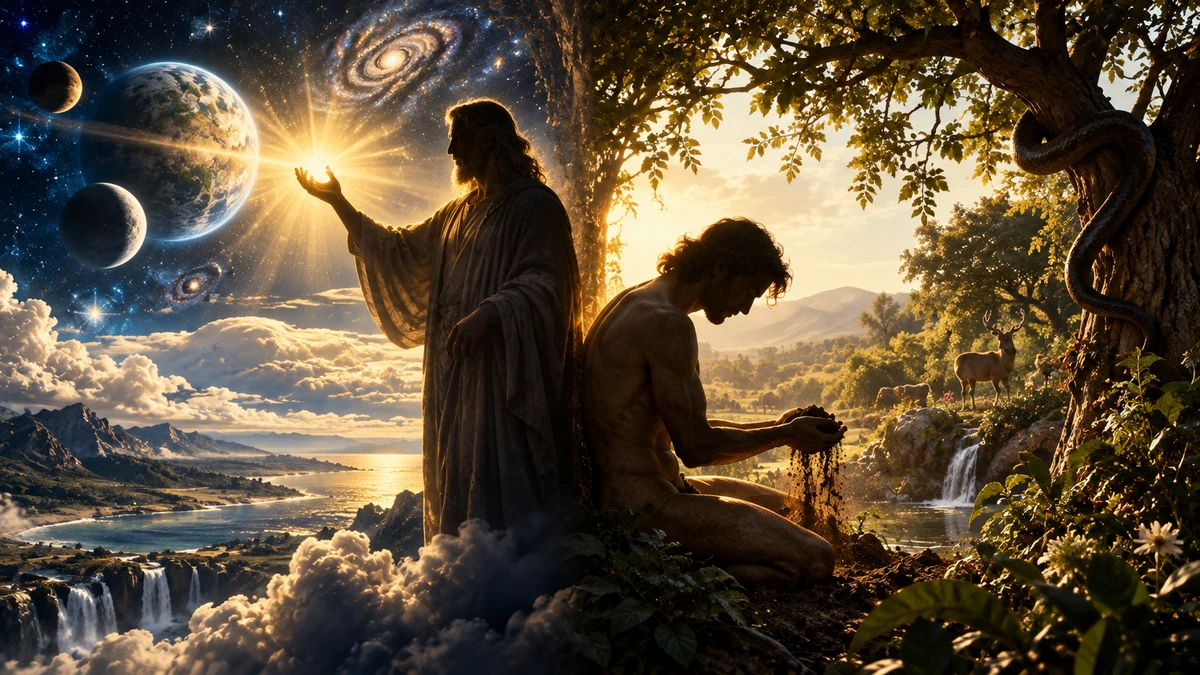
The first two chapters of Genesis are often presented as one continuous creation story. But when they are read slowly and in sequence, a seam becomes visible. Genesis 1:1–2:3 describes the ordering of the whole cosmos in a rhythm of six creative days and a seventh day of rest. Genesis 2:4b then begins differently: no cosmic panorama, but land without field vegetation, a human from dust, a garden, animals, a woman, and the problem of mortality. Critical scholarship has therefore long spoken of two creation traditions or two literary strata.
That does not mean that we simply possess two completely separate documents that can be mechanically disassembled and thereby explain everything. The final form of Genesis places the narratives side by side. Contemporary scholarship agrees more readily that the units are literarily distinct than it does about their exact date, author, and path of combination. The classic labels P and J are therefore useful as orientation, not as the names of two historically identified writers.
The differences are real. In the first account we have Elohim, cosmic separation of waters, vegetation, animals, and then humankind—male and female together—“in the image of God.” In the second we have YHWH Elohim; ha-adam, the human or earthling, is formed from adamah, the ground, then placed in a garden, animals are brought to him, and the woman is formed from his side/rib. This is not simply the same camera zooming in on the same scene; the narrative logic and sequence differ.
Only after that textual audit does it make sense to discuss later symbolic readings. Philo of Alexandria, for example, read the two portraits of humanity as a distinction between an intelligible, invisible or “heavenly” human and a bodily, sense-perceptible or “earthly” human. Such interpretation is historically important for the history of ideas about consciousness, body, and spirit—but it is not evidence that this was the original meaning of the two Genesis narratives.
Where does the first account end and the second begin?
The most common critical division places the first account in Genesis 1:1–2:3 and begins the second at 2:4b, continuing through the Eden narrative in chapter 3. Verse 2:4 is transitional and can be divided somewhat differently: its first half can function as the close of the first unit and its second as the opening of the next. Hence scholarship uses both 1:1–2:3 or 1:1–2:4a for the first account and 2:4b–3:24 for the second.
The seam is not invented from a single word. Style, scale, divine designation, and mode of creation all shift. Genesis 1 is structured by repeated formulas: God speaks, something comes into being, it is evaluated as good, and evening and morning follow. Genesis 2–3 is a narrative with characters, dialogue, a garden, a prohibition, a choice, and consequences. Even scholars who reject the classic Documentary Hypothesis generally recognize that the two units are literarily distinct.
The phrase “two creations” is therefore useful but needs precision. Genesis 1 is a full cosmogony. Genesis 2–3 is primarily a story about the origins of the human condition, garden, labor, sexual partnership, knowledge, and mortality. It can be called a second creation narrative, but we should not assume that it has exactly the same genre or purpose as the seven-day cosmic prologue.
The first creation: cosmos, order, and the seventh day
Genesis 1 begins with a world not yet ordered into a habitable structure: darkness, the deep, and waters are already part of the opening scene. God then primarily separates and orders—light from darkness, waters above and below the expanse, sea from dry land—and progressively fills those domains with vegetation, luminaries, aquatic and flying creatures, and land animals. The text speaks in the language of ancient cosmology, not modern astrophysics.
Humankind appears at the end of the sixth day. Hebrew adam in Genesis 1:26–27 means humankind or human being, and the text immediately says “male and female he created them.” Genesis 5:1–2 repeats the same logic: God creates them male and female and names them adam. This matters because the later picture of an individual male bearing the proper name Adam should not be projected without examination back into every occurrence of the word.
The climax of the first account is not humanity by itself but the seventh day. God ceases from work, blesses the day, and makes it holy. Many scholars therefore emphasize the priestly or liturgical architecture of the text: the world becomes ordered space and time receives a sacred rhythm. This differs from Eden, where the focus is the human relation to the ground, another human, a boundary, and mortality.

The second creation: earthling, garden, and mortality
Genesis 2 opens in a drier scene: field vegetation has not yet sprouted because there is no rain and no human to work the soil. YHWH Elohim then forms ha-adam from the dust of adamah. The wordplay between human and ground is central: the human is not portrayed as a being cut off from the material world but as an “earthling” who comes from the soil, works it, and returns to it.
God plants a garden and places the human there. In the narrative sequence animals are then brought to the human to be named and to seek a fitting counterpart; finally the woman is fashioned from his ṣēlāʿ, traditionally translated “rib” but also capable of meaning “side.” In Genesis 1 male and female are created together as humankind; here sexual differentiation unfolds inside a story of solitude, kinship, and “one flesh.”
Genesis 3 adds a theme not handled in the same way by the first account: the boundary between human and divine, knowledge of good and evil, and loss of access to the tree of life. David Carr therefore reads Eden within a wider ancient Near Eastern conversation about human wisdom and mortality. Humans may gain godlike knowledge without thereby gaining divine immortality.
The differences are more than details
The most visible difference is sequence. In Genesis 1 vegetation precedes land animals, land animals precede humankind, and male and female are created in the same act. Genesis 2 opens with the absence of field vegetation, then the human is formed, garden trees appear, animals are narrated as formed and brought to the human, and the woman comes last. Genesis 2:19 has sometimes been harmonized as “had formed,” but the ordinary Hebrew narrative construction and critical readings take it as part of the story sequence.
The portrayal of God also changes. In Genesis 1 Elohim creates primarily by speech and sovereign ordering of the cosmos. In Genesis 2–3 YHWH Elohim shapes from soil like a potter, plants a garden, brings animals, walks in the garden, and speaks directly with the humans. This difference does not by itself prove two specific authors, but it is a strong literary sign of two different theological and narrative profiles.
Humanity also receives a different emphasis. The first account places humanity in a cosmic frame as the image of God and grants a role in relation to other creatures. The second binds humanity to ground, labor, society, and death. If the two units are flattened into a single chronology, precisely the tension preserved by the final editor is lost. If they are completely separated and their final juxtaposition ignored, the literary meaning of Genesis as received is also lost.
Do two narratives prove two authors?
The classic Documentary Hypothesis assigned the first account to the Priestly source P and the second to the Yahwist J. The designation P for Genesis 1 remains widespread, while for the second material scholars today often prefer the more cautious term “non-P” or non-Priestly. The reason is straightforward: the formation of the Pentateuch appears more complex than the classical model of four nearly complete documents J, E, D, and P suggested.
David Carr, for example, argues for distinct Priestly and non-Priestly strata later combined, while also recognizing further growth and revision inside those strata. Other scholars give more weight to the literary complementarity of the final text. Thomas Brodie even argues that the duality itself does not require reconstructing P and J as prior documents.
The safest formulation is therefore limited: Genesis 1 and Genesis 2–3 differ enough to be treated as two creation traditions or literary units intentionally placed together in the final Genesis. From that fact alone we cannot read off an author’s name, an exact year of composition, or one uncontested path of redaction.
Myth does not mean falsehood: Genesis in the ancient Near East
In the history of religions, myth does not necessarily mean fabrication or deception. It denotes a traditional narrative that uses stories about gods, the world, and primordial humans to explain the basic order of reality. Genesis 1–3 belongs to the same wider ancient Near Eastern environment in which Mesopotamian, Canaanite, and Egyptian cosmological motifs circulated. Comparison is therefore necessary, but similarity is not proof of direct copying.
Genesis 1 has notable points of contact with Mesopotamian conceptual worlds, especially primordial waters, cosmic ordering, and the functions of heavenly bodies; Carr also sees a deliberate engagement with Enuma Elish. Yet the biblical account removes divine combat: the waters are not a divine opponent, Sun and Moon are not named as deities, and one God directs creation. Similarity can therefore represent intertextual dialogue and theological transformation rather than plagiarism.
Eden has a different comparative cluster. Carr points to themes familiar from Gilgamesh and Adapa: wisdom, the boundary between humans and gods, and unattainable immortality. Again, there is no need for the formula “Genesis copied an older myth.” It is more precise to say that Judean writers use and reshape the wider cultural language of their world, as major literary and religious systems commonly do.
From two narratives to “two humans”: Philo and readings of consciousness
In later interpretation, the difference between Genesis 1:27 and 2:7 becomes more than a question of literary origin. Philo of Alexandria, a Jewish philosopher of the first century deeply influenced by Platonic philosophy, distinguishes the human “in the image of God” in the first account from the human formed from earth in the second. He interprets the former as intelligible or rational, incorporeal humanity and the latter as bodily, sense-perceptible, mortal humanity.
In his Allegorical Interpretations Philo further maps elements of Eden onto the inner human being: mind, sense-perception, pleasure, and moral choice. This is a historically documented case in which the two creation narratives become a map of anthropology and inner life. But the chronological distance matters: Philo writes centuries after the texts were composed and reads them through Greek philosophical categories of the intelligible and sensible worlds.
Modern claims that Genesis therefore describes “two levels of consciousness,” a “spiritual Adam and biological Adam,” or a sequential incarnation of consciousness are not direct results of the Hebrew text. They may function as modern symbolic readings, just as Philo’s model was a philosophical reading. Their value may be psychological or spiritual; their historical evidential status is different from the claim about what the ancient narratives originally meant.
What can the audit actually conclude?
The first conclusion is textual: the opening of Genesis contains two sharply different creation perspectives. The first is cosmic, rhythmic, and oriented toward order and Sabbath. The second is earthy, narrative, and oriented toward humanity, relationship, knowledge, and mortality. Differences in divine designation, style, sequence, and anthropology are too substantial to reduce honestly to “chapter two merely adds details to chapter one.”
The second conclusion is historical: critical scholarship has strong reasons for a layered composition, but it is not unanimous about every step of reconstruction. P and non-P are now more useful labels than an overconfident story about one J author and one P author. The final editor did not erase the differences but preserved them in the same work; both diachronic source criticism and synchronic literary reading are therefore legitimate levels of analysis.
The third conclusion is hermeneutical: later philosophical, mystical, and psychological interpretations can build a rich symbolic language from the duality. Philo is an early and well-documented example. But later interpretation is not the same as original meaning. A disciplined reading therefore keeps three levels distinct: what the text actually says, how it probably came to be, and what later communities or individuals made from it.
Sources and further reading
- Sefaria — Genesis 1:1–2:3 (Revised JPS 2023): primary Hebrew text and translation of the seven-day creation account, including the expanse, humanity in the image of God, male and female, and the seventh-day Sabbath.
- Sefaria — Genesis 2:4–25: primary Hebrew text and translation of the garden narrative, the human from the ground, the garden, animals and the woman.
- Sefaria — Genesis 3: primary Hebrew text and translation of the tree of knowledge, the serpent, mortality and expulsion from Eden.
- Sefaria — Genesis 5:1–2: “adam” used for humankind, explicitly male and female, useful for distinguishing generic humanity from the later proper name Adam.
- David M. Carr — The Formation of Genesis 1–11: Biblical and Other Precursors (Oxford University Press, 2020): current source/redaction model for the Priestly and non-Priestly primeval histories and their interaction with ancient Near Eastern traditions.
- David M. Carr — “Precursors to the Priestly Creation Account (Gen 1:1–2:3),” The Formation of Genesis 1–11: Genesis 1, Mesopotamian traditions, Psalm 104 and likely engagement with the Eden story.
- David M. Carr — “Precursors to the Eden Narrative (Gen 2:4b–3:24),” The Formation of Genesis 1–11: Eden, wisdom, mortality, Gilgamesh and Adapa parallels.
- David M. Carr — “The Priestly Primeval History and Conflation of P and Non-P,” The Formation of Genesis 1–11: model for the later combination of Priestly and non-Priestly material.
- Ellen F. Davis — “Genesis: ‘As Our Image’—Genesis 1:1–2:3,” Opening Israel’s Scriptures (Oxford University Press, 2019): literary and theological reading of Genesis 1.
- Ellen F. Davis — “Complementarity and Rupture—Genesis 2:4–11:32,” Opening Israel’s Scriptures: clear discussion of the seam, different divine names, different sequence of vegetation/animals/humans, and the value of reading the combined final text.
- Thomas L. Brodie — “Creation and Its Harmony (1:1–2:24),” Genesis as Dialogue (Oxford University Press, 2001): minority/alternative literary model treating the two accounts as a deliberate diptych rather than requiring a classic J/P reconstruction.
- Mark Harris — “Creation According to the Bible I: Genesis,” The Nature of Creation (Cambridge, 2014): two distinct creation traditions while cautioning against overcommitment to a rigid classical Documentary Hypothesis.
- William P. Brown — “Revolution and Evolution: Ancient Near Eastern Backgrounds to Creation,” The Seven Pillars of Creation (Oxford University Press, 2010): Enuma Elish, Atrahasis, Ugaritic and Egyptian comparative backgrounds.
- William P. Brown — “The Cosmic Temple: Cosmogony According to Genesis 1:1–2:3,” The Seven Pillars of Creation: order, differentiation, Sabbath and temple/cosmos imagery in Genesis 1.
- William P. Brown — “The Ground of Being: The Drama of Dirt in Genesis 2:4b–3:24,” The Seven Pillars of Creation: the earth-bound anthropology of the Eden story and the human as a “groundling.”
- Herbert Chanan Brichto — “The Creation Story in Genesis, ch. 1:1–2:4a,” The Names of God (Oxford University Press, 1998): Genesis 1 and Mesopotamian creation traditions, including the grammatical ambiguity of Genesis 1:1.
- Herbert Chanan Brichto — “Eden and Eden’s Aftermath,” The Names of God: critical discussion of whether Genesis 2:4b onward should be classified as a second creation story in exactly the same genre as Genesis 1.
- Walter Bührer — Am Anfang… Untersuchungen zur Textgenese und zur relativ-chronologischen Einordnung von Gen 1–3; review in Journal of Theological Studies 68 (2017): P creation account and non-P Paradise narrative, with continuing debate about relative dating.
- Maryanne Cline Horowitz — “The Image of God in Man—is Woman Included?” Harvard Theological Review 72 (1979): Genesis 1:26–27 and Genesis 5:2 use adam for humanity comprising male and female.
- Phyllis A. Bird — “‘Male and Female He Created Them’: Gen 1:27b in the Context of the Priestly Account of Creation,” Harvard Theological Review: sex differentiation and the image-of-God statement within Priestly creation theology.
- Oxford Bibliographies — “Adam and Eve” (Linda Schearing): adam/ha-adam as “earthling” rather than straightforward proper name in Genesis 2–3, and the long history of interpretation.
- Philo of Alexandria — On the Account of the World’s Creation (De Opificio Mundi), especially §§134–139; Sefaria edition: later Jewish-Hellenistic distinction between the human of Genesis 1:27 and the earth-formed human of Genesis 2:7.
- Philo of Alexandria — Allegorical Interpretation of Genesis, Book I; Sefaria edition: heavenly versus earthy human, and allegorical mapping of mind/sense in Genesis 2–3.
- The Imago Dei (Gen 1:26–27): a history of interpretation from Philo to the present (Studia Historiae Ecclesiasticae): Philo’s Platonic distinction between the ideal human of Genesis 1 and concrete embodied humanity of Genesis 2.
- TheTorah.com — “Differing Conceptions of the Divine Creator”: accessible scholarly comparison of the order of animals, man and woman in Genesis 1 and Genesis 2 and the evidence for distinct literary traditions.