Madālasā: a lullaby of pure consciousness in the Mārkaṇḍeya Purāṇa
Queen Madālasā in the Mārkaṇḍeya Purāṇa soothes her son with a teaching that name, body, and relationships are not his deepest self. What does chapter 25 actually say, and what did the later “Madalasa lullaby” tradition add?
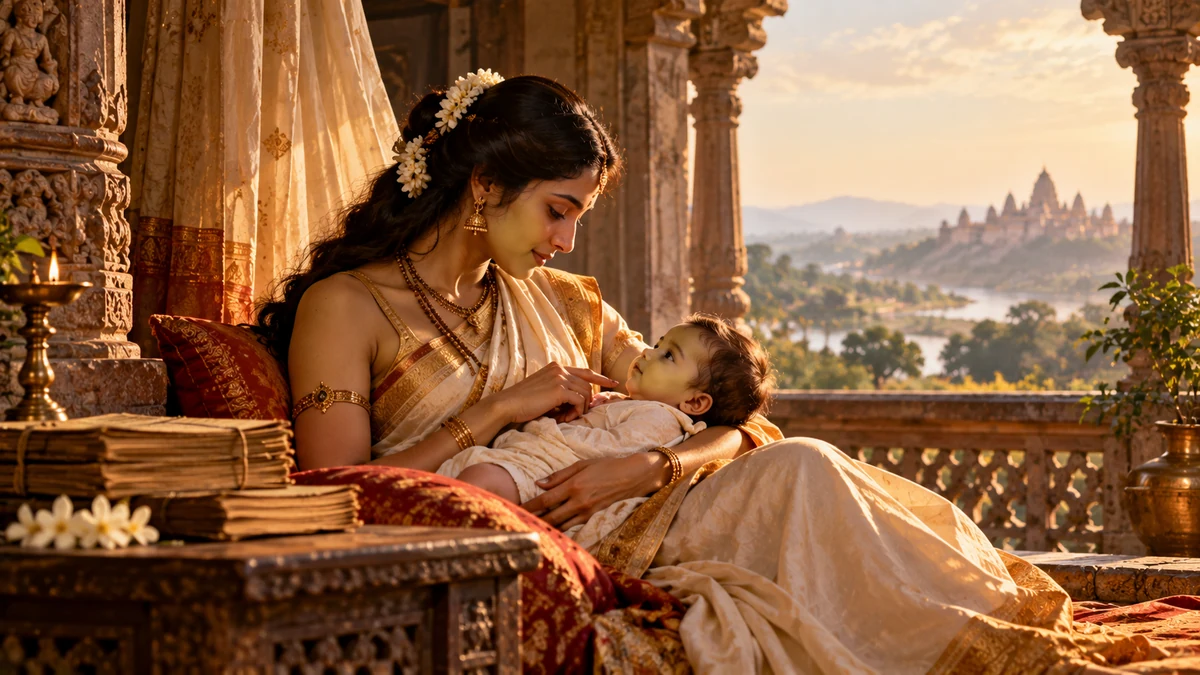
Online, Madālasā’s song is often encountered as a gentle Sanskrit lullaby: “You are pure, awakened, stainless; you are free from the illusion of saṃsāra.” Musical versions sound almost meditative, and it is easy to assume that we are hearing an ancient song preserved through the centuries in one unchanged form. But the Mārkaṇḍeya Purāṇa tells a more interesting story. Its twenty-fifth chapter really does contain a scene in which Queen Madālasā soothes her infant son with a teaching about self, body, and attachment, yet the numbered text, older translations, and modern popular versions do not always match line for line. [1][2][4][5]
Madālasā’s “lullaby” is therefore interesting on two levels. The first is philosophical: the mother does not tell the child who he should become, but who, according to her teaching, he already is beyond name and body. The second is textual: the famous song heard today is the result of transmission, selection, and reshaping, not simply the direct copying of one stable passage.
Dating requires the same caution. The Mārkaṇḍeya Purāṇa is regarded as an old representative of the Purāṇic tradition, but it is a stratified work to which it makes little sense to assign one single exact date of composition. For this article, the textual history of the particular passage matters more than the slogan that the lullaby is simply “so many thousands of years old.” [10][11]
A lullaby that begins with crying
The episode belongs to the story of King Ṛtadhvaja and Madālasā. When their first son is born, his father names him Vikrānta. The attendants rejoice, while Madālasā laughs. Later, as the child lies on his back crying, his mother begins to soothe him — and this is where her unusual speech begins. Mārkaṇḍeya Purāṇa 25.10 describes Madālasā’s action with a term connected with soothing or speaking playfully to an infant. [1][3][4]
The numbered speech in 25.11 begins with a statement that almost contains an entire philosophical program by itself: śuddho'si re tāta, na te'sti nāma — “You are pure, child; you have no [real] name.” The name, Madālasā continues, has been created by imagination or convention; the body is made of the five elements and is not what the child most deeply is. [1][2][3]
The text then expands the same distinction. The body grows through food and water, yet what Madālasā addresses as the true self does not grow and decay along with it. She compares the body to a covering or garment, while relational labels such as “father,” “son,” “mother,” “beloved,” “mine,” and “not mine” are attached to aggregates of elements and to the ideas projected onto them. [1][3]
The core of Madālasā’s teaching: original and translation
To understand Madālasā’s lullaby, it is best to read the numbered core of 25.11–18 first as a whole. Below are the Sanskrit original and a continuous English translation; commentary on the motifs follows only after the text itself. [1][2][3][4]
Sanskrit original — Mārkaṇḍeya Purāṇa 25.11–18
25.11 — शुद्धोऽसि रे तात न तेऽस्ति नाम कृतं हि तत् कल्पनयाधुनैव । पञ्चात्मकं देहमिदं तवैतन् नैवास्य त्वं रोदिषि कस्य हेतोः ॥ २५.११ ॥
25.12 — न वा भवान् रोदिति वै स्वजन्मा शब्दोऽयमासाद्य महीशशूनुम् । विकल्प्यमाना विविधा गुणास्ते गुणाश्च भौताः सकलेन्द्रियेषु ॥ २५.१२ ॥
25.13 — भूतानि भूतैः परिदुर्बलानि वृद्धिं समायान्ति यथेह पुंसः । अन्नाम्बुपानादिभिरेव तस्मात् न तेऽस्ति वृद्धिर्न च तेऽस्ति हानिः ॥ २५.१३ ॥
25.14 — त्वं कञ्चुके शीर्यमाणे निजेऽस्मिंस् तस्मिंश्च देहे मूढतां मा व्रजेथाः । शुभाशुभैः कर्मभिर्देहमेतन् मदादिमूढैः कञ्चुकस्तेऽपिनद्धः ॥ २५.१४ ॥
25.15 — तातेति किञ्चित्तनयेति किञ्चिद् अम्बेति किञ्चिद्दयितेति किञ्चित् । ममेति किञ्चिन्न ममेति किञ्चित् त्वं भूतसङ्घं बहु मा नयेथाः ॥ २५.१५ ॥
25.16 — दुःखानि दुःखोपशमाय भोगान् सुखाय जानाति विमूढचेताः । तान्येव दुःखानि पुनः सुखानि जानाति विद्वानविमूढ चेताः ॥ २५.१६ ॥
25.17 — हासोऽस्थिसन्दर्शनमक्षियुग्मम् अत्युज्ज्वलं तत्कलुषं वसायाः । कुचादिपीनं पिशितं घनं तत् स्थानं रतेः किं नरकं न योषित् ॥ २५.१७ ॥
25.18 — यानं क्षितौ तत्र गतश्च देहो देहेऽपि चान्यः पुरुषो निविष्टः । ममत्वबुद्धिर्न तथा यथा स्वे देहेऽतिमात्रं बत मूढतैषा ॥ २५.१८ ॥
English translation
25.11 — You are pure, dear child; you have no real name. This name was just created by conception. This body of yours is composed of five elements; you are not this body. Why, then, do you cry?
25.12 — It is not you yourself who weeps; this sound appears in the king’s son as an embodied being. The various qualities distinguished in you are qualities of the elements in the senses.
25.13 — The bodily elements, weak in themselves, grow by means of other elements — food, water, and the like. Therefore their growth is not your growth, and their decline is not your loss.
25.14 — When this covering of yours decays, do not fall into delusion because of that body. This body is bound up with good and bad actions; the covering is fastened upon you through intoxication and other delusions.
25.15 — One you call “father,” another “son,” one “mother,” another “beloved”; of one thing you say “mine,” of another “not mine.” Do not attach excessive weight to these aggregates of elements.
25.16 — A deluded mind thinks that pleasures remove suffering and bring happiness; the wise, undeluded mind recognizes in those same pleasures suffering that appears as happiness.
25.17 — A smile is a display of bone — the teeth; the pair of very bright eyes is tainted with fat; the fullness of the breasts is dense flesh. The seat of sexual desire — is woman not hell?
25.18 — A vehicle stands upon the earth, the body is in the vehicle, and within the body another puruṣa dwells. We do not feel “this is mine” toward earth and vehicle as we do toward our own body; that excessive identification is a great delusion.
Read together, the verses repeat the same movement: name, bodily growth, kinship labels, pleasure, and ownership are shifted away from the deepest self toward the level of body, relations, and conception. Madālasā does not teach the child how to construct an identity, but how not to identify completely with it. [1][3]
Verse 25.17 is deliberately left unsmoothed within this sequence. Its ascetic rhetoric about the female body belongs to the numbered passage; historical and interpretive comment is therefore kept outside the translation and follows in the next section. [1][3][4]
Verse 25.17 should not be hidden
Verse 25.17 is a good test of whether an article is presenting the source or merely its modern idealization. Popular presentations of Madālasā often emphasize the beautiful message “you are not the body, you are pure, awaken from illusion.” That really is part of the tradition. But the numbered chapter also contains an ascetic denigration of the female body that is clearly problematic from a modern perspective. [1][3][4]
The verse could simply be omitted, producing a perfectly harmonious “lullaby of consciousness.” But that would create a new text. It is more honest to show that Purāṇic world-renunciation is not only gentle metaphysics. In some of its forms, it also uses disgust toward the body as a technique against sexual attachment. Such rhetoric has a long history in ascetic traditions, but historical explanation does not require us to accept it today as a normative truth.
This verse also blocks another simplification: Madālasā’s song is not a modern affirmation of self-esteem dressed in Sanskrit. Its logic is much more radical. It does not say: “Your body is beautiful, believe in yourself.” It says almost the opposite: name, body, growth, family status, and sensual attraction are not what you are in the deepest sense.
What happens to the sons
The next chapter explains that Madālasā’s teaching has consequences. As the first son grows, he acquires ātma-bodha, knowledge of the self, and does not turn toward household life. The second son, Subāhu, is instructed in a similar way, and so is the third, Śatrumardana. [6][7][8]
A modern retelling often says that Madālasā “made all three sons into monks.” The primary text is more cautious. It speaks of non-attachment, self-knowledge, and lack of interest in household life; later retellings may expand this into full renunciation. What matters more is that the story changes direction with the fourth son.
When Alarka is born, the king reminds Madālasā of family and royal duties. If every son rejects worldly life, who will continue the line, perform obligations, and rule? Madālasā does not lock herself into one single doctrine. She accepts her husband’s demand and teaches Alarka how to live as a king: protect the good, govern himself, fulfill his duties, and bear responsibility for the kingdom. [6][7]
This turn is almost as important as the lullaby itself. Madālasā can tell one child about a self beyond name and at the same time give another child instruction for living within name, society, and duty. The story therefore does not set up a simple opposition between “spirituality” and “the world,” but a tension between inward non-attachment and social role.
The popular recitational version and the numbered core
Alongside the numbered core, a highly popular recitational version circulates today, often beginning with the stanza:
śuddho'si buddho'si nirañjano'si saṃsāramāyā parivarjito'si saṃsārasvapnaṃ tyaja mohanidrāṃ ...
Roughly: “You are pure, awakened, stainless; you are free from the māyā of saṃsāra; abandon the dream of the world and the sleep of delusion.” This stanza has become almost the signature of Madālasā’s song and appears in modern recordings and in some textual presentations. [1][9]
But the publicly accessible editions are not uniform. Viśvāsa inserts it before numbered 25.11 as a separate stanza “1,” whereas SanskritDocuments presents the chapter core beginning with 25.10 and 25.11, and Pargiter’s 1904 translation begins Madālasā’s speech directly with the equivalent of “Perfect art thou, darling ...” at 25.11. [1][2][4] After 25.18, some lullaby compilations also append the renunciatory verse tyaja dharmam adharmam..., which the early English translations do not include in this chapter. [2][4][5]
The popular stanza is therefore best understood as part of a living textual and recitational tradition that became attached to Madālasā’s story. The numbered core of 25.11–18 remains the central text of this article, while the additional stanzas show how themes of purity, awakening, and non-attachment continued to spread through singing and popular reception. The precise relationship among manuscript variants would require the apparatus of Wadekar’s 2011 critical edition. [10]
A mother who takes away the child’s name
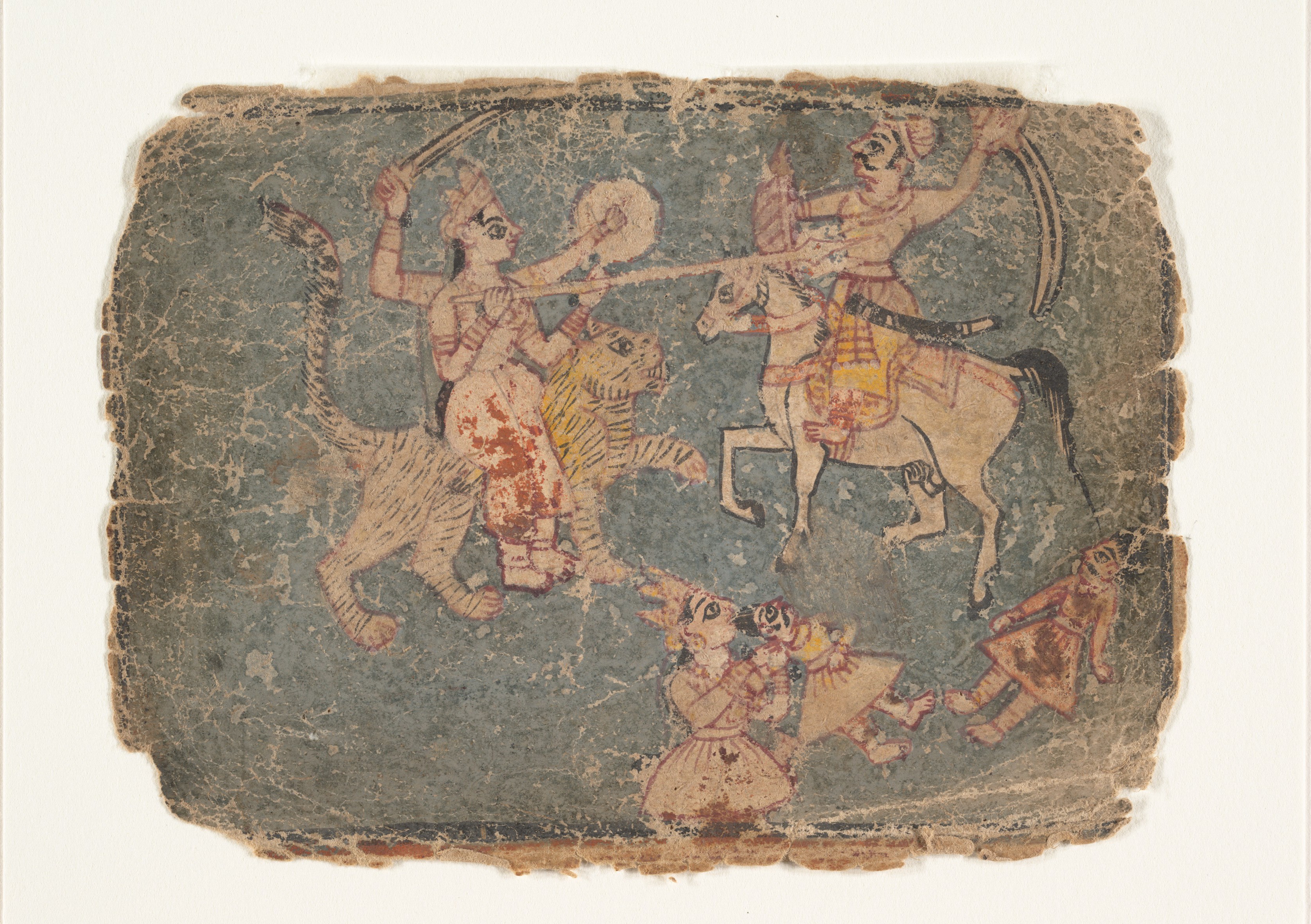
The strongest part of the story does not need modern additions. Verse 25.11 already does something striking: at the very moment the royal son has been given a name, his mother tells him that the name is not his deepest essence. As the body grows, she tells him that the growth of the body is not the growth of the self. As family and royal roles gather around him, she says that “mine” and “yours” do not reach what is most fundamental in him. [1][3]
This is a radical form of pedagogy. The child has not yet learned to speak, and his mother is already relativizing the name, body, and status that society has just given him.
Madālasā’s lullaby is therefore interesting not because it proves one single metaphysical doctrine. It is interesting because, within a Purāṇic story, it brings together two apparently opposite insights: the deepest self is not exhausted by roles, yet life still requires some roles to be played responsibly. The first three sons mainly hear the first half of that teaching. With Alarka, the story shows the second.
Sources and further reading
- Viśvāsa Sanskrit presentation — Mārkaṇḍeya Purāṇa, chapter 25. Source
- SanskritDocuments — Queen Madalasa's Lullaby. Source
- Eternal Raga — Mārkaṇḍeya Purāṇa, chapter 25. Source
- F. E. Pargiter, The Mārkaṇḍeya Purāṇa (1904), canto XXV. Source
- Manmatha Nath Dutt, Markandeya Puranam, chapter 25, public-domain scan. Source
- Eternal Raga — Mārkaṇḍeya Purāṇa, chapter 26. Source
- F. E. Pargiter, The Mārkaṇḍeya Purāṇa (1904), canto XXVI. Source
- Viśvāsa Sanskrit presentation — Mārkaṇḍeya Purāṇa, chapter 26. Source
- Gaiea Sanskrit — modern musical adaptation of Madālasā's song; reception evidence only. Source
- M. L. Wadekar (ed.), The Critical Edition of the Mārkaṇḍeyapurāṇam, vol. 1, Oriental Institute, Vadodara, 2011. Bibliographic confirmation: Source
- The Concise Oxford Dictionary of World Religions — “Mārkaṇḍeya-Purāṇa.” Source