Four Spirals — An Ancient Motif Across the Aegean, Megalithic Europe, and the Andes
Four linked spirals from Naxos and related motifs from Malta, Ireland and the Andes: archaeological evidence, distinctions and hypotheses of cultural transmission.
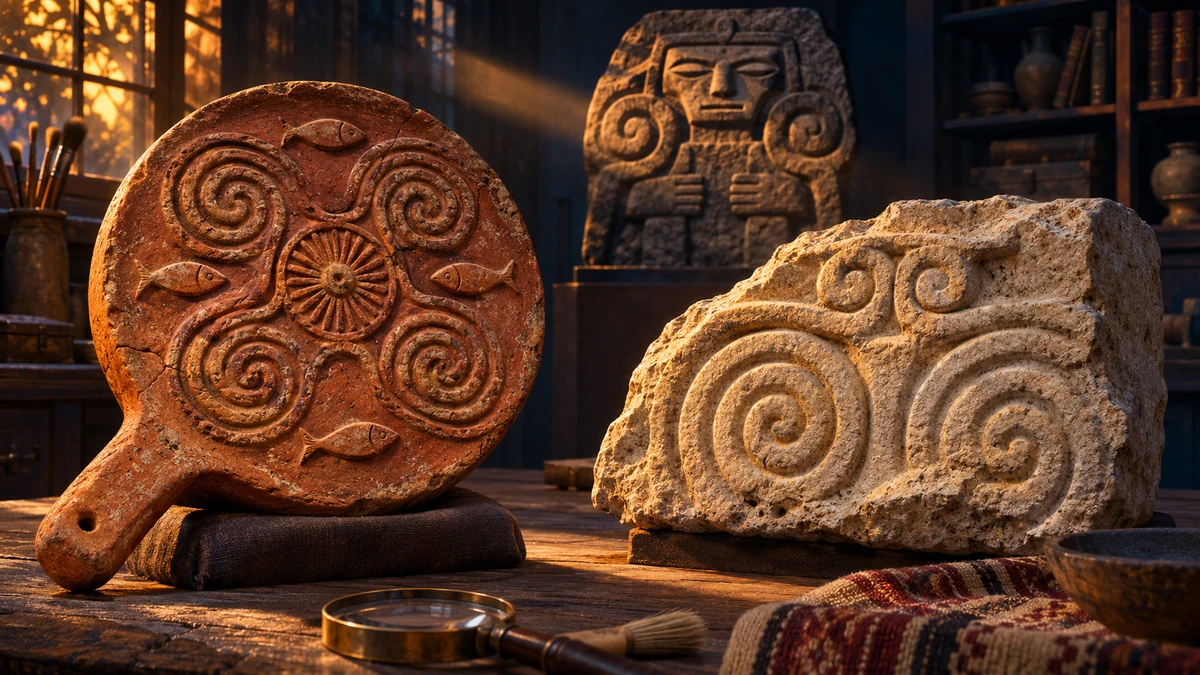
An artistic interpretation of related spiral motifs from different cultures; similarity alone does not establish a common origin.
The spiral is one of those shapes that almost inevitably raises a question: might similar images conceal similar ideas? It can be carved into stone, incised into clay, arranged around a centre, or extended into a sequence of connected curves. We encounter it in the prehistoric art of Europe, on the islands of the Aegean, and in different forms of representation on other continents. Sometimes it forms part of a burial assemblage, sometimes of sanctuary architecture or a larger figurative image. Yet the recurrence of a shape does not tell us what it meant or how it travelled.
Compositions of four spirals raise a particularly intriguing research question. Why four? Did they refer to the four directions, moving water, the sun, cycles of life, or simply a balanced composition? And might similarities between distant examples point to historical contact? These are legitimate questions. Their answers, however, must come from individual objects and their contexts, not from the apparent resemblance of cropped photographs.
One of the most tangible examples comes from the Greek island of Naxos: a ceramic vessel approximately 4,700–4,800 years old bears four interconnected spirals, four fish, and a circular motif. Elsewhere, the examples differ somewhat: in Malta, spirals were carved into monumental stones; at Newgrange in Ireland, the most famous design is a triple spiral; and on an Andean stone slab from Chiripa, the specialist catalogue speaks of volutes. These are not four proven instances of a single worldwide emblem. They are four opportunities to understand how related geometry appears in different historical worlds. [1][4][7][9]
What Exactly Are We Counting When We Say “Four Spirals”?
A spiral is a line that winds around a centre, moving either towards it or away from it. On an archaeological object it may be a single line, a double-outlined figure, an impressed design, or an incision. It can appear alone or as part of a continuous band. But an apparently similar curling shape may instead be a volute — an ornamental scroll, often associated with an edge, face, body, or architectural element. This is not a pedantic distinction. If an object on one side of the world displays four clearly distinguishable spirals around a shared circle, while another shows two curled projections beside a face, we are comparing related visual devices, not necessarily the same sign.
For that reason, any comparison should record five characteristics: number, direction of rotation, mode of connection, accompanying motifs, and placement on the object. If two designs are strikingly alike in all five respects, that is a stronger reason for further investigation than the general observation that both are “spiral-shaped.” Even a very close geometrical match, however, would not in itself prove common origins. Such a claim would also require a plausible historical route, dates, and additional comparable evidence.
We must distinguish a modern image from an ancient object as well. A drawing made from a photograph may clarify worn lines, but it can inadvertently equalise incisions of different depths or omit surrounding decoration. Mirroring, rotating, and cropping an image can further exaggerate an apparent resemblance. Serious comparison therefore depends on the whole object, its inventory number, archaeological context, and dating — not merely on a repeated black-and-white symbol.
Naxos: Four Connected Spirals, Four Fish, and a Central Circle

An unusual ceramic vessel was discovered in grave 26 at the Louros cemetery on the island of Naxos. It is now recorded in the National Archaeological Museum in Athens under inventory number 6140.4. Published photographic documentation dates it approximately to 2800–2700 BCE, during the transitional period of the Early Cycladic Bronze Age. Its decorated surface shows a central circle with radiating strokes, surrounded by four mutually connected, double-outlined spirals; closer to the rim appear four fish. The grave context and inventory number matter more than any modern graphic reproduction: they allow us to discuss a specific object. [1][2]
Unlike an anonymous, unverifiable symbol, here we know at least the burial ground, material, approximate date, and actual composition. We also know that the vessel belonged to the wider material culture of the Early Cyclades. Interpretation nevertheless leads rapidly to several possibilities. Do the four fish point to the sea? They were probably recognisable as aquatic animals, but that tells us little about the meaning of the four spirals. Is the radiating central circle a representation of the sun? This is an understandable iconographic reading, not incontrovertible evidence of its maker's intention. Does the entire composition depict movement, the sea, and daylight? Possibly, but such a reading remains a hypothesis until supported by a broader body of material.
The type of object itself raises questions. Archaeologists commonly classify it among the Cycladic “frying pans.” This is a modern descriptive name for their shape, with a low rim and distinctive handle; it is not evidence that people used them to cook food. Some have been found in graves, others in settlements. Researchers have proposed a range of functions: plates, ritual objects, vessels for offerings or cosmetics, mirrors, drums, or symbolic artefacts. The Museum of Cycladic Art stresses that their purpose has not yet been resolved. In a systematic study published in 1985, John E. Coleman argued for possible use as plates, alongside a decorative role. None of these interpretations, by itself, unlocks the meaning of this four-part design. [3][12]
The strongest conclusion is therefore both modest and important: the fourfold spiral composition on Naxos is an archaeologically documented fact. Its meaning remains open. That is precisely what makes the object so valuable for further comparisons.
The Cyclades and the Aegean: A Motif in a World of Maritime Routes
Original spiral-decorated stone block from Tarxien (inv. 14390)
The Cyclades were not isolated islands. People crossed the Aegean Sea long before the Louros vessel was made. Obsidian from Melos, found in more distant parts of the Aegean, together with similarities in pottery and other artefacts, attests to long traditions of exchanging materials and knowledge. The Museum of Cycladic Art specifically highlights maritime contacts, depictions of boats, and the movement of objects between islands and mainland communities. Some of the objects called frying pans themselves bear images of long boats with many rowers. [13]
This means that hypotheses about the transmission of artistic ideas within the Aegean have a genuine historical basis. If a spiral appears on one island, a related composition on another, and a similar vessel on the mainland, asking about models, imitation, and adaptation is entirely reasonable. But we must distinguish documented contact between communities from evidence that the particular fourfold motif from Naxos followed a specific route. To establish the latter, researchers would need to connect a sufficient number of objects with comparable dates, technical features, and contexts of use.
Consider another Cycladic vessel in the Museum of Cycladic Art collection, inventory number ΝΓ0971, dated approximately 2700–2400/2300 BCE. Its decoration includes spiral bands, circles, triangles, and impressed elements; it is not identical to the four connected spirals on the Naxos vessel. The museum's description allows interpretations involving the sea, waves, the sun, and fertility, but presents them as interpretations. Even within the same broader cultural sphere, then, we encounter multiple solutions to a similar geometrical problem. [14]
This local diversity itself cautions against an overly simple global narrative. The spiral is not a single sign that travelled unchanged through time. It may be part of a visual vocabulary that people adapted to new objects, beliefs, and uses. A familiar shape may retain a broadly similar meaning — or acquire a completely different one.
Malta: Spirals in the Architecture of Megalithic Temples
In Malta, the story differs above all in scale and setting. The Ħal Tarxien complex comprises four megalithic structures developed over the Neolithic period; the site was also used in the Bronze Age. Reliefs on stone blocks include curling spiral forms and depictions of animals. Heritage Malta explicitly documents spirals as well as goats, bulls, pigs, and a ram in the southern part of the complex. Here, the spiral is not decoration on a portable ceramic vessel but part of a monumental built environment. [4][5]
That setting matters. If images were carved into elements of sanctuaries, questions about their meaning are connected to architecture, people's movement through space, and activities that took place there. Archaeological remains, however, illuminate those activities only in part. Animal bones and architectural barriers allow us to consider different forms of ritual use, but they do not tell us what an individual called a spiral or what they thought when they saw one. The site was investigated and partly reconstructed in the twentieth century, making it important to determine which individual motifs survive in their original positions. [4][15]
Chronological comparison also requires care. The various phases of Tarxien fall broadly within the fourth and third millennia BCE, with particularly elaborate decoration in later Neolithic phases; there is no single date that applies to every relief. Parts of the Maltese tradition are older than the Louros vessel and partly overlap in time with the Early Bronze Age Aegean. That is sufficient grounds for asking research questions about similar forms across the Mediterranean, but it does not establish a direction of transmission. [4][5]
The National Museum of Archaeology in Malta also documents a megalithic block with spiral ornamentation, inventory number 14390. It allows us to compare technique and the organisation of curved lines. Even so, it would be inaccurate to describe every Maltese spiral relief as the same interconnected fourfold composition found on Naxos. To make that identification, we would need to specify the exact block and examine the structure of its lines, rather than simply recognising “four whirlpools” in a modern reproduction. [6]
Ireland: Newgrange and the Spirals of the Megalithic World
In Ireland, spiral art appears in an entirely different monumental landscape. Brú na Bóinne includes the prehistoric passage tombs of Newgrange, Knowth, and Dowth, constructed around 3200 BCE. This setting predates the Louros object. Stones within the tombs bear a variety of geometrical designs: spirals, circles, lozenges, and other forms. Ireland's heritage authorities specifically describe a triple spiral on the entrance stone at Newgrange and another triple spiral in the passage. Both are documented instances of spiral imagery — but neither is a fourfold spiral. [7][8]
At sunrise on the winter solstice, light enters Newgrange through a specially arranged opening above the entrance and reaches the interior. The National Museum of Ireland explains that the light also reaches the area of a stone bearing a triple spiral at the rear of the chamber. The relationship between architecture, light, and ritual space is thus a well-grounded subject of research. Yet it would go beyond the available evidence to conclude that every spiral at Newgrange signifies “the sun,” “a passage to the afterlife,” or “a calendar marker.” The museum's discussion itself distinguishes the documented effect of sunlight from interpretations of its spiritual significance. [9]
Another frequently overlooked issue at Newgrange is the expression Celtic spiral. Today the triple spiral, or triskelion, is often used as an emblem of Celtic culture. Neolithic Newgrange, however, predates the historically attested Celtic languages on the island by several millennia. Later adoption and reinterpretation of a motif must not obscure the age of the original stone. The same image can thus belong to more than one cultural narrative without all those narratives being equally ancient or directly connected.
The Irish example widens our investigation: the spiral was already important in European Neolithic art, appeared on enduring stone surfaces, and in some settings formed part of complex ritual architecture. It also shows why a comparative study must strictly distinguish the wider family of spiral designs from a specifically fourfold composition.
The Andes: The Chiripa Slab and the Question of Volutes
Artistic and ritual traditions developed around Lake Titicaca, in what is now Bolivia, with histories different from those of Aegean or European communities. An important artefact is a stone slab from Chiripa, included in the specialist documentation project Images in Action: The Southern Andean Iconographic Series. Its catalogue describes a ground stone slab measuring 53 × 37.5 cm, bearing a face flanked by volutes and additional projections, with a cross-shaped figure on the reverse. A published drawing by Sergio J. Chávez is based on photographs and an impression. The artefact is placed within an early expression of the Yaya-Mama iconographic tradition. [10]
This description is much more specific than “four spirals from Bolivia.” We are not dealing here with four connected spiral arms arranged around a central circle, but with elements of a figurative image. The likeness to spiral geometry exists at the level of the curling line; identity with a fourfold symbol has not been documented. The fact that a drawing can be rotated or cropped until it reminds us of another sign is not evidence of a shared tradition.
Two kinds of uncertainty must also be separated. The first is typological: are we looking at a spiral, a volute-like projection, or part of a stylised face? The second is historical: how could a motif of this kind have come into contact with the worlds of Naxos, Malta, or Ireland? We address the first by studying the original artefact, archaeological documentation, and visual typologies; the second through chronology, intermediate finds, and independent evidence of contact. [10][11]
Research at Chiripa reveals a complex ritual and social environment in which objects were more than carriers of pleasing patterns. Yet even knowledge of that wider ritual context cannot, without further evidence, explain an individual volute. It is more reliable to acknowledge authentic Andean archaeological material with related curling forms, without declaring it the same emblem found on an Aegean vessel. [11]
Why Spirals Arise: Geometry, Materials, and Technique
The spiral has an unusual quality: it can be drawn or carved quite simply, yet it produces a powerful impression of movement. Designing one does not require advanced mathematical knowledge. A maker can produce a tightly wound coil, an elongated wave, a succession of paired spirals, or four arms arranged around a common centre. Different materials permit different treatments: clay accepts regular incisions, stone preserves deep relief, while wood and textiles allow other rhythms and repetitions.
With four spiral arms, symmetry becomes particularly interesting. Four directions, four edges, and four repeated elements around a centre produce visual balance that an artisan could achieve without sharing a cultural tradition with somebody on another continent. This is a possibility, not a definitive explanation for every example. Independent design exists alongside actual imitation and transmission of motifs. The simplicity of a form merely means that resemblance alone carries less evidential weight than a resemblance between complex, rare designs sharing many distinctive details.
It is particularly misleading when a modern observer reduces different techniques to one idealised black-and-white diagram. A double incision in pottery, a shallow limestone relief, and a volute alongside a face can all become almost identical black curls on a screen. In the real archaeological record, however, they differ in scale, wear, relationship to surrounding motifs, and perhaps also in function.
Sun, Water, Fertility, Cycles: Symbolism as a Research Question
The human imagination readily associates spirals with natural phenomena: a whirlpool, a wave, a snail shell, a young shoot, the movement of the sky, or recurring cycles of life. Such associations can be useful research hypotheses, but they are not a universal translation of every ancient spiral. The historical question is which interpretation can be supported for a particular object.
For Naxos, a connection with the sea is appealing because fish are depicted alongside the spiral composition. Boats also appear on certain other Cycladic vessels. The Museum of Cycladic Art describes interpretations of spirals as waves, and of circular and radiating signs as possible celestial motifs; other suggestions include fertility, funerary rites, and symbolic relationships between natural forces. None of this allows us to conclude that every culture shared one belief about “four directions of water” or a single ritual system. [3][14]
In Malta, curling motifs appear among animal reliefs and monumental architecture, raising questions about the sacred character of a place without settling what the motifs meant. At Newgrange, there is an observable relationship between the architecture and the winter-solstice sunrise, but interpreting the spirals as paths between worlds remains an interpretation that must be attributed to those who advance it. On the Chiripa slab, the volutes form part of a composition centred on a face; they may not even be abstract representations of a natural phenomenon. [4][9][10]
It is important to allow for the same geometrical motif to have more than one meaning: in one community it could have evoked the sea, in another ancestors, and in a third it might have been chosen for its visual effect. A design can also move from one setting to another and change its meaning along the way. Similar forms do not guarantee similar interpretations, just as different forms do not rule out related traditions.
Transmission, Independent Development, and Hypotheses of Distant Connections
Three broad possibilities arise when we try to explain the distribution of spiral designs. The first is cultural transmission: a motif travels with traders, journeys, migrations, the exchange of objects, and the teaching of skills. We have evidence of such contact in the Aegean, making it reasonable to investigate whether certain spiral compositions emerged within a connected artistic world. The second possibility is independent development: different makers may have arrived at similar geometry without contact. The third is a complex history, in which some motifs travelled, others arose independently, and still others changed their form and meaning. There is no reason to expect a single mechanism to account for the whole world.
The most demanding hypothesis concerns very distant, perhaps even transoceanic, prehistoric links between the Mediterranean and the Andes. History does contain genuine long-distance contacts, including ones established only after new archaeological discoveries. That reminds us not to declare every unknown connection impossible. But possibility is not evidence of this specific connection. If the curling elements from Chiripa really derived from the same symbolic tradition as the four spirals from Naxos, we would also expect other traces: a dated sequence of intermediate motifs, similar complex compositions, artefacts with reliable archaeological contexts, evidence of the movement of people or technologies, and a chronologically feasible direction of diffusion.
In the absence of such intermediate evidence, the hypothesis of a shared lost civilisation remains unconfirmed. This does not mean that every possibility of future discoveries revealing contacts has been definitively disproved. It means only that four seemingly related curls are not yet enough to reconstruct a history of how the motif travelled. It would be equally unjustified to declare automatically that every separate instance developed independently; that, too, requires an assessment of the available evidence.
An archaeological case for connections becomes strongest when it combines dating, geography, a series of artefacts, distinctive shared details, and additional independent traces. Only then can a proposal of transmission rest on a verifiable historical account rather than an attractive pattern alone.
Comparing the Objects: What Is Actually the Same?
| Region and object | Approximate dating | What is actually documented? | Type of comparison | What remains open? |
|---|---|---|---|---|
| Naxos, Louros, vessel 6140.4 | c. 2800–2700 BCE | Four connected, double-outlined spirals, four fish, and a central circle | Direct fourfold motif | The vessel's function and the meanings of the spirals and circle |
| Cyclades, vessel ΝΓ0971 | c. 2700–2400/2300 BCE | Bands of spirals, a circle, triangles, and other marks | Related Aegean ornamentation | Whether the symbolism is comparable and how it changed |
| Malta, Ħal Tarxien | Several phases, broadly c. 3800–2500 BCE | Spiral stone reliefs within a megalithic complex | Broader spiral family | The precise relationships between individual designs and their functions |
| Malta, museum block 14390 | Prehistoric temple-culture period; a more precise date for the motif requires object-specific documentation | Spiral ornamentation on an architectural block | Related relief design | Whether a particular composition has the same four-part structure |
| Ireland, Newgrange | c. 3200 BCE | Triple spirals on the entrance stone and inside the monument | Triple, not fourfold spiral | Iconographic meaning and historical transmission within Atlantic Europe |
| Bolivia, Chiripa, Yaya-Mama slab | Formative-period Andes; the consulted catalogue does not provide a sufficiently precise independent date for this specific object | A face with volutes and projections, and a cross-shaped form on the reverse | Volutes, not a confirmed fourfold sign | Precise symbolism and any possible long-distance comparisons |
This table is not a ranking of importance, and it does not demonstrate a shared origin. Instead, it shows which comparisons are direct and which are broader. The strongest example of four connected spirals remains the Naxos vessel. Newgrange, Malta, and Chiripa are historically interesting comparisons, but only if we preserve their differences and their distinct identities. [1][4][7][10][14]
What Has Been Established, and What Questions Remain?
People in different parts of the world really did shape spirals in stone and clay. In some places they formed part of funerary or ritual objects; in others they accompanied animal images or figurative scenes. This is a documented historical phenomenon, compelling enough without an invented worldwide uniformity.
We know that a fourfold spiral composition existed on Naxos. We know that spiral reliefs in Malta formed part of a monumental prehistoric setting. We know that Newgrange is older than the Naxos vessel and that its best-known spiral images are triple rather than fourfold. We also know that the Chiripa slab preserves different curling elements, for which a specialist catalogue uses the term volutes. These objects cannot simply be equated without additional evidence. [1][4][7][10]
What we do not know definitively is what the four spirals meant to the people of Naxos, or why they placed exactly four fish around them. We do not know how many individual spiral ideas moved between prehistoric communities and how many emerged independently. Nor do we know whether future discoveries will reveal previously unrecognised connections between traditions that now appear far apart.
Those uncertainties are themselves important findings. Distinguishing the established, the plausible, and the unresolved allows us neither to dismiss unusual images as insignificant nor to assign them a history that has yet to be uncovered. Perhaps the spiral appeared in so many cultures because it is such a simple and expressive form. Perhaps some of its designs did travel with people. Its history will emerge from complete archaeological contexts rather than any single cropped image.
The four spirals, then, are not a final answer to the question of a common origin of civilisations. They are a genuine, ancient question that still deserves investigation.
Sources and further reading
- Zde, Cycladic Frying-pan, 2800–2700 BC, Louros, Naxos, NAMA 6140.4, photographic documentation of the object, Wikimedia Commons: source Source
- Zde, Grave offerings from Louros, Naxos, EC I, EC II, published photographic documentation of grave goods, Wikimedia Commons: source Source
- Museum of Cycladic Art, Frying-pan, description and discussion of its unresolved function: source Source
- Heritage Malta, Ħal Tarxien Prehistoric Complex, official account of the complex, spiral reliefs, and animal depictions: source Source
- UNESCO World Heritage Centre, Megalithic Temples of Malta: source Source
- National Museum of Archaeology, Malta, Megalithic block with spiral decoration, inv. 14390, Google Arts & Culture presentation: source Source
- Heritage Ireland / Office of Public Works, Brú na Bóinne Visitor Centre: Newgrange, Knowth and Dowth, documentation of the triple spiral motifs: source Source
- UNESCO World Heritage Centre, Brú na Bóinne — Archaeological Ensemble of the Bend of the Boyne: source Source
- Sharon Weadick, National Museum of Ireland, The Winter solstice at Newgrange, discussion of dating, light, and spirals: source Source
- Sergio J. Chávez, Images in Action — 2.20, specialist catalogue of the Chiripa stone slab (drawing, measurements, volutes), UCLA Digital Information Gateway: source Source
- Christine A. Hastorf, The actions and meanings of visible and hidden spaces at Formative Chiripa, Ñawpa Pacha 37(2), 2017, archaeological context of Chiripa: source Source
- John E. Coleman, “Frying Pans” of the Early Bronze Age Aegean, American Journal of Archaeology 89(2), 1985, pp. 191–219: source Source
- Museum of Cycladic Art, Maritime Communication and Trade, maritime routes and archaeological evidence of contacts: source Source
- Museum of Cycladic Art, collection entry for Frying-pan vessel (ΝΓ0971), ornamentation, dating, and proposed functions: source Source
- Heritage Malta, Access Statement Tarxien (2023), building phases, reconstructions, and reliefs: source Source