Seven Serpent Heads — An Ancient Motif of Conflict, Protection, and the Renewal of Life
From Mesopotamia and Ugarit to India, Buddhist Asia and Mesoamerica: what does the seven-headed serpent motif mean, and can we trace its transmission?
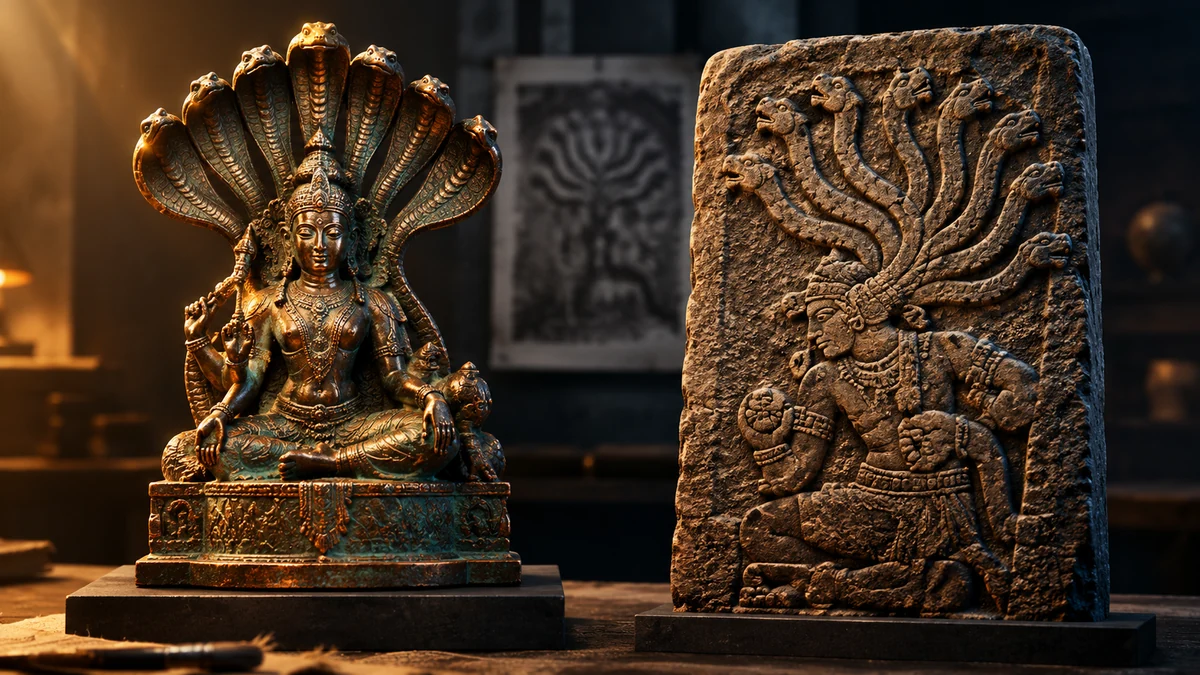
AI editorial artwork comparing different serpent motifs. It is not an authentic reconstruction of the Aparicio relief: the actual stela depicts a decapitated ballplayer with serpents emerging from the neck. Similarity does not establish a shared origin.
Why does a serpent-like being with seven heads appear in texts and images from different cultures? Are we witnessing the spread of an ancient tradition, independent inventions of related images, or several different motifs that resemble one another mainly at first glance?
A Similar Symbol, Different Stories
Seven serpent heads may at first seem an unusually specific motif. The serpent is not merely a common figure in mythology: here its body or neck branches into several heads, sometimes exactly seven. Such images occur in the ancient Near East, South and Southeast Asia, and, in a different ritual context, Mesoamerica. But the same number does not necessarily signify the same being. Any reliable comparison must begin by asking what exactly is depicted or described on each object or in each text.
At least four possibilities must be distinguished. The first is one body with seven heads, familiar from descriptions of ancient monsters. The second is a serpent's body that spreads seven cobra heads like a protective canopy over a deity or spiritual teacher. The third is seven separate serpents emerging within the same scene, for example from the neck of a ritually decapitated figure. The fourth is the name “Seven Serpent,” in which the number and the animal form a calendrical or divine designation, not necessarily an anatomical description.
This distinction is no pedantic detail. If we equate seven separate serpents with the seven heads of one being, we may manufacture a resemblance that ancient observers did not understand in the same way. If we ignore the meaning of the story, a dangerous adversary of the gods and a protector of meditation become the same “mysterious serpent.” A serious investigation must preserve both: the striking resemblance and the equally important differences.
Internet collages are not original historical sources. They may draw attention to a question, but they cannot tell us where an object came from, how it was dated, whether its heads have been counted correctly, or why it was made. We will therefore examine documented texts, museum objects, and scholarly interpretations rather than judging the credibility of a particular online post.
Mesopotamia: A Seven-Headed Adversary in the Third Millennium BCE
Among the oldest traces of a multi-headed serpent-like being are Mesopotamian depictions of a divine or heroic figure fighting a monster. In a comparative study, Christoffer Theis assembled seals and other objects from Early Dynastic III, approximately 2550–2350 BCE, showing monsters with seven serpent heads or with a head composed of seven serpents. Some scenes suggest that a warrior has already defeated individual heads. [1]
Two facts matter. First, these are not merely later legends recorded thousands of years after the motif's supposed emergence: surviving objects can be placed within identifiable archaeological and art-historical periods. Second, the motif was already associated with combat and the overcoming of a dangerous being. Nevertheless, without further evidence, we must not automatically assign every monster the same name or a uniform meaning throughout Mesopotamia.
Theis also cites cuneiform expressions translated as “serpent with seven heads” (MUŠ SAG IMIN) or “great serpent with seven heads.” Iconography and textual tradition thus partly reinforce one another: there are multi-headed figures on objects, and there are texts that explicitly identify the number of heads. Yet a dated seal and a much later written passage are not necessarily two direct attestations of precisely the same story. [1]
In certain Mesopotamian narratives, conflicts with such creatures are associated with deities including Ninurta or Ningirsu. The monster may be interpreted as danger, disorder, or a hostile force. But interpreting it as a particular natural disaster or as universal “evil” depends on the scene and the text concerned. This region thus offers a historically traceable motif of the seven-headed adversary, subsequently encountered in new forms.
Ugarit and the Levant: Lotan, Sea Monsters, and the Movement of a Motif
During the second millennium BCE, the city of Ugarit flourished on the Mediterranean coast of present-day Syria. Cuneiform texts belonging to its Baal Cycle mention the serpentine being Lotan (also rendered Līṭānu or Ltn in scholarly transcription). The passage KTU 1.5 I 1–3 refers to a slain or defeated “fleeing serpent” and to a formidable seven-headed being. Translations and interpretations of the details are not entirely uniform; it would therefore be unsafe to infer from every translation that all these designations necessarily refer to one and the same creature. Even so, this is an important early textual attestation of seven heads in narratives of divine combat. [1][2]
The Hebrew biblical texts also feature Leviathan and monstrous adversaries associated with the sea. Psalm 74:14 speaks of Leviathan's heads in the plural, but does not specify seven. Isaiah 27:1 describes a fleeing or twisting serpent and a sea monster; the similarity to Ugaritic terminology is noteworthy, although the direct identity of all these descriptions has not been established. Later, Revelation 12:3 explicitly presents a dragon with seven heads and ten horns. This combination shows the seven-headed adversary appearing across different religious and narrative settings. [1][3]
For the area between Mesopotamia and the southern Levant, we also have material evidence stronger than an arbitrary comparison of two photographs. In 2024 Christoph Uehlinger published a study of a stamp seal from Tel Hazor, discovered in 2022, depicting a hero attacking a coiled seven-headed serpent. The object belongs to the Iron Age; the researcher discusses it as a significant link between older Mesopotamian and Ugaritic traditions and later Levantine versions of the combat-with-the-monster motif. [4]
Here the possibility of cultural transmission amounts to more than speculation based on a similar outline. We have approximate dates, objects and textual traces, and historically connected cultural settings. Even this chain, however, does not prove that every seven-headed motif around the world arose in the same culture. It supports a regionally grounded hypothesis of transmission that can be tested further.
India: Shesha, Manasa, and the Serpent Canopy
In Indian traditions, serpents or nāgas occupy a rich and varied place. They may be associated with water, subterranean realms, protection, fertility, danger, and royal power. Several heads on one serpent figure therefore do not automatically identify an enemy. Unlike the Mesopotamian combat scenes, the spread hood of a cobra is often a symbol of protection.
In Hindu iconography, Vishnu appears resting on the serpent being Ananta or Shesha, which may have multiple heads; their number and representation vary. In such a scene, the multi-headed serpent is not a monster killed by a hero but part of cosmic order and divine repose. This difference reminds us that a similar shape does not justify transferring an entire story from one setting to another.
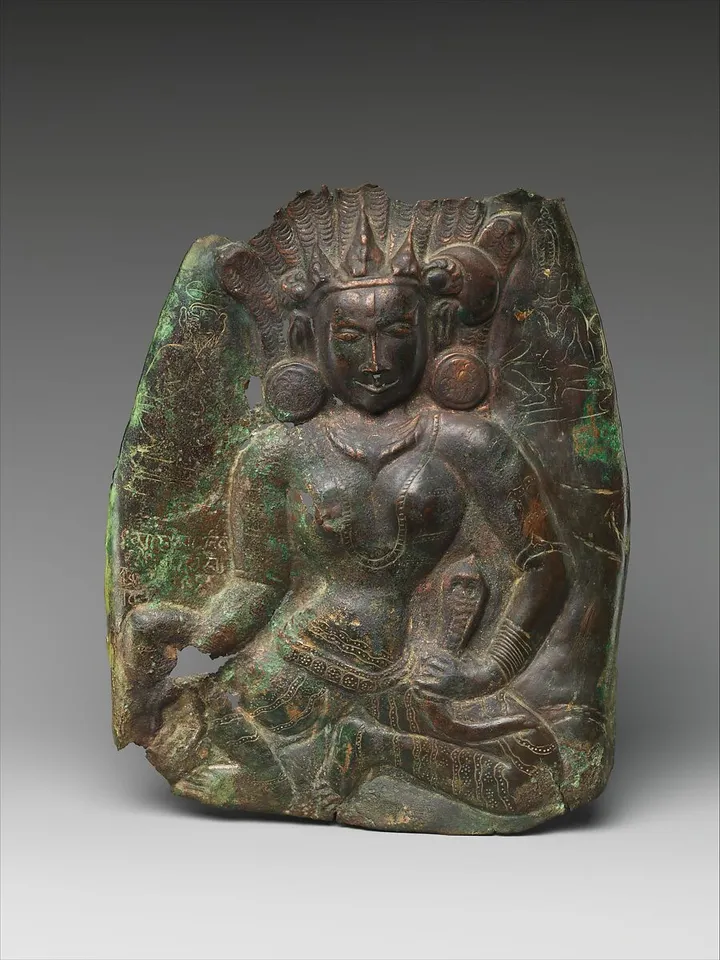
A more specific example is Manasa, the serpent goddess, from the Bengal region of India or present-day Bangladesh. The Metropolitan Museum of Art in New York holds an eleventh-century copper-alloy relief, accession number 2011.499, showing the goddess seated before a spreading seven-headed serpent canopy. She holds another serpent in her hand, while additional serpent forms make up her ornaments. The museum explicitly describes the motif and provides a period and probable geographical attribution. [5]
This object demonstrates that the seven-cobra-head motif formed part of South Asian art by the early Middle Ages at the latest. It does not establish that Manasa was worshipped in exactly this form in the third millennium BCE, or that her name has a direct linguistic relationship to the names of other seven-headed beings on distant continents. Such a claim would require primary texts, an identifiable continuity of tradition, or independent linguistic analysis.
Mucalinda: Seven Coils Are Not the Same as Seven Heads
Buddhist tradition recounts how the serpent king Mucalinda protected the Buddha from a storm after his awakening. Of particular importance is the opportunity to compare a text with later artistic depictions. In the Pali Udāna 2.1, Mucalinda coils his body around the Buddha seven times and spreads his great hood above him. This passage does not explicitly require seven anatomical heads; the number seven primarily concerns the coils and the duration of the storm or meditation. [6]
Artists, however, frequently represented Mucalinda as a seven-headed serpent. One example is the sandstone sculpture Crowned Buddha Seated in Meditation and Sheltered by Muchilinda held by the Asia Society. Made in Thailand or Cambodia in the twelfth century, it shows the Buddha beneath seven serpent heads. Another sculptural version from Cambodia, dated to the eleventh or twelfth century, is held by the Asian Civilisations Museum in Singapore. [7][8]
Here we can follow a narrative as it develops into a recognizable artistic convention. Seven coils and seven heads are not the same detail, although they became associated in later iconography. In Khmer art, a serpent throne of this kind can also express authority and sacred status, beyond protection from the rain. That is an interpretation of a historical context, not proof that a seven-headed serpent had an identical meaning everywhere.
Mucalinda teaches us another lesson: an early text sometimes says something different from the familiar image. Counting the heads on a statue is therefore insufficient. We must ask when the statue was made, what the story behind it actually says, and whether the visual representation changed over the centuries.
The Greek Hydra: Multiple Heads, but Not Always Seven
The best-known multi-headed serpentine creature in Greek mythology is the Lernaean Hydra, fought by Heracles. One of its defining features is that new heads can grow after a head is destroyed. In the narrative given by Pseudo-Apollodorus, Library 2.5.2, the Hydra has nine heads, one of which is immortal. Other ancient descriptions and artistic representations vary in the number and shape of the heads. [9]
The Hydra is consequently a valid example of the broader multi-headed monster motif, but not reliable evidence for a universal number seven. Placing the Hydra alongside seven-headed Lotan makes sense at the level of a hero's fight against a multi-headed adversary, not as a claim that both were invariably represented with seven heads.
The question of transmission remains open. Mediterranean peoples traded, migrated, and adopted narrative motifs over many centuries. This makes a comparative study of similarities between Greek and Near Eastern monsters possible. Yet an individual resemblance can have several explanations: the borrowing of a story, a shared older tradition, a similar narrative function, or an independent creative solution. Until a stronger chain of evidence is available, possible connections are a more appropriate conclusion than a definite, one-directional borrowing.
Mesoamerica: Seven Serpents from a Neck and the Name Chicomecóatl
Aparicio stelae: a decapitated ballplayer and seven serpents
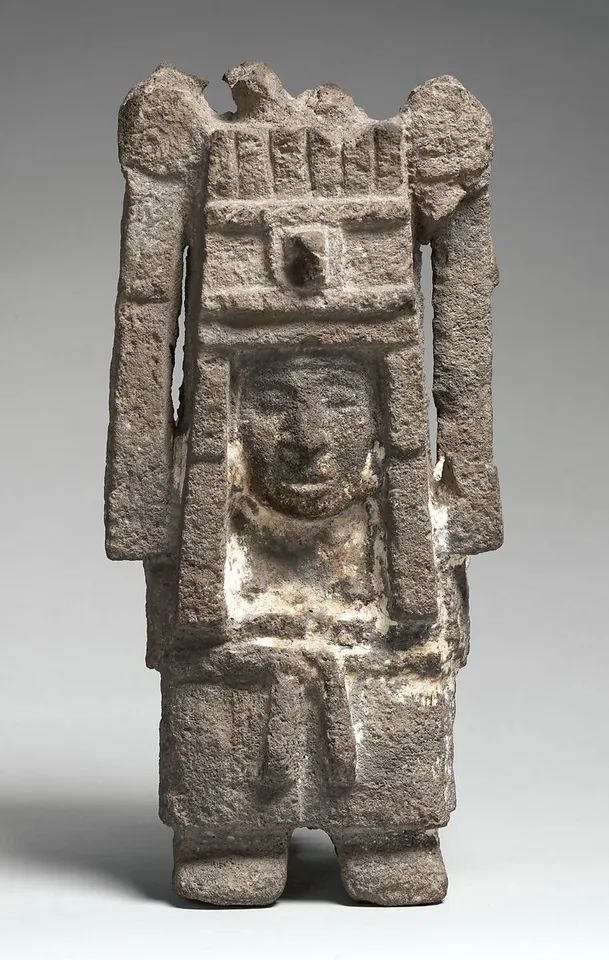
A carved slab from Aparicio in the Mexican state of Veracruz depicts a figure associated with the Mesoamerican ritual ballgame. The figure is decapitated; seven serpents rise from its neck, symbolically replacing streams of blood. The object is assigned to the Epiclassic period, approximately 800–1100 CE. Records from the Museum of Anthropology in Xalapa, the University of Veracruz, and Mexico's INAH provide a relatively concrete basis for examining the object, its cultural context, and the scene depicted. [10][11]
This is an intriguing analogy, but the configuration differs from Manasa's. At Aparicio, seven serpents emerge from the neck of a decapitated figure; with Manasa, seven heads form a canopy above the goddess. Some interpretations of the relief emphasize connections between death, blood, fertility, and renewed life. We must distinguish what is visibly present on the relief from broader interpretations of the ritual. [10][11]
There is also the divine and calendrical name Chicomecóatl, commonly translated as “Seven Serpent.” The Visual Lexicon of Aztec Hieroglyphs explains that it is a calendar name associated with a divine figure linked to maize and nourishment. The documented image in the Telleriano-Remensis codex (approximately 1550–1563) chiefly depicts a female figure, not a seven-headed monster. [12]
There is, however, a different historical interpretation. In the sixteenth century, Diego Durán explained the name as a “serpent with seven heads,” emphasizing the danger of hunger and unproductive years. This account is preserved in the Gran Diccionario Náhuatl of Mexico's UNAM. Durán's statement should not be omitted: it is genuine historical testimony about an interpretation. But dictionaries and scholarship on the Nahuatl calendar caution that the name alone does not establish that every representation of Chicomecóatl showed seven anatomical heads. [13][14]
The Mesoamerican evidence therefore presents a distinct research question: seven serpents, a calendrical name, and a seven-headed creature may be connected in ways worth investigating, but they should not automatically be treated as three identical things.
Siberia and Central Asia: Intriguing Claims, Uneven Evidence
Modern discussions sometimes feature alleged Siberian and Central Asian petroglyphs with seven heads, accompanied by assertions of extraordinary antiquity or inscriptions supposedly linking distant religious traditions. Such material would be important if we had a precise location, a published discovery record, the original field photograph, a description of the rock surface, a verified date, a transcription of the supposed inscription, and a scholarly explanation of its language.
For the example most frequently circulated, the accessible records do not allow us to confirm these details with the same degree of confidence as the Hazor seal or the museum representation of Manasa. We therefore do not treat a particular age of several millennia or the name “Manaka” as established historical fact. This does not mean that such motifs never existed in Siberia or that new discoveries should be dismissed. It simply means this example, too, needs a verifiable provenance. [15]
Southern Siberia and Central Asia are indeed rich in rock art. UNESCO, for instance, documents the petroglyph complexes of the Mongolian Altai, where scenes were produced over different periods. But the existence of a major petroglyph site does not automatically verify the date, location, or interpretation of any particular circulating photograph. [15]
A precise museum or field record for the purported seven-headed figure would be especially valuable for future comparison. If the discovery were genuinely early, it could change the discussion of the motif's distribution. For now, however, it must remain an unverified example in our comparison.
Why the Number Seven?
Seven appears in calendars, ritual structures, sacred texts, and art across many cultures. Its frequency alone does not justify concluding that it always carried the same meaning or originated in one historical source. In Mesopotamian and later Near Eastern scenes, seven heads may emphasize the exceptional power of an adversary. In the early account of Mucalinda, seven refers to days and coils, while seven heads are prominent in subsequent sculpture. With Chicomecóatl, seven forms part of a calendrical name. [1][6][12]
The contrasting case is important, too: the Greek Hydra does not consistently have seven heads. If the claim that every multi-headed serpent expresses a single primordial worldwide symbol with exactly seven heads were correct, we would also need to account for different counts and different functions. Exceptions are not inconvenient details but evidence that helps test the hypothesis.
Perhaps seven was chosen in some settings for its rhythmic or symbolic sense of completeness. Perhaps a particular, more precisely defined motif travelled through historical contacts. Or perhaps multiple heads are simply a readily understandable artistic way of expressing extraordinary power, while the number acquired significance independently in different traditions. Historical evidence allows us to investigate all these possibilities, but not to impose one explanation on the entire world.
A Shared Tradition? Comparative Evidence and Hypotheses
The question of a common origin is legitimate, but answering it requires several levels of evidence. First, we must establish whether objects actually show the same iconographic form. Next, whether they occur in places and periods between which contacts are documented. Then, whether their meanings and narratives are comparable: for instance, a hero fighting a seven-headed monster, rather than simply any serpent with seven heads. Finally, we need to look for a chain of intermediate evidence connecting the earlier and later appearances.
For Mesopotamia, Ugarit, and the Levant, connections of this kind have a degree of scholarly support. Textual similarities, geographical proximity, long histories of contact, and concrete objects such as the Hazor seal offer a verifiable foundation for investigation. [1][4]
For India and Southeast Asia, there are also known routes along which religious and artistic traditions spread. Representations of Mucalinda in Cambodia are not isolated, accidental images; they belong to the history of the spread of Buddhism and the development of Khmer iconography. Yet this does not establish that Manasa's seven-headed serpent travelled specifically from Mesopotamia, or vice versa. [7][8]
For Mesoamerica, the comparison is particularly difficult. Human connections between Asia and the Americas in deep prehistory are historically real, but the movement of populations does not automatically prove that an exact deity or serpent motif was transmitted without interruption over thousands of years. Demonstrating that would require sufficiently early, securely dated intermediate representations and a comparable tradition. The present resemblance is not enough.
Independent emergence is another possibility. Serpents have fascinated people in many environments because of their venom, shedding of skin, proximity to water and the underground, and unusual movement. Multiple heads provide a straightforward visual way to convey power, multiplicity, or protection. Yet we should not present independent emergence as a proven explanation for every pair of objects either. As with the transmission hypothesis, we need to identify distinctive features that favor one account over another.
Comparative Overview
| Region or tradition | Date and medium | Form of the motif | Meaning or function | Evidentiary status |
|---|---|---|---|---|
| Mesopotamia | Third millennium BCE; seals and later texts | Seven heads, or seven serpents forming a monster's head | Adversary in combat | Documented objects and texts; interpretations of individual figures vary |
| Ugarit / Levant | Second–first millennium BCE; cuneiform texts and the Hazor seal | Seven-headed serpent-like being | Adversary of a divine or heroic figure | Documented in texts and objects; routes of transmission remain debated |
| India | Eleventh century; Manasa image in The Met | Seven-headed serpent canopy | Protection, divine power, serpent tradition | Documented museum object |
| Cambodia / Thailand | Eleventh–twelfth century; Buddha statues with Mucalinda | Seven heads above the Buddha; seven coils in an earlier text | Protection, legitimacy, sacred authority | Documented iconography and textual tradition that are not identical in every detail |
| Greece | Ancient stories of the Hydra | Several heads; nine in Pseudo-Apollodorus | Defeating a dangerous monster | Documented, but not consistently seven-headed |
| Veracruz, Mesoamerica | Approximately 800–1100 CE; Aparicio relief | Seven separate serpents emerging from a figure's neck | Ritual death, blood, fertility (interpretation) | Documented object; its meaning is an iconographic interpretation |
| Central Mexico | Precolonial tradition and sixteenth-century records | Calendrical name “Seven Serpent”; Durán's seven-headed interpretation | Maize, nourishment, fertility, and the danger of scarcity | Documented name and historical interpretation, not invariably a literal representation |
| Alleged Siberian example | Date and identification unverified | Purported seven-headed figure | Unknown | Without verified provenance, not comparable as established evidence |
Such a table does not make the motif less interesting. On the contrary, it shows several firm lines of inquiry and several open ones that a simplified interpretation would obscure.
What Do We Know, and What Remains to Be Discovered?
It is documented that seven-headed serpentine monsters appear in very early Mesopotamian objects and later Near Eastern texts; that a seven-headed serpent canopy survives above the South Asian goddess Manasa; that seven-headed Mucalinda protects the Buddha in Khmer art; and that Mesoamerica offers both seven serpents on a relief and the calendrical name Chicomecóatl. These examples differ in date, medium, and significantly in meaning. [1][5][7][10][12]
It is a plausible research hypothesis that certain motifs involving combat with a seven-headed monster circulated among historically connected Near Eastern regions, just as Buddhist and Hindu iconographic conventions spread through Southeast Asia. But evidence for regional transmission is not automatically evidence for a single continuous motif extending from Mesopotamia to the Americas.
It remains open whether more distant similarities resulted from very ancient contacts, independent emergence, selection of similar symbolic solutions, or a combination of these processes. It also remains to be seen whether future publications of Siberian or Central Asian finds will provide new, well-documented examples. An investigation should not exclude that possibility in advance, but neither should it present it as already established fact.
The central finding, then, is not that one seven-headed deity was worshipped everywhere. More important is the real, very long, and diverse history of comparable images. In some stories a seven-headed serpent battles the gods; in others it protects them. In one setting seven counts heads, in another coils, and in a third it belongs to the name of a calendar day. This diversity is not an obstacle to be removed; it is the heart of the research question.
If one day we can demonstrate a continuous chain of dated objects and related narratives between very distant cultures, the common-origin hypothesis will rest on much stronger foundations. Until then, the most compelling question is: where can we trace a documented history of transmission, and where are we seeing independent human ideas that unexpectedly converged upon a similar image?
Sources and further reading
- Christoffer Theis (2020). “Creatures with Seven Heads in the Revelation of John: A History of the Motif in the Ancient Near East.” Distant Worlds Journal 5, 38–48. source Source
- Manfried Dietrich and Oswald Loretz. “Baal, Leviathan und der siebenköpfige Drache Šlyt.” Scholarly study of Ugaritic tradition. source Source
- The Bible, Psalm 74:14; Isaiah 27:1; Revelation 12:3. Primary passages for comparison across distinct historical settings.
- Christoph Uehlinger (2024). “Mastering the Seven-Headed Serpent: A Stamp Seal from Hazor Provides a Missing Link between Cuneiform and Biblical Mythology.” Near Eastern Archaeology 87 (1), 14–19. source Source
- The Metropolitan Museum of Art. “Manasa, the Snake Goddess,” Pala, eleventh century, accession no. 2011.499. source Source
- Udāna 2.1, Mucalinda Sutta, account of the serpent king Mucalinda; compare translations. source Source
- Asia Society Museum. “Crowned Buddha Seated in Meditation and Sheltered by Muchilinda,” twelfth century. source Source
- Asian Civilisations Museum / National Heritage Board Singapore. “Figure of Buddha seated on Muchalinda,” eleventh–twelfth century, accession no. 1998-00102. source Source
- Pseudo-Apollodorus. Library, II.5.2: Heracles and the Lernaean Hydra. source Source
- Universidad Veracruzana, Museo de Antropología de Xalapa. “Aparicio Stela,” Digital Collection of the Archaeological Heritage, accession no. 00337. source Source
- Instituto Nacional de Antropología e Historia (INAH). “El Ritual de la Pelota en Veracruz.” source Source
- Stephanie Wood. “Chicomecoatl (TR8r),” Visual Lexicon of Aztec Hieroglyphs (Telleriano-Remensis codex). source Source
- UNAM, Gran Diccionario Náhuatl. “chicomecoatl,” documenting Diego Durán's sixteenth-century interpretation. source Source
- Nahuatl Dictionary. “Chicome Coatl,” calendrical name and sources from Sahagún's tradition. source Source
- UNESCO World Heritage Centre. “Petroglyphic Complexes of the Mongolian Altai”; an example of a documented petroglyph complex, not proof of the disputed seven-headed figure. source Source