Pakal's Sarcophagus: A Maya Astronaut or a Journey Between Worlds?
On the lid of a sarcophagus almost 1,350 years old, a man is depicted in an unusual position, surrounded by serpents, plant forms, and enigmatic signs. When the image is rotated, it can resemble a pilot inside a spacecraft. But what do the tomb, the…
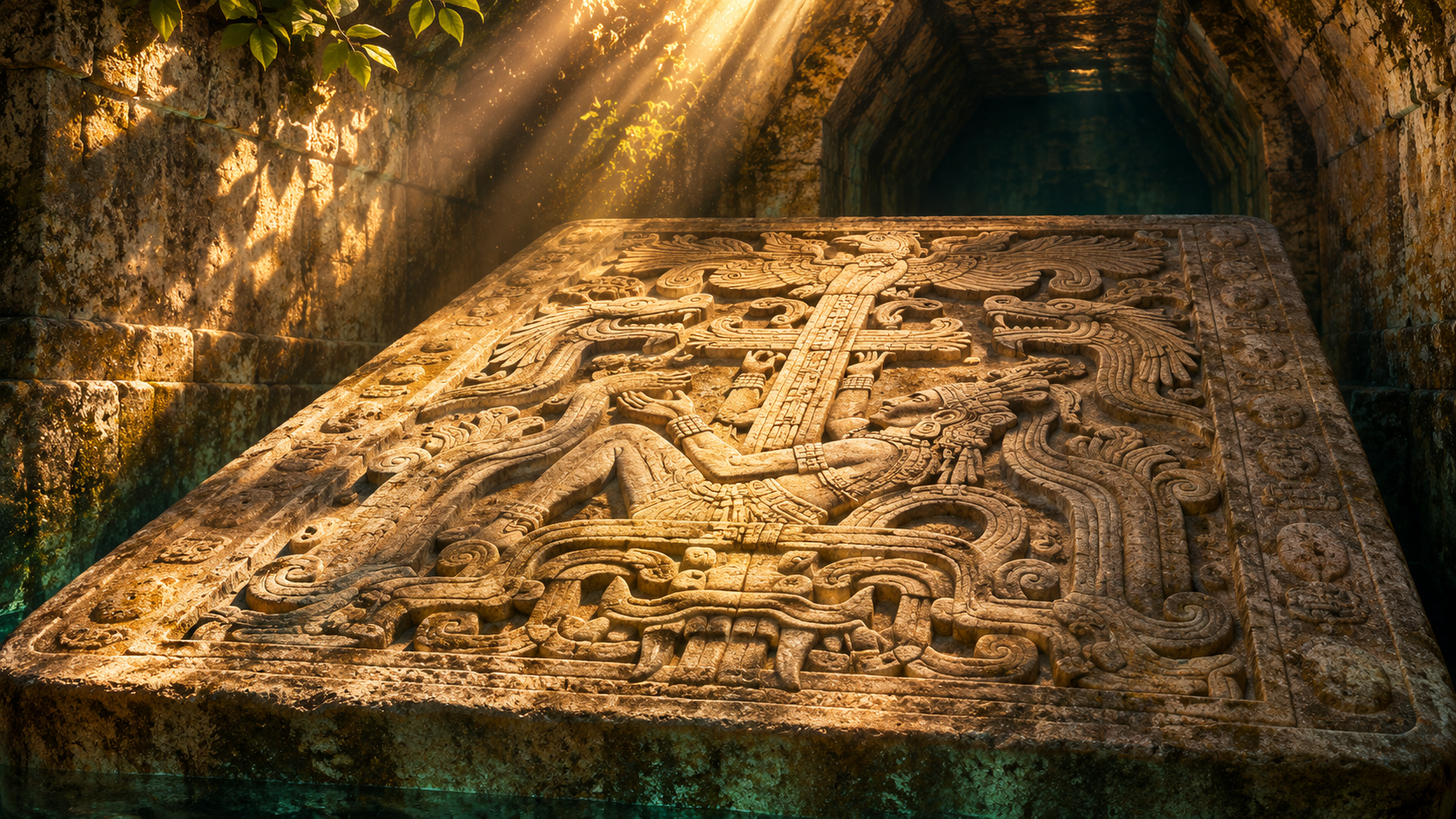
Artistic interpretation of Pakal's sarcophagus and Maya imagery of transition between worlds; not an archaeological reconstruction of the tomb.
On the lid of a sarcophagus almost 1,350 years old, a man is depicted in an unusual position, surrounded by serpents, plant forms, and enigmatic signs. When the image is rotated, it can resemble a pilot inside a spacecraft. But what do the tomb, the hieroglyphs, and the art of the civilisation that created it actually tell us?
Are We Looking at a Pilot?
The man leans backward. One leg is bent, and his hands are close to intricate forms stretching above and below his body. In one part of the image, a viewer might recognise something resembling levers; elsewhere, pipes or a seat; and at the very bottom, perhaps even an exhaust plume. Once this interpretation takes hold, other parts of the relief begin to look like components of the same machine.
Yet that impression depends on our own era and on how we look at the image. Someone familiar with aircraft cockpits, rocket engines, and science-fiction films may see outlines of technology in an ancient scene without its makers necessarily having known such technology. The reverse is also true: if we know that the Maya depicted world trees, mythological beings, and divine rulers, we will notice different connections. Neither initial association is evidence on its own.
The famous relief is not an unidentified object without a findspot or a date. It is carved into the massive stone sarcophagus lid in the tomb of the ruler K'inich Janaab' Pakal at the ancient Maya city of Palenque, in what is now the Mexican state of Chiapas. The tomb has an architectural context, human remains, funerary offerings, inscriptions, and depictions of ancestors. This context allows us to test interpretations of the relief against independent historical evidence. [1][2]
The real question, then, is not simply what the relief resembles at first glance. It is which interpretation best explains the monument as a whole, while relying on the fewest unsubstantiated assumptions.
The Tomb Beneath the Temple of the Inscriptions
Pakal's jade funerary mask — photograph by José Luiz Bernardes Ribeiro (2024)
Among the remains of Palenque in the rainforest of southern Mexico are extraordinary achievements of Maya architecture, sculpture, and writing. One of the most remarkable is the Temple of the Inscriptions, a stepped pyramid bearing extensive hieroglyphic texts. Today we know that it was not merely a sanctuary and a monument to royal power: deep inside the pyramid lies a deliberately constructed royal tomb. [2][3]
Temple of the Inscriptions at Palenque — photograph by Ferfive (2019)
In 1949, while investigating the temple, the Mexican archaeologist Alberto Ruz Lhuillier discovered the entrance to a blocked interior passage. The staircase had been filled with stones and earth, so the researchers needed several years to clear it. On 15 June 1952, Ruz's team began examining the burial chamber. Beginning to examine the chamber did not, however, mean that they could yet look inside the sarcophagus. [1][4]
On 27 November 1952, mechanical jacks were used to lift the monumental carved slab. Beneath it lay another stone cover; only after that additional barrier was removed did the interior of the sarcophagus come into view, revealing human remains, the celebrated jade funerary mask, and other grave goods. The chamber walls were decorated with stucco figures associated with Maya conceptions of death and the world beyond. [1][4]
The archaeologists had discovered a burial with an identifiable funerary context. That fact alone does not explain every carved line, but it establishes the purpose of the space and the kinds of evidence against which the relief should be read.
Pakal, Ruler of Palenque
K'inich Janaab' Pakal was born in 603 and ascended the throne of Palenque in 615, at about twelve years of age. He ruled until his death in 683. His exceptionally long reign shaped the city's political and cultural development. The ancient city was also known as Lakamha'. [2][3]
Palenque was not a settlement whose people left no written record. Its inhabitants developed complex architecture, carefully recorded royal genealogies, calendrical computation, visual art, and a hieroglyphic writing system. The inscriptions are not always straightforward to translate, and interpretations of individual passages continue to change. Nevertheless, they allow us to reconstruct events in the lives of real historical figures. [2][3]
Lineage and the legitimacy of royal power were especially important for Pakal. After a period of political upheaval, his mother, Ix Sak K'uk', played a significant role in his accession. On the famous Oval Palace Tablet, she is shown presenting symbols of rulership to her son. Some historical accounts describe her as a ruler or regent between 612 and 615, but the precise nature of her political authority and the reading of some related inscriptions remain debated. [2][12]
Pakal's tomb is therefore also a dynastic monument: it connects a historical ruler, his ancestors, and the idea of his place in the cosmic order. This matters when interpreting the imagery extending far beyond the central human figure.
More Than a Sarcophagus Lid
The lid is a monumental work of art. According to Mexico's National Institute of Anthropology and History (INAH), the limestone slab is approximately 3.80 metres long, 2.20 metres wide, and 25 centimetres thick. It bears an exceptionally elaborate relief, but the sides of the sarcophagus and the hieroglyphic texts around its edge belong to the same carefully conceived programme. [5]
The original lid of Pakal's sarcophagus — photograph by Chaccard (1985)
The sides depict the ruler's ancestors associated with plants and trees. They are not random decoration surrounding the central scene. Their images weave human genealogy into symbols of growth, fertility, and life's continuation. In his research into Maya religious beliefs, Simon Martin describes ten depictions of ancestors, with some individuals appearing more than once. Pakal's mother, Ix Sak K'uk', is associated with a cacao tree in this programme, while other figures are linked to various fruit trees. Ten relief images therefore do not necessarily represent ten different people. [6]
This is crucial to understanding the sarcophagus. If we see nothing but one individual surrounded by strange objects, we may be tempted to assign every form a technological function. Once we include the ancestors and the hieroglyphs, a much wider story emerges: the ruler's life and death are represented through lineage, plant life, and mythical renewal.
The sarcophagus is also material evidence of the skill of Maya stoneworkers. The shaping of a massive limestone slab, the fine carving and the coordination of images and text all testify to meticulous planning and highly skilled craftsmanship. That achievement deserves admiration without projecting modern technology onto it.
How the “Maya Astronaut” Idea Took Hold
In the decades following the tomb's discovery, space exploration transformed popular ideas about technology and the future. Rockets, spacesuits, and photographs of pilots in space capsules became part of the public imagination. It was during this period that Pakal's relief acquired a second, thoroughly modern life. [7]
The Swiss writer Erich von Däniken helped popularise the claim that the relief depicts an ancient astronaut, or a person inside some kind of spacecraft, in his best-selling Erinnerungen an die Zukunft, internationally known as Chariots of the Gods? (1968). He did not necessarily originate every idea about alleged extraterrestrial visits in antiquity, but he played a major role in spreading such ideas internationally. [7][8]
The proposition is simple and therefore compelling: the ruler is supposedly sitting in a cockpit, his hands near the controls, a breathing device in front of his face, and a propulsion system below him. When we rotate the relief and view it through the familiar outline of a modern rocket, its separate details seem to reinforce one another.
As early as June 1978, The Washington Post summarised a critical analysis published in the sceptical journal The Zetetic. The analysis drew attention to the proper orientation of the relief and to recognisable Maya motifs that the technological interpretation labels “controls,” a “pedal,” and an “exhaust.” The dispute did not begin in the internet age. [8]
The resemblance to a pilot may seem convincing because we rapidly recognise familiar patterns in unfamiliar forms. But moving from resemblance to historical explanation requires more: we must test whether a proposed meaning is consistent with other finds, inscriptions, and the artistic conventions of the same culture.
Reading the Scene
Scholarly drawing of Pakal's relief (Merle Greene Robertson, 1962) — Tulane
Pakal's figure occupies the centre of the composition. Yet the central motif extends far beyond his posture. Above him rises a branching, cross-shaped plant form that many researchers interpret as a cosmic or world tree. A celestial bird perches at its summit; serpentine and divine motifs intertwine on either side. In various interpretations, the composition depicts the relationship among the underworld, earthly realm, and celestial sphere of the Maya cosmos. [3][4][9]
Here the difference between the two approaches becomes clear. What resembles the framework of a machine to modern eyes has parallels in Maya iconography on other monuments. Similar cross-shaped vegetal motifs occur elsewhere in Palenque's artistic programme, including monuments of the Cross Group. The serpents and bird also have parallels elsewhere in Maya art. [3][4]
Simon Martin also draws attention to Pakal's attire, associated with the Maize God, and to the fiery attribute of the deity K'awiil near Pakal's forehead. This is not the same motif as the alleged “exhaust” near the bottom of the image; each has to be interpreted at its actual position in the composition. [6]
Below, the jaws of a supernatural underworld creature open. Some scholarship interprets it as a skeletal or centipede-like being. The motif is associated with passage between worlds. This is not a straightforward naturalistic depiction of an animal: the Maya assembled supernatural figures from animal, human, and symbolic elements. [4][6]
Near Pakal's nose is a small sign that can easily be mistaken for part of a breathing apparatus. In his overview, Eduardo Matos Moctezuma interprets it as a sign of the departure of pixán, a vital or spiritual element, from the body at death. This is a particular iconographic interpretation, not direct proof that all Maya understood the sign in exactly the same way. Nor can its shape alone establish that it represents an oxygen tube. [4]
Scholarly questions remain open about individual signs. Even so, the many parallels with other Maya images indicate that what we are seeing is an interconnected symbolic composition.
What Do the Hieroglyphs Reveal?
Hieroglyphs carved around the relief offer more than a visual comparison. Through epigraphy, they can be connected with Pakal's life, dynasty, and the tomb's funerary message.
The epigrapher David Stuart draws particular attention to the inscription on the southern edge of the lid. It brings together information about Pakal's birth and death, while the longer inscription around the lid also records the deaths of important ancestors. In connection with the deceased, it uses the expression och bih, often translated approximately as “entering the road.” This is a metaphor for death, not a description of travel aboard an actual vehicle. [10]
Reading the hieroglyphs is not entirely free from interpretative difficulties. Nevertheless, their central message is sufficiently clear: the monument concerns Pakal's life, death, and deceased ancestors. The text is consistent with the funerary purpose of the space.
No comparable evidence supports the claim of a spacecraft. We know of no inscription on the lid that, in its Maya linguistic context, describes an engine, cockpit, launch, or space voyage. This is not a claim about every technological possibility of every civilisation in the past. It is a narrower observation: the surviving text on this monument supports a funerary and dynastic interpretation.
Death and Rebirth
Is Pakal descending into the underworld, or rising from it? This is not merely a rhetorical question. Researchers have proposed different readings of his posture and the direction of his movement. Some emphasize the moment of death and descent among the dead; others stress rebirth and emergence into renewed life. Both themes may be intertwined within the same funerary programme. [3][6][9]
Stuart develops a particular interpretation linking Pakal's birth, death, and posthumous transformation with the image of the rising sun. The ruler thus appears not merely as a dead person, but as a figure of rebirth within the cosmic order. This is a scholarly interpretation supported by argument, not a fact of the same kind as the existence of Pakal's burial in the tomb. [10]
It is also important to state what Stuart does not demonstrate. Although he discusses the winter solstice in the Maya world, he notes that no obvious direct connection with that particular astronomical date can be established for Pakal's sarcophagus. It would therefore be unjustified to turn this relief into a precise “winter-solstice calendar.” [10]
Even the botanical identity of the world tree is debated. It is often associated with the kapok tree, maize, or broader plant symbolism. In 2016, J. Andrew McDonald drew on botanical and iconographic comparisons to argue that the cosmic-tree motif is more closely linked with the white water lily (Nymphaea ampla) and an aquatic environment. This is a scholarly proposal with supporting arguments, but not a universally accepted conclusion; it does not automatically invalidate other interpretations. [11]
The name Xibalba is sometimes used for the Maya underworld. Because the term is especially well known from later traditions of the K'iche' Maya, it should not be presented without qualification as the documented local name of the underworld at seventh-century Palenque. Here, “underworld” is the historically safer term.
Different iconographic interpretations may therefore disagree over details without losing their common foundation: the monument was created within the Maya religious world of death, ancestors, and the renewal of life.
What Evidence Would Support the Rocket Interpretation?
An unusual hypothesis is not false merely because it is unusual. Yet an explanation of an archaeological monument must supply evidence that can be examined independently of a visual impression.
If someone wished to argue that Pakal's lid really depicts a technological device, it would be reasonable to expect at least one stronger line of support: an unambiguous description of the device in an inscription; a comparable technical depiction with identifiable functions; material remains of such technology in the relevant historical context; or multiple consistent, verifiable testimonies not already explained by known Maya artistic conventions. We need not demand the survival of an entire machine. But we do need to know why a technological interpretation would be better than the one supported by established iconographic parallels and inscriptions.
At present, we have no such evidence for this sarcophagus. We do have an identified ruler's tomb, funerary offerings, dynastic representations on its sides, hieroglyphs around the lid, and a range of related mythological motifs. Each of these lines of evidence has its limits; together, they provide a far stronger framework for interpreting the scene. [1][4][6][10]
This is not a verdict on whether life exists beyond Earth. It is a much narrower question: does this particular Maya monument establish that a spaceflight took place? The evidence presently available does not support that claim.
A Greater Mystery Than a Spaceship
There is no need to search for a modern rocket in the tomb beneath the Temple of the Inscriptions for the scene to astonish us. In stone, the Maya brought together the history of a real ruler, his ancestors, writing, and images of plants, animals, and deities. The artwork was composed so that its parts could be understood in relation to one another. When we turn one isolated section into an image of a machine, much of that story disappears.
Not every detail has been resolved. Researchers debate the plant motifs, underworld beings, and the direction of Pakal's posthumous transformation. Study of surviving surfaces and traces of colour may yet reveal more. But debate within Maya iconography does not, on its own, support the claim that the image represents a spacecraft.
The scene on Pakal's sarcophagus lid is compelling precisely because it brings real human mortality together with a vision of life's continuation in the cosmos. The ruler died. His successors wanted his authority and memory to endure within his lineage, city, and the world of their gods. They carved that message into massive stone, linked it with writing, and concealed it within the heart of a pyramid.
Perhaps the deepest mystery of Pakal's sarcophagus is not whether a human once journeyed among the stars, but how the Maya civilisation understood the human passage between life, death, and the renewal of the world. That question is genuine, historically rich, and still worth investigating—without claiming that it provides evidence we do not possess.
Sources and further reading
- Instituto Nacional de Antropología e Historia (INAH), “Se cumplen 71 años del descubrimiento de la tumba de Pakal ‘el Grande’, en Palenque” (15 June 2023) Source
- Smithsonian Institution, National Museum of the American Indian, Living Maya Time — Palenque Source
- Smarthistory, “Palenque (Classic Period)” Source
- Eduardo Matos Moctezuma, “¿Un astronauta en Palenque?”, Arqueología Mexicana, no. 121 (2013) Source
- INAH, “El INAH emprende nuevos estudios de conservación en la lápida de Pakal, en Palenque, Chiapas” (12 September 2023) Source
- Simon Martin, “Cacao in Ancient Maya Religion: First Fruit from the Maize Tree and Other Tales from the Underworld” (2006), especially pp. 160–162 Source
- National Geographic, “Palenque: New Age” (2012) Source
- Michael Kernan, “God's Chariot! Science Looks at the New Occult”, The Washington Post (June 1978; the page masthead gives 10 June, while the archive path gives 11 June) Source
- Tulane University, “The Sarcophagus Lid Revealed”, exhibition record and documentation of Merle Greene Robertson's 1962 drawing Source
- David Stuart, “Birth of the Sun: Notes on the Ancient Maya Winter Solstice” (2015) Source
- J. Andrew McDonald, “Deciphering the Symbols and Symbolic Meaning of the Maya World Tree”, Ancient Mesoamerica 27 (2016), 333–359, DOI 10.1017/S0956536116000249 Source
- Tulane University, Palenque Rulers, research exhibition on Pakal and his mother Sak K'uk' Source