Ouroboros — The Serpent That Devours Its Own Tail: Cycles, Death, and Renewal
Imagine a serpent coiling into a circle and grasping its tail between its teeth. Its body has no visible beginning or end. Its head meets its tail, and what it devours is also part of itself.
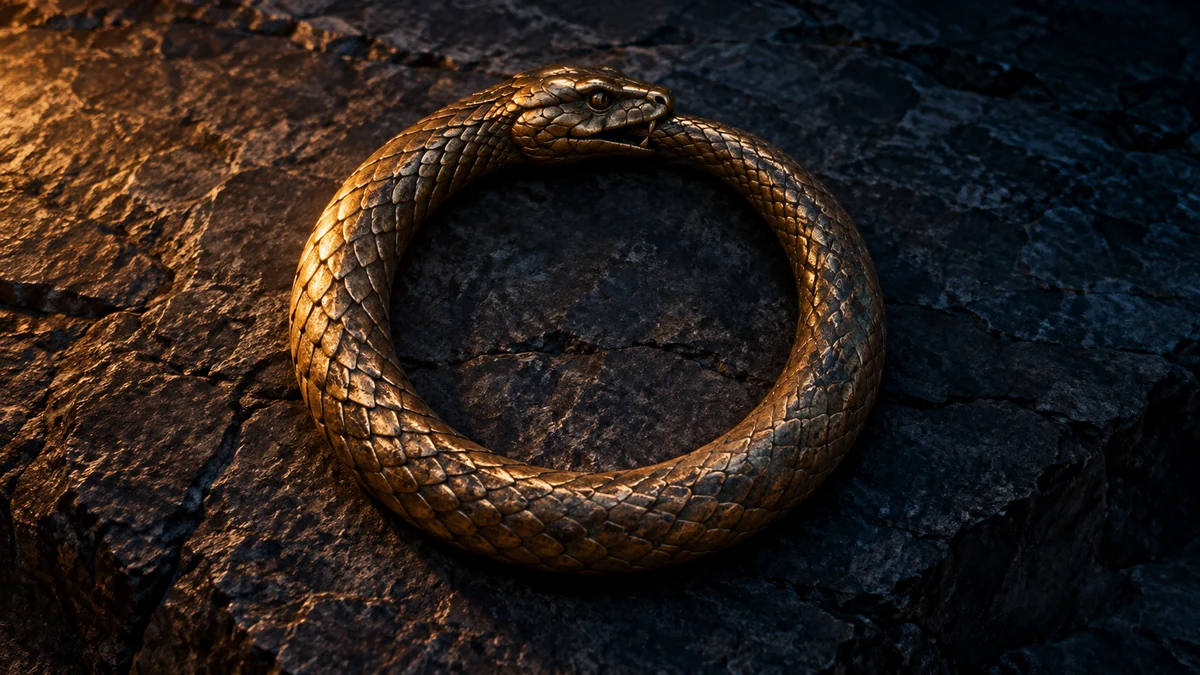
Imagine a serpent coiling into a circle and grasping its tail between its teeth. Its body has no visible beginning or end. Its head meets its tail, and what it devours is also part of itself. The image is simple, almost startlingly direct, yet it raises questions that have accompanied humanity for thousands of years. Does existence have a beginning and an end? Does death mean final disappearance, or a passage into another form? Is the world continually renewed, or is it trapped in repetition?
Today, we know this motif as the ouroboros, from a Greek expression meaning approximately “the one that devours its own tail.” In modern symbolic language, we associate it with eternity, cyclical time, death and rebirth, inner transformation, and the union of opposites. It appears in discussions of alchemy, religion, mythology, philosophy, and psychology. It has also become a popular emblem of personal transformation, since its circular form offers an appealing image of a new beginning emerging from an ending.
But the symbol's history is far more complex than it first appears. A serpent encircling itself did not mean the same thing everywhere. In some ancient Egyptian scenes, it was associated with protection. In the alchemical tradition, it expressed wholeness and transformation. In certain Gnostic texts, a related image appeared in connection with realms of punishment and confinement, while in later European symbolism it became an emblem of infinity.
In studying the ouroboros, then, we are exploring more than the history of an image. We are also examining how people across the centuries adopt old symbols, reinterpret them, and invest them with their own questions about life, death, and the nature of reality.
A Serpent Without Beginning or End
The circular form holds a special place in human symbolic thought. A circle can mark a boundary, a whole, a protected space, or repetition. Unlike a straight line leading us from one point to another, a circle returns to its starting point. Wherever we begin moving along it, we can eventually find ourselves where we started.
When a living creature forms the circle, its meaning changes. A serpent is not merely a geometric boundary. It is a creature that moves, hunts, feeds, hides, and sheds its skin. That last characteristic has encouraged associations between serpents, renewal, and the continuation of life in various cultures, although we cannot automatically assign that meaning to every depiction of a snake.
The ouroboros adds something else. The serpent is not directed toward prey outside itself, but toward itself. We may therefore read it as an image of a whole that contains itself, or of a process in which something is continually consumed and renewed. Yet the image also holds an opposite possibility. A circle can protect, but it can also enclose. It can suggest connectedness, but also captivity. A serpent can guard what it surrounds, or prevent it from escaping.
The widespread modern interpretation that the ouroboros always represents positive renewal, eternity, and spiritual perfection is therefore too one-sided. Its meaning depends on its historical setting, the story in which it appears, and the purpose for which it was used.
Ancient Egypt: The Protective Serpent and the Journey of the Sun
Some of the earliest surviving examples of the motif come from ancient Egypt. An especially important scene appears on the second gilded shrine from the tomb of the pharaoh Tutankhamun, dating to the fourteenth century BCE. There, two encircling serpents surround the head and feet of a large divine figure that scholars associate with the union of the sun god Ra and Osiris in the underworld. [1][3] The scene belongs to Egyptian conceptions of death, the sun's nocturnal journey, and the restoration of cosmic order.
In ancient Egyptian mythology, the sun god leaves the visible world each evening and travels through the Duat, a realm of the underworld or the hereafter. His journey is fraught with danger, for the sun must pass through darkness and reappear at dawn. This is more than a story about a daily astronomical event. The solar journey forms part of a broader religious understanding of how the world is sustained. Cosmic order, which the Egyptians called ma'at, was neither self-evident nor secured once and for all. It was constantly threatened by forces of disorder.
Among the sun god's chief enemies was Apophis, or Apep, a gigantic serpent that sought to obstruct the solar journey. Yet the same religious world also knew the serpent deity Mehen, whose name means approximately “to coil” or “to wrap around.” Mehen fulfilled a different role: he surrounded and protected the sun god with his body during the perilous passage through the underworld. [2][4]
This distinction is essential. In Egypt, the serpent did not represent a single principle of good or evil. Its role depended on the particular deity, scene, and textual context. Mehen represented protection, while Apep threatened cosmic order. When Mehen coils around the sun god or a deceased person, his body acts as a protective boundary. In this setting, the encircling serpent is not necessarily an abstract sign of infinity, but above all a living protective enclosure.
The scholar Dana Michael Reemes examined this issue in detail in his 2015 doctoral dissertation, The Egyptian Ouroboros: An Iconological and Theological Study. He argued that the modern interpretation of the ouroboros as a uniform Egyptian symbol of endless time is largely the product of later readings. According to his analysis, scholars have often projected onto ancient Egyptian images meanings that became more clearly established only in post-antique European traditions. [2]
A different emphasis appears in the work of Egyptologist Jan Assmann. In Ouroboros: The Ancient Egyptian Myth of the Journey of the Sun, he discusses the connections between the encircling serpent, the renewal of the sun, and Egyptian ideas of cyclical time. [3] These approaches are not identical. Assmann explores the broader religious and temporal context of the motif, whereas Reemes especially warns against treating the symbol's later meaning as its original and unchanging definition.
This is precisely why it matters not to read the earliest depictions solely through modern ideas of eternity. The Egyptian roots of the motif can be understood in relation to protection, death, renewal, and cosmic order. But the claim that a serpent biting its tail meant infinity everywhere from the very beginning is not historically justified.

Alchemy: All Is One
In the Greco-Egyptian and later Byzantine worlds, the ouroboros acquired a particular place within the alchemical tradition. Today, alchemy is often associated solely with attempts to turn ordinary metals into gold. Historical alchemy, however, was a much broader field. It combined practical work with materials, the development of procedures for heating, dissolving, and separating substances, and philosophical reflections on the properties and transformations of the material world.
Alchemists asked how one state could become another and whether shared principles lay behind the apparent diversity of substances. In this context, the image of a serpent turning back upon itself was especially suited to expressing connectedness, wholeness, and transformation.
One of the best-known alchemical depictions of the ouroboros survives in the Greek manuscript Marcianus graecus 299, dating to approximately the tenth or eleventh century and held by the Biblioteca Nazionale Marciana in Venice. Beside the circular serpent is the Greek phrase hen to pan (ἓν τὸ πᾶν), which can be translated as “the all is one” or “all is one.” [5][6] This brief expression became one of the most recognizable companions of the ouroboros.
If we understand the world as an interconnected whole, transformation need not mean creation from absolute nothingness. It can mean changes in relationships and forms within the same reality. Matter can change its properties and states, with one outcome becoming the starting point for further processes. Within this symbolic framework, the ouroboros expresses the connection between beginning and end.
The manuscript image is traditionally associated with Chrysopoeia of Cleopatra, or Cleopatra's art of making gold. But this is not Cleopatra VII, the famous Egyptian ruler. It refers instead to Cleopatra the Alchemist, a figure in the history of Greek alchemical traditions. The attribution of the diagram itself to Cleopatra is not entirely certain either. The researcher Alexandre Mattos Roberts has pointed out that the diagram appears among texts attributed to Zosimos of Panopolis, an important Greco-Egyptian alchemist. Similar diagrams also occur in other manuscripts that do not name Cleopatra. Without further evidence, therefore, the famous image cannot be attributed directly to her authorship. [5]
Despite the question of authorship, the image is highly significant. Within alchemy, the ouroboros is not merely decoration. It belongs to a symbolic language concerned with transformation, interconnection, and the relationship between the one and the many. Here, too, however, we must distinguish symbolic interpretation from scientific claims. The alchemical saying “all is one” does not, in itself, prove that the entire universe possesses a single consciousness, or that spiritual processes can directly transform chemical elements. It is a philosophical and symbolic idea embedded in historical theories and the practical study of materials.

The Gnostic Turn: When the Circle Becomes a Realm of Confinement
One of the most interesting shifts in the meaning of the ouroboros appears in certain Gnostic texts. We use the term Gnosticism for a variety of religious and philosophical movements, especially from the first centuries CE, that assigned great importance to saving knowledge, or gnosis.
Some of these movements understood the material world as a realm of limitation, ignorance, and rule by lower cosmic powers. In such frameworks, the salvation of the soul was associated with transcending those limitations. In Pistis Sophia, preserved in the Coptic manuscript tradition, we encounter a particularly striking description of a gigantic dragon. In chapter 126, the outer darkness is described as a great dragon with its tail in its mouth, surrounding the world. Within it lie regions of punishment divided into twelve chambers with different rulers. [7]
Here, the circular image does not have an obviously positive meaning of protected wholeness. It is associated with a boundary, darkness, and places of punishment. An important detail must be kept in mind: the text describes the outer darkness surrounding the world. It does not simply say that the entire cosmos, in every Gnostic tradition, is a single prison formed by a dragon. We should therefore not generalize from one passage to all Gnostic thought.
Even so, the example matters because it reveals a different symbolic possibility. A closed circle is not necessarily a sign of perfection. It can also mark a space from which a person seeks to escape. In his 2024 essay The Corrupted “Wheel of Life”: An Essay on Ouroboroses, the contemporary scholar Dmitry Uzlaner used the ouroboros as a starting point for reflecting on human unfreedom, repetition, and different forms of entrapment. [8]
In this reading, the circular image becomes a question about freedom. If a condition continually reproduces itself, does that make it perfect? Or might its persistent repetition be a sign that we do not know how to escape it?
The distinction is fundamental. In one historical setting, a circle formed by a serpent may protect what it surrounds. In another, it represents a boundary that must be crossed. The same form can thus accommodate opposing interpretations.
Jörmungandr: The Serpent That Encircles the World
The motif of a gigantic serpent biting its tail also appears in Norse mythology. In the Prose Edda, associated with the thirteenth-century Icelandic author Snorri Sturluson, we encounter Jörmungandr, also known as Miðgarðsormr, the serpent of Midgard, the world of human beings. According to the story, Jörmungandr is one of the children of Loki and the giantess Angrboða. The gods cast him into the ocean, where he grows so immense that he encircles the world and seizes his own tail. This description appears in chapter 34 of Gylfaginning. [9]
The resemblance to the ouroboros is obvious. The serpent forms a closed boundary, its body surrounding the world. But Jörmungandr is not simply an abstract symbol of eternity. He is a mythological being associated with the boundaries of the world, danger, and Ragnarök, the great conflict in which the existing cosmic order collapses.
During Ragnarök, Jörmungandr battles Thor. Their encounter belongs to a wider narrative of catastrophe, the deaths of many gods, and the continuation of the world after a great destruction. The Norse world-serpent therefore combines two important motifs: an enclosing boundary and a danger threatening the established order.
The resemblance to Egyptian and alchemical imagery is intriguing, but it does not, on its own, demonstrate direct historical transmission. To claim that the Norse motif arose by borrowing an Egyptian symbol, we would need concrete evidence of cultural contacts and the transmission of images or narratives. Different peoples may express similar ideas through related images without their traditions being directly connected. Jörmungandr is therefore an important example for comparative mythology, but should not be treated as simply the Norse version of the alchemical ouroboros.
How the Ouroboros Became a Symbol of Eternity
When we see the ouroboros today, we almost automatically associate it with eternity, infinity, and eternal recurrence. The history of that association, however, is not straightforward. In the ancient, late antique, medieval, and Renaissance worlds, old images acquired new meanings. Philosophers, theologians, alchemists, and authors of symbolic handbooks incorporated them into different explanations of time, creation, and cosmic order.
European Renaissance interpretations of Egypt were particularly influential. Many ancient images came to be regarded as carriers of hidden philosophical wisdom. Within this broader history, the ouroboros increasingly gained prominence as an emblem of the totality of time and eternity.
Dana Michael Reemes specifically cautions against projecting the interpretation of the ouroboros as a symbol of time and eternity back onto the pharaonic period without critical scrutiny. [2] Jan Assmann, meanwhile, explores the wider history connecting the circular serpent, the solar journey, and later European symbolism. [3]
An important addition to this history is Aleida Assmann's 2019 study, Ouroboros: The Circle as a Concept of Infinity. She shows how the circle acquired new meanings in European philosophy and literature. Her discussion of the American thinker Ralph Waldo Emerson is particularly interesting: in his 1841 essay Circles, Emerson associated the circle with movement, transcendence, and continual renewal. [13]
The symbolic emphasis thus gradually changes. The circle is no longer necessarily only the sign of a complete, already enclosed whole. It can also become an image of a process in which a person moves beyond former boundaries and creates new ones. This is a significant shift: from the circle as static perfection to the circle as dynamic change.
By the modern era, the ouroboros had therefore accumulated numerous historical interpretations. Its antiquity is genuine. But not every meaning we associate with it today is equally ancient.
Jung, Neumann, and the Psychology of Transformation
In the twentieth century, the ouroboros found a new place in analytical psychology. Carl Gustav Jung regarded alchemical symbolism as important material for exploring psychological processes. He was especially interested in symbols expressing opposites, their union, and the possibility of inner transformation. In Mysterium Coniunctionis, he explored the alchemical idea of the union of opposites and its connections to psychological processes. [10]
Within this framework, the ouroboros is more than a historical depiction of a serpent. It also becomes a metaphor for a whole containing internal oppositions, within which a process of change unfolds. Jung's colleague Erich Neumann played an important role in the further psychological interpretation of the image. In The Origins and History of Consciousness, first published in German in 1949, he used the ouroboros as an image of an original, still undifferentiated psychic state from which the conscious ego gradually emerges. [11]
For Neumann, this original wholeness is ambiguous. On the one hand, it represents the source from which consciousness develops. On the other, it is a state from which the individual must gradually become independent in order to establish a distinction between self and world.
Today, we may also understand this image through the experience of recurring patterns in our lives. A person may repeatedly encounter similar relationships, conflicts, or decisions. Sometimes we maintain habits even when we know they limit us. The cycle continues because its various elements sustain one another.
Yet the psychological use of the ouroboros remains a symbolic interpretation. Jung's theory of archetypes and Neumann's account of the development of consciousness are not experimentally verified universal models that can be applied without qualification to every person or culture. The ouroboros can help us think about inner processes, but it cannot, by itself, demonstrate hidden psychological laws.
Perhaps the most interesting distinction is between repetition and development. If we return to the same circumstances but understand them differently each time, something is changing. If, however, we respond in the same way again and again and obtain the same result, the circle may primarily be a sign of stagnation. Transformation, then, does not necessarily lie in the continuation of the cycle. Sometimes it lies in recognizing it.
Kekulé's Serpent and the Birth of a Scientific Idea
One of the best-known stories about a serpent biting its tail comes from the history of chemistry. In 1890, in a speech commemorating the anniversary of his benzene theory, the German chemist August Kekulé described an experience from his research years in Ghent, Belgium. As he dozed by the fireplace, he reportedly imagined groups of atoms moving like snakes. One of these shapes coiled around and grasped its tail. The scene prompted him to think about a closed-ring structure for the benzene molecule. [12]
The account became a popular example of sudden scientific insight. But two details matter. First, Kekulé described the experience retrospectively, roughly a quarter of a century after developing the theory. His speech is a historical source for how he later presented his research, not a direct record of the moment of discovery.
Second, Kekulé himself stressed that ideas arising in imagination or dreams must be examined with a waking mind. His theory did not emerge from an intellectual vacuum. It rested on earlier knowledge of chemical bonds, the development of structural theory, and further investigation of chemical compounds. The serpent image may have stimulated a new line of thought, but it did not replace the scientific method.
That is precisely what makes the story valuable. It does not demonstrate that ancient symbols conceal secret formulas of modern chemistry. It shows that the human mind can approach scientific problems through images, analogies, and imagination as well. A symbol may help generate a hypothesis. Its validity, however, must be established independently of how compelling the originating image may have been.

Does Everything Really Return?
Today, the ouroboros is often used as an image of eternal recurrence. Many cyclical processes do indeed exist in nature. Day and night alternate because of Earth's rotation. The seasons recur because of Earth's orbit around the Sun and the tilt of its axis. Ecosystems involve the cycling of water, carbon, and other substances.
But the existence of individual cycles does not establish that reality as a whole repeats endlessly. Even where processes recur, their particular states are not necessarily identical. Spring returns, but a tree is not the same as it was the year before. New organisms are born, but they are not exact copies of their ancestors. Societies may confront problems resembling those of the past, yet historical circumstances change. Repetition, therefore, does not exclude change.
We must also distinguish the cycling of matter from the question of personal consciousness. The fact that matter from a deceased organism enters new natural processes does not allow us to infer directly that personal consciousness survives death or is reborn. Similarly, the existence of cosmological theories allowing for cyclic models of the universe does not mean that an eternal return of the universe to precisely the same state has been scientifically established. The ouroboros is a useful symbol for considering such questions, but it is not evidence for their answers.
Perhaps its greatest value is not that it reveals a hidden law of the universe, but that it draws attention to the complex relationship between continuity and change. Something can continue even as its form changes. Something can recur even if its constituent parts never return entirely to an earlier condition.
For some natural, historical, and psychological processes, a spiral might therefore be a better image than a perfectly closed circle. A spiral curves around a center, yet its path can also move onward. It preserves a resemblance to its previous motion without exactly repeating it. The ouroboros thus brings us to a question: is repetition itself enough for renewal, or does genuine transformation also require a departure from what came before?
When the Circle Means Wholeness — and When It Means Limitation
Looking across the history of the ouroboros, we encounter an intriguing contradiction. In Egyptian traditions, an encircling serpent can represent protection. In alchemy, it can express connectedness and transformation. In some Gnostic texts, a comparable motif appears in the context of threatening boundaries and punishment. In Norse mythology, a gigantic serpent surrounds the world while also being associated with a threat to its existence. In modern psychology, the circular image may suggest both original wholeness and a state from which consciousness must develop. It is therefore impossible to reduce the symbol's entire history to a single definition.
Yet there is an intriguing feature shared by these different meanings. The ouroboros repeatedly raises the question of boundaries. What belongs inside the whole, and what remains outside it? Does a boundary protect or restrict? Does a process continue because it renews itself, or because there is no way out?
For an individual, a habit can be a source of stability, but it can also become a limitation. For a community, tradition can preserve knowledge and memory, yet in some circumstances it can obstruct necessary change. This is a modern philosophical application of the symbol, not its one uniform historical meaning. But such an application helps explain why the ouroboros has remained compelling across the centuries. Its closed form does not force us toward a single answer. It presents the tension between preservation and transcendence, security and freedom, continuation and ending.
Conclusion: When the End Meets the Beginning
The ouroboros has endured for millennia not because different cultures saw precisely the same message in it, but because its simple form can express many questions, sometimes even contradictory ones. Protection and captivity. Death and renewal. Wholeness and boundary. Repetition and change.
In ancient Egypt, encircling serpents appeared in contexts of protection, the afterlife, and the solar journey. In alchemical traditions, they became associated with the transformation of matter and the idea of a whole. In certain Gnostic texts, a similar motif acquired a different, restrictive function. Later European philosophy attributed meanings of eternity and infinity to it, while modern psychology used it as a symbolic way of thinking about inner processes. None of these interpretations can simply be declared the sole and unchanging meaning of the ouroboros.
Perhaps the history of the symbol is itself the best example of what it so often represents: the image persists while its meanings change. The old becomes part of the new, but the new is not necessarily a mere repetition of the old.
When we look at a serpent biting its own tail, we may recognize a promise of renewal. But we may also see a warning against a life in which we return to the same place again and again. The ouroboros does not prove that everything must repeat. It invites us to ask what truly changes within repetition.
Sources and further reading
- Ra-Osiris in the Enigmatic Book. Photograph of a scene on Tutankhamun's second gilded shrine, Eighteenth Dynasty, fourteenth century BCE. A. Parrot, Wikimedia Commons. CC0 license Source
- Reemes, D. M. (2015). The Egyptian Ouroboros: An Iconological and Theological Study. Doctoral dissertation, University of California, Los Angeles Source
- Assmann, J. (2019). Ouroboros: The Ancient Egyptian Myth of the Journey of the Sun. Aegyptiaca: Journal of the History of Reception of Ancient Egypt, 4, 19–32 Source
- Lee, S. (2023). The Journey through the Netherworld and the Death of the Sun God: A Novel Reading of Exodus 7–15 in Light of the Book of Gates. Religions, 14(3), 343 Source
- Roberts, A. M. (2015). Matter Redeemed: Alchemy and Exegesis from Antioch to Constantinople, 11th Century. Doctoral dissertation, University of California, Berkeley. In particular, the discussion of manuscript Marcianus graecus 299 Source
- Chrysopoea of Cleopatra. Alchemical diagram, Marcianus graecus 299, fol. 188v, approximately tenth–eleventh century. Wikimedia Commons. Public Domain Source
- Pistis Sophia. Chapter 126. Coptic Gnostic text, English translation by G. R. S. Mead (1921) Source
- Uzlaner, D. (2024). The Corrupted “Wheel of Life”: An Essay on Ouroboroses. Open Theology, 10(1), 20240030 Source
- Snorri Sturluson. Prose Edda, Gylfaginning, chapter 34. Thirteenth-century text Source
- Jung, C. G. (1970). Mysterium Coniunctionis: An Inquiry into the Separation and Synthesis of Psychic Opposites in Alchemy. Collected Works of C. G. Jung, vol. 14. Princeton University Press. Original German edition 1955–1956 Source
- Neumann, E. (1954). The Origins and History of Consciousness. Princeton University Press. English translation by R. F. C. Hull; German original Ursprungsgeschichte des Bewusstseins (1949) Source
- Kekulé, A. (1890). Address marking the twenty-fifth anniversary of the benzene theory, March 11, 1890. Berichte der Deutschen Chemischen Gesellschaft, 23, 1302 ff. Reproduction of the historical text Source
- Assmann, A. (2019). Ouroboros: The Circle as a Concept of Infinity. Aegyptiaca: Journal of the History of Reception of Ancient Egypt, 4, 6–18 Source