Three Faces of One God — The History of the Trifacial Trinity Between Europe and the Andes
In several European churches and museums, and in paintings from colonial America, we encounter an unusual image: a humanlike figure with one body and one head, but three faces. The central face looks directly forward, while two lateral faces turn to the left and right. Their eyes partly overlap, so that four eyes, three noses, and three mouths may…
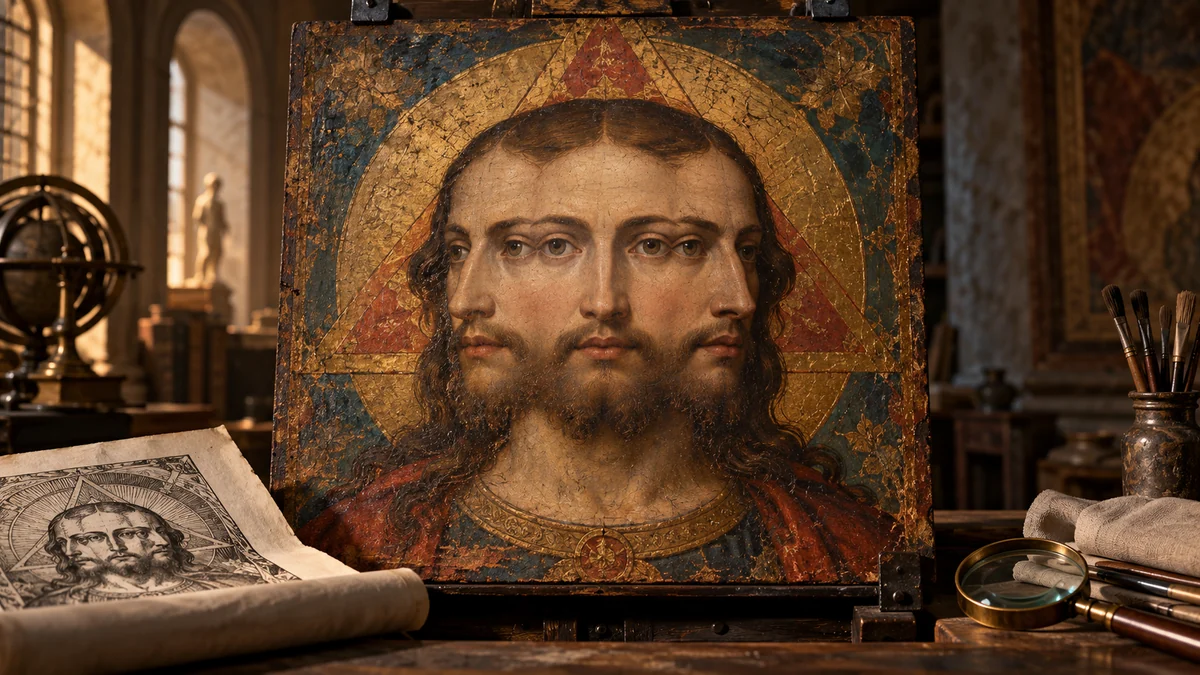
A contemporary symbolic interpretation of the historic three-faced motif, not a reproduction of Trinidad trifacial held by MALI.
One Face, Three Persons: Why the Motif Matters
In several European churches and museums, and in paintings from colonial America, we encounter an unusual image: a humanlike figure with one body and one head, but three faces. The central face looks directly forward, while two lateral faces turn to the left and right. Their eyes partly overlap, so that four eyes, three noses, and three mouths may be visible. This is not an anatomical fantasy without a history. It is a recognizable iconographic attempt to represent, within a single human figure, the Christian doctrine of three divine persons and one God. [13][18]
Such representations circulated over several centuries. They were not confined to a single artist, location, or school of painting. Their traces survive in wall paintings, altarpieces, prints, books, and colonial art. Some were understood in their time as aids to religious instruction; others raised theological concerns, while certain church authorities attempted to restrict them. The distance between their creation, reception, and opposition is precisely what this investigation examines. [3][15][16]
The history of the doctrine of the Trinity is a separate subject, explored in the related article The Holy Trinity. Here we are not deciding whether a religious proposition is metaphysically true. We are asking historically testable questions: which images were made, when, how they might have been connected, what purposes they served, and why they were not considered acceptable everywhere. Online comparisons may have drawn attention to the motif, but its origins and significance must be investigated through actual objects and sources.
Three Faces or Three Heads: How Do We Identify the Image?
Precise terminology matters. The term trifrons is generally used for one head with three faces, whereas tricephalus literally means three heads. Art-historical writing does not always use these terms consistently. It is therefore safer to describe the physical arrangement of a particular image than to classify it by a Latin term alone without further explanation. [6]
Multi-faced and multi-headed figures predate Christian art. They appear in a variety of ancient and other cultural settings, where they might signify sight in several directions, omniscience, the boundaries of time, power, or some other attribute of a depicted being. Yet the same visual device does not necessarily imply the same deity, the same doctrine, or an uninterrupted historical chain of transmission.
The same caution applies to European medieval art. A multi-faced figure is not necessarily a representation of the Trinity. In some settings it appears in connection with demonic or apocalyptic beings; elsewhere it functions as a decorative or allegorical motif. Zdenko Balog accordingly warns against identifying such facial arrangements as the Christian God without examining their context. [7]
The research question is not whether three heads or three faces were ever depicted before Christianity; they certainly were. What is harder to establish is when, and through which identifiable routes, a particular visual solution came to be associated with an explanation of the Christian Trinity. Resemblance alone is insufficient. We need a dated object, an identifiable iconographic setting, evidence of a model used by an artist, or another document connecting particular examples.
In a specialist iconographic resource at the Complutense University of Madrid, Irene González Hernando distinguishes a tricephalous representation, with three separate heads emerging from one body, from a trifacial representation, with one head and three joined faces. She also notes that historical literature sometimes overlaps these terms. Scientific comparison therefore requires a description of the actual form, not merely a catalogue label. [18]
The distinction matters. Three separate heads may suggest three independent subjects to a viewer; united faces place greater emphasis on one body and one divinity. In both cases the image is a visual mode of explanation, not a claim that God was physically seen in that form. A comparable threefold arrangement in another culture might evoke omniscience, rule over three realms, or a deity's multiple aspects. The Christian explanation cannot automatically be imposed on every older multi-faced figure.
Medieval and Renaissance Europe: From Murals to Altarpieces
The motif's history predates colonial America. Among the examples listed by the Complutense University is a stone image with three faces at San Martín de Artaiz in Navarre, assigned to the twelfth century, along with later examples in manuscripts and churches. Each case nevertheless raises a question: is it explicitly a representation of the triune Christian God, or an instance of a broader multi-faced motif? The dating of an object and its original identification are not necessarily equally secure. [18]
In the late Middle Ages and Renaissance, church painting, book illustration, and theological diagrams interacted closely. An artist could employ a figure with three faces, a triangle, verbal connections, or all of these together. Because of these combinations, we cannot posit a single, unchanging formula. Two works from the same century could emphasize different theological problems and serve different functions while using a similar facial motif.
A related representation is found at the monastery of Tulebras in Navarre, Spain, and is associated with the painter Jerónimo Vallejo Cósida. The University of Navarre describes it as a painting on a wooden support that belonged to an altar ensemble. Its central figure likewise has three faces and is accompanied by a diagram featuring the terms Pater, Filius, Spiritus Sanctus, Deus, est, and non est. [10]
This example is important because it demonstrates that the combination of a trifacial figure and the Shield of Faith was not a peculiarity of colonial Peru. It was known in a European Catholic setting before the MALI painting was made. Even so, resemblance of this kind does not establish a direct connection of authorship or ownership between the altarpiece in Tulebras and an anonymous painter in Cusco.
A further independently documented museum example belongs to the Museu Nacional d'Art de Catalunya. An anonymous oil painting dated to approximately 1600–1650 depicts a bust with three joined faces. It entered the museum collection through Enric Batlló's donation in 1914. Its inventory record and scholarly interpretation confirm that the motif did not disappear immediately after the Council of Trent. The museum description alone, however, does not establish the original patron's identity or the place where the work was made. [16]
Tulebras and Barcelona establish the motif's European distribution and the variety of its execution. Together with earlier examples, they raise questions about the painters, printers, and patrons who knew and transformed these images. They do not establish direct authorship or copying between specific works. A shared iconography is not necessarily evidence of a single workshop.
The Shield of Faith: How Did a Verbal Diagram Complement the Figure?
The triangular diagram is known by its Latin name, Scutum Fidei: the Shield of Faith, or Shield of the Trinity. Its basic concept is simple, even if the theology expressed is complex. From the centre, labelled Deus, lines marked est extend towards the three persons: the Father is God, the Son is God, and the Holy Spirit is God. Between the names of the three persons run connections marked non est: the Father is not the Son, the Son is not the Holy Spirit, and the Holy Spirit is not the Father.
In ordinary language, this immediately raises the question of whether the statement is contradictory. In classical Trinitarian theology, however, all these terms are not used in the same sense: distinguishing the persons is not presented as positing three independent gods. The diagram attempts to avoid two opposite simplifications: erasing the distinctions between the persons altogether, or treating each person as a separate god. It is therefore a representation of a religious claim, not an independent logical proof of that claim's metaphysical truth.
The Shield of Faith has a history of its own. In a 2025 study, Sophie Kelly examines early surviving examples in thirteenth-century English manuscripts and situates them in their contemporary theological and visual culture. These examples should not be presented as conclusively establishing when the diagram was first invented. The chronology matters: the scheme is documented centuries before the Peruvian painting, but its appearance on that canvas does not mean that the doctrine itself originated with the drawing. [5]
The Peruvian artwork combines two different methods of representation: a schematic diagram of relationships and a human figure with three faces. One is read through words, the other through a visual metaphor. The difficulty that led to objections emerges precisely when they are treated as a single literal statement about anatomy.
Thus, the same image can contain two different ways of persuading the viewer. The facial figure attracts attention, while the verbal diagram attempts to prevent a misunderstanding. When they appear together, they should be analysed separately. Four painted eyes are not “proof” of four persons; three instances of non est do not show that the diagram's graphic form survived unchanged from the first century. Iconographic history begins by distinguishing these levels.
Murska Sobota and Kalnik: A Nearby, but Unproven, Route of Transmission
A particularly interesting part of this story lies close to Slovenia. In a scholarly article published in Cris, Zdenko Balog discusses the frescoes in the Church of St Brice at Kalnik, Croatia, and compares them with an older painting cycle in what is now the Cathedral of St Nicholas in Murska Sobota. The journal identifies the study as belonging to its 2013 volume (XV/1, pages 7–17); online records may also display a later date of publication or digital availability. [7]
According to Balog's analysis, the Murska Sobota example belongs to the painting of the Gothic presbytery in the fourteenth century. He describes the motif in the context of Christ in Glory, or the Pantocrator. The Kalnik example is younger: he places it in the early sixteenth century, within the decorative and narrative programme of that sanctuary. His comparison extends beyond the unusual faces. He identifies similarities in the arrangement of scenes, symbols of the evangelists, angels, the treatment of wings, and certain painting techniques and design choices.
Here we must separate the scholar's observations from his hypothesis. Balog argues that these similarities raise the possibility that painters knew older models—perhaps through drawings, visits to other churches, or workshop traditions. He also explicitly acknowledges that he cannot identify a concrete route by which such an influence occurred. Did the painter at Kalnik see the Murska Sobota frescoes? Was there a workshop with experience in the same cultural region? Did both images depend on other, now-lost models? No reliable answer is available. [7]
This qualification is not incidental. If we inferred from the two images that Kalnik had directly copied Murska Sobota, then drew a line from Kalnik to Spain and Peru without further evidence, we would be inventing the itinerary of an image rather than doing comparative art history. The historical record permits discussion of a motif's distribution and possible relationships between regional models. It does not permit invention of an unbroken pedigree.
Balog's article also includes photographs and comparative illustrations. Figure 4 in his study concerns Kalnik, and Figure 5 Murska Sobota. In the present revision, identification and comparison rest on his published specialist account; the reproductions of the two frescoes have not been independently examined at their original resolution. We do not claim to have visited the sites or performed a conservation inspection. Balog's mention of a Baroque piece of furniture with a similar motif at the Regional Museum in Maribor remains an additional research lead, not an object with an independently verified inventory identity at this stage. [7]
These examples have particular value for readers in Slovenia. They demonstrate that the motif was not merely a distant Spanish or Peruvian curiosity. The Murska Sobota fresco belongs to Slovenia's heritage, while the Kalnik example belongs to the history of the neighbouring Croatian region. Any comparison should be made directly from suitable images, with equally careful descriptions of the faces, their positions, and their immediate religious context.
If sufficiently detailed documentation becomes available, it would be worth comparing the proportions of faces and haloes, their location within the presbytery, associated figures, and possible evidence of later restoration. Such a comparison could strengthen or weaken the hypothesis of a shared painterly model. For now, the connection remains a scholarly possibility, not a demonstrated direction of borrowing. [7]
A Woodcut from 1494: How Did Images Travel?
Painting workshops were not the only channels through which images spread. Books, woodcuts, prints, and prayer books enabled the same or a similar composition to appear in places far apart, without an artist needing to visit the original church or meet the maker of the first version.
For this mechanism there is a concrete, dated source. The COMEDIC bibliographic catalogue at the University of Zaragoza records Andrés de Li's Thesoro de la passión, printed in Zaragoza by Pablo Hurus in 1494. Its inventory of illustrations lists a trifacial Trinity on folio 4v. The PESSCA project indicates the same location as IIIIv; both designations refer to the verso of the fourth folio. COMEDIC also records later editions of the work dating to approximately 1496–1498 and 1517. [8][9]
This bibliographic detail matters because it takes us beyond the vague assertion that “some old prints” existed. We know the work's title, printer, place, year, and the motif's location within the publication. PESSCA further indicates that the image was subsequently copied or reprinted in certain Spanish editions of Flos Sanctorum and in French prayer books associated with Thielmann Kerver. Sabogal also discusses examples from 1522 and 1541 and other sixteenth-century derivatives. [4][9]
An important issue remains unresolved: a folio cannot necessarily be examined in an identical form in every surviving copy. COMEDIC, for example, documents a Toledo copy in which the original folios IV and V were replaced by manuscript leaves. It would therefore be wrong to claim that this particular copy provides direct visual confirmation of the original woodcut. Sabogal's caption gives Vv, whereas COMEDIC and PESSCA list 4v or IIIIv for the 1494 edition. These are not identical references. For locating the woodcut, the catalogue of the specific edition takes editorial precedence; Sabogal's differing notation is retained as a documented bibliographic discrepancy, which cannot be forced into agreement without comparing the actual copies. [4][8]
The evidence therefore establishes that the motif circulated through European print culture. It does not establish that the anonymous Peruvian artist used precisely this woodcut or this particular copy. The painter may have known a derivative print, a related composition, or a model that has not yet been identified. Sound historical inquiry must leave the concrete route of possible influence open.
Transmission through books is a better-documented and historically more plausible mechanism than the supposition that every painter had to travel personally to the same monastery. This does not mean that the 1494 woodcut was itself the Peruvian painting's direct model: it could have been only one link in a longer sequence of copies and adaptations. Later impressions, different states of a printing block, replaced pages, and an artist's own decisions all complicate attempts to reconstruct an exact route. [4][8][9]
A serious investigation of such transmission must first establish the print's date, then identify distinctive details unlikely to have been repeated by chance, and finally consider whether the print could have been available where the later work was produced. A similar triangular halo or three joined faces alone is not sufficient.
The Trifacial Trinity in the Andes: Cusco, Lima, and Bogotá
The Museo de Arte de Lima (MALI) holds one of the best-documented trifacial Trinity paintings from colonial South America. Trinidad trifacial is attributed to an anonymous painter of the Cusco school and dated to approximately 1750–1770. It is an oil painting on canvas measuring 182 × 124 cm, with museum inventory number V-2.0-0035, donated from the Memoria Prado collection. The museum itself highlights the work as a notable object in its collection. [1][15]
The monumental central figure dominates the painting. Its three faces are not painted as three separate heads: they merge into one head, producing four visible eyes, three noses, and three mouths. Other Christian symbols surround the figure, including the evangelists, heavenly clouds, emblems of ecclesiastical authority, and a large triangular diagram held before the body. A reproduction of the work at suitable resolution is available on Wikimedia Commons, while the museum description confirms this iconographic arrangement. [1][2][3]
Viewers often focus on the faces. For historical interpretation, however, the diagram in the lower portion of the composition is at least equally important. It contains the Latin terms Pater (Father), Filius (Son), Spiritus Sanctus (Holy Spirit), and Deus (God), together with est (is) and non est (is not). These are not merely decorative inscriptions. The painting's significance lies in the symbolic effort to show, by visible signs, the distinctions between three divine persons and the assertion that there is one God.
A papal tiara is also visible in the lower part of the composition, representing the special position of the papacy within Catholicism. The scholar José Gabriel Alegría Sabogal interprets the tiara as an indication that the image was intended to be recognized as Catholic and orthodox, rather than as a covert rejection of church doctrine. This is an art-historical interpretation of the symbol, not a direct record of the painter's or patron's personal beliefs. Sabogal also mentions a Latin quotation near the foot of the canvas, which he associates with John Chrysostom's sixtieth homily. Because neither the original inscription nor its correspondence with a critical edition of the homily has been independently verified here, the article does not reproduce it as an authenticated verbatim quotation. [4]
The artwork conveys several messages at once: a theological explanation, a European artistic language, marks of church authority, and local painterly execution. None of these should arbitrarily be declared its sole meaning.
The Peruvian canvas, dated to approximately 1750–1770, was made after Benedict XIV's intervention of 1745. At first sight, this looks paradoxical. How could an image opposed by some ecclesiastical authorities in Europe continue to appear in an unmistakably Catholic artistic setting?
The museum's account emphasizes a didactic function. According to this interpretation, colonial religious images helped illustrate difficult theological ideas and the three-faced figure was understood as an effective visual teaching aid. This is an important, institutionally documented interpretation. [1][13]
Sabogal offers a more pointed objection to explaining the motif as primarily a didactic invention. He notes that the large MALI canvas is full of learned symbols. In his view, the tiara, inscriptions, and complex iconography point to a representational purpose and a distinctly Catholic dimension of identity. His argument does not establish that the painting was never also used to explain religious teaching; it challenges the automatic extension of a didactic explanation to every object and every setting. The difference between the museum's emphasis and the scholar's is substantive, not merely two interchangeable ways of stating the same opinion. [4]
The interpretations need not be mutually exclusive in every respect. A large religious canvas could simultaneously serve as an object of instruction, an emblem of belonging to an ecclesiastical tradition, a learned theological composition, and a reflection of a patron's or local community's tastes. But without reliable information about the original patron, the place of display, and the first viewers, we must resist treating any one of these possibilities as conclusively established.
The art of the Cusco school was also produced in a historically unequal environment. Colonial rule involved violent Spanish conquest, social hierarchies, and missionary activity. Local artists worked within these conditions, and their art may reveal both the influence of European models and their own creative decisions. A single artwork cannot tell us how much freedom, coercion, cooperation, or resistance characterized its particular production. Such conclusions require additional documentary evidence.
Another valuable example from colonial America is documented by the Museo Colonial in Bogotá. The museum attributes a trifacial Trinity to the painter Gregorio Vásquez de Arce y Ceballos. According to the published conservation account, its two lateral faces were at one point covered with paint, leaving an ordinary single face visible. During restoration work in the 1980s, the overpainting was removed, revealing the earlier iconography again. This is evidence of a particular intervention in an actual image, not merely a general claim that restrictions once existed. Precise dating of each stage, and the methods employed, would nevertheless require the full conservation records. [17]
The Andean and New Granadan examples show that colonial responses were not uniform. Some works retained their visible three-faced composition; others were modified. The reason a particular painting was commissioned, and how a community used it, cannot be inferred from its appearance alone. Patrons, workshops, local authorities, and an object's individual history all matter.
Theological Objections: Between Expressing Unity and Confusing the Persons
Classical Trinitarian theology distinguishes the Father, Son, and Holy Spirit as three persons while affirming one God. A single body with three faces seeks to emphasize unity. In doing so, however, it risks obscuring the other part of the teaching: the distinction between the persons. Viewers might understand it as one person with three faces or masks rather than three distinct persons. In theological history, this danger recalls problems associated with modalist interpretations. Yet a visual resemblance to a theological error does not, by itself, demonstrate that an artist advocated that error.
An early and particularly valuable testimony to this difficulty comes from Teresa of Ávila. In Relación 33, whose exact dating is not entirely certain (one specialist note places it around 22 September 1572), she recalls being troubled by an image of one person with three faces. She then explains that in her mystical experience she perceived three distinct persons. Her account establishes that the visual solution was known at the time and could cause difficulties of interpretation. It does not amount to a universal demand that every such image be removed. The testimony is especially significant because it comes not from an opponent of the Catholic Trinity, but from an author within that very religious tradition. [11]
In a scholarly study published in 2018, Gesa Elsbeth Thiessen warns against reducing the controversy to a straightforward struggle between orthodox doctrine and obviously heretical art. There were multiple theological and aesthetic assessments. Some commentators argued that the figure distorted a proper understanding of God; others considered it an attempt to express artistically something that resisted ordinary description. We therefore need to distinguish normative theological judgments, artistic evaluations, and historical findings about the actual use of images. [6]
An artist may have intended to indicate one God through a single body and three distinct persons through three faces. Yet the first half of this message might overwhelm the second: the image can appear to show one divine person wearing three masks. Conversely, three separate figures might be understood as three gods. No visual model eliminates all the tensions created by attempting to translate a complex theological relationship into human anatomy.
It is important to distinguish the motif's historical use from a normative judgment about whether it was appropriate. A papal action can tell us how authorities expected an image to be assessed, but does not establish what every artist who made one believed. An art historian may identify an intentionally instructive function even in an image condemned by a particular theologian. [3][6]
Trent, Urban VIII, and Benedict XIV: Rules and Practice
One frequently encounters the assertion that the Council of Trent “banned the trifacial Trinity” in 1563. That formulation is too categorical. Trent's decree on sacred images lays down general rules: it rejects depictions liable to support false doctrine or dangerously confuse the faithful and requires episcopal approval for placing unusual images in churches. The decree does not expressly name and prohibit the three-faced motif. Some later art-historical summaries attribute its prohibition directly to Trent, but a distinction must be maintained between the council's general rule and subsequent, more specific judgments about the trifacial figure. Thiessen explicitly emphasizes this distinction in her examination of primary and secondary accounts. [6][12]
Conditions changed in the seventeenth and eighteenth centuries. According to scholarly reconstructions, the restrictions intensified. Thiessen, following Hallebeek, reports an inquisitorial intervention in 1625 and a measure by Urban VIII dated 11 August 1628 against an image of one body, three mouths, three noses, and four eyes. However, the scholar Jan Hallebeek, as discussed by Thiessen, cautions that the decision is chiefly known through several indirect sources. We should not imply that every summary of the prohibition is based on direct examination of the original archival instrument. [6]
The documentary basis is clearer for Benedict XIV. According to Thiessen's scholarly review and Hallebeek's research, on 1 October 1745 Benedict XIV issued the brief Sollicitudini nostrae, addressed to the Prince-Bishop of Augsburg, distinguishing permissible, tolerated, and rejected forms of religious imagery. The trifacial or three-headed Trinity belonged among the rejected forms, whereas three separate and equivalent human figures could be tolerated in certain arrangements. This was not a general prohibition of every depiction of the Trinity. The original papal document has not been subjected to a direct philological examination for this revision; the conclusion therefore rests on the cited specialist study. [6]
How such rules were enforced is just as important. The existence of a condemnation does not prove that every image in Catholic Europe and its overseas colonies was removed, destroyed, or never made again. Some pictures survived, and others evidently were created after documented restrictions. In discussing religious control, we need to say which source establishes a norm, which documents the removal of a particular object, and which merely establishes the survival of an artwork.
A further distinction is necessary. A normative rule could be announced in Rome, while its application might differ among dioceses, workshops, and ecclesiastical institutions overseas. A work made after a prohibition does not necessarily prove deliberate defiance. Perhaps the rule was poorly known, differently interpreted, selectively enforced, or an image survived in a setting where it was judged differently. Each individual case requires documentary evidence rather than speculation.
The chronology is revealing: European examples before Trent, printed images after 1494, Roman measures in the seventeenth and eighteenth centuries, and the Peruvian canvas around 1750–1770. This sequence alone undermines the notion of a single, completely effective prohibition that erased the motif simultaneously from every Catholic setting. [3][12][15]
Pre-Christian Multi-Faced Images: Comparison or Common Origin?
Comparing Christian trifacial imagery with older depictions of multi-faced or triple deities is a legitimate research question. Andean history, among other areas, contains discussions of pre-Columbian threefold divine concepts known through colonial chronicles. Caution is essential, however: colonial writers often described other peoples' beliefs through their own religious categories, while later authors sometimes read such descriptions as if they were independent ethnographic records.
Sabogal points precisely to the danger of treating presumed ancient “trinities” in the Andes, and superficial resemblances between images, as an automatic explanation for the origin of a trifacial painting. European printed precedents exist and are documented, so there is no need to invent a local origin for the basic iconographic formula. Yet even if a particular design came from a European source, it could still acquire additional meanings in a colonial environment. [4][14]
Sabogal also mentions the image known as Señor Jesús del Gran Poder in La Paz. According to his account, it originally belonged to trifacial iconography and subsequently developed its own history of alterations and religious interpretations. Because the full restoration documentation was not directly examined for this revision, the information is attributed to his scholarly account. The case merits a separate investigation. It cannot serve as evidence that the Christian three-faced figure was directly transmitted from a particular pre-Columbian image without a reliable chain of supporting testimony. [4]
A resemblance between three faces does not prove the same religious doctrine. A resemblance between two artworks does not establish that the second artist copied the first. Open inquiry means not dismissing a possibility in advance; evidentiary integrity means not presenting that possibility as an established fact.
Older comparisons include multi-faced Celtic heads, Greco-Roman symbolism, Janus—who ordinarily has two faces—and traditions about three-headed deities in the historical accounts of peoples living around the southern Baltic. These are not identical examples: they differ in the number of heads, symbolism, materials, and chronology. The number three alone is therefore not persuasive evidence of a shared origin. Gesa Elsbeth Thiessen recounts earlier hypotheses by Pettazzoni and Kirfel about possible common older iconographic paths, while emphasizing their speculative character. [3]
To demonstrate a concrete connection between an older multi-faced deity and the Christian trifacial Trinity, researchers would need a chronologically and geographically plausible sequence of objects, intermediary communities, a written explanation, or other connecting evidence. Without such support, one may speak of similar visual solutions, not a demonstrated identity of religious belief. The same caution applies to possible pre-Columbian triads: their existence does not automatically determine the origin of the Christian painting from Cusco. [4][14]
Conclusion: An Image That Outlived Its Prohibitions
The history of the trifacial Trinity reveals a widespread, changing, and historically identifiable motif. From medieval stone carvings and wall paintings through Renaissance altarpieces and printed works to colonial paintings in Peru and Colombia, substantial evidence documents its actual existence. European graphic precedents permit investigation of transmission, while museum objects demonstrate that the motif travelled, was adapted, and sometimes endured despite opposition from ecclesiastical authorities. [8][9][15][16][17][18]
The strongest findings are concrete. We have dated artworks, specialist descriptions of regional frescoes, a documented printed book of 1494, a theological diagram, and church decrees that help explain the history of these depictions. Less secure are claims about direct copying between particular countries, unidentified workshops, and a common origin of all three-faced images in a single ancient religion. Those remain research questions, not confirmed historical facts.
The essential distinction is between what an image demonstrates about art history and what we might wish to infer from it about the history of belief. A painting with three faces shows that some Christians represented the Trinity in this way. It does not establish that the image faithfully represented their doctrine, that every viewer understood the same meanings, or that ecclesiastical authorities everywhere accepted it equally.
Future research would benefit especially from high-quality image examinations of Murska Sobota and Kalnik, the identification of graphic models in specific workshops, publication of the Bogotá painting's conservation documentation, and investigation of the original commission and display setting of the Cusco canvas. If new evidence connects these points, the motif's history could be reconstructed in greater detail. For now, the most reliable account is the one grounded in surviving objects rather than a presumed universal explanation.
Sources and further reading
- Museo de Arte de Lima (MALI), “Trinidad trifacial”, object catalogue Historias: anonymous painter of the Cusco school, c. 1750–1770, oil on canvas, 182 × 124 cm, V-2.0-0035, Donación Memoria Prado. source Source
- Wikimedia Commons, “Anonymous Cusco School – Trifacial Trinity – Google Art Project.jpg”; object data, image dimensions 3665 × 5345 pixels, and reproduction rights status PD-Art / Public Domain Mark. source Source
- Gesa Elsbeth Thiessen, “Not So Unorthodox: A Reevaluation of Tricephalous Images of the Trinity”, Theological Studies 79/2 (2018), 399–426; especially pp. 423–424, for the image and analysis of the Peruvian painting. source ; accessible PDF: source Source 1 Source 2
- José Gabriel Alegría Sabogal, “Trinidad trifacial: fuentes grabadas y problemas historiográficos”, ILLAPA Mana Tukukuq 16 (2019), 78–85; in particular, European printed examples and interpretation of the Peruvian artwork. source ; publicly accessible article: source Source 1 Source 2
- Sophie Kelly, “Est/Non Est: Crafting the Shield of Faith Trinity in Thirteenth-Century England”, Manuscript Studies 10/1 (2025), 116–148. source ; research abstract: source Source 1 Source 2
- Thiessen, cited above, especially pp. 407–413 (papal measures, drawing on Jan Hallebeek's research) and 423–424 (reproduction and interpretation of the Cusco painting). The published PDF of this study was examined directly; the original papal documents of 1628 and 1745 were not examined directly.
- Zdenko Balog, “Osvrt na motiv Tricephalosa u crkvi svetog Brcka na Kalniku”, Cris XV/1 (2013), 7–17. source . Independent visual examination of the original photographs remains outstanding; identification and dating are based on the specialist publication. Source
- University of Zaragoza, COMEDIC CMDC190, Andrés de Li, Tesoro de la pasión (Zaragoza, Pablo Hurus, 1494), catalogue of editions and illustrations. source Source
- PESSCA / Colonial Art, “The Shield of Faith”, item 454AA, a woodcut in Andrés de Li's 1494 book, folio IIIIv. source Source
- Naiara Ardanaz, Universidad de Navarra, “Pintura de la Santísima Trinidad”, Tulebras Monastery, attribution to Jerónimo Vallejo Cósida, with an object description. source Source
- Teresa of Ávila, “Relación 33”, §§ 1–3 and note 77, on a representation with three faces and the distinction of the divine persons; uncertain date, placed around 22 September 1572 by one chronological annotation. source ; chronological commentary: source Source 1 Source 2
- Council of Trent, Session 25 (3–4 December 1563), decree “On the Invocation, Veneration, and Relics of Saints, and on Sacred Images”; directly examined textual translation of the rules governing dangerously misleading images and episcopal approval: source ; parallel translation: source . An earlier reference to a study of the Second Council of Nicaea was incorrect and is not repeated in this revision. Source 1 Source 2
- Google Arts & Culture / MALI, “Trifacial Trinity”, museum interpretative description. Some online metadata give incorrect units for the artwork's dimensions, so [1] and [2] take precedence for measurements. source Source
- José Gabriel Alegría Sabogal, “Los rostros prohibidos de Dios: Trinidades trifaciales en el ande virreinal (s. XVIII)” (2019), repository abstract, Pontificia Universidad Católica del Perú (PUCP). The full work was not treated as directly examined. source Source
- Museo de Arte de Lima (MALI), “#IconosMALI: Trinidad trifacial”, museum account of the Cusco work, dated approximately 1750–1770 (2024). source Source
- Museu Nacional d'Art de Catalunya, “Three-faced Trinity”, inventory no. 014619-000, anonymous oil painting on canvas, 1600–1650; see also Joan Yeguas, “A three-faced Trinity at the Museu Nacional d'Art de Catalunya” (2021). source ; source Source 1 Source 2
- Museo Colonial (Bogotá), “Trifacial Trinity”, museum presentation of the painting by Gregorio Vásquez de Arce y Ceballos and subsequent interventions in the facial imagery. source Source
- Irene González Hernando, “Trinidad tricéfala”, Base de Datos Digital de Iconografía Medieval, Universidad Complutense de Madrid (2010), distinguishing trifacial and three-headed depictions. source Source