The Shroud of Turin and Leonardo da Vinci — History, Image Formation, and the Limits of the Photographic Hypothesis
The Shroud of Turin is a piece of linen bearing a faint image of the front and back of a human body. For believers who associate it with the burial of Jesus, it holds profound spiritual significance. For historians, conservators, chemists, and…
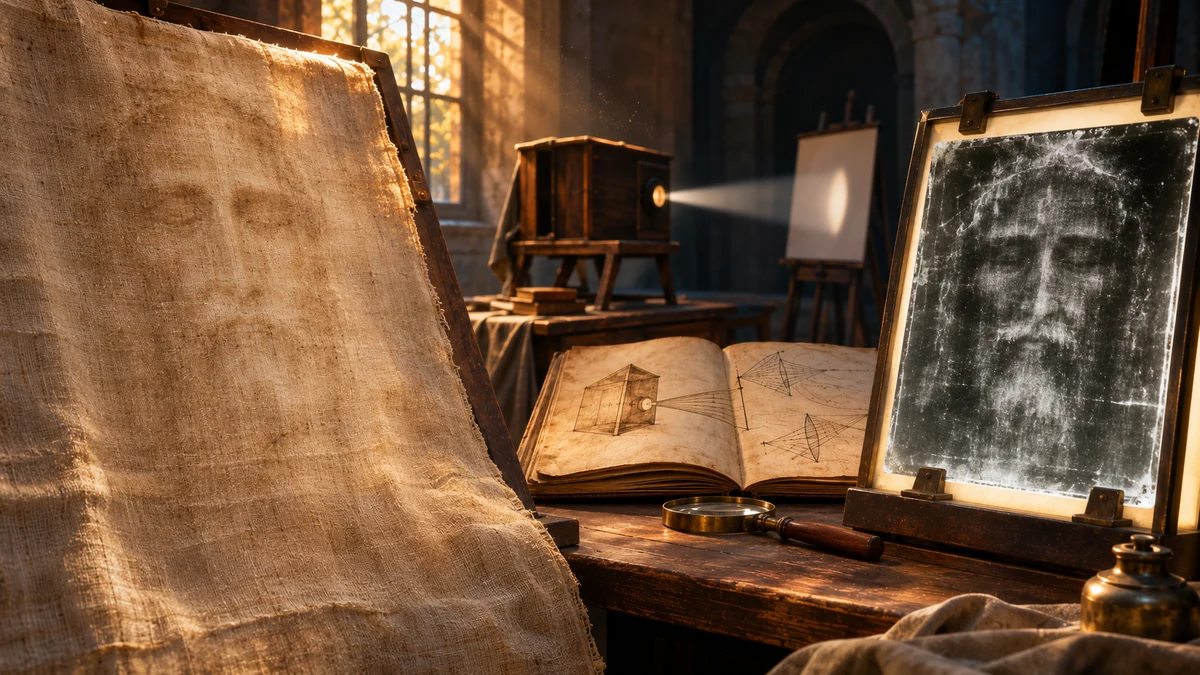
Conceptual illustration of the Shroud of Turin and its photographic-negative effect, made famous by Secondo Pia in 1898. The optical imagery is symbolic and does not establish Leonardo's authorship.
The Shroud of Turin is a piece of linen bearing a faint image of the front and back of a human body. For believers who associate it with the burial of Jesus, it holds profound spiritual significance. For historians, conservators, chemists, and scholars of images, it raises several distinct questions: where did the object come from, how old is its fabric, how was the bodily image formed on its surface, and what happened to it over centuries of storage and display? None of these questions can be answered by its unusual appearance alone. [3][5]
When the photographer Secondo Pia developed his photograph of the shroud in May 1898, he recognized a remarkably clear face on the negative. An object that had previously been primarily a focus of religious veneration thus also became one of the best-known mysteries in the history of photography. A daring hypothesis subsequently emerged: could the image have been the product of an early light-and-chemistry experiment carried out by Leonardo da Vinci? The question is not absurd because Leonardo lacked knowledge of light — on the contrary, he understood it exceptionally well. Yet there is a considerable distance between expertise in optics and evidence that he created the image on this particular shroud. [1][6][9]
This investigation is therefore not a judgment on an individual online post or an image collage. It seeks to understand the object, the historical records, the physical measurements, and the technical hypotheses, while distinguishing what is documented from what is possible and what remains unproven.
The Face That Appeared on a Photographic Negative

The Shroud of Turin measures approximately 4.30 × 1.08 metres. Alongside the bodily image, the cloth bears areas that different researchers associate with blood traces, injuries, charred portions, and later interventions. Because the image has low contrast, it is not as striking to the unaided eye as it is in many modern reproductions. Today, most people know the shroud through photographs rather than direct observation of the original artefact. [4][5]
Pia photographed the shroud during an exhibition in 1898. As he developed the photographic negatives, the light and dark tonal relationships were reversed, and the face acquired a more natural appearance. In 1931, Giuseppe Enrie produced another celebrated set of photographs, bringing this effect to an even wider public. Yet the first methodological trap lies here: the photographic negative of the shroud is not evidence that the image on the cloth was made with a photographic camera. An image made more recognizable by tonal inversion could have been produced by some other process. [1]
The negative concerns the photographic reproduction and its tonal relationships. It tells us something about how the image looks, not directly about what caused it to form. Determining the mechanism requires microscopic examination of the fibres, chemical evidence, the spatial distribution of discoloration, and experiments that can reproduce the proposed process. Even a successful laboratory experiment would primarily establish that a particular mechanism is possible, not automatically that it was the mechanism actually used in the past. [5][19]
Four questions must therefore be kept separate from the outset: the age of the cloth, the date when the bodily image formed, the process that produced the image, and the identity of its alleged maker. An answer to any one of them does not automatically resolve the other three.
A Historical Object with a Gap in Its Early Record
Historical photographs of the Shroud of Turin (1898) — Princeton University Art Museum
The earliest history of the Shroud of Turin is not supported by an uninterrupted chain of reliable records leading back to the first century. Its well-documented European history begins in Lirey, France, in the mid-fourteenth century, where it was displayed as a relic. Disputes over its authenticity and the legitimacy of its public veneration arose in the decades that followed. In 1389, Bishop Pierre d’Arcis wrote polemically about the object and alleged that the image was man-made. His allegation is historical evidence of a controversy, not the result of a modern materials examination. [2][3]
A study published in 2025 by the historian Nicolas Sarzeaud added an important element to this discussion. Sarzeaud identified an earlier reference to the disputed shroud in a text by the scholar Nicole Oresme, written sometime between approximately 1355 and 1382. Oresme mentions it among examples of problematic religious phenomena or alleged frauds. The passage establishes that the controversy surrounding the shroud existed in the Middle Ages; it does not identify who made the image or how it was produced. [2]
The shroud later passed into the possession of the House of Savoy. In 1532, it survived a fire at Chambéry, which left visible damage on the fabric; repairs undertaken in subsequent decades also left their traces. The shroud has been associated with Turin since 1578. Its later history includes examinations, exhibitions, photography, protective interventions, and handling of varying intensity. These circumstances are crucial to the interpretation of material traces: a substance found on the fibres today is not necessarily a residue of the original image-making process. It may have reached the fabric through touching, fire, repairs, storage, or testing. [4][5]
Historians must therefore distinguish between the documented presence of the relic at a particular point in time and a narrative about its original journey. An unbroken history reaching back to the first century has not been demonstrated. Conversely, the absence of such a history does not, by itself, establish the image's chemical composition or the identity of the person supposedly depicted.
The Chronological Obstacle to Leonardo's Authorship
Leonardo da Vinci was born in 1452 and died in 1519. According to the medieval documentation, the shroud was publicly displayed roughly a century before his birth. This is both the simplest and the most serious obstacle to the claim that Leonardo created the original object now known as the Shroud of Turin. [2][3]
A proponent of the Leonardo hypothesis might suggest a different scenario: perhaps Leonardo did not make the first cloth but altered or replaced the image on an older piece of linen. Such a possibility is not logically impossible, but it requires an entirely different set of evidence. One would need to establish that Leonardo or his circle had access to the shroud in the fifteenth or early sixteenth century, identify a document recording the intervention or a convincing material trace of a new image layer, and show that the trace truly dates to Leonardo's lifetime. Knowledge of optics or a resemblance between faces cannot fill these evidentiary gaps. [6][9]
This is where the question what would falsify each version of the hypothesis? becomes useful. If an examination established that the essential bodily image already existed before Leonardo's birth, his authorship of that image would be ruled out. If later alteration were independently confirmed, it would raise a new question about who carried it out — but would still not identify Leonardo as the person responsible. An open-minded investigation distinguishes versions of a hypothesis instead of repeatedly adding unsupported assumptions whenever difficulties arise.
What Did Leonardo Actually Know About the Camera Obscura?
Leonardo's studies of light and the human eye are well documented. A passage in Paris MS D, folio 8r, dating from approximately 1508–1509, describes the phenomenon now called the camera obscura. Light passes through a small opening into a darkened space, creating an inverted projection of the outside world on the opposite surface. Leonardo used the effect as a model for understanding vision. The underlying optical principle was known in antiquity and medieval optics; Leonardo's investigations do not mean that he discovered it first. [6]
It is easy to see why the connection with photography is appealing: an image of the real world appears without a draughtsman's hand. But an optical projection is ordinarily temporary. Change the illumination or the conditions in the darkened room, and the projected image disappears. A permanent photograph requires a substance that responds predictably to light, appropriate exposure, and a procedure to prevent further uncontrolled alteration of the image. The difficulty lies not simply in a lens or an aperture but above all in chemistry and permanence. [7][8]
Paris MS D contains no verifiable recipe by Leonardo for the photographic treatment of the Shroud of Turin. Nor is there a reliable archival document describing an experiment on this fabric. It is reasonable to explore how far Renaissance optical knowledge could in principle have led; without additional evidence, however, it would be unjustified to present that possibility as a documented historical act. [6]
What Would the Photochemical Hypothesis Have to Demonstrate?
The photographic hypothesis exists in several versions. In the best-known version, an artist supposedly projected a human face or body onto a light-sensitive surface inside a darkened space, obtaining a lasting image. Popular accounts invoke various silver compounds, including silver sulfate, and suggest that only a lens, light, and great patience would have been necessary. Yet silver sulfate (Ag₂SO₄) is not the same as the light-sensitive silver halides that figure prominently in the history of photography. Naming a chemical is not equivalent to describing a functioning process. [7][8][9]
Experiments carried out by Thomas Wedgwood and Humphry Davy around 1800 show just how difficult it was to fix a light-produced image permanently even centuries later. Light-sensitive surfaces darkened, but continued to change when exposed to further light. Photography's major breakthrough was not just the transfer of an image onto a surface but also its stabilization and reproducibility. A hypothesis involving Leonardo must explain how such a process could have worked on a large piece of linen and how the resulting image could have survived for centuries. [7]
Testing it would require at least the following: the presence of specific chemical residues in the image-bearing areas; comparison with unstained fibres; an explanation of the depth and distribution of discoloration; a documented, reproducible experiment on comparable linen; ingredients and equipment that could have existed in the historical period; and a fixing method that accounts for long-term stability. If silver were discovered, later sources of contamination would also have to be investigated. A single positive chemical test would not identify the image's maker. [5][7][8]
Direct investigations conducted by the Shroud of Turin Research Project (STURP) in 1978 indicated that the image coloration is associated with superficial changes to the linen fibres. Some investigators reported chemical changes in cellulose that could not readily be explained as the ordinary application of pigment. At the same time, specialists advanced differing interpretations of microscopic traces and possible mechanisms. Superficially discolored fibres are therefore important evidence, but they do not demonstrate one uniquely established process — much less a proven experiment by Leonardo. [5][19][20]
There are also non-photographic explanations: direct contact or chemical interaction between a body and the cloth, an impression made from an artistic model, various kinds of surface treatment, thermal or oxidative changes, and combinations of techniques. Investigating these possibilities does not require choosing in advance between a miraculous event and the work of a famous Renaissance artist. The task is to determine which material characteristics each explanation can actually reproduce. [5][15][19]
The Face on the Shroud and Leonardo's Alleged Self-Portrait
The hypothesis that the face on the shroud might be Leonardo's was brought to a wider audience especially by Lynn Picknett and Clive Prince. A key part of their argument compares the shroud's face with the famous drawing in Turin of an elderly bearded man, often presented as Leonardo's self-portrait. In reproductions, similarities can be accentuated by rotation, scaling, and changes in contrast. Yet the history of the drawing itself calls for caution: although associated with Leonardo, its interpretation as an unequivocal self-portrait is not beyond question. [9][10]
A resemblance in general features — long hair, a beard, an elongated face, or striking eyes — is not sufficient to establish that two images depict the same person. Such a claim would require comparison with securely documented reference portraits, attention to perspective, the different media and their damage, and an explicit method that does not select only matching features. A separate claim would still need to be established: that the image on the shroud resulted from Leonardo's intervention. One alleged facial resemblance cannot prove both conclusions. [9][10]
The narrative therefore has two levels: the history of a modern interpretation, which can be documented, and the hypothesis of actual authorship, which currently lacks independent supporting evidence. The former is an interesting part of the shroud's cultural history; the latter remains open only in the limited sense that the evidence it would need can be specified, not that such evidence has already been found. [2][3][9]
What Have Researchers Actually Examined?
The Shroud of Turin is not an object that scientists have never been permitted to study. In 1978, STURP carried out a broad programme of optical, physical, and chemical examinations. In 1988, material was taken for radiocarbon dating by independent laboratories in Arizona, Oxford, and Zurich. Access was controlled, but the history of scientific investigations does not support a general claim that studies have never been allowed. [5][11][19]
The result, published in Nature in 1989, placed the analysed material within the calibrated range AD 1260–1390, at a confidence level of at least 95 percent as reported by the authors. This was a quantitative measurement of a sample and constitutes a strong scientific argument for the medieval age of the tested portion of linen. Its limitations matter: the researchers measured a sample from a particular part of the cloth, not every fibre individually and not the age of the bodily image itself. The result also does not identify an artist or maker. [11]
In 2026, Rachel Freer-Waters and A. J. Timothy Jull examined two surviving fragments associated with the Arizona sampling of 1988. Using microscopy, they found that the structure of the examined fragments was consistent with descriptions of the main cloth; they did not find evidence of repairs or substantial contamination that could explain away the medieval dating result. This finding directly bears on the claim that the radiocarbon sample was composed of material inserted at a later date. Yet the study concerns two small fragments, not the whole cloth and not the mechanism of image formation. [4]
Scientific work must also take into account the conservation requirements of cultural heritage. Sampling cannot be repeated without limit on a fragile textile. Nevertheless, the absence of a particular analysis does not establish the existence of a concealed prohibition or the predetermined outcome of a study. A useful future investigation would need to specify sampling locations, contamination controls, methods, and comparative materials in advance and allow reproducible expert scrutiny. [4][5]
Why Do Scientific Questions Remain Open?
The 1988 findings have been extensively debated. In 2005, Raymond Rogers argued that the sampled area might have differed from the rest of the fabric. In 2019, Tristan Casabianca and colleagues re-examined the original radiocarbon data and pointed to statistical heterogeneity. That criticism is not trivial: it highlights the importance of sound sampling when drawing conclusions about an entire object. Yet a statistical objection does not automatically supply a different date, nor does it establish that every earlier result was wrong. [12][13]
A microscopic examination published in April 2026 added concrete evidence about the fragments: the authors found no signs of a later repair or contamination that would explain the allegedly incorrect date. It would therefore be misleading to present a repaired sample as an established fact. Equally, examination of such a small part cannot settle every question about the history of the whole cloth. [4]
Another avenue is wide-angle X-ray scattering (WAXS), which De Caro and colleagues used in 2022 to investigate the structural ageing of cellulose. Under certain environmental assumptions, their model found the analysed sample compatible with a considerably older history for the linen. The crucial qualification is that cellulose degradation depends not only on elapsed time but also on temperature, relative humidity, and previous storage conditions, which are poorly documented for the early period. The authors themselves called for further systematic measurements. WAXS is therefore an alternative research approach worthy of expert attention, not an already generally accepted substitute for radiocarbon dating. [14][18]
The geometry of the image is also debated. In a study published in 2025, Cicero Moraes used digital simulation to compare the transfer of an image from a three-dimensional body with transfer from a shallow relief. In his model, some outlines aligned more closely with the relief scenario. A published critical response followed in 2026, raising alleged methodological weaknesses in the simulation. Such a disagreement is valuable when it makes clear what the model actually measures. A computer model can test the geometry of a selected possibility; on its own, it cannot establish who performed the historical process, when it happened, or which chemistry was used. [15][16]
Likewise, an analysis of DNA from samples collected in 1978, published in July 2026, revealed a complex mixture of biological traces, including material associated with one of the sample collectors. Such findings help us understand contamination and the cloth's history of handling; they do not identify the person depicted or date the formation of the image. A biological trace can be younger than the object it rests on and may reflect several different periods. [17]
Which Questions, and What Evidence?
| Research question | Most important evidence currently available | What it cannot establish on its own |
|---|---|---|
| When is the shroud documented as having been displayed? | Lirey, the bishop's memorandum, and Oresme's medieval text | Who made the bodily image |
| How old is the analysed linen? | The 1988/1989 radiocarbon findings; examination of fragments in 2026 | The date and mechanism of image formation on the fibres |
| Can another method suggest an older age? | WAXS studies and models of cellulose ageing | A unique age without knowing past storage conditions |
| How did the image form? | Fibre analyses, spectral measurements, and simulations of image transfer | A single mechanism established beyond doubt |
| Did Leonardo possess the necessary optical knowledge? | His manuscripts on the camera obscura | That he conducted a photochemical experiment on the shroud |
| Was Leonardo the maker or a later modifier? | The history of the hypothesis and comparisons of faces | A direct document, material trace, or verified chronological connection |
This distinction helps avoid two opposing but equally premature conclusions. The first treats one unexplained feature as proof of a supernatural event. The second assumes that one laboratory measurement definitively answers questions that the measurement was never designed to address. [4][5][11][17]
The Shroud of Turin Without a Predetermined Verdict
The Shroud of Turin is simultaneously a historical object, a religious relic for many believers, and a material question open to scientific study. Its earliest securely documented history takes us back to the fourteenth century. Photographs taken in 1898 revealed unusual properties of its image. Radiocarbon evidence from 1988 supports a medieval age for the tested material, while subsequent research has explored sampling, surface chemistry, and possible mechanisms of image formation. [1][2][4][11]
The Leonardo hypothesis has an identifiable basis in his demonstrable understanding of optics and in the history of modern interpretations. What it lacks is a documented connection between the artist and the shroud, a verifiable procedure performed on it, or a material signature of his authorship. The chief chronological obstacle remains straightforward: the object appears in historical records before Leonardo was born. The idea of a later intervention is a separate claim requiring separate evidence. [2][3][6][9]
Unresolved questions are not a licence for arbitrary conclusions. They are an invitation to more precise inquiry: a better understanding of the provenance of individual samples, comparative fibre analysis, transparent documentation of every intervention, and reproducible experiments investigating image-forming processes. Openness to an unusual hypothesis is meaningful precisely when we can state what evidence would support it and what evidence would count against it.
Nor does the shroud lose its cultural or spiritual value when its history is not oversimplified. On the contrary, it remains most compelling when we respectfully distinguish between faith, historical testimony, laboratory findings, and research conjecture. This is not a verdict on an online post but an account of the actual state of the investigation — including its facts, its limitations, and the questions that remain unanswered.
Sources and further reading
- The Metropolitan Museum of Art, Giuseppe Enrie: Detail of the Shroud of Turin (1931); historical background on the photographs by Secondo Pia and Enrie: source Source
- Nicolas Sarzeaud (2025), A New Document on the Appearance of the Shroud of Turin from Nicole Oresme, Journal of Medieval History: source Source
- PBS, Secrets of the Dead: Shroud of Christ? Background; the historical record from Lirey and the fourteenth-century dispute: source Source
- Rachel Freer-Waters and A. J. Timothy Jull (2026), Analysis of textile fragments from the 1988 radiocarbon samples of the Turin Shroud, npj Heritage Science: source Source
- Ioannis Karapanagiotis (2025), The Shroud of Turin: An Overview of the Archaeological Scientific Studies, Textiles 5(1), 8: source Source
- Max Planck Institute for the History of Science, Leonardo da Vinci, Camera obscura, Paris MS D, fol. 8r (c. 1508–1509): source Source
- Science History Institute, Silver and Sunlight; photosensitive compounds and the history of photographic fixing: source Source
- Royal Society of Chemistry, Making a photographic print using silver chloride; chemical distinction between silver salts and halides: source Source
- Publishers Weekly, Lynn Picknett and Clive Prince's book The Turin Shroud: How Da Vinci Fooled History; origin and popularization of the hypothesis: source Source
- Musei Reali di Torino / Google Arts & Culture, Leonardo Self-Portrait; the Turin drawing and its interpretation: source Source
- P. E. Damon et al. (1989), Radiocarbon dating of the Shroud of Turin, Nature 337, 611–615: source Source
- Raymond N. Rogers (2005), Studies on the radiocarbon sample from the Shroud of Turin, Thermochimica Acta: source Source
- Tristan Casabianca et al. (2019), Radiocarbon Dating of the Turin Shroud: New Evidence from Raw Data, Archaeometry: source Source
- Liberato De Caro et al. (2022), Long-Term Temperature Effects on the Natural Linen Aging of the Turin Shroud, Information 13(10), 458; subsequent WAXS temperature model: source Source
- Cicero Moraes (published 2025, journal issue 2026), Image Formation on the Holy Shroud—A Digital 3D Approach, Archaeometry: source Source
- Tristan Casabianca, Emanuela Marinelli, and Alessandro Piana (2026), critical commentary on the Moraes simulation, Archaeometry: source Source
- Gianni Barcaccia et al. (2026), DNA signatures preserved in the official 1978 sample collection of the Shroud of Turin, Scientific Reports: source Source
- Liberato De Caro et al. (2022), X-ray Dating of a Turin Shroud’s Linen Sample, Heritage 5(2), 860–870; original WAXS study: source Source
- L. A. Schwalbe and R. N. Rogers (1982), Physics and chemistry of the Shroud of Turin: A summary of the 1978 investigation, Analytica Chimica Acta: source Source
- J. H. Heller and A. D. Adler (1984), A Comprehensive Examination of the Various Stains and Images on the Shroud of Turin, American Chemical Society: source Source