How Do We Read Old Dates? Dürer, the Dating of Artworks, and Theories of Alternative Chronology
What can an unusual numeral tell us, how does a museum arrive at a date, and what independent evidence would be needed to move historical chronology by several centuries?
What can an unusual numeral tell us, how does a museum arrive at a date, and what independent evidence would be needed to move historical chronology by several centuries?
When a Date Is Not as Simple as It Looks
Older drawings, coins, books, and buildings sometimes bear marks that seem unfamiliar to modern readers. The numeral one may resemble the letter i; the four may be shaped differently from today's version; dots may separate individual characters; and the same book may use both Roman and Hindu-Arabic numerals. An intriguing question quickly arises: have we read the inscription correctly?
This is not an unreasonable doubt. Historical inscriptions are not always self-explanatory. They may be poorly preserved, added later, copied incorrectly, or placed in a context we no longer fully understand. Copyists, collectors, and catalogue authors made mistakes. The same written number can refer in one case to the creation of an artwork, in another to the year of an event described in it, an ownership mark, or a later intervention.
Yet there is a considerable gap in the evidence required to answer two different questions: has an individual date been read correctly? and has a thousand years been added to history as a whole? The first can be examined through palaeography, comparison of scripts, and study of the object. The second requires agreement among evidence from many places, different types of records, material discoveries, and natural chronological measurements.
This investigation therefore begins with a Renaissance drawing attributed to Albrecht Dürer, but does not end there. It explores how a historical date is established, why numerals can be ambiguous, and what criteria allow us to assess theories that propose a different chronology.
A Date as a Historical Source: Mark, Inscription, and Interpretation
Today we are accustomed to four-digit years written in standardized forms of Hindu-Arabic numerals. In the European late Middle Ages and early modern period, practices were more varied. Roman numerals remained in use, Hindu-Arabic numerals spread through commerce and printing, and the shapes of their characters continued to change. Local handwriting conventions, abbreviations, punctuation, and the starting points of the calendar year also differed.
The historians of mathematics David Eugene Smith and Louis Charles Karpinski observed in The Hindu-Arabic Numerals (1911, pp. 145–146) that the numeral one was frequently represented by “i” in early printed works. They also noted variation in other numeral forms. This matters: a character that resembles a letter can function as a numeral in a particular numerical notation. [4]
But this does not mean that every i on an old sheet is the numeral one. It may be a letter, a Roman numeral, an initial, a section marker, or part of another inscription. The correct reading depends on the whole context: the position of the mark, the script, its relationship to adjacent signs, the surrounding text, and comparable examples from the same milieu. If we see a sequence resembling “i.527”, we must still establish whether it means 1527, a different counting convention, or unrelated characters. Visual resemblance alone does not establish a reading.
When dating artworks, we should distinguish at least five things: the date actually written on an object; when that inscription was applied; when the image was made; the date assigned by the collection; and the date of any event the image may depict. These dates may coincide, but we cannot assume that they do. Sometimes an inscription is later than the work; sometimes an artist depicts an earlier event in a newly created work.
We therefore examine a historical date as evidence with its own provenance, not as a self-sufficient magic key that reveals the entire past without further investigation.
How Museums and Art Historians Date an Artwork
A museum date is not necessarily a literal transcription of an inscription. It is often the result of several kinds of assessment: attribution, stylistic comparison, collecting history, material and technique, and information from older inventories. A work may be dated to a precise year, approximately dated, or assigned a date range. The strength of the attribution depends on the specific evidence and what researchers can actually access.
Stylistic comparison seeks connections with other works by the same artist or workshop. It is especially important where an inscription is missing. But similarity alone cannot prove an exact year: an artist may return to earlier motifs, a pupil may imitate a master, and copies may have histories distinct from that of the original.
Provenance examines ownership and the movements of an object. An eighteenth-century inventory, a twentieth-century exhibition catalogue, and a present-day museum record may reveal how an attribution developed. When two catalogues give the same date, we should also ask whether they reached that conclusion independently or whether the later one drew on the earlier.
Materials and technique help test whether the evidence is consistent. For a drawing, this may include paper and its watermarks, ink, the character of the strokes, and possible later additions. For a print, it can also include editions, the state of the printing block or plate, and printing methods. Laboratory analysis can be useful, but it is not automatically available for every artwork. Even the age of the paper need not be identical to the year a drawing was made: paper may have been stored before use.
Historical context brings together archival records, dated publications, iconography, commissions, known biographical circumstances, and comparable objects. The strength of an assessment generally lies not in one piece of evidence but in the convergence of evidence whose limitations are clearly stated.
A good catalogue must therefore remain open to correction. Criticism of a museum date is legitimate when it offers new material or a better explanation. Merely asserting that a museum gives a date because it follows “official history” is not enough.
Dürer's Study of a Woman Wearing a Linen Headdress
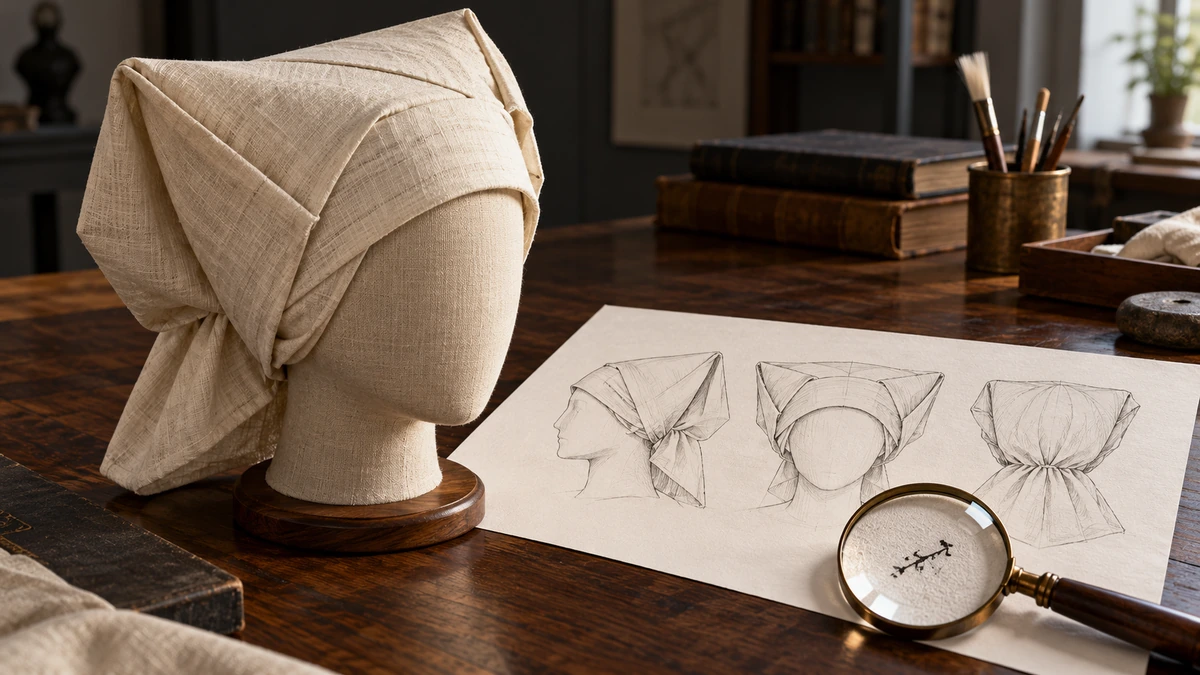
At the centre of this investigation is a sheet catalogued by Museum Boijmans Van Beuningen as Costume Studies of a Woman with Linen Headdress Seen from Three Angles. It depicts a woman wearing a distinctive tall, angular linen headdress from three different viewpoints. The museum attributes the work to Albrecht Dürer (1471–1528), describes its technique as pen and black ink with grey wash, identifies it as D I 275 (PK), and dates it to 1527. It is a drawing, not a printed engraving. [1]
The sheet belongs to the broader world of Dürer's interest in images, dress, human proportions, and the social characteristics of Nuremberg society. The headdress is more than an unusual silhouette. Women's fashion and clothing regulations could reflect social rank, status, and the relationship between public appearance and urban social order. Jutta Zander-Seidel situated such objects and their representations in the history of clothing. She reproduced the same drawing in a 1988 study, where it is dated to 1527. [2]
The museum's record contains another noteworthy detail: the drawing is among the missing works from the former Koenigs collection. The museum explains that 508 drawings were sold in a disputed transaction in 1940 in connection with the Nazi art-collecting project for Linz. Consequently, the present public record does not rest on a routine examination of the sheet in a museum storeroom, but on catalogues, reproductions, and the collection's history. [1]
This provenance demands precision. The museum's date of 1527 is a documented scholarly attribution. Yet the publicly available material reviewed here does not demonstrate that a specific laboratory examination established that the date, monogram, and other inscriptions were made at the same time. We must neither invent such a test nor claim that it has already been conducted. The originality of particular strokes therefore remains an open limitation.

The Koenigs Inventory: The Date 1527 Before Today's Controversies
One document is particularly valuable for evaluating this old drawing because it was not created in response to an online dispute: the inventory of drawings from Franz Koenigs's collection. In the German section of the typescript inventory, page 24 includes the entry D I 275. It describes Dürer's study of a woman wearing a headdress seen from three angles, mentions an inscription or mark, and gives the year 1527. At the end it also records an acquisition in 1931. [3]
The page matters because it establishes that the reading 1527 did not originate in recent decades. Zander-Seidel used the same date in 1988, and it appears in the museum record today. This is a traceable scholarly and collecting tradition that can be examined across different periods.
But the evidence must be interpreted correctly. 1931 is the year the work was acquired for the collection, not the year the drawing was made or necessarily the year the inventory entry was typed. The inventory documents an earlier catalogue description and reading of the date; it is not a physical analysis of the ink. Nor should all later catalogues automatically be counted as entirely independent confirmations if they relied on the same older inventory.
Two further resources remain of interest for deeper research: Winkler's catalogue of drawings (entry W. 943) and the 1995 exhibition catalogue of the former Koenigs collection. Their bibliographic traces are known from the earlier research, but I have not independently examined the relevant pages for this revision. Until those pages are read directly, they should not be used to support new claims. Making that limitation explicit is part of research integrity, not an excuse to leave the subject unexplored.
Dürer's Works as Comparative Evidence: One Artist, Several Ways of Writing Time
The best way to examine a historical character is not to compare it with modern handwriting, but to compare it with objects made in similar circumstances. Dürer's body of work offers several possibilities.
The famous woodcut *The Rhinoceros* bears the date 1515 and Dürer's monogram beside the image. Yet the German text above the image describes the rhinoceros's arrival in Lisbon and gives the year 1513. The National Gallery of Art transcribes both dates, while other museum catalogues and studies explain that the animal's actual arrival was in 1515. [5][6]
Here we must distinguish three things: the date of the print's creation, the year recorded in its narrative text, and the date of the event established by historical research. The discrepancy between 1513 and 1515 does not demonstrate two parallel historical eras. It is a documented example of an erroneous detail in a historical text that can be compared with other sources.
Dürer also published a treatise on measurement in 1525, *Underweysung der Messung*. The bibliographic record of a surviving edition gives the year as M.D.XXV, in Roman numerals. [7] Thus, within the same century—and even in the work of the same artist—we encounter different graphical ways of writing years. This variety does not show that the calendar changed in the meantime. It shows that people of that period used more than one form of notation.
The comparison also establishes an important limit: neither the clear date 1515 on the woodcut nor the Roman numeral date 1525 in the book automatically tells us exactly what the artist wrote on another sheet. They do, however, provide a concrete historical context for understanding his period and examining whether a proposed reading of a character was conventional.

Alternative Chronology: The Question, the Hypothesis, and the Burden of Proof
The unusual initial character on Dürer's drawing is also discussed in literature associated with Anatoly Fomenko and “New Chronology.” In History: Fiction or Science?, chapter six, the same image is used to illustrate an alternative reading. The authors call the work an engraving and, in the caption to figure 6.72, give the supposed date 1524. They interpret it as a notation beginning with “i,” or as an initial of the name Iesus. In the enlargement in figure 6.73, they indicate that some drawn elements were added by them. [8]
This position deserves to be examined on the merits of its argument. If the initial sign really indicated a religious era rather than functioning as a numeral, the date of an individual object might be understood differently. But such a conclusion first requires an accurate representation of the object on which the claim rests. Here the discrepancy is fundamental: the museum and historical inventory identify a drawing dated 1527, whereas Fomenko's publication gives 1524 and describes it as an engraving. This discrepancy cannot simply be skipped. Before reinterpreting entire millennia, we need to establish whether we are even looking at a correct transcription of the date on the same object.
The second issue is the interpretation of the initial character itself. Because historians of numerals have documented the use of i for the numeral one, a letter-like form alone cannot establish that the character is an initial of Jesus's name. To justify such a specific interpretation, we would need examples of the same written convention where its meaning is unambiguous, along with an explanation of why it should be applied differently here than in comparable numerical inscriptions.
The third issue is the scale of the conclusion. Even if one document were misdated by a hundred or a thousand years, it would not follow automatically that the entire historical sequence was wrong. A global rearrangement of chronology would require clear, calculable, and repeatable predictions: which periods are duplicates, which independently dated finds must be relocated, and how genealogies, coin sequences, construction phases, astronomical events, and scientific dating evidence could be reconciled.
Investigating unusual hypotheses is legitimate. The decisive question is whether a hypothesis allows tests that could also disprove it, and whether it explains more of the evidence than the existing account without continually introducing new exceptions.
Testing Chronology Beyond Art-Historical Catalogues
Historical time is not established solely through inscriptions on artworks. For different periods, we also have archaeological stratigraphy, coins from documented excavation contexts, records of rulers and trade, astronomical events, and dates obtained from natural materials. Every method has limitations, but their cross-consistency matters when considering broad questions of chronology.
Dendrochronology compares patterns of wider and narrower annual tree rings. Under favourable conditions, timber can be matched with a calendar-dated reference sequence, allowing the time of felling to be established. But when the outermost growth layer is missing, the exact year of felling cannot necessarily be determined. Reused timber can also create a gap between the felling date and the construction date.
Daniel Miles's study of the roof structures above the eastern chapels of Salisbury Cathedral identified timber felled in the spring of 1222. This corresponds with the documented consecration of the chapels on 28 September 1225. [9] Such correspondence does not establish the exact age of every stone in the cathedral. It does, however, provide a strong link between the material sequence of construction and the written historical record.
Radiocarbon dating measures isotope ratios in organic material. Because atmospheric carbon-14 concentrations were not constant throughout the past, results must be calibrated. The IntCal20 calibration curve incorporates calendar-dated tree-ring data, among other sources. Dendrochronology and radiocarbon calibration are therefore not always two wholly independent confirmations; they may form parts of an interconnected measurement system. [10]
An instructive example comes from research on Norse presence in Newfoundland. In a study published online in 2021 in Nature, researchers used an abrupt increase in atmospheric carbon-14 in 993, together with ring sequences in three wooden objects worked by Norse people. The result was 1021 as the year in which the trees were felled. [11] That does not necessarily establish the beginning or end of the settlement, but it does identify human activity at a calendar-anchored date that theories of medieval history must take into account.
Astronomical data offer another kind of test. The positions of the Sun and Moon and sequences of eclipses can be calculated using celestial mechanics; NASA, for example, publishes a catalogue of solar eclipses covering several millennia. [12] Yet the connection between a calculated eclipse and an ancient text is not automatic. A historical description may be imprecise, the location uncertain, the calendar different, and the conversion between time systems disputed. Astronomy is most useful where the description, location, and historical context can also be evaluated independently.
None of these examples constitutes an analysis of the ink on Dürer's sheet. Taken together, however, they show why a theory of hundreds or thousands of omitted years cannot be substantiated by a single disputed graphical character.
Comparing the Evidence: What We Know and What Remains Open
| Material | What is established | What remains unresolved |
|---|---|---|
| Museum record D I 275 (PK) | A drawing attributed to Dürer is catalogued with the date 1527 | No specific material analysis of all inscriptions has been presented |
| Koenigs inventory, p. 24 | An earlier collecting record already gives 1527 and an acquisition in 1931 | The acquisition date is not the creation date; the marks on the sheet have not been laboratory-tested |
| Zander-Seidel, 1988 | Reproduction of the drawing and scholarly dating to 1527 | This is not an independent scientific examination of the material |
| Fomenko's interpretation | Documents an alternative reading of the initial sign and gives 1524 | The 1524/1527 discrepancy and the description of the object remain unexplained; the enlargement contains added lines |
| Comparative Dürer material | The Rhinoceros dated 1515; the erroneous event year 1513; a book bearing the Roman-numeral date 1525 | Does not allow direct examination of the original inscription on the missing drawing |
| Dendrochronology, radiocarbon, and astronomical calculations | Provide some independent or interconnected chronological tests | Require suitable samples, calibration, context, and a verifiable connection to historical events |
It is important to retain questions that have not yet been answered. Were all the inscriptions on Dürer's sheet made at the same time? Did historical catalogues accurately reproduce every stroke? Which reproduction preserves the details most faithfully? Why did a particular publication give 1524 rather than 1527? These are concrete research questions that additional archival documentation—or renewed access to the original—might resolve.
Now consider two quite different types of claim. It is possible in principle, and testable, that an individual inscription has been misread. The claim that the entire historical chronology has consequently been shifted by a thousand years requires vastly more evidence. The material examined so far does not provide such a coherent evidential basis.
What Could Actually Change the Interpretation?
If we are to investigate without dismissing possibilities in advance, we must also say what evidence would be strong enough to revise the present conclusion.
For Dürer's drawing itself, valuable evidence would include an accessible original or new high-resolution reproductions of both sides; conservation records; comparisons of paper, watermarks, ink, and strokes; a sequence of older catalogues with original transcriptions; and a systematic comparison with authenticated examples of Dürer's date inscriptions. Such material could support, qualify, or overturn the present dating of the individual object.
The hypothesis of a shifted European or global chronology would demand substantially more: a connected alternative sequence of historical events capable of consistently explaining independently dated objects, chronicles from different societies, archaeological layers, numismatic sequences, astronomical observations, and measurable natural records. It would also need to explain where different methods agree and demonstrate where the standard interpretation is reproducibly mistaken.
A new discovery can, in principle, correct an old date. That is precisely why science and historical scholarship revise dates when better evidence becomes available. But it does not mean that an old and a new explanation are equally supported simply because both have been proposed. The weight of evidence still differs.
Conclusion: Reading History Means Examining More Than One Number
Dürer's drawing is intriguing for its artistic and collecting history, its unusual headdress, its small inscriptions, and its journey through the twentieth century. It becomes more instructive still when we use it to ask how dates are established and tested.
Museum Boijmans catalogues the work as a drawing from 1527. This reading also appears in the older Koenigs inventory and in scholarly literature published in 1988. The history of European numerals includes examples in which i functions as the numeral one. Therefore, the letter-like appearance of the initial sign does not by itself establish a different era. An alternative reading exists in the New Chronology literature, but it also presents specific discrepancies concerning both the date and the type of artwork.
These facts cannot substantiate the claim that a thousand years were added to history. This conclusion does not rest on trusting a single institution, but on the difference between evidence concerning one object and evidence concerning an entire chronology. Alongside old inscriptions, we have scientifically and archaeologically testable chronological sequences that any serious alternative theory would have to explain together.
Yet the inquiry is not closed. The fate of the original, the origin and age of the inscriptions, and differences between reproductions remain questions worth revisiting when new sources become available. Historical dates need not be accepted uncritically; they should be tested in ways that can also expose our own mistakes. That is why an old date is much more than four digits.
Sources and further reading
- Museum Boijmans Van Beuningen, Costume Studies of a Woman with Linen Headdress Seen from Three Angles, inventory D I 275 (PK), dating to 1527, technique, and provenance. source Source
- Jutta Zander-Seidel, “Ständische Kleidung in der mittelalterlichen und frühneuzeitlichen Stadt,” in Terminologie und Typologie mittelalterlicher Sachgüter: Das Beispiel der Kleidung (1988), pp. 59–77, especially fig. 18 on p. 70. source (examination documented in the original C10 research, 22 October 2026). Source
- Koenigs Collection, Duitse Tekeningen tot 1800, typescript inventory, p. 24, entry D I 275; date 1527 and acquisition in 1931. source (visually checked 11 November 2026). Source
- David Eugene Smith and Louis Charles Karpinski, The Hindu-Arabic Numerals (1911), pp. 145–146. source Source
- National Gallery of Art, The Rhinoceros, Albrecht Dürer, 1515; the inscription dated 1515 and narrative text giving 1513 for the event. source Source
- Louvre, Rhinocéros, Dürer, museum record of a 1515 print and the erroneously recorded year 1513 for the event. source Source
- ETH-Bibliothek Zürich, Albrecht Dürer, Underweysung der Messung, 1525, surviving copy with “M.D.XXV” on the title page. source Source
- Anatoly Fomenko and collaborators, History: Fiction or Science?, vol. 1, ch. 6, p. 341, figs. 6.72–6.73; the author's interpretation and the 1524/1527 discrepancy (original C10 research review). source. A primary source for the hypothesis, not independent confirmation of it. Source
- Daniel Miles, The Tree-Ring Dating of the Roof Carpentry of the Eastern Chapels, North Nave Triforium, and North Porch, Salisbury Cathedral, Wiltshire, Historic England, 94/2002. source Source
- Paula J. Reimer et al., “The IntCal20 Northern Hemisphere Radiocarbon Age Calibration Curve,” Radiocarbon 62(4) (2020), pp. 725–757. source Source
- Margot Kuitems et al., “Evidence for European presence in the Americas in AD 1021,” Nature 601 (2022), pp. 388–391, published online 20 October 2021. source Source
- NASA, Five Millennium Catalog of Solar Eclipses, calculated solar-eclipse data for the period 2000 BCE–3000 CE. source Source