Palmyra — The Ancient Monumental Arch Between Destruction, Reconstruction, and Historical Memory
The history of Palmyra’s monumental arch: its ancient architecture, earlier restorations, destruction in 2015, and modern replicas.
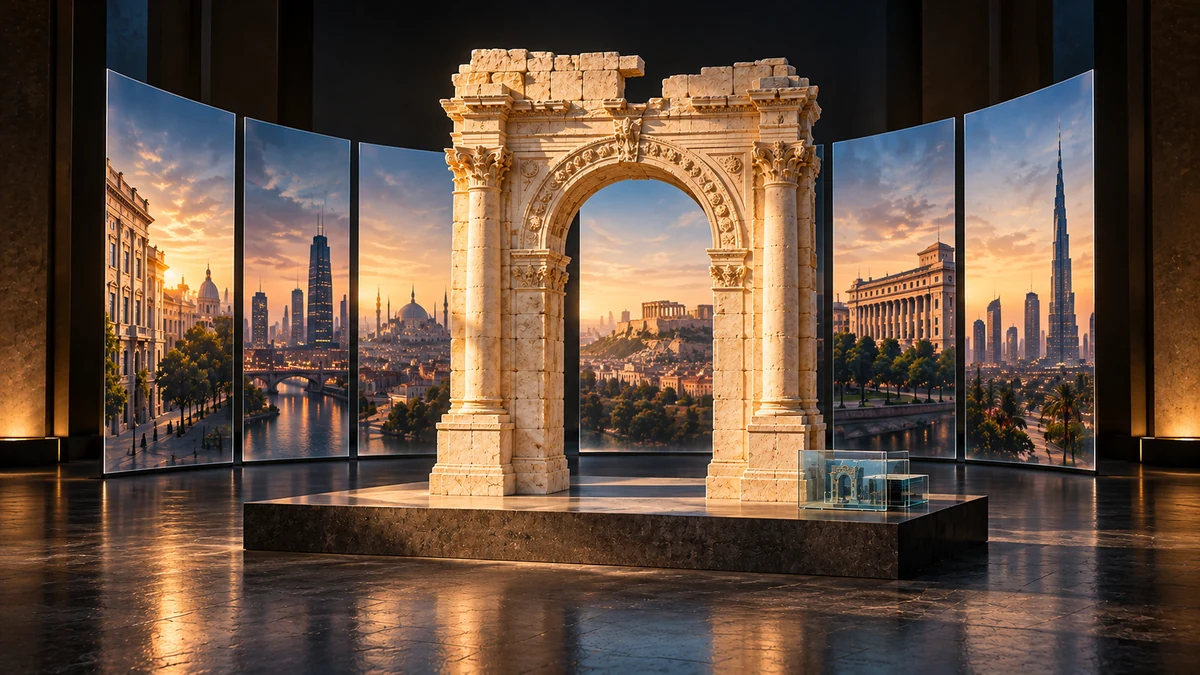
Symbolic illustration. One arch viewed against different urban settings evokes how a travelling reconstruction could be mistaken online for several separate monuments. This is neither a photograph of the historic structure nor an actual exhibition.
What was actually built at Palmyra, what did time and restorers change, and what can modern replicas tell us about a lost monument?
Among the ruins of ancient Palmyra once stood a monumental stone arch connecting two sections of the city's magnificent colonnaded street. Its appearance survived in drawings, photographs, archaeological measurements, and the memories of people who knew it. The monument itself passed through far more than one historical period: its ancient construction, centuries of deterioration, early investigations, restoration work, and, finally, its deliberate destruction in 2015.
After its loss, a question emerged that reaches far beyond Palmyra. Can destroyed cultural heritage truly be brought back? Is a stone copy still the same monument if it has the same shape but different materials, scale, and history? Who should have a say in its reconstruction, and how important are the voices of people who live with that heritage?
Answering these questions requires distinguishing between the ancient original, its condition as it changed through history, the archaeological documentation, and modern reconstructions. Photographs showing a similar arch in cities around the world are only one intriguing episode in this much larger story.
Palmyra: A City at the Crossroads of Civilizations
Palmyra, also known by its ancient name Tadmor, lies in the Syrian desert. Its oasis made settlement possible along important connections linking the eastern Mediterranean, Mesopotamia, and more distant trade networks. Under Roman rule, the city acquired exceptional economic and cultural significance. UNESCO emphasizes that its architecture brought together Greco-Roman building practices, local traditions, and Persian influences. [36]
Palmyra was therefore not simply a copy of Rome in the middle of a desert. Trade routes, languages, artistic styles, and religious traditions met there. Temples, colonnaded streets, squares, a theatre, tombs, and public buildings shaped its monumental landscape. The great colonnaded street connected several of these structures and became one of the city's most recognizable features. [36]
The history of such a city is not the history of a single ruler or a single people. Palmyra developed in relation to the Roman Empire while retaining a strong local identity. Its famous ruler Zenobia belongs to the later story of Palmyra's political ambitions in the third century. But something else matters most for understanding the arch: monumental architecture expressed civic prestige, guided the movement of people, and linked different parts of the urban landscape.
When we speak today of “the arch of Palmyra,” we mean just one part—albeit a very important one—of an extensive archaeological complex. Palmyra was inscribed on UNESCO's World Heritage List in 1980 and has been on the List of World Heritage in Danger since 2013. [36]
The Monumental Arch: More Than an Ornamental Gateway
The monumental arch stood at a bend in the principal colonnaded street. Its purpose was not merely to frame an attractive view. It connected two sections of the road whose axes did not run in precisely the same direction. In 1933 the French architect Robert Amy explained that the complex was approximately V-shaped in plan. Its two wings followed the differing directions of the colonnaded street, with smaller side passages arranged beside the larger openings. [2]
This is an important detail. The word triumphal arch may call to mind a freestanding Roman arch erected in honour of a particular military victory. The Palmyrene monument, however, must first be understood as part of a complex urban design. The conventional designation “triumphal” or “monumental” arch does not, by itself, establish the exact original ceremonial purpose of every element of its design.
The monument is usually placed in the Roman period, often in the early third century or the reign of Emperor Septimius Severus. This dating forms part of scholarly discussions of Palmyra's wider urban development, but we should not present the various building phases and their purposes as though they were all proven by a single unambiguous inscription. [14] [37]
The stone arch consisted of different structural elements. We must distinguish the voussoirs forming the arch, any keystone at its crown, the masonry above it, decorative architectural components, and later replacement stones. This distinction becomes crucial when trying to infer from an old photograph which part of the structure was damaged and when the damage occurred.
Nor should the monumental arch be confused with the entrance to the Temple of Bel. Both belonged to Palmyra, but they were different structures with different architectural and historical roles. This confusion also surfaced later in the history of modern reconstruction projects. [10]
Drawings, Photographs, and Restorations: Why There Is No Single Image of the “Original”
A researcher attempting to reconstruct the history of Palmyra's arch cannot select the most attractive photograph and declare it an image of unchanged antiquity. The monument survived in different conditions at different times. The means of recording it changed as well, from travellers' drawings to precise architectural surveys.
In 1753 Robert Wood and his collaborators published the celebrated The Ruins of Palmyra. Its engravings are exceptionally important to the history of European knowledge of the Syrian ruins, but the drawings also reflect observation, measurement, and artistic or architectural interpretation. They do not show the building as it was when first constructed; they represent the view of eighteenth-century investigators examining the remains that survived in their own day. [3]
During the nineteenth century, early photography made a different and more detailed kind of documentation possible. Louis Vignes photographed Palmyra in 1864. His images show damage, gaps, and collapsed sections that cannot be consequences of the destruction of 2015. Photographs from later collections, including images dated to 1925, offer further evidence of how the monument's condition changed before the Second World War. [4] [5]
Particularly valuable is Robert Amy's article Premières restaurations de l’Arc monumental de Palmyre, published in 1933. Amy records that he arrived in Palmyra in April 1930 at the invitation of the antiquities service. He described surviving structural elements, leaning columns or supports, and urgent measures to stabilize the damaged main arch. [2]
Amy's account does not prove that the entire arch familiar from later photographs was constructed at that time. It does, however, provide direct testimony that the monument was already a ruin before modern warfare and that restorers were trying to protect it. An essential methodological principle follows: a restored ruin is not the same thing as an untouched ancient building.
When comparing an eighteenth-century drawing, a nineteenth-century photograph, and a twentieth-century image, we must examine the viewing angle, possible interventions, the quality of the record, and the identity of individual stone elements. A similar gap in two photographs may indicate the persistence of damage, rather than two independent incidents. Conversely, a difference in appearance does not in itself prove that we are looking at another monument.

The Year 2015: When More Than a Stone Monument Disappears
During Syria's armed conflict, Palmyra became one of the most recognizable sites of the deliberate destruction of cultural heritage. Members of the organization Islamic State (ISIS) damaged or destroyed several important structures at the site in 2015. These included the temples of Baalshamin and Bel and, in early October, the monumental arch itself. A UNESCO mission that assessed conditions on site from 23 to 27 April 2016 confirmed the intentional destruction of these monuments. [1] [23]
But if we confine the story to stones, we leave out its human dimension. War affected the city's inhabitants, museum staff, archaeologists, and communities whose lives were not separate from this historic place. The destruction of Palmyra was not merely the loss of an attractive tourist view; it was also a violent assault on cultural memory and on people's ability to determine the future of their own heritage.
The archaeological site was left with scattered architectural fragments, damaged buildings, and unresolved conservation questions. With heritage of this kind, restoration does not begin with an image of the desired final appearance. It begins with securing the remains, documenting them, inventorying surviving material, and assessing structural stability. Some stones may remain at the site; others may have been moved or stored earlier. Every intervention requires knowing where the material came from and what can actually be established about it. [1] [17]
This is also why the term “rebuilding” is too imprecise. Surviving parts of an ancient monument are not simply building supplies for a new attraction. They are historical evidence whose positions, damage, and material composition have research value.
From Historical Photographs to a Marble Copy
Following the destruction, the Institute for Digital Archaeology (IDA) presented a project to reproduce the monumental arch. The project employed modern digital methods. The Victoria and Albert Museum explains that photogrammetry was used to create a three-dimensional model from several hundred two-dimensional photographs. Computer-controlled machining was then used to carve marble elements for a reproduction at approximately 35 per cent of the original scale. [6]
Photogrammetry does not magically “bring back the past.” Software calculates spatial relationships between visible surfaces using overlapping images. The quality of the model depends on the number and resolution of photographs, their viewpoints, the scales available, and the ability to check for errors. If part of a monument is missing from the photographs or hidden from view, it can be represented only through additional assumptions, other evidence, or interpretation.
The next stage is physical manufacture. For the large exhibition copy of the Palmyra arch, CNC milling of marble was used: material was removed by computer-controlled machinery. The common media description “3D-printed arch” is therefore not an accurate description of the manufacturing process used for this large marble structure. Computer modelling, 3D printing, and mechanical carving of stone are different processes, even if a project may employ several technologies. [6]
Why was the replica roughly one-third the size of the original? The publicly exhibited reproduction was made for travelling displays, not to replace every ancient stone on the original site. Its scale and material were features of a new museum or public installation. Its appearance could introduce visitors to the lost monument, but it was neither the original arch transported from Syria nor an assembly of its surviving ancient blocks.
This distinction does not diminish the value of digital documentation. On the contrary, it reveals where its real strength lies. It enables the study of form, comparison of plans, creation of models, and education. But a very similar object is not thereby the same historical object.
The Travelling Replica: Public Art, Memory, and Political Space
The reproduction was first unveiled publicly on 19 April 2016 in Trafalgar Square, London. On 19 September of the same year, it was presented in City Hall Park, New York. IDA described the project as an expression of solidarity with the people of Syria, a warning about threatened heritage, and a demonstration of what digital technologies could achieve. The locations and dates are also recorded in contemporaneous reporting. [7] [8] [10] [27]
The project was subsequently presented in other cities and at various public events, including Dubai and Florence and, later, Washington, as well as European venues such as Geneva and Luxembourg. Some appearances were associated with international meetings or cultural-diplomatic occasions. This is part of the publicly documented history of the project, not something that can only be discovered by analysing an internet collage. [8] [9]
It is important, however, to distinguish several displays of a similar or identically reconstructed design from the claim that every exhibition necessarily used exactly the same inventory of physical marble components. Exhibition records establish that reproductions of Palmyra's arch were presented; without a complete transport and inventory record, the material history of each individual piece cannot be described with certainty.
Why might a cultural reconstruction appear at a political gathering? Organizers and hosts may present it as a symbol of peace, solidarity, heritage protection, or technological progress. These are publicly stated purposes. It is also legitimate to ask who gains visibility from such an event, who funds it, and how much space is given to Syrian specialists and communities. A public exhibition programme may express a worthwhile aim while also raising legitimate questions about cultural representation.
The fact that such political venues existed is not, by itself, evidence of a secret ritual or a single hidden plan. Equally, the organizer's public explanation of its intentions is not a final answer to every question about costs, oversight, and the project's longer-term benefits.


Original, Restoration, Anastylosis, and Replica Are Not the Same Thing
When conserving heritage, we need to name precisely what has been done. An original monument bears traces of its material, workmanship, damage, and historical interventions. Restoration may stabilize or supplement some parts, but it should not erase the building's history. Anastylosis is the reassembly of original disassembled or fallen elements when their former positions can be determined with sufficient confidence. Reconstruction may also involve newly made components, whereas a replica is a new object intended to represent another. A digital model is a further, primarily data-based form of documentation.
These boundaries are not always simple. Even a restored object can incorporate elements from different centuries; a photograph taken “before the destruction” may depict a building in which some elements had already been replaced. Authenticity therefore cannot be reduced to a single criterion. We may speak of authenticity of material, form, location, technique, historical experience, or documented information.
Palmyra's arch offers an excellent example. Its damaged archway was photographed in the nineteenth century, and restoration work took place in the twentieth. The 2016 replica reproduced a recognizable historical appearance, but it could not restore centuries of material continuity. If some of the surviving original stones were re-erected at the site today, they would need to be distinguished from any newly made additions. [2] [5] [6]
A careful discussion therefore does not end with “Is the copy real?” A more useful question is: What kinds of historical knowledge and experience can each form of preservation provide—and what can it not provide?
Who Decides the Future of Heritage, and Who Owns Its Digital Image?
IDA's project generated a debate that extends beyond the technical achievement of producing a marble copy. In 2018, researcher Roshni Khunti raised several questions: the reduced scale and different material, access to digital data, possible patent-related or institutional restrictions on reproduction, and the risk that a spectacular replica might overshadow the needs of people who had experienced the war directly. These are arguments in a scholarly discussion, not an automatic legal determination that every activity of the organizer was unlawful. [15]
In 2020, Monika Stobiecka examined the case in the context of digital colonialism. She warned that digital technology does not remove questions of power: who gathers the data, who holds it, who constructs the narrative of the past, and who decides where a copy will be displayed? An object declared by one institution to be a universal symbol of heritage may mean something different to a local community than it does to visitors in a Western capital. [14]
Public reactions were not uniform either. During the London installation, archaeologist Zena Kamash conducted the Postcard to Palmyra project, in which visitors wrote about their responses. Their messages raise questions about originality, knowledge of Syria, emotional engagement with the monument, and the purpose of reconstruction. These reactions are not a representative survey of every visitor, but they show how differently people can understand the same exhibition. [16]
IDA emphasized cooperation with people from the region and the universal value of endangered heritage. Its account is an important source for its own intentions, but not independent assurance that every perspective of Syrian residents, archaeologists, and institutions was taken into consideration. [8]
There is another side to this question: digital documentation can be valuable for research and protection, particularly when data can be checked, shared, and used by local institutions. Initiatives advocating more open forms of digital collaboration, including New Palmyra, offer alternatives to closed institutional projects. The issue, then, is not whether technology is inherently good or bad, but under what conditions, with whose participation, and for whose benefit it is used. [24]
What Is Actually Being Restored at Palmyra in 2025 and 2026?
Reports about restoration often conflate three different processes: stabilizing the surviving original ruins, the long-term recovery of the archaeological site as a whole, and displaying a modern replica in public. These are not identical undertakings and may be carried out by different institutions, in different places, and on different timelines.
In its 2025 Decision 47 COM 7A.53, UNESCO's World Heritage Committee expressly regretted that work to restore the monumental arch had been halted. It also called for the protection of the arch's surviving elements, whether still standing, fallen, or held in storage. This is a specific statement about the monument itself, not merely a general report on tourism. [17]
The following decision, 48 COM 7A.18 in 2026, noted progress in protective measures and preparations for the recovery of Palmyra as a whole. It mentioned the development of a project to restore the national museum and welcomed the Recovery and Reuse Master Plan, a wider programme for the site's recovery and future use. It placed particular emphasis on the need for a conservation plan, clear responsibilities, priorities, and professional oversight. But this decision does not confirm that the monumental arch has already been physically re-erected or that its restoration is complete. [18]
Public statements by organizers about a possible future installation of their reproduction in Syria must be assessed separately from the actual restoration of the ancient original. Until there is documentation of a completed handover, physical installation, and the object's proper status, it is accurate to speak of a plan or announcement, not a completed event. [19]
It also remains an open question how archaeological specialists, Syrian institutions, local communities, international funders, and site protection will be coordinated. UNESCO's decisions indicate a direction and require documentation; they cannot themselves substitute for future field reports.
When One Image Travels the World: How Misleading Comparisons Arise
Online comparisons sometimes place photographs of a similar arch in London, New York, and other cities side by side. A viewer may get the impression that they show several different ancient monuments with almost identical damage above the arch's crown. Once the images are connected to the documented public exhibitions of the Palmyra reproduction, a different explanation emerges: the resemblance is unsurprising because the photographs show modern realizations of the same reconstructed design. It is not necessary to declare every individual photograph fully verified in order to understand that an international exhibition programme did, in fact, exist. [7] [8] [9] [27]
Another mistake is the confusion of architectural elements. A gap in the masonry above the crown of an arch cannot automatically be called a “removed keystone.” The keystone is a component of the arch ring; the masonry above it may belong to another structural layer. A precise explanation of a particular area of damage would require comparison of historical plans, joints between stones, photographs from different periods, and restoration reports. The presence of a similar gap in two images does not, by itself, prove coordinated removal of stones. [2] [3] [4] [5]
Early announcements about reconstruction also led to confusion with the entrance to the Temple of Bel. Contemporary reporting from April 2016 indicates that the original proposal was changed following warnings from UNESCO and concerns raised by Syrian interlocutors. References to “Bel's arch” in some online accounts should therefore be treated cautiously: they do not prove that the Temple of Bel's entrance and the monumental arch were the same monument, or that the travelling replica was a religious ritual. [10]
Images circulating online may be a useful starting point for an investigation, but they cannot replace the history of the object itself. If a photograph inspires an unusual hypothesis, it is worth testing: what structures are we looking at; when and where were they documented; are the scale and materials comparable; and what do the original records actually allow us to conclude? The difference between a compelling visual resemblance and a historical connection often rests on just such apparently small questions.
What Can Be Recovered—and What Remains Lost?
Palmyra's monumental arch was more than a stone passageway. It formed part of the urban design of a city at the crossroads of civilizations, witnessed centuries of change, and was a valuable source for architectural history. Artists, photographers, and archaeologists preserved its appearance, but their work did not erase the reality of its destruction.
Modern technology can allow closer study of surviving evidence and the creation of convincing models. A replica can draw attention to destruction, stimulate public debate, and make distant heritage more accessible. What it cannot do on its own is restore ancient stone, the lives of communities, or a broken continuity of history.
We can establish with confidence that the arch existed, that its appearance changed over the centuries, that it underwent restoration before 2015, and that it was then deliberately destroyed. The creation of a modern reduced-scale marble reproduction and its public display in several cities are documented. So, too, are substantive scholarly debates about reconstruction methods, authenticity, and who has a voice in restoration.
But we still do not know everything about the history of each stone element, the monument's eventual future form, every material version of the travelling copy, or the full implementation of future conservation plans. These are not gaps to be filled with assertions of certainty. They are research questions requiring further evidence.
Protecting heritage, therefore, is not simply a matter of making a similar-looking object. It means safeguarding surviving evidence, respecting the people to whom that heritage belongs, and honestly distinguishing between what we can reconstruct and what we can no longer bring back.
Sources and further reading
- Rapid assessment mission to Palmyra Source
- Premières restaurations de l’Arc monumental de Palmyre Source
- The Ruins of Palmyra Source
- Triumphal arch at Palmyra LOC matpc.14042 Source
- Louis Vignes Views and Panoramas of Beirut and the Ruins of Palmyra, 1864 Source
- Recreating Palmyra’s Arch of Triumph using photogrammetry Source
- World Heritage Week on Trafalgar Square, 19.–21. 4. 2016 Source
- History of the Arch Source
- Arhiv postavitev (vključno z Luksemburgom) Source
- Palmyra arch destroyed by Isil rises over Trafalgar Square Source
- Dubai – Arch of Baal at World Government Summit Source
- Coincidences? Or can someone shed light on this? Source
- Очередные «совпадения» на разных концах света Source
- Archaeological heritage in the age of digital colonialism Source
- The Problem with Printing Palmyra Source
- “Postcard to Palmyra”: bringing the public into debates over post-conflict reconstruction in the Middle East Source
- Decision 47 COM 7A.53 – Site of Palmyra Source
- Decision 48 COM 7A.18 – Site of Palmyra Source
- Triumphal Arch of Palmyra – 10th Anniversary Source
- IDA FOUNDATION 09842677 Source
- К вопросу о реставрации Триумфальной арки в Пальмире Source
- Luxembourg Source
- Isis blows up Arch of Triumph in 2,000-year-old city of Palmyra Source
- Community modelling project Source
- The IDA Palmyra Arch Copy Source
- Louis Vignes finding aid, 2015.R.15 Source
- Palmyra’s Triumphal Arch rises again in New York Source
- Restoration of the Triumphal Arch of Palmyra, Bulletin 13 Source
- Damien Gayle, Palmyra arch that survived Isis to be replicated in London and New York, The Guardian, 28. 12. 2015 Source
- IDA, Building the Arch Source
- IDA, Geneva (12.–27. april 2019) Source
- IDA, Florence (27. marec – 27. april 2017) Source
- Library of Congress / Matson Collection, Triumphal arch at Palmyra (1925), prek Wikimedia Commons Source
- IDA, Dubai Source
- IDA, Washington D.C. Source
- Site of Palmyra Source
- From the Temple of Bel to Zenobia Source