The Golden Gate of Constantinople — How a Monumental Gateway Became a Narrow Doorway
In present-day Istanbul, the monumental Golden Gate still stands where Roman and Byzantine emperors once made their ceremonial entrances into Constantinople. Over the centuries, its imposing marble arches were partially walled up, its passageways…
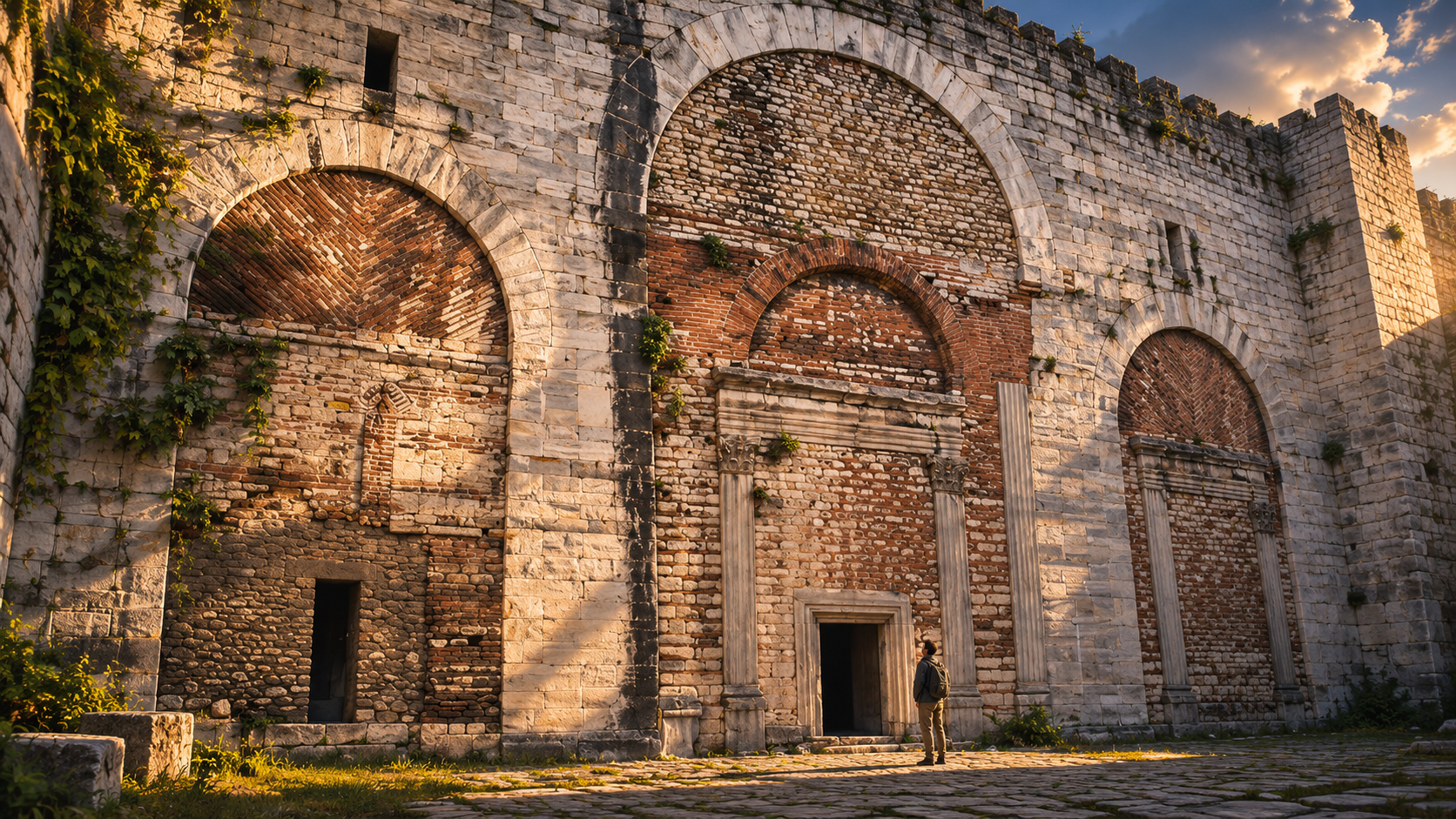
Symbolic artistic interpretation of the Golden Gate; not a documentary photograph.
In present-day Istanbul, the monumental Golden Gate still stands where Roman and Byzantine emperors once made their ceremonial entrances into Constantinople. Over the centuries, its imposing marble arches were partially walled up, its passageways narrowed, and what had once been a symbol of imperial victory became part of a defensive fortress. Why would people close a gateway originally intended for magnificent processions? The answer reveals a long history of changing rulers, wars, architecture, and the memory of one of the most important cities of the medieval world.
Before us stands an imposing stone gateway. Its towering arches resemble Roman triumphal arches, the kind once erected to honour emperors and military victories. Large, carefully dressed marble blocks testify to the extraordinary craftsmanship and wealth of the ancient city.
But something is unusual. The arches are no longer open. Beneath their stone curves rise walls of brick and other masonry. Where we might expect broad passageways, we find blocked openings, smaller entrances, and narrow doorways. The original architecture was clearly designed for something grand. Later construction, however, closed off much of that space.
Why would anyone build such a magnificent gateway only to wall it up? Was it fear of enemies? A change in the city's defensive needs? A consequence of the Ottoman conquest? Or was the reason something that cannot be understood from the photograph alone?
A photograph taken on 29 August 2006 by Dave Proffer shows part of a genuine historical monument in present-day Istanbul. This is the Golden Gate of Constantinople. It was once one of the most important ceremonial entrances to the capital of the Eastern Roman Empire. Today it stands within the Yedikule fortress complex, known as the Fortress of the Seven Towers.
But its story is not about a gateway mysteriously sealed in a single night. It is the story of a structure whose meaning and use changed over the centuries. Once, it represented imperial grandeur. Later, it became part of the city's defences. Eventually, it was incorporated into a new fortress, where controlling access mattered more than ceremonial entry.
Yet even this explanation is incomplete. At different times, the passages were closed, altered, and in some cases reopened. Their present appearance reflects both medieval interventions and modern restoration work.
What was built as a symbol of imperial victory gradually became part of a defensive system. But every blocked arch has its own history, and that history cannot always be dated precisely.
To understand this remarkable transformation, we must return to the period when Constantinople was becoming one of the most powerful cities of its age.
The Gateway Through Which Emperors Entered
In 330, the Roman emperor Constantine I formally dedicated Constantinople as a new imperial capital. The city occupied an exceptionally important position between Europe and Asia, along the maritime connection between the Black Sea and the Mediterranean. Its location provided opportunities for trade, control of transport routes, and the defence of a vital part of the eastern Mediterranean.
But Constantinople was more than a commercial and military centre. It was also a city in which Roman imperial power expressed itself through architecture. Palaces, churches, public squares, monuments, and city gates did not serve only practical purposes. They announced to visitors that they were entering the capital of an empire.
Among its most prestigious ceremonial monuments was the Golden Gate, known in Latin as Porta Aurea and in Greek as Chryseia Pylē. It stood in the southern part of the landward defensive system, not far from the Sea of Marmara.
From the west, an approach connected to the Roman road network and the Via Egnatia led towards it. Inside Constantinople, the ceremonial route continued towards important public spaces and the imperial centre.
The Golden Gate had a special purpose. It was associated with imperial prestige. When an emperor returned to the capital after an important victory, his arrival could become a public ceremony. The procession represented victory, the restoration of order, and the legitimacy of imperial rule.
Such an arrival was more than a celebration of a successful military campaign. It was also a political message to the city's inhabitants. The emperor entered the capital as a victor, and the gateway marked the moment when military success received public recognition as an expression of his authority.
But ceremonial use did not mean that every emperor always entered by the same route, or that every arrival followed an identical ritual. The Golden Gate held a special position precisely because it was associated with exceptional ceremonial occasions.
Its grandeur lay not merely in the size of its passageways. It was part of the way Roman imperial authority presented itself.
Who Built the Golden Gate?
Even the question of its original construction is not entirely straightforward. For a long time, the prevailing interpretation was that the Golden Gate had been built during the reign of Emperor Theodosius II, in the first half of the fifth century. During his reign, Constantinople acquired the famous Theodosian Land Walls. These formed an extraordinary defensive system consisting of inner and outer walls, towers, and a defensive moat. For centuries, they contributed significantly to the city's ability to withstand sieges. The Golden Gate was incorporated into this system. But was it originally built at the same time?
In 1999, archaeologist Jonathan Bardill published a study that challenged the traditional interpretation. He examined the construction joints between the monumental Golden Gate and the adjoining sections of the walls. Such joints are important in archaeology. If one structure was built against another, their relationship may help establish which was constructed first.
Bardill found substantial reasons to conclude that the Golden Gate had originally been an independent monument. According to his interpretation, it began as a Roman triumphal arch of Emperor Theodosius I. Theodosius I defeated the usurper Magnus Maximus in 388. Bardill argues that the arch may have been erected between that victory and the emperor's ceremonial arrival in Constantinople on 10 November 391.
The Latin inscriptions that once stood above the central arch are particularly important. Bardill maintains that they were not added much later but belonged to the monument's original design. Their wording would therefore refer to Theodosius's victory over Maximus.
If this interpretation is correct, the initial development followed a particular sequence. First, a monumental triumphal arch was built. Then, at the beginning of the fifth century, the new defensive walls were constructed around or alongside it. The triumphal arch thus became part of the city's fortifications.
But this interpretation has not entirely displaced the earlier dating to the reign of Theodosius II. Some scholarly and conservation accounts still associate the monument with Theodosius II, especially when discussing the wider defensive system and later architectural additions.
It is also important to recognise that not every surviving element of the Golden Gate necessarily dates from the same period. Some stone doorframes and decorative elements were added or moved during later alterations.
What is certain is that this is an exceptional monument of Late Antiquity that became part of the Theodosian Walls. Whether its original construction took place under Theodosius I or Theodosius II remains a subject of archaeological debate.
This is not an insignificant detail. It shows that the building's present appearance is insufficient to explain its origins. The same principle applies to later blockages: we should not assume a single construction period where the evidence points to several phases of alteration.
Which Golden Gate Are We Actually Looking At?
Another difficulty arises when studying Constantinople. The name Golden Gate was not always associated with just one entrance. The most important was the monumental Golden Gate in the Theodosian Walls. This is the great marble gateway with three arches discussed in this article and shown in Dave Proffer's photograph.
But there was also a smaller entrance in the outer defensive system in front of it, known as the Small Golden Gate. This provided passage through the outer line of walls and formed part of the wider Golden Gate complex. It was not simply another name for the same monumental marble triumphal arch. The Small Golden Gate was a separate architectural component, associated with defence and control of access to the main gateway. Its surroundings were also decorated with reliefs depicting scenes from ancient mythology. Some of these decorations were later removed or lost.
There is, however, a third historical question. Did Constantinople possess a Golden Gate even before the construction of the famous monumental gateway?
In 2017, researcher Georges Kazan published a study examining the possibility of an earlier Golden Gate in the area of Constantine's city walls. These walls stood farther east than the later Theodosian Walls. Drawing on written and archaeological evidence, Kazan argues that a ceremonial entrance may have existed there, possibly planned during Constantine's reign and completed shortly after his death in 337. According to his interpretation, this entrance may later have acquired the name Porta Aurea.
However, this is a historical reconstruction based on limited physical evidence. The earlier monument has not survived in a form that would allow the same degree of architectural investigation as the Golden Gate in the Theodosian Walls.
It is therefore important not to confuse three different structures or research questions: The monumental Golden Gate of the Theodosian Walls, the Small Golden Gate of the outer defensive system, and the possible earlier ceremonial entrance in Constantine's walls.
The photograph that prompted our investigation shows the monumental Golden Gate in the area of today's Yedikule fortress. Its blocked passages must be investigated within the history of this particular monument.

Why Was It Called the Golden Gate?
Today, pale stone, brickwork, and traces of numerous repairs dominate the appearance of the Golden Gate. Gold is no longer its most noticeable feature. But in Late Antiquity, the monument was far more richly decorated. Historical sources mention gilded bronze door leaves, while metal ornaments and inscriptions also played an important role.
There were Latin inscriptions on both faces of the central arch. Their metal letters have not survived, but the holes used to secure them remain visible in the marble. These traces are important physical evidence. By studying the positions of the fastening holes alongside historical records, researchers can investigate how the inscriptions were originally arranged.
The texts connected imperial victory with the idea of a new golden age. Their interpretation, however, is also connected with the question of who first commissioned the monument. Did they refer to the victory of Theodosius I over Magnus Maximus, or to later events during the reign of Theodosius II? Bardill supports the first interpretation, whereas the traditional dating associated the monument with the second emperor.
The sculptural decoration was also magnificent. Historical accounts and archaeological studies mention a group featuring an imperial chariot and elephants, together with figures associated with victory and civic authority. Not every detail of its original arrangement can be directly verified, however. Much of the former sculptural decoration has disappeared.
The monument was built of pale marble associated with the quarries of Proconnesus, now the island of Marmara. Its central arch was taller and wider than the two side arches. This composition was characteristic of monumental Roman architecture that emphasised imperial victory and public prestige.
But the entire structure was not made of gold. Its name was associated with luxurious metal fittings, gilded decorations, and the symbolism of imperial power.
The Golden Gate was above all a magnificent marble monument whose decorations and inscriptions represented the strength and glory of the empire.
That is precisely why its present appearance is so striking. A structure once intended for the lavish display of imperial authority gradually acquired a much more restrained and defensive character.
How Did the Monumental Arches Become Less and Less Passable?

Here we reach the central question. Why were the great openings walled up?
The original architecture contained three monumental passageways. The central arch was the largest, while two smaller arches completed the arrangement. This design suited a Roman triumphal arch and its ceremonial function.
But large passageways also presented challenges for a city's defences. Once the triumphal arch became part of the defensive system, the circumstances of its use changed. Broad openings were more difficult to control and secure. During periods of military danger, a smaller, well-protected entrance could be more practical than a monumental gateway.
The surviving structure confirms that the passageways were gradually reduced over the centuries. Brick and stone infill appears within the great openings. Smaller arches and doorways were created beneath the original marble arches. Some architectural elements were moved and reused. The original arrangement was therefore altered, while the monumental arches remained visible even after losing much of their function as open passageways.
A historical publication issued by Fatih Municipality in 2021 states that the side passages were walled up during the Middle Byzantine period, while a smaller entrance remained in the central section. This is significant evidence concerning the monument's history. But it must not be treated as a complete dating of every individual phase of infill masonry. Other architectural and historical accounts likewise describe several phases in which the openings were reduced or closed. For particular alterations, it is not always possible to determine who ordered them, when they were carried out, or what immediate circumstances prompted them.
Defensive needs probably played an important role. But damage, repairs, the declining use of the gateway for ceremonies, and new arrangements in the surrounding fortifications may also have contributed.
The blocking of the Golden Gate's passageways is a historical fact. The claim that every individual opening can be linked to one particular war or ruler, however, has not been demonstrated.
This is especially important when looking at a photograph in which different building alterations seem to form a single story. In reality, we may be looking at construction traces from several different centuries.
1261 and 1347: A Gateway Through Which Rulers Still Entered
Two medieval events demonstrate particularly clearly why the history of the Golden Gate cannot be described as a single, permanent closure.
The first took place in 1261. Since 1204, Constantinople had been under the rule of the Latin Empire, established following the Fourth Crusade. When the forces of the Empire of Nicaea recaptured the city in 1261, Emperor Michael VIII Palaiologos prepared for his ceremonial entrance. He chose 15 August, the Feast of the Dormition of the Virgin Mary, an important date in Byzantine religious life.
In a study published in 1980, historian Ruth Macrides demonstrated that the event was not organised as a conventional imperial triumph. Its central emphasis was a ceremony of thanksgiving. A prominent role was given to the celebrated icon of the Virgin Hodegetria, associated with the religious protection of Constantinople. The emperor chose not to make the traditional ceremonial entrance in a triumphal chariot. He entered through the Golden Gate on foot.
This event proves that a ceremonial passage was still possible there in 1261. It does not, however, prove that all three original arches were open to their former full width. The emperor may have used an entrance that had already been reduced in size. The event tells us that the gateway retained symbolic significance, not that its entire architectural form remained unchanged.
The second important event is associated with 1347. During the Byzantine civil conflicts, John VI Kantakouzenos entered Constantinople through the area of the Golden Gate. An architectural and historical account of the monument describes how a passage that had been walled up was breached in order to gain entry.
This information is important for understanding changes during the fourteenth century. It shows that the gateway might be used in one period and blocked or fortified in another. But even this event cannot tell us exactly when every surviving section of infill masonry was built.
The broader conclusion is what matters. The Golden Gate was not simply open until a particular day and then closed forever. Its use and architectural arrangement changed over the centuries.
Both imperial entrances help us understand why the monument's history cannot be reduced to an interpretation based solely on its present-day photograph.
When Defence Became More Important Than Imperial Ceremonies
Following the Byzantine reconquest of Constantinople in 1261, the city never fully recovered the political and economic power it had possessed in earlier centuries. It remained important, but the empire was losing territories and facing internal conflicts and mounting external pressure. Under these circumstances, the area around the Golden Gate acquired strategic importance. Its massive stone structure and neighbouring towers made it possible to establish a particularly well-defended position.
During the fourteenth century, the area underwent a succession of defensive alterations. John VI Kantakouzenos repaired the fortifications and used them as an important stronghold. After his rule ended, the area passed into the hands of John V Palaiologos. Later emperors continued to build and modify the defensive structures there. This was no longer simply the history of a ceremonial city entrance. The area had become part of internal struggles for political power.
The events surrounding 1389–1391 are particularly significant. John V Palaiologos attempted to strengthen the Golden Gate complex and establish a more secure defensive position there. Such a fortress could have provided a refuge and protection even against dangers arising from within the city itself.
But the Ottoman sultan Bayezid I opposed the construction. According to historical accounts, he threatened to blind the emperor's son Manuel, who was then under Ottoman control, unless the fortifications were removed. John V was forced to give way. Part of the new defensive construction was demolished.
This event clearly illustrates the political weakness of the late Byzantine Empire. The emperor still ruled the capital, but he could no longer make entirely independent decisions about its defences.
Here, however, we must distinguish between the fortress he was required to remove and the various blockages within the monumental arches themselves. It has not been established that all the infill visible today resulted from these events. Nor is there reason to interpret every narrowing of a passageway solely as an expression of political decline. Reducing the size of city gates could also be a practical response to genuine defensive needs.
A large gateway can be a symbol of power in times of peace and a difficult defensive position in times of war.
Throughout its history, the Golden Gate experienced both roles.
1453 and the Ottoman Fortress of the Seven Towers
In 1453, the Ottoman army under Sultan Mehmed II conquered Constantinople. This brought the history of the Byzantine Empire as an independent state to an end. The city became one of the most important centres of the Ottoman Empire. The Ottoman authorities inherited an exceptional architectural legacy, including the land walls and the Golden Gate. But the gateway's original imperial ceremonial role changed.
Between 1457 and 1458, Mehmed II had a new fortress built in the area of the Golden Gate, known as Yedikule Hisarı. Its name means the Fortress of the Seven Towers. The new design incorporated existing Byzantine structures and added Ottoman defensive elements.
Here it is important to distinguish between the construction of the new fortress and the creation of the Golden Gate itself. The Ottomans did not build the monumental marble gateway in the first place. Nor were they the first to reduce the size of its original openings. They made use of an existing monument and its defensive position. Older towers and new structures were brought together within the fortress.
Yedikule served several functions at different times. It was used to safeguard state valuables and important documents. It also became a prison for politically significant captives, senior officials, and certain foreign representatives. Its history thus acquired a different character from the original history of imperial processions.
The Golden Gate had once been associated with the public display of victory. Later, it formed part of a fortified complex where control and protection mattered more than ceremonial arrival.
But the Ottoman period itself was not uniform or unchanging. The fortress was repaired, adapted, and used for different purposes. Its present appearance is therefore not solely the result of Mehmed II's building programme.
The Ottoman conquest of 1453 was a decisive political turning point, but it did not mark the beginning of the entire history of the Golden Gate's blocked passageways.
That process already had a long Byzantine past.
The Legend of the Marble Emperor
The Golden Gate has a history that is not recorded in stone alone. It is also connected with one of the best-known legends surrounding the fall of Constantinople. This is the story of the Marble Emperor. Its central figure is the last Byzantine emperor, Constantine XI Palaiologos, who died during the Ottoman conquest in 1453. His death became part of Greek historical memory.
But a different account emerged in popular tradition. According to one version, the emperor did not truly die. At the decisive moment, an angel supposedly rescued him, turned him into marble, and concealed him in an underground chamber near the Golden Gate. There, he was said to be waiting until the day he would awaken and return to the city.
This story carried profound symbolic meaning. For people who had lost their state and former capital, it represented the hope that historical defeat was not necessarily final. The image of the sleeping emperor expressed an expectation that the lost world might one day be restored.
In a 2018 study, researcher Petre Guran examined the development of this tradition and its connections with earlier ideas about a final or hidden ruler. Importantly, the legend did not remain entirely unchanged over the centuries. Its emphasis, locations, and details varied. But the Golden Gate retained a special place as a symbol of the former imperial capital and the possibility of a future return.
Popular tradition also connected the legend with the closing of the gateway. In some later accounts, the gates were said to have been closed out of fear of the emperor's return.
Historically, however, caution is essential. The legend does not prove that particular sections of masonry were built because of a prophecy.
Some alterations to the gateway are older than 1453, the year in which Constantine XI died. Other changes were associated with defence and the rebuilding of fortifications.
We must therefore distinguish between two different research questions. The first concerns the physical history of the gateway's closure. The second concerns the history of the beliefs and stories people developed about it.
Both are important. Archaeology helps us understand how the gateway was built and altered. The study of popular tradition helps us understand memories of loss, hope, and political identity.
We do not need to accept the legend as historical fact to understand what it meant to the people who told it.
What Do Brickwork, Marble, and Modern Restorations Reveal?
If we look again at the photograph of the Golden Gate, we notice substantial differences between its architectural elements. The great original arches are formed from pale, carefully worked stone blocks. Beneath them are areas filled with brickwork and other materials. We can see smaller entrances, arches of different shapes, and stone doorframes that do not necessarily belong to the same building phase. These are important traces of the monument's transformation.
But looking at stone and brick is not enough to determine precise dates. Brick was used in many different historical periods. Old stone elements could be reused in later walls. Some apparently historical features may even be the result of modern conservation work.
Archaeologists therefore examine several types of evidence.
How the stone was worked.
The dimensions and composition of bricks.
The type of mortar.
Construction joints.
Fastening holes.
Traces of architectural elements that have been moved.
Historical plans and descriptions.
Old photographs are particularly important. Why? Because the Golden Gate has not remained entirely unchanged even in modern times.
Significant conservation work took place in the Yedikule complex during the 1950s and 1960s. Between 1958 and 1970, an extensive restoration programme was directed by the Turkish architect Cahide Tamer. Her work is also documented in archival material held by Koç University, including correspondence, plans, reports, and restoration photographs. A publication issued by Fatih Municipality states that around 1960, part of the later infill was removed from one of the side passages in order to reveal more of the earlier architecture.
This is important for understanding the gateway's appearance today. If we see an opening in a modern photograph, we cannot automatically assume that it was equally open in the late Middle Ages. Likewise, a blocked passage visible in an older photograph does not prove that the masonry dates from a particular century. We need documentation of the specific building intervention.
This leads to an important question about the conservation of cultural heritage. What should a conservator preserve? The original Roman architecture? The Byzantine infill? The Ottoman alterations? The later historical layers?
Sometimes removing a more recent section of masonry can reveal an older architectural form. At the same time, however, physical evidence of a later period may disappear. That is why conservation decisions need to be carefully considered and documented.
At the Golden Gate, the oldest marble arches are not the only features that matter. The alterations that testify to the building's use in different historical periods are important as well.
The Golden Gate is not a frozen moment from the Roman past. It is a monument on which many people and different authorities have left their marks.
Every layer may reveal part of its history.
When a Gateway Closes, Its History Remains
The Golden Gate of Constantinople was once a symbol of imperial grandeur. On important occasions, rulers entered the capital through it, their authority founded on military victories, political power, and the idea of continuity with the Roman Empire. The great marble arches were part of that message.
But the political world in which they were built did not remain unchanged. Rulers came and went. State borders shifted. Sieges, wars, and internal conflicts followed. And with them, the needs of the city changed.
A monumental entrance designed for ceremonial processions became part of a more demanding defensive environment. Some openings were blocked. Others were narrowed. Stones were moved into new positions. Towers were repaired and strengthened. Later, the entire area became part of the Ottoman Fortress of the Seven Towers.
Yet the original monumental architecture did not disappear. Its arches still stand today. Traces of imperial inscriptions remain in the marble. Later building alterations can be recognised in the brickwork.
Historical sources preserve accounts of ceremonial arrivals and military conflicts. And legends preserve the stories of people who lost their political centre and sought hope in the image of a sleeping emperor. All these stories are connected with the same place. But they cannot all be demonstrated with the same degree of certainty.
We can establish that the monumental gateway existed, that its openings were walled up, and that it was altered over the centuries. For some building interventions, we also know the historical context. For others, questions remain unanswered.
This does not mean that we should fill the gaps with whichever explanation sounds most dramatic. Quite the opposite. It is precisely our ability to distinguish between evidence, plausible interpretations, and legends that allows us to understand the monument.
The Golden Gate also reminds us that political power changes. What once expressed imperial triumph later became part of a system intended for protection and control.
But such a transformation does not, by itself, prove that every closure resulted from fear or decline. Defensive fortifications could protect inhabitants and save lives. Adapting buildings was often a response to new needs. The important thing is to understand the circumstances rather than judging every alteration by a single measure.
Today, the Golden Gate is above all part of an extraordinary historical heritage. Its purpose is no longer to receive imperial processions. Its value lies in allowing us to investigate more than a thousand years of changes in the city, its rulers, and its culture.
When we look at a blocked monumental arch, we may begin with a simple question. Why did such a great gateway become so narrow?
But research leads us to much broader questions. Who first built it? When were the individual passageways narrowed? How was the gateway used during the Byzantine Empire? What did the Ottomans change? What traces were revealed by modern restorations? And how can we distinguish historical reality from stories that arose much later?
Such questions are what make historical research meaningful. Not because we want to confirm the first explanation that seems convincing. But because we want to come as close as possible to understanding what actually happened.
The Golden Gate of Constantinople did not lose its historical significance when people began walling up its passageways. It acquired new layers of history that we must now learn to understand and preserve.
Its greatest value no longer lies in the former brilliance of gilded decoration. It lies in the testimony it carries. Of the people who built it. Of the rulers who passed through it. Of the generations who closed, repaired, and transformed it. And of our responsibility to pass its history on to future generations as accurately as possible, without unnecessary exaggeration or invention.
Sources and further reading
- Bardill, J. (1999). The Golden Gate in Constantinople: A Triumphal Arch of Theodosius I. American Journal of Archaeology, 103(4), 671–696. A foundational archaeological study of the Golden Gate's construction, inscriptions, and structural connections with the Theodosian Walls. Source
- Macrides, R. (1980). The New Constantine and the New Constantinople – 1261?. Byzantine and Modern Greek Studies, 6(1), 13–41. A scholarly analysis of Michael VIII Palaiologos's ceremonial entrance through the Golden Gate on 15 August 1261. Source
- Kazan, G. (2017). What's in a Name? Constantinople's Lost 'Golden Gate' Reconsidered. In T. Papacostas and M. Parani (eds.), Discipuli dona ferentes: Glimpses of Byzantium in Honour of Marlia Mundell Mango, pp. 291–320. Brepols. A study of a possible earlier ceremonial entrance in Constantine's walls. Research manuscript. Source 1 Source 2
- Ekim, Z. E. (2021). Yedikule Fortress at the Postcards / Kartpostallarda Yedikule Hisarı. Fatih Municipality, Istanbul. Bilingual documentation of the Golden Gate, the blocking of its passageways, historical photographs, and restoration work. Source
- Fatih Municipality (2021). Yedikule Fortress. An official historical overview of the Golden Gate, the Small Golden Gate, and the construction and use of the Yedikule fortress. Source
- The Byzantine Legacy. Golden Gate. An architectural and historical overview of the monument, its sculptural decoration, doorframes, the narrowing of its openings, and late Byzantine fortification works. Source
- Guran, P. (2018). From the Last Emperor to the Sleeping Emperor: The Evolution of a Myth. In The Apocalyptic Complex: Perspectives, Histories, Persistence. Central European University Press. A scholarly examination of the traditions surrounding the last Byzantine emperor. Book information. Source
- Ürküt, İ., and Erdönmez, E. (2025). Zafer Anıtından Tarihi Mirasa: Altın Kapı'nın Kolektif Bellekteki Yolculuğu. Kent Akademisi, 18(5), 3054–3068. A recent study of the Golden Gate's transformation in collective memory. Source
- Koç University, Suna Kıraç Library. Cahide Tamer Historic Buildings Restoration Projects Collection — Yedikule and the Golden Gate. Archival documentation of twentieth-century restoration work, plans, and photographs. Source
- Turkish Archaeological News. Golden Gate of the Theodosian Walls of Constantinople. A historical and photographic overview of the monumental gateway. Source
- UNESCO World Heritage Centre. Historic Areas of Istanbul. The international framework for protecting Istanbul's historical heritage, including the Theodosian Walls. Source
- Koç University. Istanbul City Walls. A digital research project documenting the walls of Constantinople. Source
- Proffer, D. (2006). Turkey, Istanbul, The Golden Gate. Wikimedia Commons. Documentary photograph taken on 29 August 2006, licensed under CC BY 2.0. The original photograph that prompted this investigation. Source