Baalbek — How Did Ancient Builders Move the Stone Giants?
Three enormous blocks in the Trilithon and unfinished stones in Baalbek’s quarry reveal astonishing ancient craftsmanship and questions about its methods.
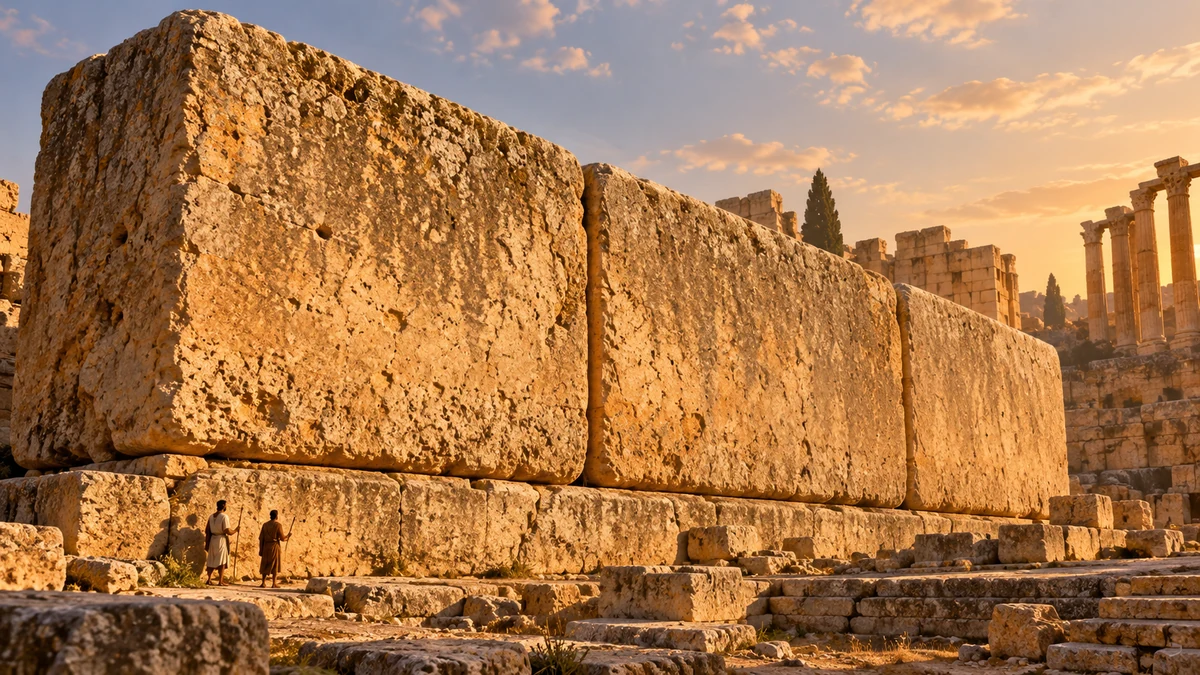
Editorial artistic interpretation of the Trilithon at Baalbek; not a documentary photograph or a reconstruction of a specific stone-transport method.
When Stone Exceeds Our Imagination
Standing before the substructure of the Temple of Jupiter in Baalbek, Lebanon, our usual understanding of stoneworking begins to shift. A stone block almost twenty metres long is no longer merely a building material. It is a challenge that someone first had to conceive, then separate from the bedrock, keep under control while moving it, and finally fit into a wall. At Baalbek, we are not left with plans or legends alone. Enormous stones still stand there—stones that people actually brought into position. [1, 2]
Their size inspires awe, but their true distinction is not measured in tonnes alone. It lies in the succession of decisions without which the undertaking might have ended in the quarry: where to begin, how to prevent damage, which route to choose, how to organise the work, and how to place a mass weighing hundreds of tonnes under control at the end of its journey. We cannot describe every one of these steps today with the same degree of certainty. Yet where the surviving evidence falls silent, a tangible result of human labour remains before us. [2, 3]
Baalbek is therefore fascinating not because ancient construction must have been “impossible”. It matters because it demonstrates just how far the knowledge, experience and organisation of ancient communities could reach, even when the details of individual working methods have not survived.
A Sanctuary Built Across Generations
Baalbek stands near the Beqaa Valley, beneath the slopes of the Anti-Lebanon mountains. The city, known as Heliopolis in the Hellenistic period, had a religiously significant history before the magnificent Roman buildings arose. Its temple complex was not created from a single design or during one building season. Monumental structures were built and altered over a long period; UNESCO draws attention to the interweaving of older local traditions and Roman architecture. [1]
That long history matters because an enormous stone cannot automatically be assigned to a particular ruler, decade or group of workers on the strength of its appearance alone. Such a claim requires construction joints, archaeological layers, working traces and a verifiable chronology. Admiration for the past is not diminished by admitting that we do not know the names of all its craftsmen. It becomes more honest: what stands before us is not the work of a mythical “race of giants”, but of real people whose personal stories have largely been lost. [1, 3]
UNESCO specifically notes that the colossal buildings developed over more than two centuries and that Roman and earlier local elements coexist within the complex. This is an important warning against reducing the site to one vast, single-phase construction project. [1]
The ambition to build a great sanctuary demanded more than stonemasons. It required people who knew how to plan, measure, supply a building site and coordinate difficult tasks. The surviving evidence does not allow us to count with confidence how many people directly participated in moving any particular block. Nor can we infer the precise social organisation of their labour without specific evidence. The scale of the work itself, however, shows that it was a remarkable achievement of long-term organisation. [1, 2]
The Trilithon: Three Stones That Really Arrived
Baalbek's most recognisable megaliths are three immense limestone blocks incorporated into the substructure of the Temple of Jupiter, commonly known as the Trilithon. Their lengths approach twenty metres. Estimates of each block's weight generally run to several hundred tonnes, often around 800 tonnes; these are calculations based on dimensions and assumed stone density, not the results of direct weighing. [1, 2, 4]
Here lies the strongest evidence of the achievement. We are not merely looking at an object that could have been carved but never transported. We are looking at stone that was moved and incorporated into a building. Whatever precise methods were used, a successful chain of operations, from extraction to installation, must actually have taken place. That is reason for respect, not permission to replace a missing step with an arbitrary story. [2]
There is no need to pretend that this was simple. Moving such a load means managing friction, ground conditions, gradient, direction, safety and, above all, predictability. Any unintended slip could have had serious consequences. Although the forces required by different techniques can be calculated, those calculations alone do not tell us which method Baalbek's builders used. [2, 4]
The Quarry and Its Unfinished Giants
The nearby quarry is home to the famous Ḥajjar al-Ḥibla, the “Stone of the Pregnant Woman”. In 2014, the research team identified a specific, evidence-based explanation for why this particular stone had been abandoned: poorer-quality rock at one corner and a natural crack that could have caused the block to break during transport. This is a supported explanation for this particular stone, not a general explanation for every unfinished megalith. [5] Archaeological investigations also documented an even larger unfinished block there. In 2014, the Lebanese–German team reported that the partially excavated stone mass was about 19.6 metres long, 6 metres wide and at least 5.5 metres high, estimating its weight at around 1,650 tonnes. Since its lower portion had not yet been fully investigated, that figure must be treated as an estimate based on the available measurements, not as a precisely measured weight. The same report estimated the famous Ḥajjar al-Ḥibla at somewhat less than 1,000 tonnes. [3, 5]
These figures make a dramatic headline easy to write, but they can also obscure the crucial distinction. There is no evidence that the approximately 1,650-tonne block was carried out of the quarry and built into the temple. On the contrary, its survival in the quarry makes it possible to investigate an unfinished process. It must not be equated with the stones of the Trilithon, which really do stand in the masonry. [3, 5]
Even an unfinished block, however, speaks of the boldness of the builders' ambitions. Someone selected a place and dimensions, began working the rock, and envisaged an object of extraordinary scale. Why work stopped on the newly discovered, larger block remains an open research question. The explanation involving the crack in the nearby Ḥajjar al-Ḥibla cannot automatically be transferred to it. Technical, organisational or economic factors must remain possible explanations until direct evidence supports them. Respect does not require us to declare every undertaking a success simply because it was begun. [3, 6]
Cutting Stone Is Not the Same as Moving It
When a stonemason looks at rock, they do not see mass alone. They see the directions of cracks, the quality of the material, how it can be worked, the intended surfaces and the hazards that could ruin weeks or months of effort. At Baalbek, a mistake early in the process would have been especially costly: damage to a vast block would mean an extraordinary loss of labour. Research into the quarries is therefore not a side chapter in the story, but a route to understanding the builders' knowledge itself. Margarete van Ess reports that field investigations sought traces of the techniques used to extract and move enormous blocks; this directly establishes the purpose of the research, but does not in itself prove that any one particular method was used. [3, 6]
We can divide the process into several connected yet questions that require different kinds of archaeological evidence: how the stone was marked out, how it was separated from the bedrock, how it was prepared for movement, how the route was arranged, how its motion was controlled and how it was finally placed. Marks left by stoneworking tools may help answer the earliest questions, but they are not direct evidence for the use of any particular hauling device. Likewise, a nearby quarry does not automatically resolve the questions of route and changes in elevation. [2, 3]
When we speak of “ancient technology”, we should also mean such skills and procedures, rather than only imagining unusual machines. Technology includes experience acquired over time: how to prepare a bearing surface, distribute forces and coordinate people so that difficult work can be repeated. In that sense, Baalbek points to a highly developed technical culture, even though its complete handbook has not come down to us. [2, 4]
How Could Hundreds of Tonnes Be Moved Without a Modern Crane?
In 1977, Jean-Pierre Adam devoted a scholarly study to the transport and installation of Baalbek's megaliths. The starting point of his research is revealing: he combined astonishment at the scale of the stones with the insistence that moving them should not be explained through fantastic speculation, but treated as a serious problem in construction engineering. Different mechanical solutions should be assessed in terms of their physical requirements and archaeological traces; no reconstruction, however, is itself direct testimony to the particular method used for the Trilithon. [2]
A convincing model must demonstrate more than the fact that the combined force would have been sufficient on paper. It must account for the actual route, the load-bearing capacity of the ground, changes of direction, possible gradients, the danger of becoming stuck and the means of placing the block in its final position. It should also identify the traces such a method would be expected to leave in the landscape or building — and whether those traces have actually been found. Every additional testable constraint makes an explanation stronger. [2, 4]
It also matters what we are not claiming. The existence of modern machines capable of shifting enormous loads does not lessen our admiration for people who solved such problems with different means. The claim that moving blocks of this size is inherently impossible for the modern world is not justified. The historical question is not whether we could do it with today's equipment, but how they achieved their actual successes. [2, 4]
Between Technical Knowledge and Wonder
Two hasty explanations often arise in the presence of enormous stones. One says that the work simply could not have been accomplished with ancient means. The other reduces the answer to a few familiar words — ropes, rollers, levers — as though naming them had already explained the entire undertaking. Neither is satisfactory. The first underestimates people of the past; the second underestimates the difficulty of what they achieved. [2, 4]
A more respectful approach acknowledges both sides: the laws of physics applied in antiquity too, but applying them successfully on such a scale required exceptional care and forethought. Rheidt's chapter also places the megaliths within the broader question of the architectural significance of building with such immense stones and their possible role in displaying power. Whether the choice of particular blocks arose primarily from a structural plan, the representation of authority or a combination of motives cannot be established from their size alone. This interpretation is supported here by the accessible bibliographic record and chapter abstract; the full chapter was not reviewed. [4] We do not need to imagine lost supernatural abilities for the achievement to be magnificent. Quite the opposite: it is all the more worthy of admiration when understood as the outcome of human learning, skill, discipline, cooperation and practical problem-solving. [2]
Nor would it be fair to credit modern researchers with greater certainty than the evidence permits. If clear traces of a particular stage are missing, we should say that this stage is reconstructed. Acknowledging an open question is not a weakness of an explanation, but a mark of respect for history and for the reader.
What Do We Really Know — and What Remains Uncertain?
We know reliably that Baalbek is a monumental sanctuary with a long building history, that its masonry contains extraordinarily large installed stones, and that other, unfinished examples remain in the quarries. We can measure many of their dimensions, investigate working traces and construct technical models of their movement. What we cannot establish with equal confidence is the precise sequence of every operation, the equipment used and the number of people involved in each individual block. [1, 2, 3, 5]
It is therefore essential to distinguish three kinds of statement: a documented physical remain, an estimated quantity, and a technical reconstruction. A stone built into a wall is a documented physical remain. Its weight in tonnes is a calculated quantity depending on dimensions and density. An account of how it was moved is a model supported by evidence to a greater or lesser degree. Mixing these three levels might make an article more dramatic, but it would make it less truthful. [2, 3]
Baalbek does not ask us to abandon critical thinking. It asks almost the opposite: to preserve our sense of wonder even as we begin asking precise questions. Every scholarly explanation that future research can test more closely will make the builders' achievement more intelligible, not less impressive.
Respect for the People Behind the Stone
Standing before Baalbek's wall today, we see the end result, not the day construction took place. We cannot hear the conversations, we do not know every failed attempt, and we do not know which craftsperson found the right solution at the decisive moment. The stone has outlived its makers and almost all their words. [1, 2]
Yet that is precisely where the monument's value lies. These are not abstract numbers or a puzzle invented for a modern audience. They are evidence that people in a distant age could plan and carry out works that still inspire astonishment today. If one day we reconstruct every stage of their transport more precisely, Baalbek's builders will remain just as worthy of respect. Understanding their achievement does not diminish its greatness. It finally gives that achievement the human dimension it deserves.
---
Sources and further reading
- [1] UNESCO World Heritage Centre. Baalbek. source Source
- [2] Adam, Jean-Pierre (1977). “À propos du trilithon de Baalbek. Le transport et la mise en œuvre des mégalithes.” Syria 54(1–2), 31–63. source Source
- [3] Abdul Massih, Jeanine (2015). “The Megalithic Quarry of Baalbek: Sector III the Megaliths of Ḥajjar al-Ḥibla.” Journal of Eastern Mediterranean Archaeology and Heritage Studies 3(4), 313–329. source Source
- [4] Rheidt, Klaus (2022). “Large Stones—Big Challenge?” In Building the Classical World, 170–188. Oxford University Press. source Source
- [5] Deutsches Archäologisches Institut / Informationsdienst Wissenschaft (2014). “Libanesisch-deutsches Forscherteam entdeckt weltweit größten antiken Steinblock in Baalbek.” source Source
- [6] van Ess, Margarete. “Baalbek, Libanon: Forschungen im Steinbruch und die Aufarbeitung der Forschungen von 2001–2012.” e-Forschungsberichte des DAI, issue labelled “Faszikel 3 (2015)”, pp. 88–92; the publisher's online record gives 8 June 2023 as the date of publication and recommends citing 2023. source Source