The Grooves of Gotland — Traces of Tools, Rituals or Skywatching?
Thousands of grooves in Gotland rock raise questions about their age and purpose. What does archaeology support, and what remains a hypothesis?
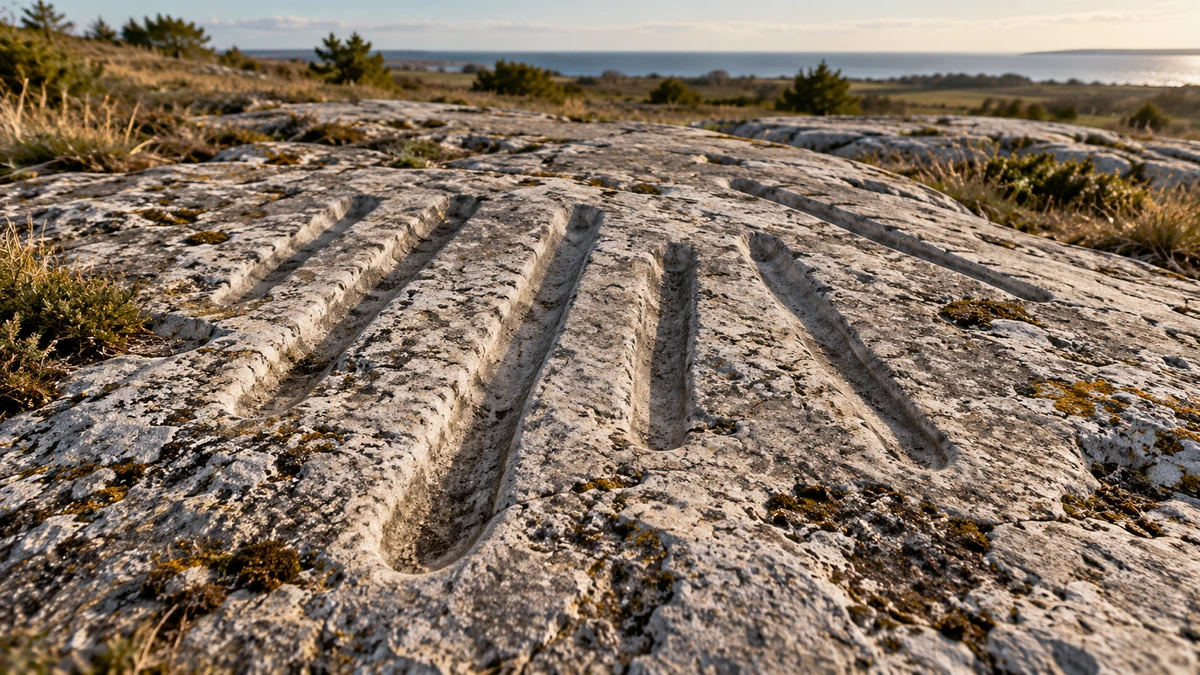
Editorial illustration of grooves in limestone, not a documentary photograph of a specific archaeological site.
On Gotland, a Swedish island in the Baltic Sea, elongated, often smoothly formed grooves can be seen in bedrock and individual stone blocks. Sometimes they run almost parallel; elsewhere they intersect. Their distinctive, often repeated form can give the impression of deliberate work. Yet a groove alone cannot tell us who made it, on what date, or why someone once set to work on that stone. [1, 3, 4]
Swedish research uses the terms slipskåror and sliprännor for these features, while local traditions also preserve names suggesting the sharpening of swords. This reveals the first trap: a name people use for an object may preserve an assumption about its purpose rather than reliable evidence of its historical use. Some grooves can be associated with physical processes of grinding or abrasion, but the question of what was ground, when, and in what social context is considerably harder to answer. [3, 10]
Over the past several decades, explanations have linked the grooves to the making of implements, mechanical devices, ritual collection of stone dust and even observation of the sky. None should be accepted merely because it sounds simple or mysterious. Gotland is fascinating precisely because a single stone invites us to ask what we can observe, what we are interpreting, and what would actually put an interpretation to the test. [1, 3, 4, 6]
A Stone Bearing the Traces of Repeated Work
Imagine a low stone block with several narrow depressions worn into its surface. Their sides are smooth; in some cases, their bottoms become deeper toward the centre and rise again near the ends. Such a shape is consistent with repeated sliding or grinding, but it does not itself reveal whether the object being worked was a blade, a whetstone, a component of a device or something else entirely. A functional explanation requires measurements of the groove's profile, microscopic examination of wear traces, and investigation of residues in and around it. [3, 4, 5]
Consider an actual object: the Gotland Museum catalogue describes the picture stone GP 172 Hangvar Austers II, an approximately 68-centimetre-high limestone fragment from the upper part of a monument. Three vertical grooves are visible on its surface. Based on its form, the catalogue assigns the stone to a type dated approximately from the eighth to the early twelfth century and interprets the grooves as secondary modifications. It does not claim that the tool used to make them is known. [1]
An even more striking example is GP 327 Othem Othemars. This large, broken picture stone, now held in the museum collection, was found during ploughing in 1951. Alongside five deep grooves on its front are broader, shallow depressions; the recorded description notes at least nine additional deep grooves on the back. Only fragments of the original relief decoration remain, including a pattern from a ship's sail. The catalogue describes the grooves as later interventions; that description does not mean every point of contact between a groove and the relief has been independently dated. Such an object is more than an appealing illustration of the question: it offers an opportunity to investigate the sequence of alterations to its surface. [2]
Museum entries are not substitutes for direct archaeological testing of every proposed explanation. They nevertheless give the investigation a firm starting point: a particular identifiable object, its findspot or documented history of movement, its material and its observable grooves. When a photograph of an arbitrary hollow is presented without that context and declared to show an astronomical instrument thousands of years old, most of the evidential chain is missing. [1, 2, 9]

How Many Are There, and Where Are They Found?
The grooves are not an isolated feature from a single discovery. In a scholarly article published in 1997, Jonathan Lindström referred to more than 3,000 grooves at more than 900 locations on Gotland. In his 2020 master's thesis, Sören Gannholm referred to approximately 3,600 known examples. These figures cannot be combined into an allegedly official count for 2026: they are estimates made by different authors at different times. What can safely be said is that there are several thousand grooves, not just a handful of curiosities. [3, 4]
When comparing figures, we must distinguish grooves, stones and locations. One block may bear several grooves, and one archaeological site may contain several blocks. Registers also use different Swedish names for such finds. In a spatial analysis of three parishes in southeastern Gotland, Anna Sointula found that searches using different terms did not return identical sets of records; she also noted inconsistencies in older entries and gaps in the data. Her local sample comprised 116 recorded locations, 35 of them no more than four metres above present sea level; these are not counts of individual grooves. This is more than an administrative detail: the quality of the inventory determines how much we can infer from spatial patterns. [9, 10]
Grooves occur both in bedrock and on movable blocks, often in clusters of varying sizes. In Gannholm's 2017 analysis, many examples are roughly half a metre to one metre long and five to ten centimetres wide, with varying depths. These are descriptive measurements of the material he studied, not a rule for deciding whether any particular Gotlandic groove is authentic. Nor do similarly shaped grooves elsewhere in Europe automatically demonstrate an identical purpose or a common origin. [4, 5]
Location matters. Gotland's shorelines have shifted over thousands of years as sea levels changed and the land rose after the last ice age. Research around former coastal routes, wetlands and fishing stations can therefore suggest chronological and economic connections. Yet proximity to what was once a waterside environment is not proof that the grooves were made for boats or fishing. Researchers must also establish whether a stone has remained in place and reconstruct where the shoreline lay at the relevant time. [10, 11]
When Were They Made? A Groove Need Not Be as Old as Its Stone
For an archaeological monument, at least three moments must be distinguished: when the block of stone formed naturally, when people selected or shaped it as a monument, and when a particular groove was ground into it. Confusing these moments can produce a chronology that sounds convincing but is wrong. The geological age of limestone does not date human work, and dating a picture stone by its style does not automatically date every depression added later. [1, 2]
The museum catalogue interprets the grooves on GP 327 Othem Othemars as secondary and suggests that they were most likely made after the stone had ceased to serve its original commemorative purpose. The description of GP 172 Hangvar Austers II is similarly cautious: the stone has a broad art-historical date, while its grooves are treated as later interventions. This is a considered interpretation of specific objects, not proof that every groove on Gotland dates to the Middle Ages. [1, 2]
Sören Gannholm has advanced a different position. In his view, some sequences of cutting and shaping at the edges suggest that grooves already existed on a block before it was fashioned into a picture stone. His comparisons with Stone Age sites and groove distributions support a proposal that part of the material is considerably older. That objection deserves to be taken seriously as a testable hypothesis. The crucial question, however, is whether measurements and documented intersections on individual stones independently support the proposed sequence. [4, 5]
The research programme The Connecting Point introduced a third approach. In 2021, Anna Sointula analysed the distribution of recorded grooves across Grötlingbo, Eke and Rone, comparing their elevations with former coastlines. Citing an earlier report, she noted a proposed date of approximately AD 800–1200 for certain low-lying finds. She also acknowledged gaps in the register and uncertainties in reconstructing ancient shorelines. This is a spatial estimate conditional on local circumstances, not a direct date for every groove. [10]
A 2022 field report likewise described grooves at elevations of approximately two to three metres above today's sea level near some former coastal areas and historic fishing locations. That association raises a useful research question: could at least some grooves have been related to activities by the water? Moving from that question to a convincing answer requires stratigraphic associations, evidence of function and more precise chronological controls. [11]
Workshop or Practical Device?
A practical explanation begins with a deceptively simple question: what movement, repeated over time, would create such a mark? If a groove was worked into stone by sliding another object along it, we could compare the properties of both materials, the width of their contact, the direction of microscopic scratches and the resulting dust. An experiment reproducing a similar groove would be useful, but even that would not by itself prove that people on Gotland engaged in precisely that activity. Showing that something can be made is not the same as demonstrating how it was actually used. [4, 7]
Earlier researchers connected the grooves with the grinding of stone tools and therefore placed them in the Neolithic period. Later interpretations noted that similar grooves can result from other practical processes. In 1936, Torsten Mårtensson associated some grooves in the province of Skåne with the preparation of whetstones used to sharpen scythes; he also drew on accounts of comparable work in more recent times. Oskar Lidén challenged this broader dating in 1937: at other sites in Skåne he pointed to archaeological material and older layers that an explanation based on a more recent craft did not adequately account for. This does not prove that all the grooves under discussion were Neolithic, still less that the same applies to Gotland. The dispute shows why distinct groups of finds must be evaluated separately. [7, 12]
The history of research on Gotland also includes a possible connection with ironworking. The title of Lennart Swanström's 1995 study points to a proposed connection between Gotlandic grooves and ironworking. Because the full study has not yet been examined directly, we can report that such a connection was proposed, but cannot claim evidence of any particular metalworking workshop. [8]
In 2013, Olov Gibson proposed in the journal Fornvännen that some Gotlandic grooves might have arisen from friction brakes in wind-powered devices. To substantiate this explanation, it would be necessary to examine the forces involved, material wear, the distribution of the grooves and the historical plausibility of the proposed construction. The existence of the article is therefore not evidence that such devices actually operated on Gotland. [6]
Anyone advocating a practical explanation must therefore address an important challenge: not only how one groove could have formed, but why several similar or differently oriented grooves were made on the same stone, why they occur near particular settlements, and why they sometimes cut across older monuments. This is not an argument against everyday uses. It is a reminder that broadly similar forms can result from different activities in different periods. [1, 2, 4]
Ritual, Stone Dust and the Memory of Old Monuments
In medieval and later European history, people sometimes attributed healing, protective or commemorative powers to stones. The museum's interpretation of Gotland's picture stones allows for the possibility that some grooves added later were connected with collecting stone dust for folk healing or religious customs. Comparable alterations have also been documented on churches, gravestones and memorial crosses elsewhere in Europe. [1, 2]
Evidence for such an interpretation might come from the setting, the special treatment of an older monument, a documented historical custom or the nature of the worked surface. Yet moving from the observation that 'some people scraped dust from particular stones' to the conclusion that 'every groove on Gotland was sacred' would skip the entire evidential argument. Even the term ritual is not an explanation unless we can say who supposedly performed it, when, with what movement, and why it would have left precisely these marks. [1, 2]
The Othem Othemars stone bore an image of a ship before it acquired its present appearance. If people living later regarded the stone as special, that might help explain why they treated it differently from an ordinary rock. But we still lack direct testimony from the makers of the grooves. The catalogue proposes a possible folk-religious use; it does not preserve an account by someone explaining their own intention. [2]
Ritual and practical interpretations are not always mutually exclusive: working stone could have had both a practical and a symbolic significance for a particular community. What matters is that this possibility must not become an excuse for an untestable story. A sound archaeological argument must still identify how the traces expected from one practice would differ from those produced by other possible actions. [3, 4]
The Moon Above the Island: The Appeal of the Astronomical Hypothesis
Gotland's grooves become even more intriguing when their orientations are linked to the sky. In 1983, Göran Henriksson proposed that some grooves marked the directions of moonrise or moonset during particular events, drawing on astronomical reconstructions for millennia before the Common Era. In this interpretation, a groove is seen not merely as a trace of work but as part of an observational system. The idea is interesting, but meaningful testing begins only when we ask how the directions were selected and dated. [3, 4]
In a wider discussion of the orientation of Swedish monuments published in 1997, Jonathan Lindström warned about rounding measurements, inconsistent precision and the danger of seeking a matching celestial event after seeing the data. That same year, he also published a separate critical study of the grooves on Gotland. His criticism of the Gotlandic interpretation was pointed: the fact that some directions match calculated positions of the Moon does not itself show that people ground the grooves to mark those events. If a different star, date or lunar cycle can be chosen retrospectively for every groove pointing in a different direction, the hypothesis becomes difficult to falsify. [3, 13]
Gannholm revisited the orientations and referred to approximately 1,250 measured directions in his 2020 master's thesis. He interpreted aspects of their distribution as possible correlations with celestial positions, taking these as an argument against a purely random arrangement. Yet a non-random orientation is not by itself evidence of astronomical purpose. Direction can be influenced by the shape and position of a stone, access to the working surface, the slope of the terrain and the grinding process itself. The essential question is whether the model also performs well on an independent sample that was not used to construct it. [3, 4, 5]
A groove, moreover, is not an arrow: it generally defines an axis with two ends, not one unambiguous viewing direction. An alleged celestial alignment must therefore specify which end an observer would have used, what the horizon looked like at the time, and whether the stone was subsequently moved. If the proposed system is called a 'lunar calendar', we must also establish how such a calendar would have been used and how its age was independently determined. Without that, it remains an imaginative but unconfirmed model. [3, 4]
There is no need to ridicule an astronomical idea in order to test it rigorously. Past communities certainly observed the sky. The question is not whether they were capable of doing so, but whether the grooves in question show a specific relationship to chosen celestial phenomena rather than a coincidental or more general pattern of orientation. Demonstrating a deliberate astronomical system would therefore require more than an interesting distribution of directions. [3, 5]
Hörsne: Why an Excavation Is Not Yet a Definitive Answer
When rival interpretations disagree about the age of the grooves, an excavation may be more revealing than another photograph showing the direction of a cut. Sören Gannholm described fieldwork undertaken in 2019 near the Hörsneån watercourse, where grooved stones occur in association with layers of river sediment. Beneath the turf, the investigators examined sandy layers and looked for fine material that might have been produced by grinding. The relationship between a groove and its surrounding deposit is precisely what matters for establishing chronology. [4]
In his master's thesis, Gannholm mentions stone dust in a sediment layer and 46 milligrams of shell fragments separated by washing a sample for radiocarbon measurement. In his account, the result was too old to provide a usable date, which he attributed to older shell material carried into the sample by water. It is not a direct date for the grooves: the author himself notes that the sample was mixed, so it cannot securely establish when the stone was worked. [4]
Gannholm therefore used a different argument. He compared the thickness of river deposits above and below a presumed layer containing grinding dust and inferred a Neolithic date from their sequence. That is an interpretation of the sedimentary succession. Its strength depends on whether the dust remains in its original position, whether the layers have been undisturbed and how reliably their rate of accumulation can be reconstructed. The age of material in a layer may be measurable, but the date of the groove's manufacture remains an indirect inference. [4]
Coastal investigations in 2021 and 2022 further show why caution is necessary before extending a conclusion from one site to the entire island. Low-lying stones known not to have been moved may allow chronological limits to be derived from former sea levels, but different places need not share the same history of deposition, movement or reuse. It is even possible that different grooves belong to different periods. This could account for some apparently contradictory observations, but the possibility also requires empirical testing. [10, 11]
Hörsne is therefore not an empty episode in the research. It offers an actual excavation, a stratigraphic hypothesis and a clearly documented failure to obtain a usable radiocarbon date. That is exactly why it is instructive: serious investigation is not a process in which every observation confirms a preferred explanation. It also requires recording results that fail to support a preferred explanation. [4]
What would support each interpretation?
| Interpretation | Proposed explanation | Evidence that could support it | What remains uncertain |
|---|---|---|---|
| Tool grinding or preparation | A groove resulted from repeated friction during work. | Reproducible experiments, microscopic wear, material residues and workshop context. | A similar profile alone does not identify the worked object or its date. |
| Mechanical device | A groove may have formed during a particular mechanical operation. | A physically viable reconstruction, matching wear and associated components. | A published suggestion is not proof that the device was historically used. |
| Ritual or folk-healing use | Stone powder may have been ground off for symbolic or medicinal purposes. | Local historical sources, patterns of monument reuse and characteristic working marks. | Cases involving particular stones cannot explain every Gotland groove. |
| Astronomical alignments | Certain orientations may have been linked to observing the sky. | A prespecified predictive model, independent samples and independently supported chronology. | Matching directions alone cannot establish a lunar calendar. |
Note: The table compares hypotheses and possible tests; it does not identify four proven functions.
What Might Resolve the Dispute?
First, grooves should be compared by shape, microscopic wear traces and material, not merely by how similar they look in photographs. A groove produced through a known process using a particular kind of abrasive stone should leave characteristic wear patterns and residues. Experimental replicas can show which activities really produce comparable surfaces. But to establish a convincing function, that evidence must also be joined to archaeological context: traces of workshops, comparable objects and a demonstrable chronological relationship. [4, 7]
For picture stones, detailed photographs taken under raking light, three-dimensional measurements and records of places where a groove intersects a relief, an edge or a broken surface would be decisive. Such evidence could help establish whether a groove was made before or after a stone was fashioned into a monument. The museum's digital collection already provides descriptions and models of particular objects. Further analysis of GP 172 and GP 327 should yield transparent conclusions specific to each artefact, not a single date imposed on the entire phenomenon. [1, 2]
Discussion of shorelines would benefit from precise local reconstructions of sea-level change and comparison with sites where a stone can reliably be shown not to have moved. The Fornsök register can help identify and compare objects spatially, but records need to be reconciled where different names describe the same kind of find, coordinates are outdated or groove counts are inconsistent. Otherwise, the percentages may tell us more about the history of archaeological recording than about the history of the people themselves. [9, 10, 11]
The astronomical hypothesis could be tested with a model specified in advance: which orientations should occur, within what tolerance, on which stones, and taking account of both ends of each groove and the age of individual examples. The model would then need to predict orientations successfully in a new sample and demonstrate that technical or terrain-based explanations do not account for them equally well. This is not a rejection of astronomy; it is a requirement that a hypothesis state what could prove it wrong. [3, 4]
Finally, dating requires suitable material in a secure, undisturbed archaeological relationship to the making of a groove. A radiocarbon result obtained from mixed shell fragments does not establish when the cuts were made. A good research programme would document both successful and unsuccessful tests alongside its dates, and explain precisely where uncertainty remains. [4]
The Greatest Mystery Is Not the Pattern but the Missing Context
Gotland's grooves were formed through repeated action on stone; what remains today is a durable physical trace. But several thousand similar marks need not have been made by one generation, for one craft or during the same ritual. If some occur on altered monuments, others near former coastlines and still others in different kinds of rock, perhaps our first mistake is to expect one explanation for them all. [1, 2, 3, 10]
Grinding tools must be tested against wear traces. Mechanical devices must be assessed through the physics of their operation and their historical setting. Ritual explanations require actual evidence of use and comparable documented practices. Astronomical theories call for independently tested orientations and chronology. Each explanation has its own burden of proof; none can declare victory merely because there are many photographs, because a story is often repeated, or because a pattern looks mathematically ordered. [3, 4, 6]
For now, the most accurate answer is less grand than 'a stone calendar has been discovered' and more interesting than 'nobody knows anything'. We know enough about Gotland to describe individual stones, compare their forms, document earlier and later interventions, and pose questions that can be tested. We do not yet know enough to assign the same origin and purpose to every groove. An unanswered question is not evidence of a hidden civilisation—and neither is it a licence to dismiss uncomfortable questions. [1, 2, 3, 4, 10]
Sources and further reading
- [1] Gotlands Museum, GP 172 Hangvar Austers II, digital catalogue Gotlandic Picture Stones: source Source
- [2] Gotlands Museum, GP 327 Othem Othemars, digital catalogue Gotlandic Picture Stones: source Source
- [3] Jonathan Lindström (1997), The Orientation of Ancient Monuments in Sweden — A Critique of Archaeoastronomy and an Alternative Interpretation, Current Swedish Archaeology, 5, 111–125: source Source
- [4] Sören Gannholm (2020), The Mysterious Grinding Grooves, master's thesis, Uppsala University (author-hosted text available): source Source
- [5] Sören Gannholm (2017), Gotlands slipskåror — En rumslig analys, Uppsala University: source Source
- [6] Olov Gibson (2013), Gotlands slipskåror — spår av friktionsbromsar hos väderkvarnar?, Fornvännen, 108, 130–133: source Source
- [7] Torsten Mårtensson (1936), Sliprännornas praktiska bruk, Fornvännen, 31, 129–144: source Source
- [8] Lennart Swanström (1995), Slipskåror och järnhantering på Gotland, in Gotländskt Arkiv 1995, bibliographic entry from Gotlands Museum: source Source
- [9] Riksantikvarieämbetet (RAÄ), About Fornsök, Swedish national heritage register: source Source
- [10] Anna Sointula (2021), Grinding Grooves in the Parishes of Grötlingbo, Eke and Rone, appendix to Arendus 2021:26, The Connecting Point: source Source
- [11] Dan Carlsson and colleagues (2022), Rapport Eke 2022, The Connecting Point, field research project: source Source
- [12] Oskar Lidén (1937), Grophällarna i Kullabygden, Fornvännen, 32, pp. 157–171; bibliographic entry and indexed excerpts examined, complete PDF not yet reviewed: source Source
- [13] Jonathan Lindström (1997), Fornlämningarnas orientering på Gotland: en kritisk granskning av den arkeoastronomiska tolkningen av slipskåror samt en studie av riktningsfördelningen hos öns forntida gravar, hus och medeltida kyrkor, in Till Gunborg: arkeologiska samtal, Stockholm Archaeological Reports 33, pp. 497–508 (bibliographic entry; full text not directly reviewed): source Source