Petroglyphs Above Ilirska Bistrica — The Mystery of the Markings in a Cave Near Trnovski Studenec
What do the petroglyphs above Ilirska Bistrica reveal? Incised signs, a damaged calcite formation and competing interpretations of a mythological landscape.
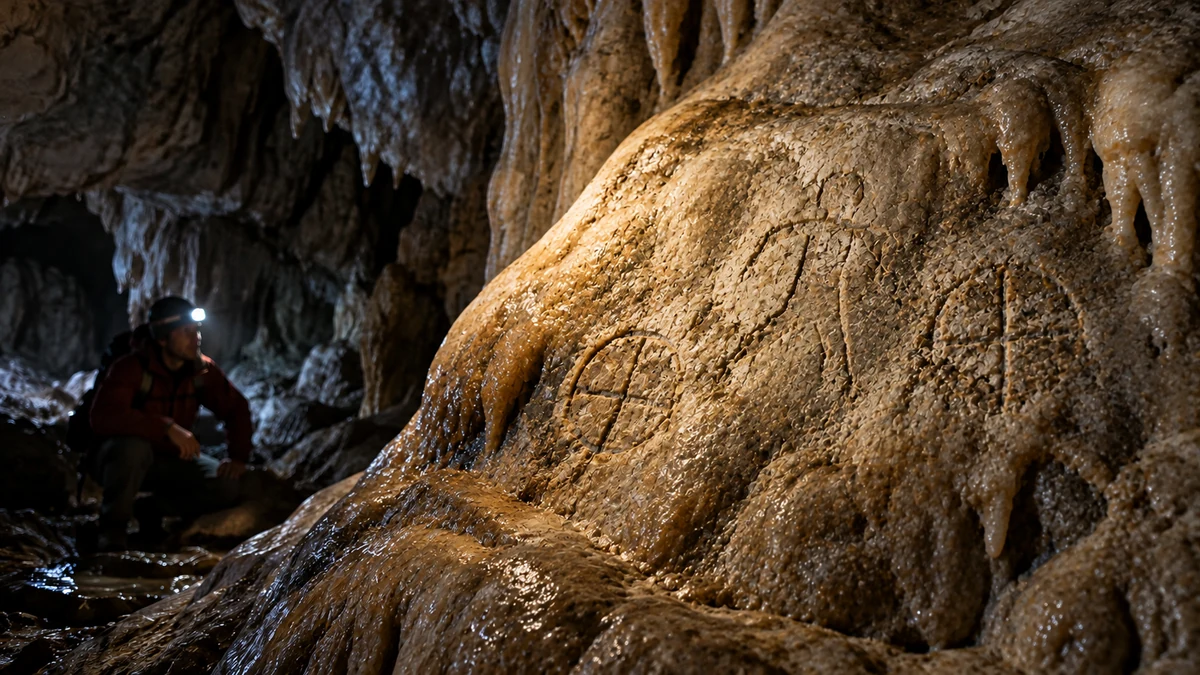
AI-generated conceptual illustration; it does not depict the actual Japodska jama cave or its petroglyphs.
Marks carved into a calcite-covered surface in a cave above Ilirska Bistrica raise more questions than we can answer. One of the figures resembles a person holding a bow, or perhaps a rider. Nearby are circles crossed by lines. The cave lies in a landscape where old stories, place names, water and hills converge, and where researchers have proposed connections with mythology. These circumstances suggest an alluring possibility: perhaps the site was once a sanctuary dedicated to a deity associated with thunder, the Sun or fertility.
Yet there is something else we must acknowledge first. Part of the calcite formation bearing the marks has been removed. Only some of the incisions survive; we do not know what the complete arrangement, if there ever was one, looked like. Nor do we know with confidence who made the surviving marks or when. The mystery of the cave is therefore not simply what its symbols mean. It is also a question of lost evidence.
A Cave with Several Names
The site is widely known as Japodska jama, or the Japodian Cave. The name seems to suggest a direct association with the Japodes, an ancient people who inhabited parts of the northwestern Balkans. But that would be a premature inference. A cave's name is not evidence of who carved its petroglyphs, still less of how old they are.
In a 2014 study, ethnologist Katja Hrobat Virloget explained that, according to the accounts she collected, local people had used the simple name Jama (“Cave”) or the descriptive Jama v bližini Trnovskega studenca (“Cave near Trnovski Studenec”). In her assessment, the name Japodska jama probably arose in caving circles rather than surviving as an inherited local name. Stories about the cave are also connected with water: according to oral accounts, people visited it when the nearby spring ran dry. Another tradition holds that the cavity was once covered and that its roof later collapsed. These accounts matter, but they are neither a measurement of the cave's age nor proof that it served as a sanctuary in any particular period.
During a field visit in August 2012, the researcher and caver-geographer Borut Peric observed damp walls, water at the bottom of a rocky depression and two artificially built supporting walls incorporating wooden beams. The cave is therefore no untouched scene from prehistory. It bears traces of natural processes, subsequent human use and, unfortunately, damage. We can understand a place like this only by distinguishing those layers.
The cave is listed as a natural feature of national importance. An official register from 2023 records it under the name Japodska jama, identification number 47691, and describes it as a shallow cave or rock shelter; the designation also appears in an earlier list from 2006. The protected status underscores the importance of conserving the site. It does not, by itself, establish that the cave is an archaeologically dated ritual sanctuary. The national register number is also different from the cave-cadastre number 7691 cited in older literature.
An Archer or a Horseman?
A human-like figure stands out on the surviving section of calcite-covered wall. Among the marks described in the 2014 study, this one is noticeably more deeply and precisely incised. An observer might discern spread legs, a torso, a head and an extended arm; two diagonal lines could represent a bow and arrow. But if some strokes are connected differently, another figure emerges: a rider on a stylized horse.
This is no trivial distinction. With a highly schematic drawing, the interpretation may change according to which stroke we regard as a separate element and which as the continuation of another. The same visible lines can support different reconstructions. Calling the image an “archer” in a photograph caption or description does not mean that its identity has been settled. “Archer or horseman” is less decisive, but it better reflects the state of the evidence.
The 2014 article draws comparisons with carved figures in Valcamonica, the celebrated rock-art landscape in the Italian Alps. Resemblance to prehistoric art may draw attention to a particular motif, but it cannot tell us when an incision above Ilirska Bistrica was made. Valcamonica contains images from numerous periods and in different natural settings, often on exposed rock. Similar-looking human figures need not have been created by the same culture or in the same century.
The fundamental problem is that no independent dating has yet been demonstrated for these particular petroglyphs. Without it, we cannot tell whether the marks are prehistoric, early medieval, later, or even the product of several different periods.
Circles That Might Represent the Sun
A second group consists of irregular circles crossed by varying numbers of lines. In many traditions, a circle containing a cross or rays may represent the Sun, a wheel, directions in space, protection, or something quite different. Their very ubiquity creates a problem: when a motif occurs in different settings and centuries, its meaning cannot be determined without context.
There is no single unmistakable “sun wheel” in the cave from which we can simply read the carver's intention. Hrobat Virloget describes irregular, shallower strokes, some of them partly overlapping. She compares them with other incised circles, including petroglyphs in neighboring regions, while warning that iconographic analysis does not provide a reliable route to a definitive conclusion.
The 2014 study also considers possibilities beyond a solar interpretation. Conservator Božidar Premrl pointed to comparable circular signs on railway buildings erected in Ilirska Bistrica in the 1870s; the researcher also mentions Christian symbolism and stonemasons' marks. These parallels do not date the cave's incisions either. Their value lies in showing just how many meanings a simple geometric form can carry.
Solar symbolism is therefore worth investigating, not automatically accepting. A resemblance between two signs is not the same as continuity of belief. Even if a mark truly represented the Sun, it would not tell us which god or goddess it honored, whether it belonged to a ritual, or who carved it.
Why Does the Missing Part of the Calcite Formation Matter So Much?
By the 2012 visit, the lower section of the calcite formation had already been partly cut away; the researcher's account indicates that a substantial area was missing. The wall showed evidence of deliberate intervention, including drilling. The study also records a caver's second-hand recollection of having once seen the formation intact, with marks resembling an unknown script. This is not direct documentation of the lost portion. We have no verified photograph showing all the marks that were allegedly present, nor do we know their age or what happened to the removed piece.
That loss makes any complete “translation” or reconstruction of a supposed message particularly problematic. Perhaps the wall once bore a unified composition. But perhaps different people added marks over time at the same location, without knowing the original meaning of earlier ones. Researchers often call such a layering of activity a palimpsest: one place preserves traces from different periods which we now see together, even though they were not created at the same time.
The age of the calcite formation is not the age of the incisions upon it. A stone surface may be vastly older than the human intervention. Evidence would have to come from the characteristics of the cuts, whether later calcite has grown over them, any associated archaeological material, and other suitable non-invasive investigations—not from the formation's size or unusual shape.
Seen in this light, the damage to the site is especially regrettable. More than a piece of stone may have been lost: we may also have lost part of the sequence that could explain how the symbols relate to one another. We should not replace its missing appearance with imagination, however attractive the idea of an ancient sanctuary may be.
Calcite, Water and Fertility Rites
Viewed from the front, the calcite formation can resemble a phallus. This resemblance led the researcher to draw comparisons with caves where similar forms have been linked to traditions of fecundity and fertility. In the nearby karst region, the Triglavca rock shelter is particularly relevant: recorded local traditions associate it with ritual practices and a symbolic relationship between male and female principles.
Hrobat Virloget also discusses a cave at Nakovana on the Pelješac Peninsula. There, alongside a striking calcite formation, archaeologists documented concentrations of material finds, including fine pottery and animal bones. These additional traces provide a stronger basis for discussing a ritual setting than an unusual rock formation alone.
Such comparisons are valuable, provided we recognize their limits. We cannot conclude that every cave with a phallic-looking formation was necessarily a fertility sanctuary. Nor does a recorded rite at Triglavca establish that the same rite took place above Ilirska Bistrica. Analogies help us formulate questions; evidence from the particular site must answer them.
Water adds another intriguing dimension. In local tradition, the cave offered a source of water when the nearby spring dried up. Across many cultures, traditions, ceremonies and ideas of purification or fertility have developed around water. Yet a site may simultaneously provide drinking water, shelter and a setting for symbolic acts. Human use of a place does not always have a single purpose. It would be mistaken to choose between “merely practical” and “exclusively sacred” when we do not know what activities actually occurred there.
Snežnik, Devin and the Mythological Landscape
Interpretations of the petroglyphs have extended beyond the cave walls. The surrounding landscape contains place names, hills and traditions that can be studied in relation to Slavic mythology. Frequently discussed features include Devin, Snežnik, nearby water sources and places associated with other pre-Christian motifs. Such a landscape may preserve traces of older ideas; today's place names, however, are not always a direct window into the time when particular images were carved.
In 2020, Ladislav Placer examined the geomorphology of Milanja and its neighboring hills, including a large fossil rotational landslide whose head scarp forms a distinctive semicircular ridge. Drawing on historical maps, place names and geometric relationships, he proposed reading this landscape as a place associated with Mokoš. In a sequel published in 2021, he developed an expanded “ideogram” of Mokoš and Jarilo: he described Velika Milanja as the mythic center of a “Solar Circle,” and Japodska jama, with its phallic calcite formation, as the center of a “Lunar Semicircle.” It is an elaborate hypothesis about symbolism in the landscape, not an independent archaeological identification of the deities or a dating of the incisions. It can prompt questions about how a landscape might have been experienced as a whole, but geometric correspondences alone cannot tell us who made the marks or when.
The same caution applies to names that might preserve echoes of older deities. Etymological comparisons must consider documented early forms, linguistic change and alternative explanations, rather than similar sounds alone. References to Kresnik, Perun or Mokoš can legitimately describe particular research hypotheses; they cannot serve as a factual identification of a deity whose worship in this cave has been established.
This approach takes nothing away from the site's enigmatic appeal. On the contrary, it allows cultural memory and scholarly precision to coexist. The question of how people once understood their landscape deserves investigation in its own right, even when no definitive answer can be found for every feature.
Kresnik's Sanctuary and the Question of the Sun
In 2016, Saša Iskrić put forward a more decisive interpretation. He associated the human-like figure with Perun or Kresnik, the circles with solar symbolism, and the cave's orientation with directions allegedly important for observing the Sun. The hypothesis has a recognizable mythological framework. But that does not make it independently verified.
When describing a summer observation, we must distinguish two language versions of the same text. The Slovenian version gives 20 June 2015, while the English version gives 20 July 2015, although both describe the date as the day before the summer solstice. Because the solstice falls in June, the July date is very likely a translation or editorial error. It is not a reason to dismiss the observation outright; nor does it entitle us to regard the author's measurements as verified without field data. More important is the author's own description of the light reaching the vicinity of the marks: he estimated that, around the solstice, a sunbeam came within approximately 75 centimeters of the carvings. This is not direct illumination of the petroglyphs, and it does not in itself demonstrate that they were made for this light effect.
Testing the astronomical hypothesis would require repeatable measurements, a clearly identified observation point, the orientation and original shape of the cave entrance, data on the local horizon, and records that allow the date to be checked. Subsequent changes to the roof or surrounding vegetation would complicate a reconstruction of past lighting conditions. Without such information, a solar association remains a hypothesis, not evidence of a confirmed solstice device.
The distinction between types of interpretation is important here. An ethnologist may offer possible analogies and openly say that the meaning is unknown. An author proposing a sanctuary to Kresnik may assemble a more complete story from the same signs. But a more confident conclusion does not, on its own, amount to stronger material evidence. To establish that the cave was dedicated to a specific deity, we need more than a compelling narrative framework.
What Would Stronger Evidence Look Like?
A useful comparison is Božična jama near Nova Štifta, examined in a 2020 scholarly study by Domen Češarek and Pavel Jamnik. There, material finds—including pottery and a coin—were documented alongside the cave context, making it possible to pose more specific questions about the age and use of the site. Where such objects have been securely recorded in context, researchers can examine their dating and relationship to possible ritual activities.
This does not mean every find comes with a definitive explanation. It means that some inferences can rest on material that is better constrained in time and function. At the cave above Ilirska Bistrica, equally important evidence would include reliable documentation of the earliest photographs, the history of the removed portion of the calcite formation, older field notes and any associated finds. Results from authorized professional investigations capable of clarifying the sequence of incisions would be especially valuable.
Hrobat Virloget cites a 2009 item by Franc Poklar in the Numizmatični list of the Primorska Numismatic Society as the first published report on the petroglyphs. Here a bibliographic problem arises: the bibliography in her study lists a work under Poklar's name entitled Motiv na spominskem kovancu za 10 let EMU – 2009 (“Design on the commemorative coin marking ten years of EMU”), which does not match the cave subject. It is unclear whether the title is wrong or whether another bibliographic error occurred. As we have not been able to inspect the original issue directly, we must not claim that the discrepancy has been resolved. The 2009 publication remains an important research lead, not a source from which additional details can responsibly be quoted without examination.
Above all, the cave deserves careful documentation and protection. Part of its calcite-covered wall has already been damaged. Public directions to this sensitive spot, or encouragement of unorganized visits, would do nothing to help us understand the site and could increase the risk of further harm.
The Unknown Is Not the Imaginary
The petroglyphs above Ilirska Bistrica are real. So are the human-like incision and the group of circles, the damaged calcite formation, and the traditions and scholarly discussions that attempt to situate the place within the wider history of the karst landscape and Slavic mythology.
What has not been demonstrated is that all the marks were made in one period, that they depict Perun or Kresnik, or that the cave served as an astronomical sanctuary. The appeal of an interpretation cannot settle these questions when the necessary evidence is missing.
The site remains compelling precisely because it sits at the intersection of archaeology, oral tradition, geography, the history of religion and heritage protection. Each discipline can contribute part of the picture. None can replace evidence already removed from the stone merely by pointing to a handful of similarities.
Perhaps this was once a sanctuary. Perhaps its marks were made on separate occasions. Perhaps it began as a useful source of water and only later acquired symbolic significance. It is reasonable to leave these possibilities open until there are grounds to confirm or reject any of them with greater confidence.
The most important task is not to declare the mystery solved at any cost. It is to preserve enough evidence for a better understanding of it to become possible one day.
---
Sources and further reading
- Katja Hrobat Virloget (2014). Petroglifi iz Jame v bližini Trnovskega studenca nad Ilirsko Bistrico na Snežniški planoti. Studia mythologica Slavica 17, 155–172. source Source
- Ladislav Placer (2020). Kulturno in zgodovinsko sporočilo Milanje (Slovenija). Annales, Series Historia et Sociologia 30(2), 215–234. source Source
- Ladislav Placer (2021). Kulturno in zgodovinsko sporočilo Milanje – 2. del: Sv. Jurij v Ilirski Bistrici in Sv. Marija v Knežaku. Annales, Series Historia et Sociologia 31(3), 413–426. source (publication, bibliographic details and Figure 12 caption verified; the full PDF could not be inspected directly during this revision). Source
- Domen Češarek, Pavel Jamnik (2020). Božična jama pri Novi Štifti (Gornji Grad) – primer antičnega jamskega svetišča. Studia mythologica Slavica 23. source Source
- Seznam naravnih vrednot – podzemne jame, Official Gazette of the Republic of Slovenia, No. 53/2023, Annex 3 (entry 47691). source (compared also with the 2006 register). Source
- Saša Iskrić (2016). Japodska jama: staroslovansko svetišče boga Kresnika (Slovenian: source) and A newly discovered Slavic shrine in Slovenia? (English: source). Author's interpretation, not independent archaeological dating. Source
- GOV.SI. Podzemne jame (“Underground Caves”) — conservation and legal guidance. source Source
- Seznam naravnih vrednot – podzemne jame, Official Gazette of the Republic of Slovenia, No. 70/2006, entry 47691. source Source