Triglav: Mountain, Deity, or a Later Connection?
A Pomeranian deity, Slovenia’s highest mountain, and one of the most influential interpretations of a national symbol: what is documented, and where does the later connection begin?
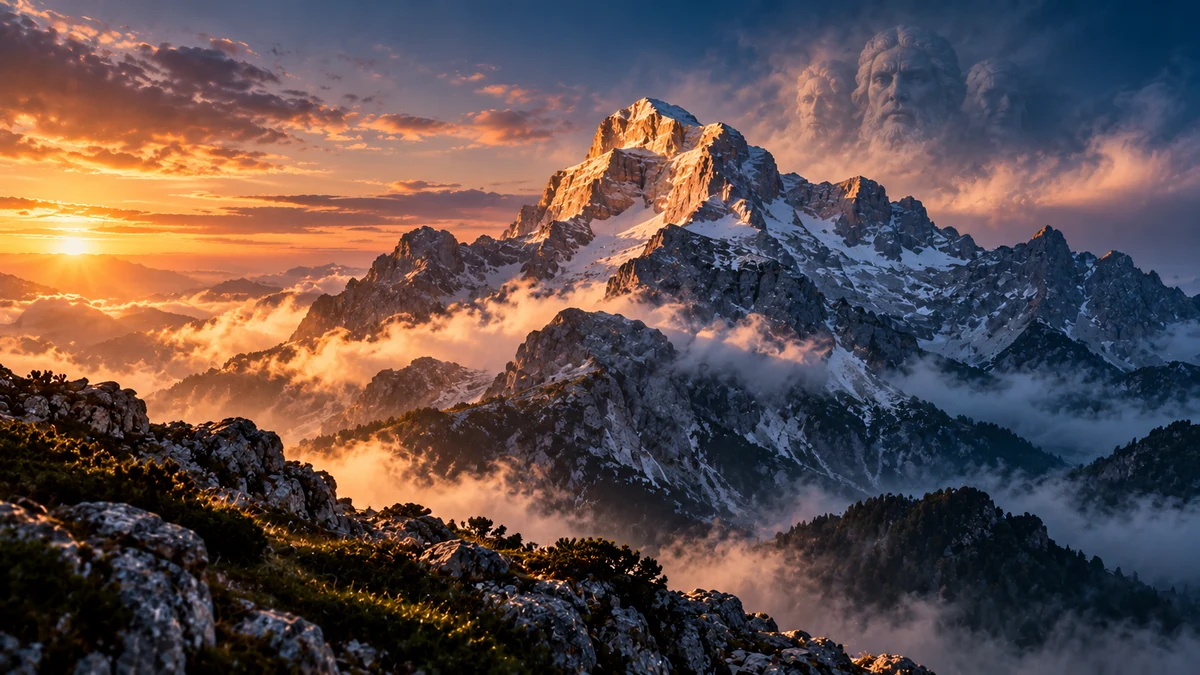
The name Triglav today almost automatically evokes Slovenia's highest mountain. Yet the same name also appears in medieval accounts of the pre-Christian religion of the Pomeranian Slavs on the Baltic, where an important sanctuary at Szczecin was dedicated to Triglav. Because the deity was described as three-headed and the mountain name transparently suggests “three heads,” the Enlightenment already produced the idea that the mountain had been named after the old god. The connection became culturally influential, but it is not supported at the same evidentiary level as either the mountain or the Pomeranian cult itself. [1][3][4][7]
The safest distinction is therefore threefold: the Pomeranian deity Triglav is historically documented; the Alpine mountain name Triglav is historically documented; but no direct pre-modern source demonstrates that the mountain in present-day Slovenia was a sanctuary of that deity or was originally named after him. Later historians, linguists, and ethnologists have interpreted this gap differently, ranging from a topographical etymology to the possibility of an older sacred connection. [5][6][7][8][9]
Triglav as a deity: what is actually recorded
The strongest body of evidence for the deity comes from the twelfth century and is connected with Bishop Otto of Bamberg's missionary journeys through Pomerania in 1124–1125 and 1128. His biographers Ebbo and Herbord describe Szczecin as a city with several sacred places and Triglav as a major or supreme deity of the local cult. Ebbo describes an image with three heads whose eyes and mouth were covered by a golden covering. [1][2]
These texts are not neutral ethnographic reports. They were written within a Christian missionary setting and aim to portray the victory of the new religion over the old. Even so, several related accounts converge on key details: Triglav, the triple head, the sanctuary at Szczecin, cult objects, and an association with divination. The existence of a local cult is therefore not reasonably treated as a late Romantic invention, although interpretations of its meaning still require source criticism. [1][2][3]
Three heads and three worlds
Ebbo reports that the priests explained the three heads as a sign of rule over three regions: heaven, earth, and the lower world. The covered face was said to mean that the deity did not look upon human sins or speak of them. This is one of the relatively rare cases in which a medieval source records not only the appearance of an image but also an indigenous explanation of its symbolism — though that explanation reaches us through a Christian author, so we cannot test how precisely he transmitted the priests' concepts. [1][2]
Modern reconstructions have connected Triglav with different tripartite cosmologies, the underworld, warfare, and other multi-headed Indo-European figures. Luka Trkanjec, for example, argues especially for a chthonic aspect of the Pomeranian Triglav. Such comparisons can be productive, but they are not direct testimony. The sources confirm three heads and a threefold sphere of rule; they do not establish a single pan-Slavic theology of Triglav. [3]
The black horse and divination
Herbord's tradition also associates Triglav with a sacred black horse that no mortal was permitted to ride. Before a military expedition, spears were laid on the ground and a priest repeatedly led the horse across them; the manner of its steps was interpreted as an omen for success or failure. Comparable forms of horse divination are known from other Baltic and Polabian cult centres. [2][3]
This detail matters because it shows that Triglav was not merely an abstract triple figure. The cult had institutional, political, and divinatory functions. Yet the very geographical specificity of the evidence limits later generalizations: the medieval descriptions concern Pomerania and related northern regions, not the Julian Alps. [1][2][3]
A missing link between Szczecin and the Julian Alps
The central difficulty in identifying the Pomeranian god with the mountain is simple: between the medieval testimony for the Baltic cult and the historical records of Alpine Triglav, there is no direct source stating that the mountain was dedicated to Triglav. No known medieval description of a temple, idol, rite, or local tradition unambiguously connects the peak above Bohinj with the deity described by Ebbo and Herbord. [5][6][7]
This does not prove that the mountain could not have had sacred significance before Christianization. Mountains can function as sacred places without a temple or written record. The evidentiary boundary is narrower: possible sacredness of the mountain is not evidence that it was named after the Pomeranian Triglav, and an identical transparent name does not by itself establish continuity of cult. [6][7][9]
How old is the mountain name?
The history of the mountain name itself is complex. Božo Otorepec noted that the word triglav appears in various contexts already in fourteenth-century sources, but as a name for the highest summit of the Julian Alps it is securely documented only at the beginning of the seventeenth century, in 1612 as Terglau. A 1744 map gives Mons Terglou, and in 1778 Hacquet's Oryctographia Carniolica published the oldest known depiction of the mountain. [5][13]
This is a fundamentally different kind of evidence from the medieval description of the deity. For the mountain, we are tracing the history of a geographical name; for the Pomeranian Triglav, we are tracing a cult and an image. The fact that the forms are related and semantically transparent is important, but it does not by itself tell us the direction or cause of naming. [5][6]
Do “three heads” describe the shape of the mountain?
The most common linguistic explanation connects the name with the compound tri + glava, “three heads,” understood as three summits or heads. The Alpine Association of Slovenia today summarizes the view that the name most probably refers to the shape seen from Bohinj and that derivation from the pre-Christian deity is less likely. Marko Snoj's etymological work likewise rejects a simple equation of the mountain name with the god. [6][11]
Even the topographical explanation, however, has attracted objections. The mountain does not display three equally obvious summits from every direction, and some nineteenth- and twentieth-century writers therefore argued that visible three-headedness could not account for the name. This helps explain why the mythological interpretation repeatedly returned. The mountain's appearance is not mathematical proof of an etymology, but it offers a natural linguistic explanation that does not require a lost cult. [7][8]

Linhart: when mountain and god explicitly met
The decisive historical moment in the connection can be dated fairly well. In his Versuch einer Geschichte von Krain und der übrigen südlichen Slaven Oesterreichs (1788–1791), Anton Tomaž Linhart described Triglav as a three-headed deity of northern Slavs and then wrote that Carniola's highest mountain seemed to derive its name from that deity. His wording is important precisely because it is cautious: he presents a hypothesis, not a preserved local tradition from the mountain itself. [4][5][7]
Linhart thus created a bridge not contained in the medieval sources themselves. Later writers often treated the possibility with increasing confidence, especially as Triglav became central to Slovenian historical and national identity. Here another story begins: no longer merely a question of etymology, but the cultural construction of the mountain's sacred and national meaning. [5][7]
The nineteenth century: when explanation becomes identity
Božidar Jezernik has shown how nineteenth-century debate over the origin of the name became entangled with the making of modern Slovenian national consciousness. Linking the mountain with an ancient three-headed god supplied it with a deeper pre-Christian past and made it a symbol of historical rootedness. Jezernik explicitly notes that the etymology does not confirm such a connection. [7]
The process also had a highly material dimension. Amid competition between Slovenian and German mountaineering organizations, Jakob Aljaž bought the summit in 1895 and erected his tower there. Triglav increasingly shifted from a natural landmark into a national sign; Plečnik used it as a symbol of Slovenes in 1934, a stylized three-peaked mountain became an emblem of the Liberation Front during the Second World War, and after independence it entered the national coat of arms. [5][12]

What about Old Faith testimony from western Slovenia?
Modern discussion does not end with Linhart. Monika Kropej Telban has highlighted traditions and research directions that take the possibility of deeper links among three-headed figures, landscape, and older belief more seriously. The 1322 lapis Triglaw, folk figures such as Trdoglav, and comparative tripartite structures have all entered the discussion. These materials show that triadic imagery is not limited to a single Pomeranian medieval account. [9]
At the same time, Pavel Medvešček's material from the Soča region demands special caution. It contains valuable testimony about nineteenth- and twentieth-century beliefs whose historical depth remains a subject of research and debate. Reviews of the material note Triglav as a sacred mountain but do not provide a simple direct demonstration that the same medieval deity known from Szczecin survived in the Soča region. Late traditions may preserve older layers, but their antiquity cannot be established by thematic resemblance alone. [8][10]
Mountain, deity, or a later connection?
The answer is therefore slightly paradoxical: all three are real, but not at the same evidentiary level. Triglav is a mountain with a documented history of its name. Triglav is also a historically documented pre-Christian deity of the Pomeranian Slavs. And Slovenian cultural tradition has indeed linked the two at least since Linhart. What remains unproven is that this cultural connection directly continues an ancient cult on the Slovenian mountain itself. [1][4][6][7]
That unresolved space is part of what made Triglav such a powerful symbol. The geographical name, the deity's three heads, the mountain's perceived triple form, an Enlightenment historical hypothesis, and later national symbolism accumulated layer upon layer. Historical method does not require us to erase any of them; it requires us to distinguish the documented Pomeranian deity, the documented history of the mountain name, and the later interpretation connecting the two. [5][7][8][12]
Sources and further reading
- Primary medieval biographical traditions on Otto of Bamberg; key evidence for Szczecin, the three-headed image, the three realms, and the Christianization of Pomerania. Source
- Early scholarly synthesis of Herbord, Ebbo, and Prüfening; useful for the temple, black horse, and later history of the cult. Source
- Modern scholarly analysis of the Pomeranian Triglav, the source base, and chthonic comparisons; an example of interpretation beyond the direct medieval testimony. Source
- Primary Enlightenment source for the explicit hypothesis that Mount Triglav may have been named after the three-headed deity. Source
- Historical review of early occurrences of the name, documentation of the mountain name from 1612, and the development of Triglav into a national symbol. Source
- Major etymological reference for Slovene geographical names; cited in scholarship for the view that equating the mountain name with the deity is unlikely. Source
- Key cultural-historical analysis of Valvasor’s Krma, Enlightenment exploration, Linhart’s connection, and the later nationalization of Triglav; explicitly notes that etymology does not confirm the divine link. Source
- Survey of competing explanations of the name, Linhart’s influence, literary representations, and the limits of Soča-region material for proving continuity of the deity. Source
- Represents a research direction that takes deeper links between three-headed figures and Slovene tradition more seriously; an important counterpoint to stricter etymological readings. Source
- Primary recorded corpus of Old Faith testimony from the Soča region in the nineteenth and twentieth centuries; important for sacred landscape, but not direct medieval evidence for a cult of Triglav. Source
- Institutional summary of the modern mountaineering interpretation of the name as “three heads” and the view that a derivation from the deity is unlikely. Source
- Recent overview of Triglav as a national symbol: mountaineering, the Aljaž Tower, Plečnik, and twentieth-century political symbolism. Source
- Public-domain historical visual source; the oldest known depiction of Mount Triglav, published in 1778. Source