Green George: Between a Spring Ritual, a Saint, and Older Tradition
Green George combines a spring procession, greenery, carolling, gifts, and St George. What is historically documented, what belongs to the Jarylo reconstruction, and how did the custom become a symbol of Bela Krajina?
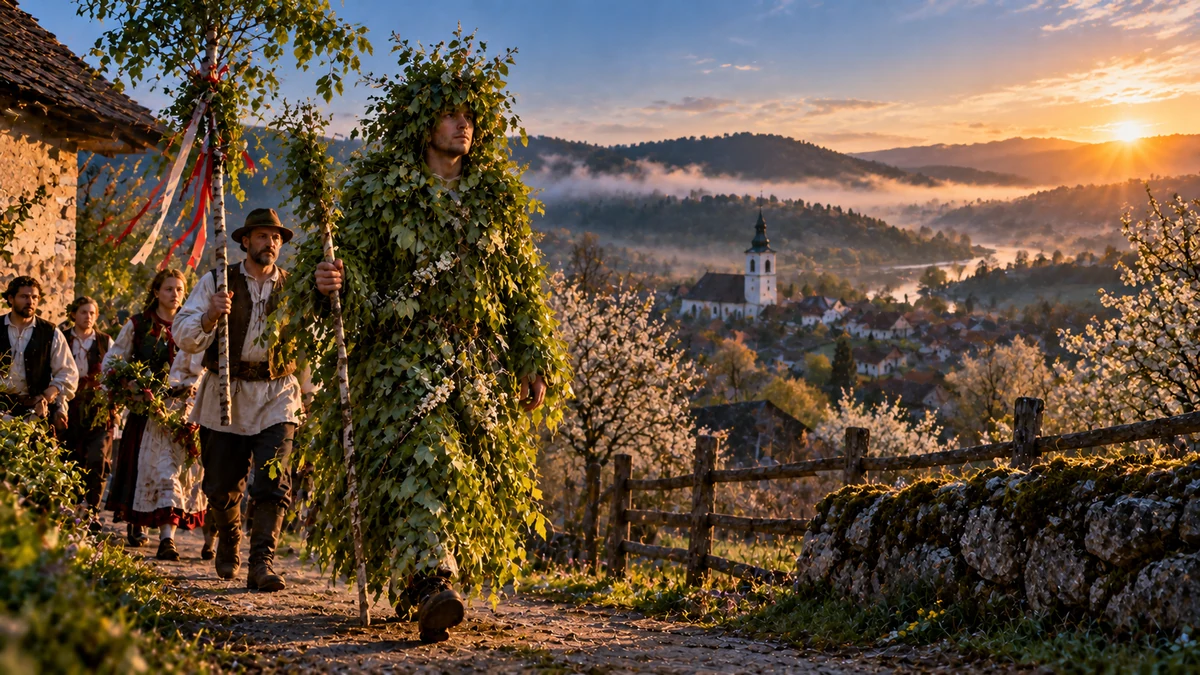
Green George is one of the most striking Slovene spring ritual figures: a person almost disappearing beneath fresh branches and leaves enters the village, a song announces his arrival, households give gifts, and the group continues on. Today he is closely associated with Bela Krajina and St George’s Day, but the historical sources reveal a much more branching story. [1][2][5]
A documented procession is not the same thing as a proven pre-Christian deity. Green George can be interpreted through the Christian feast of St George, the agricultural and pastoral calendar, older symbolism of greenery, and the comparative reconstruction of Jarylo. This article therefore does not force one comfortable explanation, but follows what the sources actually show — from Črnomelj around 1830 to today’s Jurjevanje festival. [2][3][4][8]
Who Is Green George?
Green George is a spring ritual figure in which a boy or young man is wrapped in fresh greenery and led through a village, often from house to house. In Bela Krajina, the accompanying groups sang carols, wished households a good year, and received eggs, bread, wine, grain, or other gifts. The firmest historical core of Green George is therefore a living spring custom, not a single definitive mythological explanation of its origin. [1][2][5]
Today the figure is most strongly associated with Bela Krajina, but historical records and visual material show a wider distribution of St George processions elsewhere in Slovene-speaking regions. Variants were not identical: in some places George was completely covered in birch greenery, elsewhere he carried a branch or small tree, in some versions he rode a white horse, and in others he was accompanied by shepherds, singers, or musicians. [2][7][11]
St George’s Day: a saint at the calendrical threshold of spring
St George’s Day falls on 23 or 24 April, a time when the traditional agrarian year reaches important transitions: vegetation accelerates, livestock move to pasture, and spring becomes economically visible. Green George is therefore connected in folklore both with the Christian saint and with strongly vegetational, pastoral, and calendrical symbolism. [1][2][4]
Later interpretations often linked St George’s combat with the dragon to the victory of spring over winter. Historically, however, there is no need to assume that every detail of the custom is a direct survival of one ancient myth. Christian feast day, agricultural calendar, local economy, and older symbolic patterns could overlap and reshape one another over centuries. [1][4][8]
Črnomelj around 1830: procession, tree, and water
One of the most valuable descriptions concerns Črnomelj around 1830. According to Johann Kapelle’s later account, published in 1839 and discussed in modern folklore scholarship, young people gathered after vespers; boys sounded bark trumpets and pipes, one participant carried a tree decorated with greenery, flowers, ribbons, and scarves, and behind it walked Green George wrapped from head to foot in birch leaves. A chorus of girls followed. [2][3]
When the procession reached the town, the tree was stripped of its decorations and Green George was taken to a bridge. The person was not thrown into the water; his green covering was. Later ethnological interpretation sees this as a symbolic removal of the old, of winter, or of accumulated misfortune and as a transition into a new vegetational season. It is important to separate the description of the action from the interpretation of its meaning. [2]
Bela Krajina did not have one single version
St George customs in Bela Krajina varied locally. In Adlešiči and Vinica, some accounts describe Green George riding a white horse and carrying a birch branch; elsewhere a boy was wrapped in greenery and led from house to house; other variants include a combat with Rabolj, interpreted as an opponent or personification of winter. [2][7]
This diversity is itself important evidence. Searching for one uniquely ‘original’ version would erase local history. Songs vary in their verses, gifts differ, costumes change, and some places emphasize the horse while others emphasize a leafy covering or ritual tree. Green George is a family of related practices, not a frozen script. [5][6][7]
What do greenery, tree, water, and horse mean?
The most visible element is greenery. Birch, fresh branches, flowers, and decorated trees bring the image of new growth literally into the rite. In some variants the green figure moves through the village or rides across the fields; in the Črnomelj account the greenery ultimately ends in water. All of this strongly supports interpretation of the custom as a spring transition and renewal. [2][8]
Yet symbolic plausibility is not the same as proof of antiquity. Trees, water, horses, and greenery are widespread ritual motifs and may acquire new meanings in different periods. They are therefore treated here as documented components of the custom, not as automatic proof that every modern form survived directly from pre-Christian times. [4][8][9]

The carol is part of the rite, not merely an accompaniment
The Green George carol is a practical component of the house-to-house round. It announces George’s arrival, describes his green journey, and then asks for gifts: pogača, wine, meat, eggs, grain, rye, buckwheat, and money. Many lines are built as playful rhymes whose function is less literal narrative than the rhythm of request, blessing, and exchange between visitors and household. [5][6][7]
Early records also make clear that the text was not transmitted as one immutable song. Primostek, Trebuče, Adlešiči, and other places preserve related but different verses. The full text in Primary Texts is therefore identified as one documented Bela Krajina variant, not the uniquely correct form of the Green George song. [6][7]
Jarylo: a powerful reconstruction, not direct local testimony
Comparative mythology frequently connects Green George with Jarylo or with a broader spring vegetation hero. Monika Kropej and other scholars identify motifs of return from the otherworld, spring fertility, the horse, combat with an opponent, and cyclical renewal in St George songs and customs. Šmitek places such connections within a wider comparative mythological framework. [8][9]
The evidentiary boundary must remain clear: there is no medieval Slovene source that directly names the Green George of Črnomelj or Adlešiči as Jarylo and describes the modern custom as his cult. The connection is a scholarly reconstruction based on comparisons among languages, songs, customs, and myths. It can be interpretively strong without being the same thing as direct historical testimony. [8][9]
Another explanation: pastoral economy and nineteenth-century change
Gorazd Makarovič proposed a much more social-historical explanation. St George’s Day was an important threshold in pastoral life, and the village herdsman visited farms as common grazing began, receiving food or gifts. As the institution of the communal herdsman weakened in the nineteenth century, groups of children or young shepherds may have taken over parts of the round, using the green mask as a recognizable sign of solicitation. [4]
This account does not prove that older symbolic layers were absent. It does demonstrate that a concrete ritual form can emerge or be strongly reshaped through changes in economy and village social organization. Green George is therefore a useful case in which mythological and social-historical explanations should be weighed according to their evidence rather than collapsed into certainty. [4][8]
From rite to stage — and from article to primary text
By the early twentieth century, some older Črnomelj forms of the custom had already been interrupted or transformed. A photograph from 1908 documents a public presentation of Green George, while in the 1930s folklorists and organizers deliberately reconstructed the Črnomelj rite from archival descriptions and oral recollection. In 1939 Green George was presented at a major folklore event in Črnomelj. [3][10][13]
In 1964, the Jurjevanje festival in Bela Krajina was established. Pisk and Kunej analyze this as a transition from ritual to organized folklore festival. This is not simply a story of ‘lost authenticity’: festivalization moved older material into a new social setting while also influencing which version became most visible. Green George today is simultaneously custom, reconstruction, staged heritage, and regional symbol. [3][12]
A representative opening from one early Bela Krajina version is sufficient for the ritual analysis here. Ivan Šašelj’s complete public-domain record, together with the THY-REALITY English translation, is published in Primary Texts. Because several variants are documented, it is not presented as “the one original” Green George carol. [6][7]

Sources and further reading
- Institutional overview of St George’s Day, Green George, the spring calendrical meaning, and the custom’s survival in Bela Krajina. Source
- Scholarly overview of Bela Krajina variants, the Črnomelj testimony around 1830, the white horse, Rabolj, and present-day enactment. Source
- Key modern source for the transition from local custom and 1930s reconstructions to the Jurjevanje folklore festival established in 1964. Source
- Important alternative account of the custom’s genesis, emphasizing pastoral institutions, the village herdsman, and nineteenth-century socioeconomic change rather than direct prehistoric continuity. Source
- Early public-domain ethnographic source for Green George and nineteenth-century St George’s Day tradition. Source
- Public-domain early record of Bela Krajina customs and the selected Green George carol reproduced in full in the article and Primary Texts. Source
- Comparative primary corpus of several St George carols from Primostek, Trebuče, Adlešiči, and elsewhere, showing that no single fixed text existed. Source
- Source for comparative-mythological interpretations of Green George, Jarylo, Rabolj, cyclical time, and spring renewal; treated as reconstruction rather than direct historical testimony. Source
- Comparative study linking combat motifs, vegetation cult, and Jurij/Jarylo; used to present the reconstruction and its evidentiary limits. Source
- Visual source for an early public depiction of a Green George group; public domain (PD-Slovenia). Source
- Public-domain visual source showing that the Green George procession motif was documented outside Bela Krajina as well. Source
- Contemporary local source for current St George’s Day practice in Bela Krajina; its interpretive claims about pre-Christian origins are separated from documented facts. Source
- Bibliographic corpus for early printed mentions and public-domain records of Green George and for checking the chronology of printed tradition. Source