Zlatorog: Between Folk Tradition, Literature, and Slovenian Myth
From Dežman’s 1868 record to Baumbach’s bestseller, the Triglav flower, the folkloristic authenticity debate, and Zlatorog as a symbol of Slovenia’s mountain world.
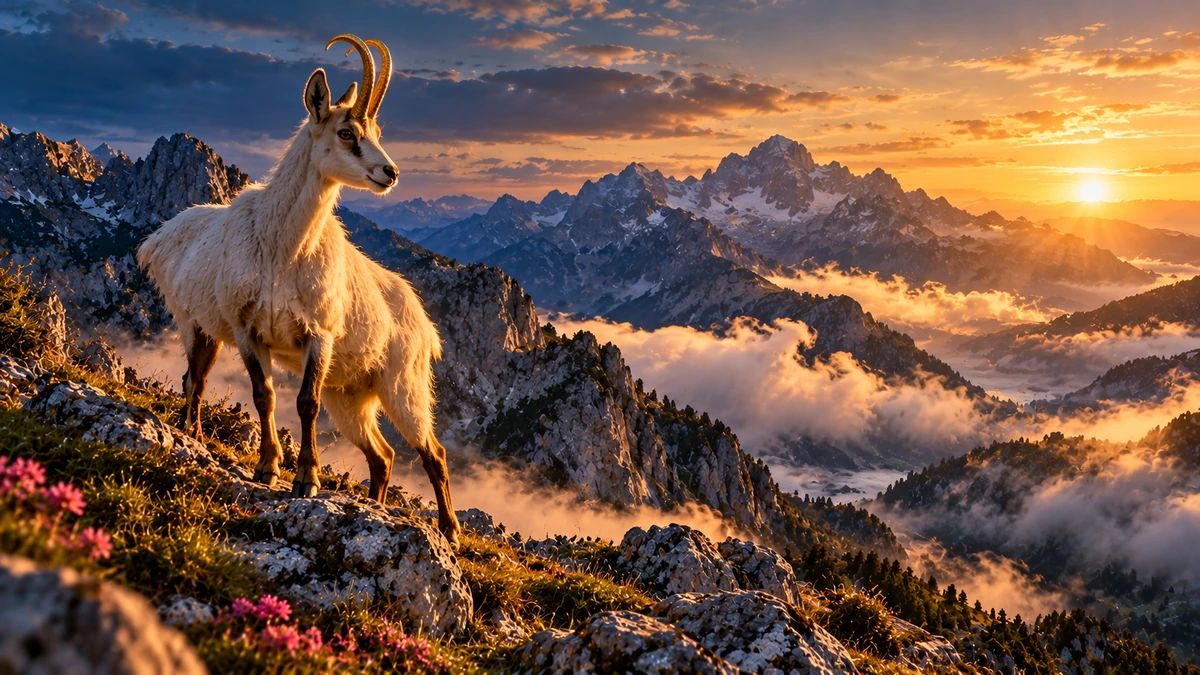
Today Goldenhorn, or Zlatorog, appears almost as the perfect Slovenian mountain myth: a white chamois with golden horns, the White Ladies, a hidden treasure beneath Mount Bogatin, the miraculous Triglav flower, and a hunter destroyed by greed. That coherence can make the story seem like an unchanged survival from a remote pre-Christian past. The textual history is more complicated. The earliest preserved written version was published by Karel Dežman in 1868, Rudolf Baumbach expanded it into a highly successful epic poem less than a decade later, and subsequent writers reshaped it again. [1][2][5]
This does not mean that Zlatorog was simply invented in 1868. Folklorists have documented related traditions about white chamois, golden hooves, mountain treasures, miraculous plants, and supernatural guardians beyond Dežman’s text. At the same time, Milko Matičetov argued that Dežman’s complete narrative bears strong marks of late Romantic construction. The safest model is therefore layered: folk motifs, the first recorded version, literary canonization, and the later cultural myth. [2][3][4]
1868: the earliest preserved record
On 21 February 1868 Karel Dežman published “Die Sage vom Goldkrikel (Zlatorog)” in the Laibacher Zeitung as part of an article on the Triglav glacier. Slovenska biografija explicitly lists the publication as the Zlatorog legend, while modern folkloristic scholarship treats it as the earliest preserved written version of the story. This is an important chronological boundary: at present, we do not possess an older text containing the complete narrative arc that later became canonical. [1][2]
Dežman presented the tale as material connected with the Bovec and Trenta oral tradition; later summaries preserve his claim that he knew it from old shepherds of the Bovec region. But “earliest record” does not necessarily mean a verbatim transcript of an oral performance. The printed narrative is already a shaped nineteenth-century text, produced in a period when educated collectors frequently edited, connected, and stylistically framed oral material. This is where the later debate begins over how much of Dežman’s complete version was heard and how much was constructed. [2][3]
What Dežman’s story already contains
The core that modern readers associate with Zlatorog is already present in Dežman. The Alpine paradise is inhabited by the White Ladies or Fates, benevolent beings who assist people and protect their mountain gardens. Their herd of white chamois is led by Zlatorog with golden horns. His horns open the way to the treasure beneath Mount Bogatin, while drops of his blood produce the miraculous Triglav flower that restores the wounded animal. A young hunter shoots Zlatorog, but the revived chamois causes his death on a dangerous ledge; the mountain paradise is then destroyed and the White Ladies depart. [2]
Later versions do not agree on every detail. Zlatorog is often visually represented as an ibex with massive curved horns, whereas Dežman’s narrative and the folkloristic literature generally identify him as a white chamois. Even this small difference shows how visual culture and repeated retellings can reshape a figure while its symbolic identity remains recognizable. [2][12]
Folk tradition or Romantic construction?
Milko Matičetov raised a sharp challenge to the authenticity of Dežman’s version in 1986–1987. In his view, the story in this complete form was a late-Romantic mystification with little foundation in genuine oral tradition. The warning matters because it prevents us from automatically treating a nineteenth-century publication as an intact pre-Christian myth. [3]
The discussion does not end there. Tone Cevc documented traditions in the Kamnik Alps about chamois with golden hooves, treasures, and mysterious mountain animals; Monika Kropej notes that related motifs have a wider distribution and that Matičetov’s rejection of the Zlatorog tradition may have been too categorical. Thus both “Dežman faithfully preserved an ancient myth” and “Zlatorog was wholly invented in 1868” are stronger claims than the evidence supports. [2][4]
Baumbach: when the tale became literature
The German poet Rudolf Baumbach encountered the Zlatorog material and wider Slovenian mythic lore through Viljem Urbas. At Bled in 1874–1875 he shaped the epic-lyric poem Zlatorog, published in Leipzig in May 1877. Its success was remarkable: Slovenska biografija reports that the various editions exceeded 110,000 copies by the mid-1930s. A regional tale had entered a much wider Central European cultural sphere. [5]
Baumbach was not merely copying Dežman. His version is strongly Romantic and expands the love plot, characters, and other motifs. Kropej specifically notes Jerica, Špela, and additional narrative elements that are not simply identical with Dežman’s record. The “classic” Zlatorog known today is therefore partly folklore and partly literary history. [2][5]
When Zlatorog returned to Slovene
Anton Funtek translated Baumbach’s poem into Slovene in 1886. His preface is a revealing historical document: he wrote that the Zlatorog tale still lived in the Upper Soča Valley and that the Fates, Čatež, Škrat, and other mythic figures would already be familiar to local readers. The translation therefore reveals an almost circular route: local tradition was printed in German, a German poet greatly expanded it, and the expanded literary form then returned to Slovene print culture. [6][7]
Anton Aškerc published his own Zlatorog: a folk tale from beneath Triglav in 1904. The story was no longer merely transmitted; Slovenian authors were actively using it to shape images of mountains, nature, and cultural belonging. By the beginning of the twentieth century Zlatorog had become a literary motif with several generations of authors, not simply the record of one local tale. [8]

The Triglav flower: a real plant, a miraculous function
One of the most memorable motifs is the flower that grows from the wounded Zlatorog’s blood and heals him. Modern Slovenian natural-history interpretation associates the Triglav flower with Potentilla nitida, a pink cinquefoil that grows on rocky and scree habitats in the Julian Alps. Triglav National Park today presents it as one of its symbols and explicitly notes its connection with the Zlatorog legend. [9][10]
The boundary between landscape and narrative is unusually visible here. The plant is real and its high-mountain environment is real, but a healing flower that springs from blood and instantly restores a wounded animal is a narrative motif. Folkloristic comparisons place it beside wider European and ancient stories of miraculous plants, yet motif similarity alone does not demonstrate an unbroken historical chain. [2][10]
The treasure beneath Bogatin and older echoes
Zlatorog’s horns are more than decoration: in the tale they are the key to the treasure beneath Mount Bogatin. Marjeta Šašel Kos has shown that Polybius and Strabo reported a rich gold deposit associated with the Taurisci and an unusual Alpine animal. This creates a suggestive historical background for later traditions about mountain gold and mysterious animals in the wider Alpine region. [13]
Caution is essential. Šašel Kos interprets the unusual animal in the ancient account as probably an elk, not as Zlatorog himself, and a vast chronological gap separates the classical sources from the nineteenth-century tale. Older parallels can show that motifs of gold, wild animals, and mountains did not arise in a vacuum; they cannot prove that an ancient author already knew the Zlatorog story. [13]
What related mountain traditions tell us
Across Slovenian narrative material, motifs associated with Zlatorog break down into smaller units: a chamois or stag with golden signs, a miraculous animal guarding treasure, an opening mountain, golden water, forbidden quarry, and punishment for greed. Cevc’s Kamnik Alps material is especially important because it shows that the motif of golden mountain game is not confined to Dežman’s single text. [4]
This may be the most useful way to understand the relationship between folklore and literature. Oral tradition need not have contained one canonical narrative with every scene now considered essential. A network of motifs and local stories could have existed from which a collector or poet shaped a more coherent narrative. Such a model allows individual motifs to be old without requiring us to treat Baumbach’s complete epic as an ancient folk text. [2][3][4]
From folktale to Slovenian cultural symbol
In the twentieth century Zlatorog moved beyond the book. In 1931 Janko Ravnik made V kraljestvu Zlatoroga (In the Kingdom of Goldenhorn), the first Slovenian silent feature-length film, or more precisely a pioneering feature-length docudrama. The film does not simply dramatize Dežman’s hunt for the magical chamois; “the kingdom of Zlatorog” becomes a name for the Slovenian mountain world and the journey toward Triglav. This is an important shift: Zlatorog becomes a symbol of place, not merely a character in a story. [11]
Triglav National Park uses a similar cultural language today, presenting its landscape as the Kingdom of Goldenhorn and including the legend within its interpretation of natural and cultural heritage. In this context Zlatorog acquires a further role: the broken taboo, greed, and lost mountain paradise can be read as a story about protecting nature. That is a legitimate and influential modern interpretation, but historically it remains distinct from the question of what shepherds told before Dežman. [9][11]
So what is Zlatorog?
If we ask whether Zlatorog is folk tradition, a literary figure, or a Slovenian myth, the most accurate answer is all three, but not at the same level. Independently documented folk motifs exist concerning miraculous mountain animals and treasures; in 1868 we obtain the earliest preserved complete Zlatorog narrative; Baumbach and later authors create a literary canon from it; film, mountaineering, and nature conservation transform the motif into a broader cultural sign. [1][2][4][5][11]
The least secure claim would be that the story as we know it today descends directly and unchanged from the pre-Christian period. It would be equally simplistic to say that Dežman invented it from nothing. Zlatorog is a good example of how myth actually lives: older motifs, local storytelling, a collector, a poet, translators, artists, and institutions collectively shape a story through time—one that can be older than any individual book version, yet younger than it first appears. [2][3][4][13]

Sources and further reading
- Primary bibliographic anchor for Dežman’s 1868 publication and its context within his article on the Triglav glacier. Source
- Main modern folkloristic synthesis of the tale, Dežman’s record, Baumbach’s adaptation, comparative motifs, and the authenticity debate. Source
- Key skeptical source treating Dežman’s complete version as a late-Romantic construction or mystification. Source
- Independent folklore material concerning chamois with golden hooves and related mountain motifs; an important counterweight in debates over the tale’s motif background. Source
- Source for Baumbach’s encounter with the material, composition at Bled, the 1877 publication, expansion of motifs, and exceptional circulation. Source
- Public-domain digitized copy of the first Slovene book translation of Baumbach’s poem. Source
- Primary text source for Funtek’s preface, the verse text, and the historical Slovene reception of the poem. Source
- Primary evidence for further Slovene literary reworking of the Zlatorog material at the beginning of the twentieth century. Source
- Official modern presentation of the canonical legend and its connection with the natural and cultural heritage of Triglav National Park. Source
- Institutional natural-history source for Potentilla nitida and its modern symbolic connection with Zlatorog’s blood. Source
- Official source for the 1931 film, its pioneering place in Slovenian film history, and the use of Zlatorog’s kingdom as symbolic mountain space. Source
- Modern mountaineering-historical review of the first publication, Baumbach’s popularization, and the iconographic chamois-versus-ibex question. Source
- Critical ancient-historical study of links among Tauriscan gold, an unusual Alpine animal, and later Zlatorog motifs; it does not simply identify the ancient animal as Zlatorog. Source