To the Soča — Simon Gregorčič: a prophetic poem between patriotism and the Isonzo Front
Gregorčič’s To the Soča praised the river’s beauty in 1879 and warned of a future storm from the south. When a front actually opened along the Soča in 1915, the poem acquired a prophetic reputation. This article separates the original poem, its political context, and later historical memory.
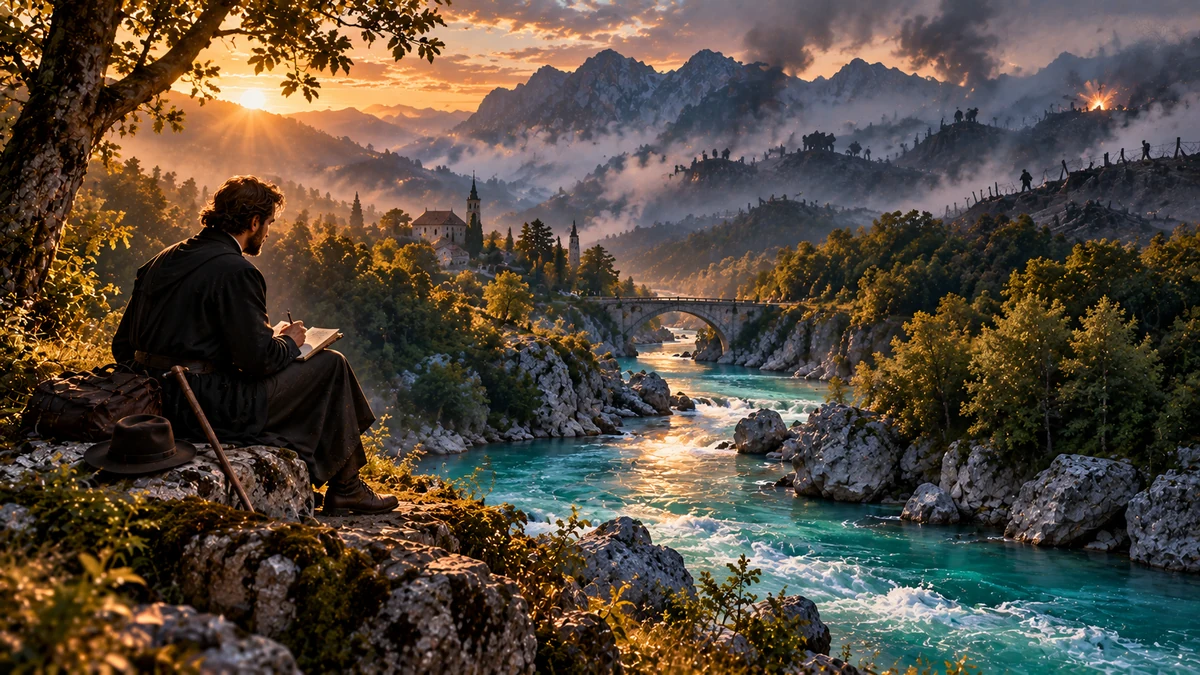
When Simon Gregorčič published To the Soča in 1879, its first movement was a hymn to one of the most beautiful rivers of his homeland. Then the tone changes abruptly: a storm from the south threatens the Soča, bringing metal, thunder, blood, and battle. In 1915 — almost thirty-six years later — a front opened along that same river. [1][2][6]
That unusual correspondence gave the poem its reputation as “prophetic.” Yet the interest lies in more than whether Gregorčič predicted the future. Equally important are what was politically imaginable in 1879, how the poem moves from natural beauty to national anxiety, and how the First World War changed the way later generations read it. [3][5][8]
1879: a hymn to a river that turns into a warning
To the Soča was first published on 1 August 1879 in issue fifteen of Josip Stritar’s literary journal Zvon. Gregorčič was already deeply connected with the Slovene Littoral and the mountain world of the Soča Valley; the river is therefore not a distant symbol but a homeland landscape addressed almost as a living being. [2][3][4]
The opening is an emphatic hymn to beauty: the Soča is clear, lively, blue-green, and inseparable from the mountains. Gradually, however, the tone changes. As the river leaves the highlands and approaches the plain, graves, grief, danger, and the anticipation of violence enter the poem. That internal turn is central to the poem’s later reputation as “prophetic.” [1][5] The shift already shows that Gregorčič uses natural imagery not merely descriptively but as a vehicle for emotional and historical intensification.

The complete poem — THY-REALITY translation
The Slovene original is in the public domain. The complete English text below is a THY-REALITY editorial translation of Gregorčič’s poem, prepared from the primary Slovene text and prioritising meaning and imagery over reproducing the original rhyme scheme. [1] For uninterrupted reading, the Slovene original and the complete THY-REALITY translation are also available in Primary Texts.
The Soča as river of home and border of memory
Gregorčič personifies the river. The Soča listens, feels, carries greetings from the mountain homeland, and changes with the landscape. In its upper course it is playful and free; farther downstream it becomes slower and more sorrowful. The poet links it with the “graves of the Slovene homeland,” giving a natural image historical and national meaning. [1]
This joining of landscape and community belongs to the wider European Romantic and post-Romantic national poetry of the nineteenth century. The river is not merely geography but a bearer of memory, language, and belonging. For that reason later historical events could fill its verses with meanings that a reader in 1879 could not yet have known. [4][5] The landscape thus becomes a shared archive in which personal memory of home merges with the idea of a historical community.
From beauty to war: the “storm from the south”
The poem’s most famous turn comes when Gregorčič warns the Soča of a future “storm” arriving from the south. The sky is still clear, yet the language shifts toward metal, blood, tears, thunder, and battle. The river is imagined as a future battlefield, its waters running beside the blood of defenders and enemies. [1]
The geographical direction is especially striking: danger comes from the south and moves across the plain along the river. When Italy entered the war against Austria-Hungary in May 1915 and a front opened precisely along the Soča, that detail acquired extraordinary retrospective force. Almost thirty-six years separated the poem’s publication from the opening of the front. [2][6] The effect is stronger because the warning arises from almost pastoral beauty rather than from a scene that is martial from the outset.
What could already be imagined in 1879?
The year 1879 was not politically empty. The Tolmin Museum’s chronology of Gregorčič notes the founding in 1878 of the Italia irredenta movement, which counted parts of the Slovene Littoral among Italy’s “unredeemed” lands. Gregorčič therefore wrote in a border region where national boundaries, language, and political belonging were already live questions. [3]
That context does not fix a single meaning for the poem’s storm from the south. It may be read as patriotic warning, as a response to political tension on the western border, as a general image of future war, or — with knowledge of 1915–1917 — as a remarkably precise intuition. Historical context mainly shows that conflict arriving from the south was not wholly unimaginable in Gregorčič’s own time. [3][5]
1915–1917: when poetic imagery became a front-line landscape
After Italy entered the First World War in May 1915, a new front opened along the Soča. Fighting stretched from the high mountains above Bovec and Tolmin through the Gorizia region to the Karst and the Adriatic. Slovene civilians faced mobilisation, displacement, shortages, and the direct consequences of war. [6][7]
The Kobarid Museum describes twenty-nine months of fighting along the Soča. The period saw repeated major offensives, artillery bombardment, mass troop movements, and enormous losses. A landscape that Gregorčič had rendered through water, mountains, and plains thus became one of the most heavily militarised zones in this part of Europe during the First World War. [7] The valley’s direct transformation into a battlefield later allowed readers to compare the poem’s metaphors with actual images of the front.

Why the label “prophetic poem” has proved so durable
A later reader can easily recognise a sequence that resembles collective memory of the Isonzo Front: a peaceful river, danger coming from the south, metal and thunder, blood along the Soča, and defence of the homeland. Because it combines universal images of war with unusually concrete geography, the poem came to be read almost as an advance description of later events. [1][5]
That reception appears in museums and education as well. The Museum of Contemporary History of Slovenia explicitly links Gregorčič with anticipating fighting along the Soča in educational material, while the Encyclopedia of Romantic Nationalism in Europe notes that part of the poem’s popularity derives from what is regarded as its prophetic quality. [5][6] In that reading the poem is not only a nineteenth-century literary document but also part of how a community later understood its own wartime experience.
Prophecy, political intuition, or the power of hindsight?
The word “prophetic” can mean several things. Culturally, it describes a striking correspondence between poetic imagery and events that came later. Historically, however, there is no document showing that Gregorčič knew the concrete scenario of a world war, Italy’s decision in 1915, or the future course of the front. [2][3][6]
There is no need to reduce the poem to a single verdict between those possibilities. The poet knew the borderland and the tensions of his age; at the same time he drew on a universal language of war and patriotic defence. Later history gave those images an almost literal geography. The combination of political intuition, poetic symbolism, and retrospective memory helps explain why the phrase “prophetic poem” remains so compelling. [3][5] The question therefore remains historically and literarily interesting even when documented political foresight is distinguished from broader ideas of prophecy.
After the First World War: the poem in school and national memory
Gregorčič was already popular during his lifetime, and the first volume of his Poezije in 1882 achieved exceptional success. Yet the canon familiar today did not emerge all at once. Research on Gregorčič in secondary-school readers shows that several poems now considered central, including To the Soča, became firmly established in educational selections only in the early twentieth century or after the First World War. [4][8]
The Isonzo Front therefore also shaped the way later generations read the poem. Verses that were patriotic and visionary poetry in 1879 acquired a direct memorial framework after the war. The poem came to join the natural beauty of the Soča Valley with a historical wound, strengthening its place in Slovene cultural memory. [5][8]
Two Sočas: clear daughter of the mountains and river of wartime memory
The poem’s durability lies in a duality built into its structure from the beginning. The Soča first appears as almost ideal nature: clear, green, blue, and free. The same river then becomes a place of graves, danger, and war. Beauty and threat are not two different poems but two layers of the same landscape. [1]
After 1915, that duality gained a new historical reality. The Soča remained one of Slovenia’s most recognisable natural images while also becoming a river of memory for the front. To the Soča therefore matters for more than the question of whether it was a “prophecy.” It shows how a poem can meet history decades later in a place that poetry had already transformed into a symbol. [5][6][7] In that sense the river connects three times: Gregorčič’s present, the future war, and the memory of generations that read the poem afterward.
Sources and further reading
- Primary text of the poem; Wikisource explicitly marks it as public domain in Slovenia. Source for the complete Slovene reproduction and the THY-REALITY English translation. Source
- Primary bibliographic record for the 1 August 1879 issue of Zvon in which the poem first appeared. Source
- Gregorčič’s productive year 1879, publication of Soči, and the broader political context of Italian irredentism from 1878. Source
- Biography, development of Gregorčič’s poetry, and publication of the first volume of Poezije in 1882. Source
- International literary-historical record of the poem, its 1879 date, canonical status, and later “prophetic” reception. Source
- Official historical context for the opening of the Soča Front in 1915, its effects on civilians, and fighting along the river. Source
- Chronological framework for 29 months of fighting on the Soča Front and the relation between the local landscape and the wider world war. Source
- Reception of Gregorčič in the school canon; Soči became more firmly established among central texts especially in the early twentieth century and after the First World War. Source