Kurent: From Ritual Figure to Symbol of Slovenia
From Shrovetide ploughing groups and village rounds to Kurentovanje and UNESCO: what can be historically established about Kurent, and where do origin hypotheses begin?
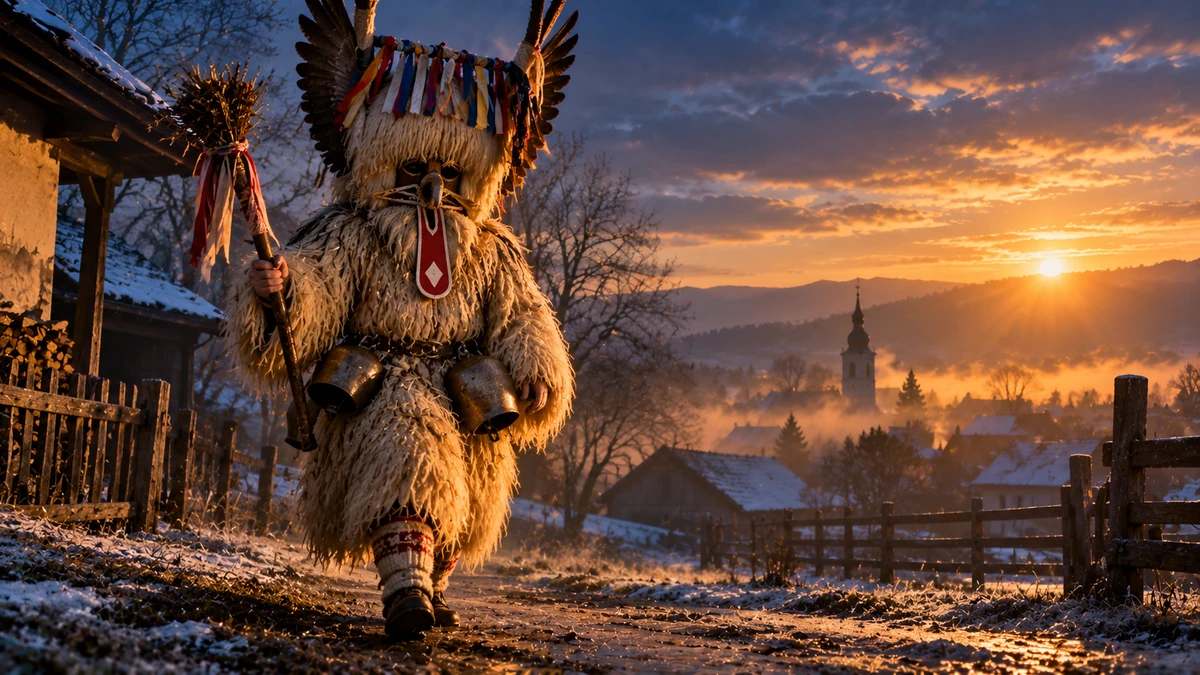
Today the Kurent is one of Slovenia’s most recognizable Shrovetide figures: sheepskin, heavy cowbells, a long red tongue, the hedgehog-stick, and a forceful dance that is heard before it is seen. Door-to-door rounds of Kurenti have been on UNESCO’s Representative List of the Intangible Cultural Heritage of Humanity since 2017, while Slovenia had already declared the custom heritage of national importance. [3][4][5]
Precisely because the figure now carries such symbolic weight, its history has to be separated into layers. The documented Shrovetide custom of the Lower Drava region is not the same claim as a hypothesis about an ancient deity, the modern Kurentovanje festival is not identical to a nineteenth-century village round, and UNESCO inscription does not prove a pre-Christian origin. The clearest picture emerges when ritual figure, local tradition, ethnological interpretation, folklorization, and modern national symbolism are kept distinct. [1][7][12][13]
Kurent or Korant?
The Slovene Ethnographic Museum notes that both names are used. Kurent spread especially strongly from the 1960s through media and the urban Kurentovanje festival, while korant is again emphasized in parts of the rural home environment. The distinction is therefore more than spelling: it also records how a local custom became a widely recognized cultural phenomenon. [1]
The etymology is not settled either. Marko Snoj lists several proposals but considers none fully conclusive; one plausible direction links the word with a Romance base related to Latin currere, “to run,” and to a term for a runner, messenger, or young servant. He also explicitly rejects the assumption that the name itself proves an ancient deity. The word alone does not establish a divine genealogy for the figure. [6]
What Can Actually Be Dated
According to the Slovene Ethnographic Museum, independent rounds of Kurenti are documented especially from the second half of the nineteenth century, above all in Markovci and nearby villages. Andrej Brence’s study of traditional Shrovetide figures also reproduces a detailed description by Matej Slekovec from the parish chronicle of St Mark below Ptuj: a shaggy cap, leather face, long red tongue, horns, sheepskin, bell, and hedgehog-stick. [1][10]
An official presentation by the Republic of Slovenia gives 1880 as an early documentation point, but such dates are best treated as the period of the first well-attested appearances rather than the “birth” of Kurent. The custom may be older than surviving records; what we do not possess is an uninterrupted documentary chain leading the modern figure directly back to antiquity or an unspecified pre-Christian age. [13]
Kurent Was Part of a Larger Shrovetide Group
Today Kurent is often imagined as a self-contained figure, but the older village context was broader. The Slovene Ethnographic Museum describes Kurenti as ploughmen and companions of the Shrovetide ploughing groups. At a homestead the leading Kurent first asks permission to plough; a whip-cracker announces the group, “horses” pull a decorated plough, the ploughman cuts a symbolic furrow, a collector sows seed, and Kurenti jump and make noise with their bells. [2]
This context matters because it shows that the figure did not exist in isolation. The rite is tied to the homestead, field, gifts, and the coming harvest. Symbolic ploughing and sowing are directly documented parts of the custom, so an association with renewal and fertility can be understood without claiming that we know Kurent’s supposed ancient predecessor. [1][2]
Sheepskin, Bells, and the Hedgehog-Stick Are Not Frozen in Time
A modern kurentija is instantly recognizable: long-haired sheepskin, a chain with large cowbells, high boots, knitted leg warmers, a mask or headpiece, and the hedgehog-stick. The museum distinguishes feathered and horned forms according to the headpiece. Older costumes were much less standardized; young men assembled them themselves from available hides, old leather, and household materials. [1][10]
This is a clear example of living tradition. Modern costumes are often made by specialized craftspeople and have become more standardized through folklorization, public performance, and craft production. That does not make them “fake”; it means that the material form of the heritage changed together with its social setting. [1]
What Is Kurent Supposed to Do?
In contemporary local tradition and official descriptions, bell-ringing, jumping, and house-to-house rounds are associated with driving away evil and bringing happiness, a good year, and spring. In the ploughing groups the purpose is even more concrete: symbolic ploughing and sowing point toward a successful harvest. Slovenia’s heritage register therefore describes the rounds as a Shrovetide custom in which Kurent is believed to drive away winter and invite spring. [1][2][3]
Yet “driving away winter” is primarily an interpretation of the custom’s meaning, not a historically testable function that can be followed unchanged for millennia. Ethnologically, the more secure point is that communities today understand the rounds as acts of good transition, luck, fertility, and renewal. That is documented; how far each individual meaning reaches into remote antiquity remains open. [1][3]

Was Kurent Once a Deity?
This is where the genuine scholarly dispute begins. Milko Matičetov warned against automatically fusing the folktale Kurent, the Shrovetide Korant, and a reconstructed deity into one ancient figure. Marko Snoj is even more direct in his etymological dictionary: in his view Kurent is not an ancient Slavic deity, and the folktale hero must be distinguished from the later name of the Shrovetide mask. [6][7]
Another research tradition allows for an older mythic layer. Monika Kropej connects Kurent with flood stories, the moon, fertility, and renewal of the earth, while Slavko Ciglenečki proposed comparisons with the Late Antique cults of Cybele and Attis and their attendants. These are serious scholarly hypotheses, but they remain reconstructions and comparisons, not a direct record that people of the Lower Drava region in antiquity worshipped the same Kurent who now goes from house to house. [8][9]
From a Young Men’s Mask to Women and Children
Until the second half of the twentieth century, according to the museum, kurentija was worn mainly by adult young men. Today many groups include married men, women, and children. UNESCO accepted this change as a normal feature of living heritage: the nomination process explicitly noted that a practice once performed only by men had expanded to women and children and that this did not conflict with safeguarding intangible heritage. [1][11]
At the same time, local practice is not uniform. Some communities retain stricter rules concerning who may wear the costume and how it should look. It is therefore misleading to speak of one single “correct” modern performance. The heritage is a network of local communities that transmit, interpret, and partly reshape the tradition. [11]
1960: Kurent Leaves the Village for the Town
A major turning point came in 1960, with the first organized Kurentovanje in Ptuj. The Slovene Ethnographic Museum explicitly notes that the event strongly influenced the appearance and behavior of Kurenti and that from the 1960s they increasingly performed outside their home villages. The name “Kurent” also spread through the media. [1]
Aleš Gačnik and later discussions of folklorization describe the development as a shift from a one-day ethnographic event toward a multi-day festival suspended between rural tradition, urban carnival, tourism, and spectacle. This was a major transformation, not necessarily a loss. Kurentovanje made a local ritual figure nationally and internationally visible, while also changing the conditions in which people encountered it. [12]
From the National Register to UNESCO
Door-to-door rounds of Kurenti entered Slovenia’s Register of Intangible Cultural Heritage in 2012. In December 2015 the state declared them intangible cultural heritage of national importance, and in 2017 UNESCO inscribed them on the Representative List of the Intangible Cultural Heritage of Humanity. [3][4][5]
The UNESCO documentation is revealing: it emphasizes transmission in families, associations, schools, and museums, community identity, and the continuous recreation of the custom. UNESCO safeguards a living practice and its bearers; it does not decide whether Kurent is two thousand years old, nor does it validate a particular mythological theory of origin. [4][11]
How Kurent Became a Symbol of Slovenia
As the village figure began appearing in Ptuj, across Slovenia, and abroad, it gradually moved beyond its original regional setting. An official government presentation now explicitly describes Kurent as one of the symbols of Slovenian identity, while Kurentovanje places the figure at the center of the country’s best-known Shrovetide event. [12][13]
Its history, however, shows that a symbol is not the same thing as a fossil. Kurent can simultaneously be a traditional figure of the Lower Drava region, part of ritual ploughing rounds, the subject of competing mythological interpretations, an urban carnival protagonist, UNESCO-listed heritage, and a modern sign of Slovenia. Its strength does not depend on proving one unchanged story from antiquity to the present, but on the way the tradition has remained recognizable through change—as a relationship among community, season, body, sound, and place. [1][4][12]

Sources and further reading
- Core museum source for the custom’s region, Kurent/Korant terminology, development of independent rounds, changes in costume, feathered/horned forms, bearers, and the influence of Kurentovanje. Source
- Institutional source for Kurent within Shrovetide ploughing groups, symbolic ploughing and sowing, bells, the hedgehog-stick, and harvest symbolism. Source
- Official register source for the 2012 inscription, geographic scope, and classification of the custom as a social practice, ritual, and festive event. Source
- Primary UNESCO document for the 2017 inscription, the rounds, bearers, transmission of knowledge, and social role. Source
- Official act declaring the rounds intangible cultural heritage of national importance in 2015. Source
- Etymological source for name variants, uncertainty of origin, and Snoj’s skeptical distinction among the folktale Kurent, the Shrovetide mask, and a supposed deity. Source
- Key skeptical folkloristic source for distinguishing the mythic figure, folktale hero, and Shrovetide Kurent. Source
- Archaeological-comparative hypothesis connecting Kurenti with Late Antique cults of Cybele and Attis; used as a hypothesis, not proof of direct continuity. Source
- Comparative source for Kurent in flood, lunar, fertility, and earth-renewal traditions and for the debate with Matičetov/Kretzenbacher. Source
- Ethnological-historical source reproducing Slekovec’s older description of Kurent and documenting changes in costume materials and form. Source
- Source for the nomination methodology, expansion of bearers to women and children, and UNESCO’s understanding of intangible heritage as continuously recreated practice. Source
- Overview of Kurentovanje’s development between rural tradition, urban carnival, tourism, and modern cultural presentation. Source
- Official modern source for Kurent as a recognizable symbol of Slovenian identity and an early documentation point around 1880; its stronger mythological claims are not used as proof. Source