Joshua’s conquest of Canaan and archaeology
Jericho, Ai and Hazor became tests of the historicity of Joshua’s conquest. What do destruction layers, ruins and the emergence of early Israel actually show?
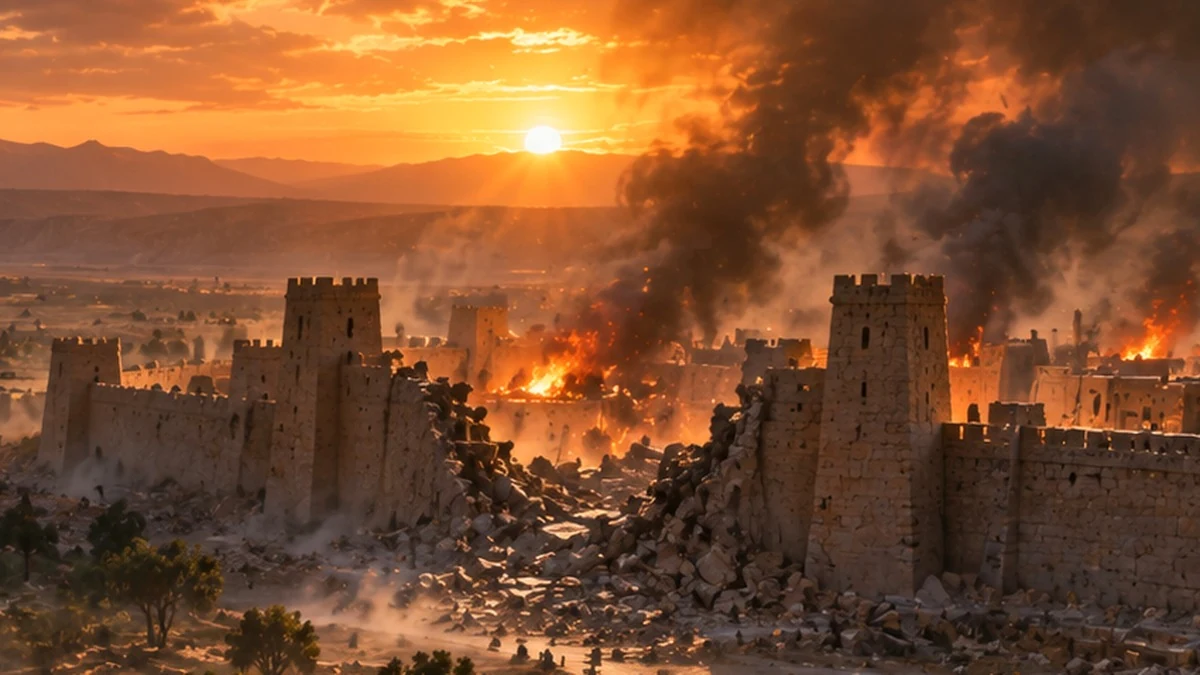
The book of Joshua presents the conquest of Canaan as a sequence of decisive military victories: Jericho falls after the city is encircled, Ai is taken by ambush, southern and northern coalitions are defeated, and Hazor is burned. If the narrative is read as a report of a short, coordinated campaign by a unified Israel, archaeology offers a concrete test: did the key cities exist at the same time, were they destroyed then, and can their destruction layers be linked to one historical event?
The answer is not simple. Jericho really has a spectacular destruction horizon, but the fortified Bronze Age city, in most chronologies, fell centuries earlier than required by a late conquest model. At Ai the problem is sharper if the site is identified with et-Tell: its great Early Bronze Age city had long been a ruin by the period in which Joshua is normally placed. Hazor is the opposite case — a major Late Bronze Age city there really did suffer violent burning and collapse.
Yet one genuine destruction layer does not establish an entire campaign. At Hazor archaeology by itself does not tell us who destroyed the city. Amnon Ben-Tor has argued for an Israelite attack, while Sharon Zuckerman developed from the same site a model of internal social collapse and ritualized destruction. Elsewhere in Canaan, destruction episodes belong to different decades and to different political crises of the late thirteenth and twelfth centuries BCE.
This article therefore does not ask whether archaeology has 'proved' or 'disproved' Joshua as a person. It tests a narrower and more measurable claim: whether the material record supports a single, rapid, nearly complete conquest of Canaan. It then separates that question from the possibility that the narrative preserves real memories of individual battles, destroyed cities, and the much longer emergence of Israel in a world that was genuinely changing rapidly at the end of the Bronze Age.
What does the conquest narrative actually claim?
Joshua 6–11 does not describe one battle but a literarily shaped sequence: Jericho is the first major city after the Jordan crossing; Ai is taken by ambush after an initial defeat; campaigns then follow against southern and northern kings. Joshua 11 specifically says that Hazor was burned, while many other cities were not. This matters because archaeology should not expect an identical burn layer at every city mentioned in the book.
At the same time the book uses sweeping language of victory: the land is taken, kings are defeated, and organized Canaanite resistance is broken. Yet within the same book there remains 'very much land' to possess, and Joshua 13–19 describes territories and populations not under complete Israelite control. The book itself is therefore not a one-dimensional military report.
Judges 1 adds a slower, incomplete and regional picture: many Canaanite communities remain in place and individual tribes fail to dispossess them. The literary relationship between Joshua and Judges is complex, but the texts themselves already warn us that 'conquest' is not one simple chronicle.
Jericho: a real destruction, but the wrong time for a late conquest
Tell es-Sultan is securely identified as ancient Jericho, and the site experienced several destructions over its long history. Its best-known Bronze Age catastrophe includes fire, collapsed structures, and abandonment of a fortified city. These features long encouraged attempts to connect the layer with Joshua.
The problem is chronology. Radiocarbon measurements on short-lived cereal samples from Kenyon's destruction contexts place the end of fortified Middle Bronze Jericho in the late seventeenth or, more probably, the sixteenth century BCE. This does not support a destruction in the thirteenth century BCE, when many historical models would place the emergence of early Israel in Canaan. For that period there is no evidence of the large walled city required by the most literal reading of Joshua 6.
Minority reconstructions date some of the Jericho evidence later, around 1400 BCE, and emphasize correspondences between the mode of destruction and the biblical story. Those views should not be hidden, but they are not the dominant chronological interpretation. The safest conclusion is narrower: Jericho has genuine destruction layers, but their identification with Joshua's campaign is not an archaeologically established fact.
Ai: the sharpest problem if the city is et-Tell
Ai in Joshua 7–8 is a second crucial test because the story is unusually concrete: the town is inhabited, has a king, an army and a gate, and is then burned and turned into a ruin. The most common traditional identification places it at et-Tell east of Bethel.
The archaeology of et-Tell is difficult for that reconstruction. A large fortified city flourished there in the Early Bronze Age and was destroyed in the third millennium BCE; during the Middle and Late Bronze Ages, when normal conquest chronologies would require Joshua's Ai, there was no comparable Canaanite city. Iron Age settlement appears only later. If et-Tell is indeed biblical Ai, the gap between text and site is severe.
Defenders of a historical conquest therefore propose alternative sites, especially Khirbet el-Maqatir, where Late Bronze remains and a burn horizon have been reported. That is a legitimate hypothesis to test, not a settled solution. The identification is not generally accepted and also depends on an early conquest chronology. It is therefore fair to say that the 'Ai problem' remains partly a site-identification problem — but at et-Tell the material record does not fit Joshua's narrative.
Hazor: here the fire is real — who caused it?
Hazor is the strongest individual case where archaeology and Joshua genuinely touch. In the second millennium BCE it was the largest urban center in Canaan. At the end of the Late Bronze Age it suffered a violent conflagration and collapse, after which its lower city was not rebuilt. Joshua 11, meanwhile, singles out Hazor as the city Israel burned.
But evidence that 'Hazor burned' is not the same as evidence that 'Joshua burned Hazor.' Amnon Ben-Tor has argued, by eliminating other candidates and considering iconoclasm together with the biblical testimony, for an Israelite attack. Sharon Zuckerman interpreted the same destruction horizon as the climax of an internal political, social and ideological crisis in which the city's own inhabitants played a major role.
Recent microarchaeological work confirms a major, single fiery collapse in the Late Bronze gate, but ash cannot identify the ethnicity of its destroyers. Hazor therefore illustrates a methodological boundary: archaeology can establish with high confidence that a catastrophe occurred; it is much harder for the material alone to say who caused it and whether a specific literary narrative is its direct historical description.
There is no single destruction horizon for a Joshua campaign
Older models of biblical archaeology hoped to trace a shared horizon of destroyed Canaanite cities and connect it with one Israelite military wave. The picture is now much more fragmented. Hazor, Lachish, Megiddo, Azekah and other centers have different stratigraphic histories, and their destructions are not all the same date.
The end of the Late Bronze Age was a wider eastern Mediterranean crisis: Egyptian control over Canaan weakened, some city-states collapsed, groups associated with the 'Sea Peoples' appeared along the coast, trade networks changed, and new communities formed inland. A burn layer at one tell can therefore have several plausible historical causes.
Radiocarbon sequences from sites such as Tel Azekah show why different destructions should not be compressed artificially into one year or one decade. Archaeology supports an era of major upheaval, not a simple synchronous map of cities falling in a single Joshua campaign.

The highlands: Israel's emergence looks more like a process than an invasion
The most important archaeological shift around the late thirteenth and twelfth centuries BCE is not a cluster of burned cities but a rapid increase in small settlements in the central highlands. In roughly the same broad period as Merneptah's reference to Israel, a landscape of new villages emerges that is later associated with early Israel.
The material culture of these communities continues Canaanite traditions in many respects. Modern models therefore often speak of ethnogenesis: various local groups, pastoralists, former residents of lowland cities, and perhaps smaller incoming groups gradually shaped a new identity. This is not the same as saying that no one ever came from outside or that no military conflicts occurred.
But this pattern is difficult to reconcile with the idea that a fully formed nation entered from outside and replaced most of Canaan's population in a short period. It fits better with a gradual transformation of Canaanite society in which warfare, migration, alliances and local collapses were only parts of a larger process.
From local wars to a national story
If archaeology does not confirm one complete campaign, it does not follow that every war in Joshua is literary invention without historical background. Late Bronze and early Iron Age Canaan was politically unstable, and military conflict was real. Hazor's destruction is the clearest reminder that some narrative motifs stand next to genuine catastrophes.
The question is how such memories were organized. Joshua is a theologically and literarily shaped book concerned with possession of the land, covenant loyalty, and the consequences of disobedience. Modern biblical scholarship notes that the book contains different conceptions of how complete the conquest was and that its final form addresses much later questions of identity, land and religious loyalty.
A historically plausible mechanism is therefore one in which different local wars, destroyed cities, migrations and memories of heroes were later organized into a national story. That is a historical reconstruction, not a magic solution to every inconsistency, but it fits the diversity of the textual and archaeological evidence better than a model of one nearly complete lightning conquest.
Conclusion: archaeology does not erase Joshua — it erases an overly simple model
The safest conclusion is that archaeology does not currently support a strictly literal model in which a unified Israel conquered most of Canaan in a short campaign corresponding to the most summary reading of Joshua 6–11. Jericho and Ai present major chronological problems, destructions elsewhere are not synchronous, and Israel's material emergence looks above all like a process within the Canaanite world.
At the same time archaeology does not prove that there was no historical Joshua, no Israelite warfare, or no external component. Hazor really did undergo catastrophic burning; the region was full of military and social disruption; and memories of individual conflicts could have survived and expanded in later narrative.
A better question than 'Did Joshua really conquer Canaan?' is therefore: which layers of the book of Joshua can be connected with real places and crises, which represent later literary organization of those memories, and where do we simply lack evidence? A historically serious discussion begins precisely in the distinction between a destroyed city, the identity of its destroyer, and the later meaning assigned to the event.
Sources and further reading
- Bible Gateway — Joshua 6, NRSVUE: Jericho narrative and burning of the city
- Bible Gateway — Joshua 7–8, NRSVUE: Ai narrative, ambush and burning
- Bible Gateway — Joshua 10–11, NRSVUE: southern/northern campaigns and burning of Hazor
- Bible Gateway — Joshua 13, NRSVUE: 'very much land' still remaining
- Bible Gateway — Judges 1, NRSVUE: incomplete dispossession and continued Canaanite settlement
- Ann E. Killebrew — ‘Early Israel’s Origins, Settlement, and Ethnogenesis,’ Oxford Handbook of the Historical Books of the Hebrew Bible (2020)
- Avraham Faust — ‘The Birth of Israel,’ The Oxford History of the Holy Land (2023)
- Victor H. Matthews — ‘Settlement and Competition in Iron Age I Canaan,’ The History of Bronze and Iron Age Israel (Oxford, 2018)
- David M. Carr — ‘The Big Upheaval: Canaan in the Thirteenth Century,’ Opening Israel’s Scriptures (Oxford, 2019)
- Nili Wazana — ‘Everything Was Fulfilled’ versus ‘The Land That Yet Remains,’ Oxford University Press (2014)
- Marvin A. Sweeney — ‘Joshua,’ King Josiah of Judah (Oxford, 2001): theological/historical tension in the conquest account
- Ian Douglas Wilson — ‘Conquest and Form: Narrativity in Joshua 5–11 and Historical Discourse in Ancient Judah,’ Harvard Theological Review (2013)
- Ovidiu Creangă — ‘The Conquest of Memory in the Book of Joshua,’ Oxford Handbook of Biblical Narrative (2015)
- Hendrik J. Bruins & Johannes van der Plicht — Tell es-Sultan/Jericho radiocarbon results for the end of the Middle Bronze Age, Radiocarbon
- Council for British Research in the Levant — Kathleen Kenyon’s Excavations at Jericho (1952–1958)
- Titus Kennedy — ‘The Bronze Age Destruction of Jericho, Archaeology, and the Book of Joshua,’ Religions 14 (2023): minority later-dating/historicity argument
- George Herbert Livingston — ‘The Excavation of et-Tell (Ai) in 1966,’ Asbury Seminary archive: excavation history and the Ai identification problem
- Bryant G. Wood — ‘Excavations at Kh. el-Maqatir 1995–2000, 2009–2011,’ Bible and Interpretation: alternative identification of Ai
- Hebrew University of Jerusalem — Tel Hazor excavation overview and selected bibliography
- Guy Bar-Oz et al. — ‘Fire at the gate of Hazor: A micro-geoarchaeological study of the depositional history of a Bronze Age City gate,’ Journal of Archaeological Science: Reports
- Sharon Zuckerman — ‘Anatomy of a Destruction: Crisis Architecture, Termination Rituals and the Fall of Canaanite Hazor,’ Journal of Mediterranean Archaeology 20 (2007)
- Amnon Ben-Tor — ‘Who Destroyed Canaanite Hazor?’ Biblical Archaeology Review 39/4 (2013): Israelite-conquest interpretation
- Lyndelle C. Webster et al. — ‘Preliminary Radiocarbon Results for Late Bronze Age Strata at Tel Azekah and Their Implications,’ Radiocarbon
- Ronald Hendel — ‘Israel Among the Nations: Biblical Culture in the Ancient Near East,’ Remembering Abraham (Oxford): Merneptah and highland expansion
- Bill T. Arnold — ‘Land,’ The Cambridge Introduction to the Old Testament (2026): Joshua/Judges and archaeological models for Iron Age I populations