The Exodus: history, memory, or an Israelite origin story?
Archaeology does not confirm a mass Exodus on the scale implied by a literal reading of the text. Yet Semitic communities in Egypt, Egyptian rule over Canaan, Ramesside geography and early memories of deliverance leave open the question of a historical core.
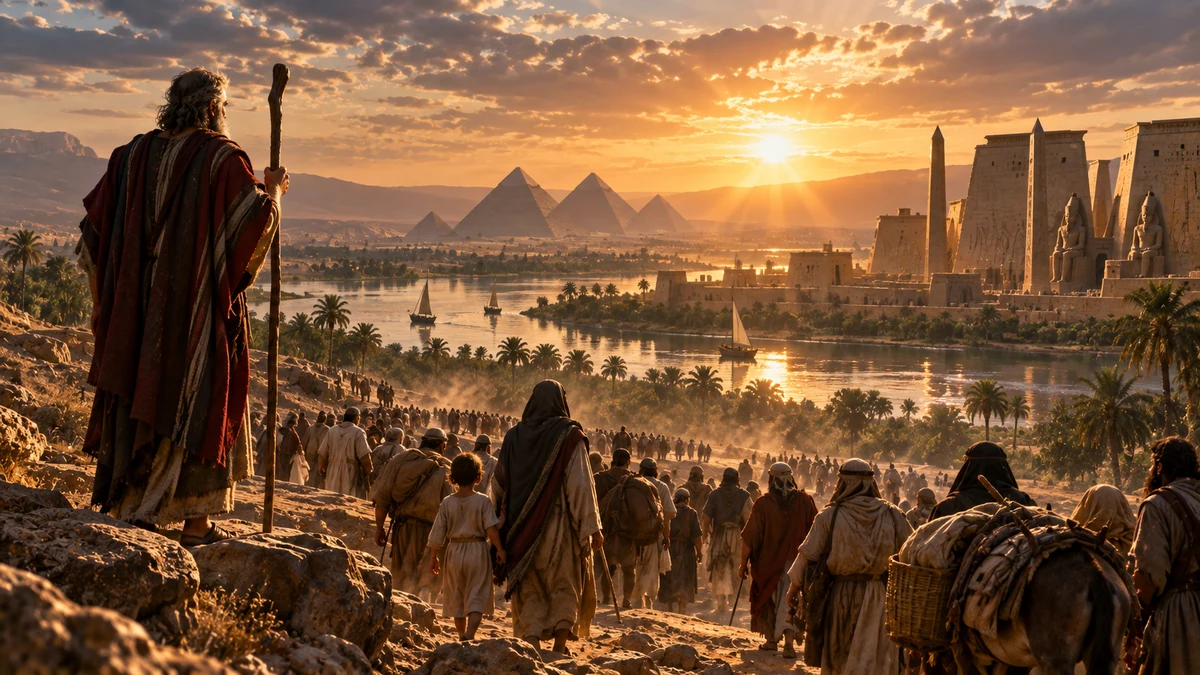
The Exodus is one of the most influential liberation narratives in human history: an enslaved community leaves Egypt, crosses the sea, receives law and becomes a people. Yet the historical question is often framed too crudely—as a choice between “everything happened exactly this way” and “everything was invented.” Historical evidence rarely permits such a simple answer.
For a mass Exodus on the scale produced by a literal reading of the numbers in Exodus and Numbers, there is no direct Egyptian confirmation, no unambiguous chain of Sinai encampments, and no archaeological signal of the sudden arrival of a population numbering in the millions in Canaan. Most current reconstructions of early Israel’s emergence also emphasize a strong indigenous Canaanite component.
At the same time, the surrounding historical world is not fictional. People from the Levant entered Egypt for centuries and lived, worked or were incorporated there under compulsion; the eastern Delta hosted substantial West Semitic populations; Pi-Ramesses was a real Ramesside city; and Egypt ruled much of Canaan in the Late Bronze Age. By about 1207 BCE, the Merneptah inscription already knows a group called Israel in Canaan.
This article therefore separates four claims: whether the entire biblical scenario is literal history; whether a smaller group left Egypt and its memory later became the story of all Israel; whether the narrative reshapes a wider memory of Egyptian domination over Canaan; and how later writers combined such memories into a theological story of national birth. These possibilities overlap, and they do not carry the same evidentiary weight.
What would a historical Exodus actually have to demonstrate?
The first task is to define what is being tested. Exodus 1–15 narrates forced labor, Moses’ confrontation with Pharaoh, signs and plagues, departure, a sea crossing and the destruction of the pursuers. Other parts of the Pentateuch add a long wilderness sojourn, population censuses and a later movement toward Canaan. This is not one claim but a bundle of claims of different kinds.
The largest difficulty for a strictly literal model is scale. Exodus 12:37 speaks of roughly six hundred thousand male foot travelers besides children; ordinary family multiplication produces a population in the millions. Some interpreters note that the Hebrew term ʾelef need not function only as an arithmetic “thousand,” so the number is not as simple as it looks. Yet the present text clearly aims to portray an exceptionally large people.
A historical audit therefore has to distinguish at least three levels: a mass departure, a smaller emigrant event, and cultural memory without one single migration event. Evidence against the first is not automatically evidence against the second or third.
The Egyptian setting is real—but “Semites in Egypt” are not yet Israelites
Archaeology and Egyptology clearly show that movement between the Levant and Egypt was a persistent feature of the second millennium BCE. Tell el-Dabʿa/Avaris in the eastern Delta was a major city with strong Levantine connections; nearby Qantir later became Pi-Ramesses, the residence of Ramesses II. Egyptian texts also attest people of western Asiatic origin in a variety of social positions.
This makes the basic scenario—groups from the Levant entering Egypt, living and working there, and some later moving back toward the Levant—historically plausible. But plausibility is not identification. No known document of the relevant period unambiguously calls these groups in Egypt “Israelites” or confirms the biblical genealogy of Jacob’s sons.
Compulsory labor is also well attested in Egypt, but not every Egyptian building project is evidence for the Exodus. The safer conclusion is narrower: many features of the social and geographic world in which Exodus sets its story have real Egyptian analogues.
What is missing: a Pharaoh, a mass departure and expected traces
There is no contemporary Egyptian inscription reporting Moses, the ten plagues, the escape of an Israelite labor force or the destruction of Pharaoh’s army in the sea. That silence alone cannot prove that no smaller departure occurred: royal inscriptions were propagandistic, archives are incomplete and mobile desert groups often leave little archaeology.
But an argument from absence becomes stronger when a claim predicts very large effects. A population in the millions, decades of residence and a major military-demographic shock would normally be expected to generate several kinds of evidence. This is why the maximal literal reconstruction is much harder to defend historically than a smaller-group scenario.
There is also a methodological boundary. Archaeology cannot confirm or refute the supernatural meaning of the plagues or sea crossing as theological claims. It can test material consequences, geography, demography, chronology and whether the narrative fits a known historical environment.
Merneptah: Israel is in Canaan by about 1207 BCE
The strongest external chronological anchor is the Merneptah inscription. The late-thirteenth-century BCE Egyptian royal text lists Israel among defeated groups in Canaan. Its hieroglyphic determinative treats Israel as a people or social group rather than a city-state. It is the earliest widely accepted extrabiblical reference to Israel.
The inscription does not say where this Israel came from, how long it had existed or whether any of its members had lived in Egypt. But it establishes an important boundary: by roughly 1207 BCE a group called Israel was already part of the Canaanite political landscape.
Around the same broad period archaeology shows substantial growth of new settlements in the central highlands. Much recent scholarship therefore understands early Israel as an ethnogenesis in which indigenous Canaanite populations played a major role. That weakens a model in which the entire population arrived from Egypt as an already formed nation, but it does not exclude smaller immigrant components.
Ramesses, Pithom and the danger of dating too quickly
Exodus names the store cities Pithom and Raamses. Pi-Ramesses is a well-attested residence of Egypt’s Nineteenth Dynasty in the eastern Delta, especially associated with Ramesses II. Such names are one reason many reconstructions place an Exodus tradition in a Ramesside thirteenth-century setting.
But a place name can function in several ways. It may preserve genuine memory of a Ramesside setting; it may be a later update of an older name so readers know which region is meant; or it may belong to a later literary geography. The name by itself therefore does not identify the Pharaoh of the Exodus.
The same caution applies to the 480 years between the Exodus and Solomon’s temple in 1 Kings 6:1. The number may be schematic and does not combine simply with other chronological data. Attempts to derive one exact date and then one Pharaoh from a single number exceed what the sources can securely bear.

From event to collective memory: several live models
One possibility is a “small Exodus”: a limited group came from Egypt and its memory of deliverance and cultic language later became part of the identity of a much larger community that had formed mainly in Canaan. Such models often point to Egyptian personal names, some Egyptian vocabulary and distinctive Levite traditions. These are suggestive supports, not proof.
A second model stresses that Canaan itself had been under Egyptian imperial rule for centuries. Canaanite populations knew Egyptian coercion, taxation, campaigns, deportation and political subordination. As Egyptian power receded, a memory of “deliverance from Egypt” could resonate far beyond people who had physically lived in the Nile Valley.
A combination is also possible: a smaller memory from Egypt fused with the experience of Canaanites under Egyptian hegemony and with the emerging identity of Israel. Cultural memory is not a tape recording; it selects, combines, enlarges and gives meaning to events for later communities.
The Hyksos are not a simple solution—and “absence of evidence” is not a magic formula
The expulsion of the Hyksos from Egypt in the mid-sixteenth century BCE is often proposed as the historical Exodus. The resemblance is tempting: a population with Levantine roots lives in the eastern Delta and is driven toward the Levant. But the Hyksos were a ruling elite, not the enslaved people of Moses’ narrative; the event is centuries earlier than the Ramesside toponyms; and an identification of Hyksos with Israel is not demonstrated.
The opposite extreme is to say, “no camp has been found, therefore nothing happened.” That is also too strong. Small mobile groups can be archaeologically elusive; names change; later literature can preserve a genuine motif in heavily reshaped form. Archaeological silence has to be weighed against the scale and type of event that should have produced evidence.
The evidentiary standard should therefore be symmetrical. Real Egyptian details do not automatically prove the whole narrative, just as the absence of one type of find does not automatically prove total invention. The strongest cases come from independent lines of evidence that converge.
Conclusion: an origin story with historical layers, not a simple event report
The safest historical judgment is narrower than either popular extreme. We currently lack evidence for a mass Exodus in the scale and sequence produced by a strictly literal reading of the final biblical narrative. In material culture, early Israel largely appears as a community emerging within Canaan.
Yet this does not turn Egypt into an arbitrary literary backdrop. Levantine movement into Egypt, compulsory labor, the eastern Delta, Pi-Ramesses, Egyptian imperial rule over Canaan and the very early centrality of departure-from-Egypt in Israelite memory provide enough historical material for a core—or several combined memories—to remain a serious possibility.
The answer to the title question may therefore be: the Exodus is certainly an Israelite origin story and certainly cultural memory; how much concrete history that memory preserves remains open. Perhaps we are not looking for one event that simply “did or did not happen,” but for a process in which smaller events, centuries of Egyptian-Canaanite entanglement and later theology together created the narrative through which Israel explained who it was.
Sources and further reading
- Bible Gateway — Exodus 1–15, NRSVUE: oppression, Moses, departure and sea-crossing narrative
- Bible Gateway — Exodus 12:37–41, NRSVUE: the departure numbers and chronology
- Bible Gateway — 1 Kings 6:1, NRSVUE: the 480-year chronological formula
- Ann E. Killebrew — “Early Israel’s Origins, Settlement, and Ethnogenesis,” Oxford Handbook of the Historical Books of the Hebrew Bible (2020)
- Avraham Faust — “The Birth of Israel,” The Oxford History of the Holy Land (2023)
- Ronald Hendel — “The Exodus in Biblical Memory,” Remembering Abraham (Oxford, 2005)
- Ronald Hendel — “Israel Among the Nations: Biblical Culture in the Ancient Near East,” Remembering Abraham
- Christopher Hays — “Egypt in the Old Testament,” Oxford Research Encyclopedia of Religion (2018)
- Carol Meyers — Exodus, Cambridge University Press: historical context and limits of direct verification
- James K. Hoffmeier — “Semites in Egypt: The First and Second Intermediate Periods,” Israel in Egypt (Oxford, 1999)
- James K. Hoffmeier — “Israelites in Egypt,” Israel in Egypt (Oxford, 1999)
- James K. Hoffmeier — “The Geography and Toponymy of the Exodus,” Israel in Egypt (Oxford, 1999)
- James K. Hoffmeier — “From Egypt to Mt. Sinai: Traveling and Living in the Wilderness,” Ancient Israel in Sinai (Oxford, 2005)
- James K. Hoffmeier — “The Geography of the Exodus: Ramesses to the Sea,” Ancient Israel in Sinai (Oxford, 2005)
- Austrian Archaeological Institute — Tell el-Dabʿa / Avaris excavation overview
- Austrian Archaeological Institute — The harbour of Tell el-Dabʿa: Avaris as a major second-millennium BCE city and trade center
- Thilo Rehren & Edgar Pusch — Qantir/Pi-Ramesse, Late Bronze Age production context (UCL Discovery)
- Nava Panitz-Cohen — “The Southern Levant (Cisjordan) During the Late Bronze Age,” Oxford Handbook of the Archaeology of the Levant
- Shlomo Bunimovitz & Zvi Lederman — “Migration, Hybridization, and Resistance: Identity Dynamics in the Early Iron Age Southern Levant,” Cambridge Prehistory
- Victor H. Matthews — “Israel’s Earliest Historical Traditions: The Middle and Late Bronze Period,” The History of Bronze and Iron Age Israel (Oxford, 2018)
- Victor H. Matthews — “Settlement and Competition in Iron Age I Canaan,” The History of Bronze and Iron Age Israel
- Mark Leuchter — “Egypt, Land, and the Patron Deity in Emergent Israel,” The Levites and the Boundaries of Israelite Identity (Oxford, 2017)
- Oxford Bibliographies — Book of Exodus: composition, genre, historicity and theology overview
- Oxford Bibliographies — Canaanites: Late Bronze/Iron Age populations and the emergence of Israel from Canaan
- Biblical Archaeology Society — Ancient Israel in Egypt and the Exodus: collected debate including Hoffmeier and Malamat