The Stairs of Dendera — Centuries of Wear or Traces of Unknown Technology?
Why do the stairs of Hathor’s temple at Dendera appear unusually rounded? Ritual history, visible wear and the limits of material evidence.
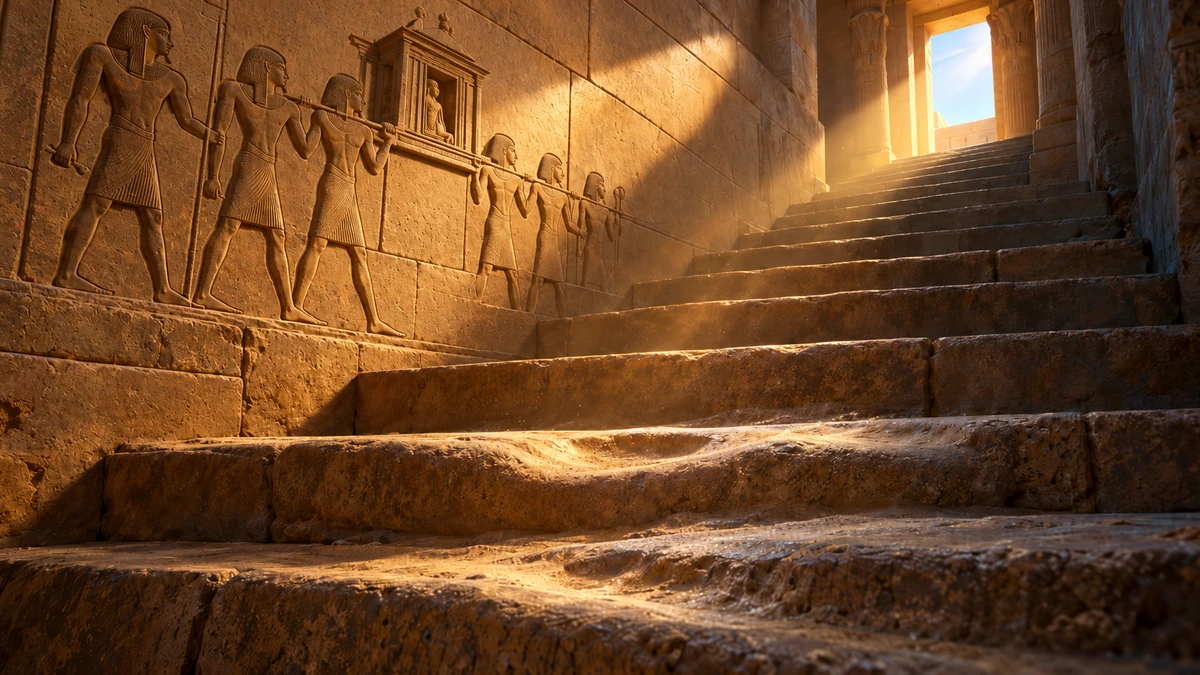
Symbolic editorial artwork of the Dendera stairs; not a documentary photograph or evidence of how the wear formed.
On the stairways inside the Temple of Hathor at Dendera, Egypt, light falls across unusually rounded and irregular stone surfaces. Images of these stairs circulate online under the nickname “melted stairs.” In places, the edges are so softly contoured that it is easy to imagine stone once flowing like a thick liquid. But a resemblance in shape tells us nothing definite about the temperatures the stone experienced. A photograph alone cannot tell us when the damage occurred, what a particular section is made of, or whether we are seeing only the original stone or later changes to its surface as well. [2, 10, 11]
Dendera, however, is more than the setting for a modern mystery. The two stairways belong to an extensive religious programme in which, during the Ptolemaic and Roman periods, an image of the goddess Hathor was carried up towards the roof to be exposed to sunlight during the New Year festival. Inscriptions, reliefs and specialised Egyptological studies attest to this practice. The ritual function of the stairways is therefore much better documented than the precise physical origin of the most irregular tread surfaces. [2, 5, 6, 14, 16]
The real heart of the story lies between these two different kinds of evidence. History can tell us what a space was used for; a study of its materials would have to establish what happened to the stone. If we want to distinguish wear from foot traffic, weathering, deposits, repairs and possible thermal alterations, we need more than a striking photograph or a persuasive conjecture. [3, 10, 11]
Stairs that look as though they were melting
A photograph of a damaged stairway first shows us a shape, not its origin. At Dendera, some tread surfaces appear smoothed and rounded, while others are irregularly hollowed out. The word “melted” is an understandable description of the impression they make, but it is not a geological diagnosis. An image cannot measure a temperature reached in the past or identify mineral changes that would establish actual melting. Such a conclusion would require an examination of the stone and comparison with less altered areas of the same material. [10, 11]
The identity of the section shown is important too. The temple has several levels and routes; its two principal ceremonial stairways connect the lower rooms with the roof. An online photograph without a documented location in the building, date, scale or record of possible image processing cannot support reliable conclusions about the history of those particular steps. Still less can we combine pictures of different sections as though they all depicted the same kind of damage. [5, 9, 12]

Lighting can make hollows appear deeper, a wide-angle photograph can alter proportions, and a tight close-up can leave out the joints between stone blocks. A researcher would therefore need photographs taken under even lighting, a scale, a floor plan and several views of the same section. It would be useful to establish whether the tread edges differ from the central walking surfaces, whether the surface contains cracks, and whether its colour or texture changes abruptly. These are questions for a future examination, not findings from a study already carried out. [9, 10, 11]
None of this makes the stairs less interesting. Quite the opposite: an object that people recognise from a single photograph may reveal far more when placed within a real building and its historical setting. Before discussing the damage, it therefore makes sense to understand what kind of temple Dendera was. [1, 3]
Dendera before today's photographs
Dendera lies in Upper Egypt, near present-day Qena. Its temple is dedicated to Hathor, a goddess associated with the sky, joy, music, motherhood and many other aspects of life. Among the building's best-known features are columns bearing Hathor's image, along with richly decorated ceilings and walls. Its monumental appearance encourages the impression of an unchanging antiquity, but the sanctuary was built and used across several historical periods. [1, 3]
According to the French archaeological institute IFAO, construction of the present main sanctuary began in July 54 BCE, during the reign of Ptolemy XII. Building and decoration continued into the Roman period, and the overall construction programme was never fully completed. This dates the beginning of the present principal temple — not each visible stair block directly, and certainly not the origin of every mark or area of damage. One of the Egyptian ministry's broader popular accounts mentions Ptolemy III; when dating the present main sanctuary precisely, priority should be given to the more specifically substantiated information from IFAO and epigraphic studies. [2, 3, 4, 15]
Older sanctuaries stood on the same site, and researchers also describe settlement in the surrounding area dating from much earlier periods. Three things must be kept separate: the age of the sacred site, the age of the standing building, and the history of an individual piece of stone. A thousand-year tradition of worship in one place does not mean that every step visible there today was made in the earliest phase of that tradition. [1, 3]
Dendera also demonstrates sophisticated spatial planning. The temple incorporates different levels and numerous rooms, while its builders brought together architecture, decoration and directions of ritual movement. IFAO points out that publishing inscriptions alone is not sufficient to understand the complex: archaeology, architecture and research into the site's long development are also essential. The two stairways illustrate particularly well why these disciplines cannot be considered separately. [3, 9, 12]
Two routes towards the sun
The New Year festival occupied a special place in the ancient Egyptian religious calendar. At Dendera, its central rite connected Hathor with a renewed encounter with sunlight. Egyptologist Alexa Rickert devoted an extensive monograph published in 2019 to the two stairways and the rooftop kiosk; its subject matter is confirmed by accessible publisher information and a detailed scholarly review of the book. It is a study of inscriptions, reliefs and their architectural arrangement, not an analysis of deformation in the stone tread surfaces. [5, 16]
According to the official Egyptian account, the reliefs on the stairways depicted priests carrying sacred images during New Year celebrations. In an article about the rooftop kiosk, Rickert explains that an image of Hathor was exposed to the morning light; in the ancient Egyptian theological interpretation, this represented the goddess's encounter with her father, the sun god Ra, and the renewal of the yearly cycle. The rooftop kiosk was also associated with the representation and reckoning of ritual time. [2, 6]

The scholarly review of Rickert's book reveals how complex the ritual space was. It examines different rooms, stairways, bearers of sacred objects and the sequence of festive actions. Individual sections of the route had different functions, and the researcher identifies some details of the reconstruction as probable rather than certain. The shorthand description “up one side, down the other” must therefore not be presented as a complete, directly transcribed ritual script. [5, 16]
A point from Rickert's 2022 study is important as well: the walls of both Dendera stairways show rows of ascending and descending figures. The direction in which the figures are depicted and the actual direction of a particular ritual movement are not automatically the same thing. The scenes must be read alongside their inscriptions and spatial context; partial access to the research does not permit a definitive reconstruction of every step of the procession. [8, 9]
Architecture thus played a role in the religious action. The route drew its meaning from images, the calendar, light and people together. This demonstrates the ritual use of the stairways, but not how frequently they were later used for ordinary walking or how much material was removed from any particular step over the centuries. [2, 5, 6]
What the reliefs tell us — and what the steps tell us
A relief or inscription is a deliberately created record. When preserved, it can be studied as a historical source: researchers can identify figures, objects, terms and connections with other religious texts. That is why we know a considerable amount about how the Egyptians of Dendera represented New Year rituals. At the same time, we must distinguish the original meaning of the texts from modern reconstructions, which scholars continue to test and refine. [5, 7, 8, 16]
A walking surface is a different kind of source. Most hollows and rounded edges were not formed as messages deliberately set down for others to read. They may result from various material and human processes that recurred or overlapped. Identifying them requires measurement and comparison, not the translation of hieroglyphs. A ritual image cannot tell us whether a particular grain of sandstone became detached because of pressure, salts, moisture or a later intervention. [10, 11]
Nor should we confuse age with a count of footsteps. Even if the temple has stood for roughly two millennia, that does not mean every section was walked upon with equal frequency throughout that time. Access to rooms may have changed; movement during festivals was not necessarily similar to everyday use; and individual surfaces may have experienced different periods of closure, repair or cleaning. Without a record of these circumstances, we cannot calculate the supposed “millions of footsteps.” [2, 3, 9]
The phrase “unknown technology” is not a single hypothesis either. Incomplete knowledge of every ancient stoneworking method is an ordinary historical question. A claim about a particular device, intense heat or an energy-based process, by contrast, offers a specific physical explanation. It would need to be supported by material consequences characteristic of that event. An unusual shape is a reason to investigate, not proof of a mechanism chosen in advance. [9, 10, 11]
Sandstone: a rock that changes over time
Sandstone is a sedimentary rock made up of grains and a mineral cement. Its durability is not uniform: composition, porosity, cracks, the bonds between grains and environmental conditions all matter. Adjacent pieces of stone may therefore exhibit different states of preservation. A rock's strength does not mean its surface will remain unchanged over the centuries. [10, 11]
In 2025, Essam H. Mohamed published a laboratory study of Dendera sandstone in which specimens treated with conservation consolidants were exposed to 40 salt-crystallisation cycles. The experiments examined the effects of sodium sulphate and sodium chloride solutions and the resistance provided by different consolidation treatments. This is primarily a study of accelerated ageing and the protection of treated specimens, not field research on the famous stairs. The findings show that salt damage to sandstone is a relevant conservation concern, but they do not establish the cause of any particular deformation in the stairway. [10]
In 2026, Wafaa S. Youssef, Essam H. Mohamed and Ashraf T. M. Abdallah published an open-access investigation of stone blocks recovered from a damp buried environment near the Dendera mammisi, or Roman birth house. They analysed sandstone samples and associated mortars, describing cracks, grain disintegration, flaking, material loss and salt deposits. Their study expressly limits its findings to the samples examined and warns that the results do not automatically apply to other exposure conditions. These were other archaeological blocks, not the stair treads shown in online photographs. [11]
Dissolved salts can move through the pores of sandstone with water. As conditions change, crystallisation and other processes can generate stresses, weaken the cement or accelerate the loss of grains. Mechanical wear can accompany such deterioration: contact with the surface removes material already weakened, while more resistant areas survive elsewhere. This combination is scientifically plausible, but for an individual step it remains a hypothesis until that step's material has been examined. [10, 11]
That is precisely the boundary we must not erase. The fact that a study at the same site confirms salt-related damage in other blocks does not mean salts produced every rounded shape on the stairs. Likewise, the possibility of mechanical wear does not demonstrate that every rounded surface was created solely by walking. [10, 11]
Wear, deposits or repairs?
One testable possibility is mechanical wear. On a stairway used by people, prolonged contact, pressure and fine abrasive material can gradually remove the surface. If this process played a significant role, it would make sense to compare areas most likely to have been walked upon with less accessible edges. Yet evidence of ancient processions tells us neither how often the stairs were used nor precisely what footwear people wore, which routes they followed or how long any one step remained in use. [2, 5, 9]
A second possibility is weathering occurring at the same time. Pores, moisture, salts and small cracks can influence how quickly a particular part of the stone crumbles or wears away. Tests and studies of sandstone from Dendera confirm that these processes matter for conservation, but they do not provide a direct damage map of the ceremonial stairway. Assessing their influence would require an examination of the mineral composition and spatial distribution of damage on the actual surface. [10, 11]
A third possibility concerns surface deposits and the history of repairs. A rounded form in a photograph can result from the loss of stone or from material that was added or otherwise altered. Appearance alone, however, is not enough to identify an individual infill as mortar, cement or a modern repair. The boundaries between materials would need to be identified and records of interventions examined. Official accounts of restoration across the temple do not automatically prove that the particular section familiar from photographs was filled in. [2, 11, 12]
The fourth possibility is a thermal event that substantially changed the rock. Such a claim would require distinctive physical effects, not merely a resemblance to the appearance of a flowing material. In the literature reviewed, we did not find a published, direct mineralogical investigation of these particular steps demonstrating melting. That is not the same as proof that every kind of thermal alteration is impossible; it means that we currently lack sufficient evidence for the claim. [10, 11]
These possibilities need not be mutually exclusive. Different sections may vary in their material, environment and history of use. A sound investigation would therefore not search for one explanation for an entire photograph, but would test where the evidence supports individual processes and which questions remain open. [2, 10, 11]
What would it mean for the stone to have actually melted?
The word “melted” can serve as a metaphor, but in materials science it carries a more definite meaning. To claim that sandstone actually melted is to claim that at least part of the material entered a molten state—not merely that it was damaged or altered by heat. In addition to possible traces of heat damage, we would need to identify signs that cannot be adequately explained by ordinary wear, grain disintegration, deposits or restoration materials. [10, 11]
Such a hypothesis could be tested by comparing the area alleged to have undergone thermal alteration with a suitable, less damaged sample of the same rock. Possible methods include petrographic examination, microscopy and X-ray diffraction; authorised conservators would, however, have to determine an appropriate sampling strategy. These methods have been applied to other blocks from Dendera, demonstrating the feasibility of certain kinds of investigation — not that the disputed stair tread has already been examined. [11]
Surface damage from fire, heat-induced mineral transformation and actual melting are not the same thing. The Egyptian ministry described the removal of soot from some surfaces during the temple's restoration. Soot attests to past exposure to smoke, but it is not proof that the sandstone melted. Rounded forms could likewise result from a combination of material processes without exceptional heat; which explanation is appropriate for a given section remains an open research question. [2, 10, 11]
Testability is essential. What would have to remain in the structure of the stone if it had been subjected to very high temperatures? How would wear be distributed if walking were the predominant cause? Are boundaries visible between original and newer material? A useful hypothesis is not the one that sounds most mysterious, but one that precise measurements could challenge or support. [10, 11]
Two thousand years of different lives
Human activity at Dendera did not end when the temple's religious role changed. IFAO describes the site's extended history and later settlement continuing into the Middle Ages. The temple we see today must therefore be understood as architecture that survived different eras, not a building frozen at the moment of its creation. We do not, however, know the complete history of access to and use of each individual stairway section. [3]
The Egyptian ministry's official report states that some parts of the building bore layers of soot associated with cooking, burning wood and using lamps at times when certain rooms also served as living spaces. This evidence confirms the temple's later life and the varied influences on its surfaces. It does not tell us that the most unusual steps were the scene of those activities or that fire changed the rock at that exact location. [2]
The modern conservation programme has a clearer chronology. According to the ministry, the programme began in 2005, was interrupted in 2011, and resumed in 2017. Work during the first phase explicitly included cleaning the straight descending stairway. This is concrete evidence of an intervention in a stairway area. The official description does not, however, provide a detailed petrographic diagnosis of the photographed deformations or an account of how they originated. [2]
Older photographs, plans and descriptions may also be valuable, including Auguste Mariette's historical publications and the modern archives of Egyptological research. But a temple plan is not automatically a photograph of wear, and an old image of one section cannot be directly compared with a modern photograph of another. For a historical comparison, the location, viewing angle and date would first have to be established; only then could possible changes to the surface over time be investigated. [12, 13]
A mystery we can investigate
If we wanted to investigate Dendera's much-photographed stairways systematically, we would have to begin by identifying each section precisely. Where in the building are they located? On which stairway, and at what level? Which block or group of blocks appears in a particular photograph? Without a floor plan, a scale and comparable views, different forms of damage can mistakenly be grouped into a single phenomenon. Accurate documentation is the first step before hypotheses are compared. [9, 12]
Next would come mapping surface forms and boundaries between materials. Tread surfaces should be compared with less worn edges; photographs from different periods should be checked against restoration records; and information about moisture and possible salts should be evaluated alongside the results of material analyses. If there were grounds to suspect thermal alteration, appropriate mineralogical and microstructural indicators would need to be examined. Any such study would have to be safe for the monument and carried out with the necessary permissions; this is a proposed methodology, not a report of measurements already performed. [2, 10, 11, 12]
What We Know About Dendera's Stairs — and What a Photograph Cannot Tell Us
| Question | What is documented | What this does not establish | Source |
|---|---|---|---|
| When was the present temple built? | Construction of the present main temple began in July 54 BCE. | This does not date the wear on every individual step. | D03, D15 |
| What were the staircases used for? | Inscriptions, reliefs and Egyptological studies associate them with New Year rituals and access to the roof. | The number of passages or precise wear history of each tread is unknown. | D02, D05, D06 |
| What do the photographs show? | Irregular and rounded walking surfaces on actual staircases. | An image does not establish a physical cause or measure a past temperature. | A01, D10, D11 |
| What do sandstone studies show? | Analyses of other samples and blocks from Dendera establish that sandstone deterioration is a relevant material process. | These samples are not a direct examination of the disputed stair treads. | D10, D11 |
| What is documented about restoration? | The official report records cleaning of the straight descending staircase. | It does not diagnose these unusual surfaces or document every hypothetical intervention on them. | D02 |
| Did the steps melt? | The sources reviewed contain no direct published material evidence that these treads melted. | This absence is not a final diagnosis of all alternative processes. | D10, D11 |
The results might reveal several processes occurring together. One part of the surface could be more heavily worn mechanically, weathering could predominate elsewhere, and later interventions might have affected appearances in yet another place. A successful investigation does not require one dramatic explanation, but a clear distinction between what has been measured, what is probable and what remains unknown for now. [10, 11]
In the end, we return to the stairs and their twofold significance. The reliefs and inscriptions describe a New Year rite in which Hathor's image encountered sunlight; the stone beneath them bears traces of the building's long and complicated life. The nickname “melted stairs” may awaken curiosity, but it does not settle their history. The most interesting question is not which story is the most spectacular, but what new evidence could genuinely explain how these stone surfaces acquired their present shape. [2, 3, 5, 6, 11]
Sources and further reading
- [1] Egyptian Ministry of Tourism and Antiquities, Temple of Dendera. source — Official overview of the cult of Hathor and the chronology; no direct investigation of the stairs. Source
- [2] Egyptian Ministry of Tourism and Antiquities, The Ministry ... completes the second phase of the restoration and developing project at the Dendera Temple in Qena. source — Official information about cleaning the straight descending stairway, restoration work and ritual reliefs. Source
- [3] IFAO, Dendara — Architecture et archéologie d’un sanctuaire de Haute-Égypte (Pierre Zignani). source — Beginning of construction of the main sanctuary in July 54 BCE, site development and research objectives. Source
- [4] UNESCO World Heritage Centre, Pharaonic Temples in Upper Egypt from the Ptolemaic and Roman Periods, Tentative List 1824. source — A tentative listing, not confirmed inscription on the World Heritage List. Source
- [5] Alexa Rickert (2019), Das Horn des Steinbocks: Die Treppen und der Dachkiosk in Dendara als Quellen zum Neujahrsfest. Harrassowitz, 2 volumes, XVI + 858 pages. source — Publisher description and a secondary scholarly review; the complete monograph has not been directly reviewed. Source
- [6] Alexa Rickert (2019), Time Measuring and Time Units in the Kiosk on the Roof of the Temple of Dendera, Current Research in Egyptology 2018, pp. 141–148. source — Verified research abstract on the rooftop rite and calendar. Source
- [7] Alexa Rickert (2020), Eine Beschreibung der Neujahrsprozession im Hathortempel von Dendera. source — Bibliographic record; the full paper has not been read. Source
- [8] Alexa Rickert (2022), „A Game of Thrones“: Zu einigen mutmaßlichen Treppenbezeichnungen im Horustempel von Edfu und im Hathortempel von Dendara, in Gestaltung, Funktion und Bedeutung antiker Treppenanlagen, pp. 181–206. source — University bibliographic record; public excerpt: source. The complete text has not been reviewed. Source 1 Source 2
- [9] Pierre Zignani, Designing Vertical Circulation: The Lessons of the Monuments of Dendara, pp. 227–240. source — Scholarly architectural discussion; the full text has not yet been reviewed. Source
- [10] Essam H. Mohamed (2025), An Experimental Study on Consolidated Sandstone by Accelerated Salt Crystallization Cycles: A Case Study of Dendera Temple, Qena, Egypt, Research on Engineering Structures & Materials, 11(2), 985–1002. source — Laboratory experiments on treated specimens, not a diagnosis of the stairway. Source
- [11] Wafaa S. Youssef, Essam H. Mohamed and Ashraf T. M. Abdallah (2026), Investigation of the Physical and Mineralogical Properties of Archaeological Sandstone Blocks Extracted from the Burial Environment at the Dendera Temple Site, Egypt, Multiscale and Multidisciplinary Modeling, Experiments and Design, 9, article 173, published 10 August 2026. source — Reviewed full open-access text; samples of other blocks from the mammisi area, not the stairs. Source
- [12] IFAO, Temples — Dendara, catalogue of scholarly and epigraphic publications. source — A catalogue; its existence does not mean every individual volume has been read. Source
- [13] Auguste Mariette (1870–1875), Denderah, historical descriptions and plates, bibliographic overview. source — Bibliography and metadata; no verified historical photograph of the particular step. Source
- [14] Angelique Corthals (2005), The New Year Procession in the Staircase at Edfu and Dendara. source — Bibliographic description; the complete paper has not been reviewed. Source
- [15] Sylvie Cauville, Dendara: La Fondation du Temple, in Les structures décoratives du temple d’Hathor. source — Published scholarly excerpt concerning the foundation and dating of the present temple. Source
- [16] Stefan Bojowald (2021), review of Alexa Rickert's Das Horn des Steinbocks, Aestimatio, 2(1). source — The complete, open-access four-page scholarly review was examined; it summarises specific parts of the ritual reconstruction, not an analysis of stone wear. Source