The Porphyry Basin in the Vatican — Roman Stoneworking and the Labour We Do Not See
How did the Romans quarry, shape and transport imperial porphyry—and what remains uncertain about the monumental Vatican basin?
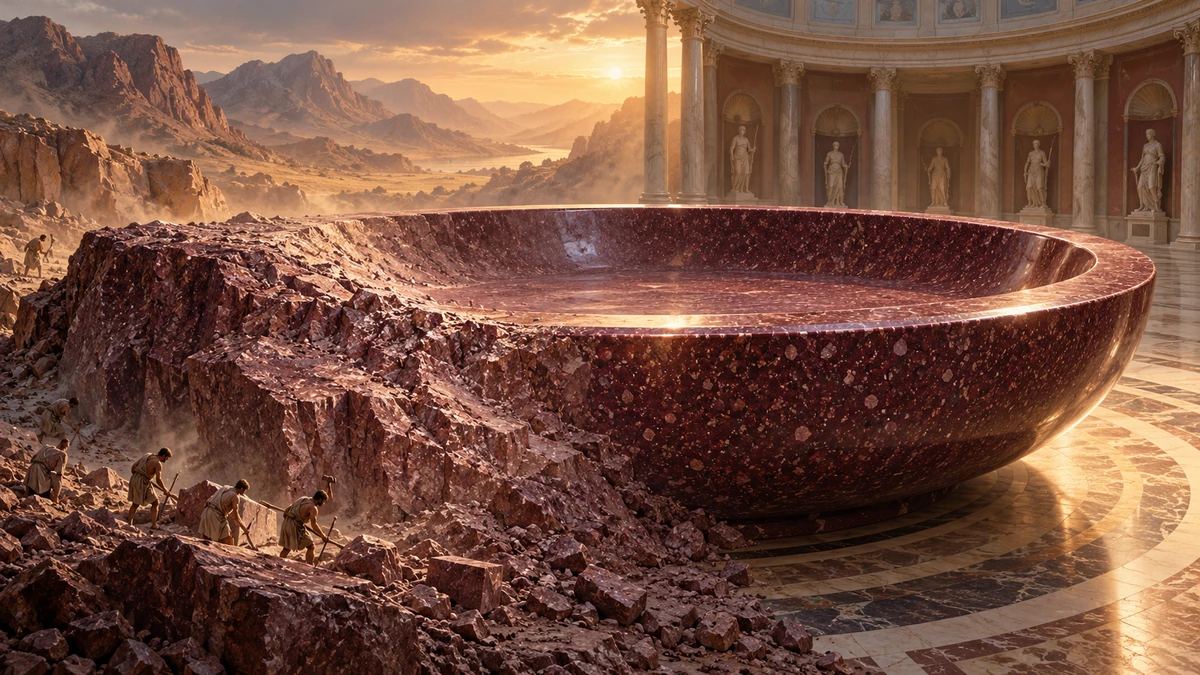
Symbolic editorial artwork of stoneworking and the modern museum display, not a documentary reconstruction of the Vatican basin’s manufacture.
At the centre of a circular gallery in the Vatican Museums stands an enormous basin of dark red porphyry. Its polished surface gleams beneath the dome, and visitors can easily overlook how that very sheen conceals a history of labour. The object could not have been made in a single masterful stroke. Its creation required someone to identify suitable stone, separate it from the bedrock, shape it, hollow it out, smooth it and transport it to a setting where it could become a symbol of Roman prestige. But how many of these steps can we actually reconstruct for the Vatican basin? [1, 2, 6]
The Vatican Museums state that the basin measures 13 metres in circumference. Their Italian and French descriptions supply a crucial qualification: this dimension includes modern additions. It is neither the diameter nor an independently measured circumference of the original ancient portion. Nor does the museum identify a securely established original setting, although it suggests that the object once adorned a large public space in imperial Rome. These two limitations alone make its history more compelling than the frequently repeated legend of “Nero’s bathtub”. [1, 12]
The story of porphyry, then, is not a search for a mysterious machine supposedly beyond the capabilities of the ancient world. It is an investigation of material, tool marks, transport, social status and circumstances that have been lost. By distinguishing documented quarrying techniques from possible methods of making this particular basin, we can understand both Roman expertise and the limits of what we know. We must begin with the object visible today, then follow the stone far beyond the Vatican. [2, 6, 14]
An object at the centre of the gallery
Today's Sala Rotonda belongs to the Museo Pio-Clementino. The architect Michelangelo Simonetti designed it with the Roman Pantheon as a model, and its construction was completed in 1779. Large ancient statues and portrait busts stand around the room; a composition of Roman-period mosaics covers its floor. Those mosaics, too, were incorporated into the museum display at a later date. The circular gallery is therefore not a Roman room in which the basin has stood since its creation. It is a carefully composed eighteenth-century museum presentation of ancient objects. [1, 12]

At the centre of the space, the basin almost becomes a piece of architecture. Its broad circular form, massive rim and distinctive colour draw the eye because the material contrasts with the pale stone of the surrounding statues. From the official description, we can reliably establish its present position, the type of stone and the circumference reported by the museum. We cannot obtain from it a verified estimate of the original weight, a precise volume or the name of a Roman craftsperson. Introducing such figures without documentation would give an impressive object a precision that the research does not yet possess. [1, 12]
The surface appears continuous today, but the Vatican Museums' Italian description explicitly mentions modern additions. This changes how we should read the form. Studying the ancient portion requires distinguishing Roman stonework from later restorations and, where applicable, from subsequent supports or display structures. The question of how much material an ancient stoneworker removed cannot be answered simply by calculating from the present overall circumference. [12]
The same caution applies to its original use. The word “basin” describes a shape, not necessarily a bath used by a particular historical individual. Large stone basins could have served a display or water-related function, but the official description does not identify this object as Nero's personal bathtub. It provides neither a securely documented findspot in the Domus Aurea nor surviving ancient testimony about its use. Such restraint is not a weakness in the story. It allows us to examine the real object rather than a legendary owner. [1, 12]
What is porphyry, and why is it difficult to work?
Imperial red porphyry, also known as porfido rosso antico, is an igneous rock with a characteristic porphyritic texture: larger crystals are visible within a fine-grained groundmass. In places, these paler inclusions form a fine pattern against a dark purplish-red background. Geologically it is not marble, although ancient and later descriptions often grouped prestigious decorative stones under broad terms. The Oxford museum describes its specimen as andesitic to dacitic porphyry, while a 2018 petrological study classifies rocks from Mons Porphyrites as ranging from trachyandesitic to dacitic. These are descriptions of geological samples of the material, not laboratory results from the Vatican basin itself. [2, 3, 8]

The difficulty of working stone cannot be reduced to a single number. The Mohs scale primarily describes minerals' resistance to scratching. When working a substantial mass of rock, however, the way it fractures, the presence of cracks and the effects of different crystals on tool wear also matter. A stoneworker needs methods suited to the material and the intended result. The fact that porphyry is more resistant than ordinary limestone does not mean that only a modern machine could shape it. Research into hard-stone working instead shows the importance of combining different techniques. [6, 7]
Colour itself is not simply a matter of one pigment. A 2018 petrological study chiefly associates imperial porphyry's purple appearance with fine hematite flakes formed during hydrothermal alteration. The Oxford catalogue emphasises traces of piemontite, a manganese-bearing mineral in the epidote group, in its specimen. The publications examine samples and highlight different mineralogical aspects; without analysing the Vatican object, we cannot turn them into a precise mineral “recipe” for that basin. [2, 3, 8]
Researchers used zircons from three samples in the Mons Porphyrites area to establish a geological age of approximately 609–600 million years. That is the age of the rock's formation, not of the Roman basin. The history of the object has a different timeline: when people opened the quarry, selected a suitable block and finished the basin. A museum label may compress these three histories into a few words, but an archaeological account must keep them distinct. [2]
Egyptian quarries and Roman ambition
The principal ancient source of imperial red porphyry was Mons Porphyrites, now known as Gebel Dokhan, in the mountains of Egypt's Eastern Desert. The Oxford museum explicitly associates its imperial porphyry specimen with this location, and geological studies describe the rocks and Roman quarries found there. This provides a strong basis for explaining where Romans obtained their prestigious material. A visual resemblance between the Vatican stone and the quarry material, however, is not a published geochemical analysis of this specific museum object. The geological source of a material and the individual provenance of an artefact are related but not identical questions. [2, 3, 5]
An inscription mentioning Gaius Cominius Leugas provides an early first-century CE point of reference. Leugas presents himself as the discoverer of several kinds of quarries. Researchers date the Greek inscription, associated with the fourth year of Tiberius's reign, to 18 CE. This does not mean that the Vatican basin was made that year, or that nobody knew about the area's rocks before the inscription. It is early written testimony to Roman identification and exploitation of a landscape that later became an important source of imperial decorative stone. [2]
A 2018 scholarly article places exploitation of the imperial porphyry quarries from the beginning of the first century to approximately the middle of the fifth century CE, although activity at individual workings must be assessed separately. Valerie Maxfield and David Peacock's research programme investigated the quarries, settlements and associated facilities between 1994 and 1998; their extensive monograph subsequently presented the excavations. Because the complete book was not accessible in a verified repository for this review, we can establish the project's archaeological relevance without attributing to it detailed findings that we have not directly read. [2, 4]
The desert mountains preserve far more than empty rock faces. Researchers report unfinished stone pieces, working areas, spaces used by stonecutters and smiths, the remains of dwellings, a fort and cult buildings. This variety shows that extracting porphyry was not an isolated flash of genius by a single person. It was an organised system in which geological knowledge, toolmaking, supply networks and human labour depended on one another. [2, 4]
A museum object can still tell us a great deal even when its individual excavation history is unknown. Knowing the ancient source of a material, the general period in which that source was exploited and the range of surviving products allows us to test realistic methods of extraction. It does not let us select the date when this particular basin was made, or name the emperor who commissioned it. That distinction between a well-documented production system and a poorly documented individual object leads to the next question. [1, 2, 4]
Removing a large, intact piece of stone
For a large stonework object, the initial choice of block is exceptionally important. A crack barely visible on a rock face may cause the stone to break during rough shaping or movement. Quarries therefore provide a special kind of evidence: surfaces where stone was detached, unfinished blocks and tool marks that have not been erased by final polishing. Geological properties and fractures in the rock mass influenced which working areas could be used. In their directly examined illustrated survey, Harrell and Storemyr show an actual worked face at the porphyry quarry of Mons Porphyrites, including traces of successive rows of extracted blocks. These are evidence of quarrying at that site, not a record identifying which block became the Vatican basin. [2, 7]
Known ancient techniques for separating stone included percussion tools, cutting channels and controlled splitting; iron wedges also became important in the Greco-Roman period. Yet a tool effective in one quarry or type of rock is not automatically a proven account of how every porphyry block was detached. Harrell and Storemyr describe the adoption of iron wedges for splitting hard stone in the Late Period of Egyptian history and their widespread use during the Roman era. Their photograph from Mons Porphyrites confirms Roman working of the quarry face, not the precise method by which the block intended for the Vatican basin was detached. [7, 14]
A stone-lowering track—a slipway—is also documented at Mons Porphyrites. The track extends for approximately 500 metres downhill from the Lykabettus working area. The photograph and accompanying description show how the terrain was adapted to move heavy stone pieces downhill. The route itself does not reveal the number of workers, ropes or other devices needed for any individual journey. Still less does it prove that the Vatican basin travelled along this particular path. [7]
A monumental basin presents a further dilemma. Did the Romans transport a largely unworked block to its intended destination, a roughly shaped basin, or an object already close to completion? Unfinished products attest to different stages of working at quarries, but the reviewed official museum description does not document the production journey of the Vatican object. Some choices would have reduced the mass transported; others might have reduced the risk of damaging the work during movement. Without direct evidence, it is more responsible to compare these possibilities than to select one as historical fact. [1, 2, 6]
None of these difficulties proves that the work was impossible. They show that success depended on a coordinated sequence of choices: selecting the stone, gradually removing excess material, preserving the block's stability and planning its movements. The precision of that organisation is itself remarkable. A hypothesis about lost advanced technology would only be justified if testable evidence ruled out known processes and demonstrated an alternative mechanism. We do not have such evidence here. [2, 7, 14]
From block to polished basin
Obtaining a suitable block was far from the end of the work. A basin requires the outside rim, the distribution of mass and the hollow interior to be planned together. Its final shape and durability also depend on the thickness of the walls; removing too much stone can weaken the rim or base. Roman stoneworking provides evidence of various stages of rough shaping, cutting, hammering and smoothing. Yet the reviewed publications do not allow us to reconstruct the entire sequence by which this particular Vatican basin was made. [6, 14]
In a 2023 study, Anna Serotta showed how archaeologists can examine tool marks on ancient Egyptian stone sculpture using photography under changing illumination, surviving tools and experimental archaeology. Percussion and chipping leave different traces from abrasion. Rough work may create characteristic pits, while subsequent smoothing can almost erase earlier marks. A gleaming surface is therefore not a complete inventory of all the tools used in its manufacture. [6]
Abrasives are especially important: grains that gradually remove stone through friction. Museum research documents the use of different grinding stones, sand and fine particles, sometimes in combination with tools, in ancient sawing and drilling techniques. In one Egyptian find from Amarna, laboratory analysis identified particles of corundum alongside other minerals and corroded metal residues inside a drill hole. This is valuable evidence for understanding certain techniques in ancient Egypt. It is not evidence, however, that the Roman porphyry basin in the Sala Rotonda was hollowed out with corundum, with the same type of tubular drill or through the same sequence of operations. [6, 10]
More direct comparisons exist for Roman stoneworking. The research project The Art of Making in Antiquity describes the sawing of harder stone with a straight metal blade and a mixture of water and abrasive grains; surviving surfaces can preserve traces of sawing and subsequent smoothing. This mechanism helps explain how Roman stoneworkers could gradually remove relatively hard stone without modern electric tools. It does not establish that the Vatican basin's interior was made with a saw or any particular machine. [14, 16]
What would clarify the question for the Vatican basin itself? A conservation study mapping the boundary between ancient portions and modern additions would be valuable, as would examination of the interior, underside and less heavily finished surfaces for microscopic marks. Comparison with other monumental porphyry basins and securely documented unfinished pieces might reveal recurring technological patterns. Without such work, we can explain how the task may have been technically feasible, but we cannot identify every tool or worker involved. [1, 6, 12, 14]
Across the desert and through the empire
Mons Porphyrites lies in the mountainous, arid region of Egypt's Eastern Desert, far from major Roman cities. Access to water there mattered as much as knowledge of the stone. The decision to use porphyry in imperial projects demanded more than successful cutting: people had to be supplied, routes maintained, stores secured and heavy loads moved. Geological research documents links between the quarry area and the Nile Valley, while broader historical works describe the road and supply network across the desert. [2, 9, 11, 13]
In discussing the quarry routes towards the Nile, Robert B. Jackson describes a chain of fortified watering stations—hydreumata—along the route from Mons Porphyrites towards the area of modern Qena. These stations were not decorative additions. They were essential to operating in a desert where groups of people and animals had to know in advance where water could be found. This wider setting makes the movement of heavy stone easier to understand, without requiring us to assume that every load followed the same route or that a travel log survives for the Vatican basin. [13]
From the Nile Valley, cargo could enter the broader Roman transport network connecting Egypt with the Mediterranean and Rome. Transferring a large stone piece between different forms of transport required organisation, experience and appropriate equipment. Yet even a well-documented route for porphyry shipments in general is no proof that the Vatican basin travelled along those precise roads, on a particular vessel or under a particular imperial commission. Such a claim would need a direct delivery record, an original find context or some other traceable link to the quarry. [2, 4, 13]
It also helps to look beyond the weight alone. A large stone block represents time invested, material discarded and the risk of damage in transit. An accident could undo work already completed, and repair was not always possible. How many people accompanied a particular load, how much did it cost, and how many days did the journey take? The sources reviewed do not yield reliable answers for the Vatican basin. The absence of figures is itself a reminder not to invent apparently precise logistical calculations. [4, 13]
Colour, power and the workers
Imperial porphyry was prized for more than its durability. Its dark red to purple colour was associated with Roman and late-antique ideas of authority, while its restricted source helped make it a potent material for displaying wealth and status. The geological study describes its use in columns, statues, sarcophagi and monumental basins, highlighting periods of particularly intensive use under certain emperors. The material therefore brought more than its physical properties into a space. It also conveyed prestige and access to a valuable resource. [2, 3]
The claim that porphyry was “reserved for emperors” requires historical interpretation, not treatment as an unchanging rule for every century and every object. Roman and late-antique artefacts could be moved, reworked and reused, and the lives of objects extended beyond their first settings. A large basin might retain an appearance of imperial wealth in a place and period entirely different from its original use. The message conveyed by the present museum installation should therefore be distinguished from whatever the object communicated when first made. [1, 2, 12]
The word “imperial” can easily erase the people who extracted and worked the material. Excavated quarries were not merely exposed stone surfaces: they included places to live and work, supply systems and security arrangements. In describing imperial quarries, the Oxford museum also mentions enslaved labour. Yet this does not tell us the composition of every workforce, or who personally hollowed out and polished the Vatican basin. A social history of labour must distinguish between general evidence of coerced work and a documented account of one particular object's manufacture. [2, 3, 4]
Success depended on skills rarely credited by name on ancient monuments: those of stoneworkers, supervisors, blacksmiths, suppliers, transport workers and people who later maintained the object. A monumental basin may appear to celebrate a patron or institution, but it also bears witness to knowledge passed between workshops. In this sense, the “unseen work” of the title is more than an aesthetic metaphor. It is a genuine research question: how many distinct kinds of activity have disappeared beneath the visible surface of the finished object? [2, 4, 14]
From a Roman setting to a Vatican museum
Visitors can now walk around the porphyry basin and examine its interior, but its journey to its present location is much harder to trace. The Vatican Museums suggest that it originally adorned a large public space in imperial Rome, yet their brief official description gives no archaeologically established original findspot. Its later history is more accessible. G. Baldwin Brown's editorial notes to the 1907 English edition of Vasari's work describe a connection with Ascanio Colonna and Pope Julius III in the sixteenth century, subsequent movement through papal collections and eventual placement in the Sala Rotonda. Those same notes recount older, not entirely consistent claims about the ancient place of discovery. They document the history of collecting and interpretation, not proof that the basin actually stood in Nero's palace or the Baths of Titus. [1, 12, 15]
The basin's movements and the creation of the present gallery belong to different timelines. According to the official description, construction of the hall was completed in 1779. Historical notes, meanwhile, report that the basin was moved and restored within the papal collections, and that a guide published in 1792 already described it as repaired. The collection presented today is therefore the product of several phases of collecting and restoration. It would be a mistake to assume that the porphyry basin, the statues and the mosaics once belonged to one Roman interior. Harmony in a museum display is not evidence of common origin. [1, 12, 15]
The Italian reference to modern additions is consistent with older historical accounts of restoration. These short sources still cannot provide a detailed map of the original stone and later replacements. Which sections of the rim survive in their ancient form? When were particular fragments filled in, and how did restorers decide on the basin's finished appearance? Until dedicated object records have been examined, the 13-metre circumference must be understood as a measurement of the present, augmented basin, not a confirmed dimension of the ancient original. [12, 15]
In the very museum where the object seems most familiar, we can therefore ask some of the most useful questions. Are ancient fractures and joins between fragments documented? Were the restoration campaigns recorded? Could the stone be compared with verified geological samples? Does the basin appear under a different name in early drawings or inventories? Investigations of this kind would add far more to its history than another repetition of an unverified story about its supposed imperial owner. [1, 2, 12]
What can we actually demonstrate about Roman craftsmanship?
Roman stoneworking has left numerous kinds of testable evidence. At Mons Porphyrites we know of quarries, some unfinished blocks, working settlements and routes used to move material. Microscopic study, comparison of tool marks and experimental testing of possible processes are also available for the analysis of ancient stone objects. The evidence therefore does not rest on a single mystery; it consists of different kinds of observation that can reinforce one another or sometimes point in conflicting directions. [2, 4, 6, 14]
For this porphyry basin in particular, however, several crucial gaps remain. The brief museum description examined here does not establish its original location, reconstruct the stages of manufacture or provide a detailed production account. Modern additions also mean that we cannot use the present circumference as a measurement of the ancient original without qualification. Progress would require object-specific records, examination of restoration layers and comparison with other securely dated monumental porphyry pieces. [1, 6, 12]
What do we know, and what remains unverified?
| Question | Documented or supported by scholarship | What remains uncertain |
|---|---|---|
| Present object and size | The Vatican Museums give a circumference of 13 m including modern additions. [1, 12] | The precise original circumference and full map of restored sections are not established by the available short museum record. |
| Origin of the stone | Imperial red porphyry was quarried by the Romans at Mons Porphyrites in Egypt’s Eastern Desert. [2, 3] | The reviewed sources do not include a dedicated geochemical analysis of this specific Vatican basin. |
| Quarrying and transport | Ancient quarrying traces and an approximately 500 m long slipway at Lykabettus are documented. [7] | The exact block, route and transport sequence for this basin are unknown. |
| Stone shaping | Romans used multiple stoneworking methods, including abrasive cutting and surface finishing. [6, 14, 16] | The tool sequence, basin-hollowing method and workshop for this particular object have not been established. |
| Original setting and later display | The Sala Rotonda was completed in 1779; the museum suggests that the basin once decorated a major public space in imperial Rome. [1, 12, 15] | Its precise ancient findspot, commissioner and any link to Nero remain unverified. |
Could a modern reconstruction produce a similar basin using historically plausible methods? Such an experiment might tell us a great deal about time, tool wear and technical feasibility. But even a successful attempt would not prove that a particular Roman workshop used exactly the same methods. Nor would one failed attempt establish that ancient manufacture was impossible. Experimental archaeology is strongest when its assumptions are compared with real traces on artefacts, and when its methods allow the evidence to disprove a proposed model. [6, 10, 14]
When we return to the Sala Rotonda, the red surface is no less impressive because we refrain from inventing a lost machine or a famous bather. On the contrary, the object becomes richer when we recognise the work of stonecutters, desert routes, decisions about materials, the political meaning of colour and its many later lives. The Vatican porphyry basin is not evidence that Roman craftsmanship is beyond our understanding. It invites us to distinguish carefully what the evidence already allows us to explain from what remains to be investigated about this remarkable object. [1, 2, 6, 12]
Sources and further reading
- [1] Vatican Museums, Round Hall / Sala Rotonda, official English museum description; the gallery completed in 1779, the basin and its reported 13-metre circumference. source Source
- [2] M. M. Abu El-Enen et al. (2018), A new look on Imperial Porphyry: a famous ancient dimension stone from the Eastern Desert of Egypt—petrogenesis and cultural relevance, International Journal of Earth Sciences 107, 2393–2408. The accessible abstract and indexed excerpts were reviewed; the full published article is behind a paywall. source Source
- [3] Oxford University Museum of Natural History, Corsi Collection 783: Imperial porphyry, official museum record on the stone and its geological source. source Source
- [4] David Peacock and Valerie Maxfield (2007), The Roman Imperial Quarries: Survey and Excavation at Mons Porphyrites 1994–1998, Volume 2: The Excavations, Egypt Exploration Society. University bibliographic abstract verified; the full monograph has not been examined. source Source
- [5] Oxford Roman Economy Project, Gazetteer of Stone Quarries in the Roman World, documentary register of quarries. source Source
- [6] Anna Serotta (2023), Reading Tool Marks on Egyptian Stone Sculpture, Rivista del Museo Egizio 7. Methodological article examined directly; comparative evidence, not a study of the Vatican basin. source Source
- [7] James A. Harrell and Per Storemyr, Ancient Egyptian quarries: an illustrated overview. The accessible complete PDF was examined, in particular the illustrations of Mons Porphyrites and the approximately 500-metre slipway. source Source
- [8] Emil Makovicky et al., Imperial porphyry from Gebel Abu Dokhan: Part I—mineralogy, petrology and occurrence. Bibliographic entry and research summary. source Source
- [9] Brandon McDonald, The Downturn of Egypt’s Eastern Desert in the Middle Roman Imperial Period, Journal of Egyptian Archaeology. Bibliographic record and abstract; it does not establish the route taken by this basin. source Source
- [10] Anna Serotta and Federico Carò (2015), Hidden Secrets of Ancient Egyptian Technology, Metropolitan Museum of Art. Laboratory evidence concerning abrasives at Amarna, not evidence relating to this Roman basin. source Source
- [11] Robert B. Jackson, At Empire’s Edge: Exploring Rome’s Egyptian Frontier, Yale University Press. Broad historical context based on an accessible overview, not an object-specific study. source Source
- [12] Vatican Museums, Sala Rotonda, official Italian museum description explicitly stating that the 13-metre circumference includes modern additions (con le integrazioni moderne). source Source
- [13] Robert B. Jackson (2002), The Quarry Roads to the Nile River, in At Empire’s Edge: Exploring Rome’s Egyptian Frontier, pp. 55–74. Bibliographic summary on watering stations and transportation routes; the complete chapter has not been reviewed. source Source
- [14] Will Wootton, Ben Russell and Peter Rockwell, The Art of Making in Antiquity: Stoneworking in the Roman World, research database; in addition to the general project description, the essay on Roman stoneworking tools [16] was reviewed directly. source Source
- [15] Giorgio Vasari, Vasari on Technique (1907), translated by Louisa S. Maclehose, edited by G. Baldwin Brown, editorial notes “The Porphyry Tazza of the Sala Rotonda of the Vatican”, pp. 108–110. Historical secondary account citing earlier writers, not independently verified archaeological provenance. source Source
- [16] Will Wootton, Ben Russell and Peter Rockwell, Stoneworking Tools and Toolmarks, The Art of Making in Antiquity. Specialist essay on Roman sawing and abrasion reviewed directly; a general technological comparison, not a study of the Vatican basin. source Source