Plimpton 322 — Did the Babylonians Know the Pythagorean Theorem Before Pythagoras?
What does the 3,800-year-old Plimpton 322 tablet actually show? Babylonian numbers, Pythagorean triples and debates over its purpose.
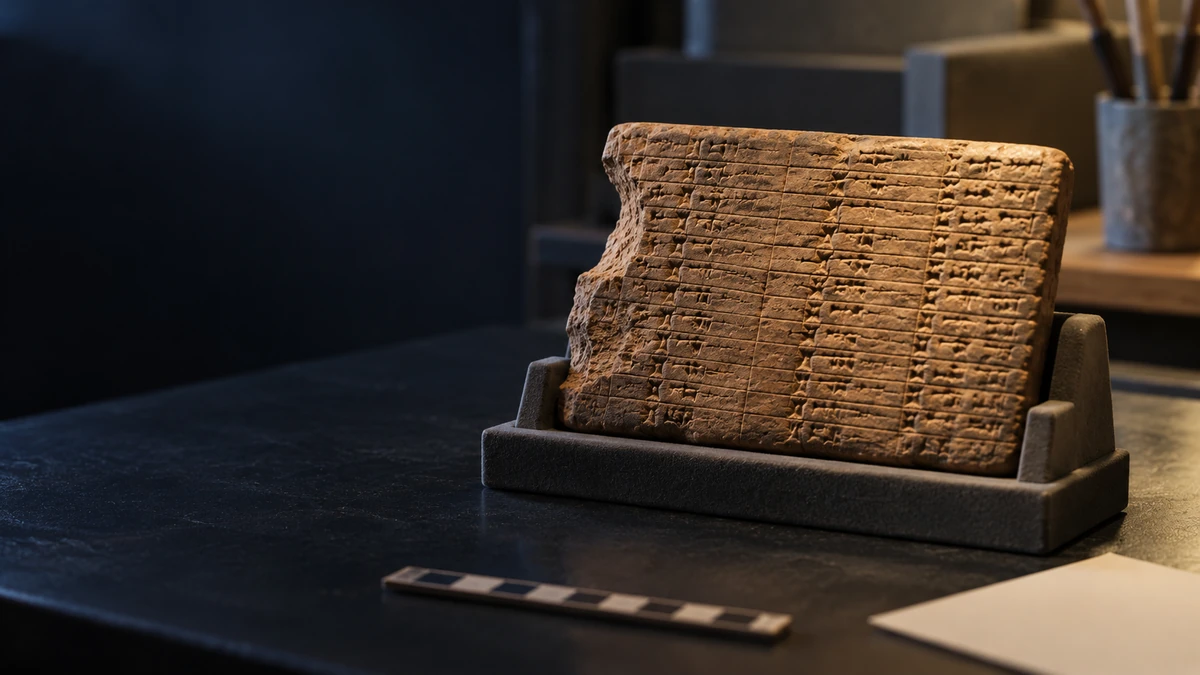
AI-generated conceptual illustration; it is not an accurate depiction of the original Plimpton 322 tablet.
One of the most fascinating documents in the history of mathematics is not a lengthy textbook but a damaged clay tablet. It does not bear a drawing of a right triangle of the kind familiar from school notebooks. It contains neither the name of a celebrated mathematician nor a statement of a general theorem. Instead, there are columns of cuneiform numbers, fifteen surviving rows and a broken edge. Yet the entries establish something important: in Old Babylonian Mesopotamia, people already knew and systematically arranged numerical relationships that we now explain using the Pythagorean theorem — long before Pythagoras lived.
The tablet is known as Plimpton 322. One influential modern interpretation even calls it the oldest known trigonometric table. But a closer look reveals three distinct questions. What is actually written on the tablet? What could its maker calculate? And what were those calculations used for? We can read the surviving numbers and verify their mathematical relationships; how the entries were generated, and above all their original purpose, must be reconstructed from a wider historical context. [1–4]
Fifteen Rows That Do Not Look Like a Schoolbook Theorem
Plimpton 322 is a clay tablet approximately 12.7 centimetres wide and 8.8 centimetres high, dating to the Old Babylonian period, roughly between 1900 and 1600 BCE. It is now held by Columbia University's Rare Book and Manuscript Library in New York. The Cuneiform Digital Library Initiative identifies it as object P254790, museum number CULC 460. Its name comes from the Plimpton collection: 322 is a collection number, not the name of an Old Babylonian mathematical concept. [1, 2]
Four columns and fifteen rows survive. The final column numbers the rows; the others include mathematical values and cuneiform column headings. The left-hand side has broken off. The extent of the missing portion is not certain; some researchers have reconstructed further columns and a different original number of rows. Hypotheses about additional columns or a longer list are not equivalent to surviving physical evidence. [3–5]
At first the figures may mean little to a modern reader. What matters to researchers, however, is that they do not occur at random. Among them are systematically ordered ratios that can be related to the sides of rectangles and their diagonals. This structure makes the tablet one of the most extensively studied mathematical artefacts of the Old Babylonian period. What is absent is revealing as well: there are no instructions for constructing a particular building, no direct reference to measuring angles, and no general geometrical proof formulated in modern terms. [2–4]

From Mesopotamia to a New York Collection
The tablet is often associated with the city of Larsa in what is now Iraq. But the history of its discovery is nothing like a modern archaeological excavation in which every layer is carefully documented. The CDLI catalogue explicitly lists Larsa as an uncertain provenance. The style of the writing and the mathematical context help to date the tablet, but they cannot recreate a missing excavation record. [1, 3]
In the early 1920s, the antiquities dealer Edgar James Banks sold the tablet to George Arthur Plimpton. The museum catalogue dates the acquisition to 1922/1923; since the historical accounts do not consistently identify a single year, that is more precise than simply stating 1922. After Plimpton's death, his collection passed to Columbia University in 1936. In this way, an Old Babylonian record became part of an American library collection, where scholars were able to examine it anew. [2, 5]
This journey is more than an anecdote. For an archaeological object, the place where it was found can be as important as the writing it bears. If we knew exactly which archive, school, sanctuary or administrative room housed the tablet, we would be better placed to assess its purpose. Without that information, researchers must rely primarily on its surviving text and comparisons with other mathematical tablets. This is also why a reliable calculation should not be confused with an equally reliable account of how it came to be made. [3]
Why Did the Babylonians Count in Sixties?
The most obvious difference between our mathematics and Old Babylonian calculation lies in how numbers were written. Today we use the decimal positional system: the rightmost digit represents units, the next tens, then hundreds. Babylonian scribes used a sexagesimal positional system, based on sixty. Successive positions represented one, sixty, three thousand six hundred, and so on — or corresponding fractions of those values when fractional places were involved. [3, 4]
With one appropriate choice of scale, the notation `1:59` represents `1 × 60 + 59`, or 119, while `2:49` represents `2 × 60 + 49`, or 169. This normalization is appropriate when comparing the tablet's numerical ratios. The colon is a modern aid for distinguishing sexagesimal places, not a sign used in precisely this form by an Old Babylonian scribe. Old Babylonian positional notation generally lacked our equivalent of a sign marking the boundary between the integer and fractional parts of a number. Depending on the problem, the same sequence of signs could represent quantities of different magnitudes. [3, 4]
Sixty has many divisors — including 2, 3, 4, 5 and 6. As a result, many fractions that cannot be written as terminating decimals can be expressed with a finite number of sexagesimal places. Babylonian scribes also used tables of reciprocals to make calculation easier. That does not mean that every fraction could be expressed exactly without approximation, or that their calculations were error-free. It means that they developed an effective computational language suited to their own mathematical tradition. [3, 4]
Dividing units into sixties is still familiar from our measurement of time and angles. In understanding Plimpton 322, however, the relevant point is that positional notation allowed efficient calculations involving selected ratios; there is no evidence that the tablet was intended for timekeeping.
The Numbers 119, 120 and 169
Consider the first surviving row. A column that researchers interpret as one side of a rectangle contains `1:59`, while the diagonal column contains `2:49`. If we interpret the two values at the appropriate integer scale, we obtain 119 and 169. The rectangle's other side, 120, can be reconstructed mathematically, but it is not explicitly written as a separate entry in that row. [3, 4]
If we use the three lengths to form a right triangle, they satisfy the equation:
119² + 120² = 169²
Calculating each term gives:
14,161 + 14,400 = 28,561.
The equality holds exactly, without rounding. In a modern calculation we find the missing length by subtracting the square of one side from the square of the diagonal: 169² − 119² = 14,400. Its square root is 120. This is a comprehensible modern illustration of the reconstruction, not a documented transcript of the Babylonian scribe's thinking. The same result can be reached in different ways. Sexagesimal arithmetic, reciprocal pairs and rules for calculating diagonals are historically relevant, but the tablet does not expressly identify which procedure its maker used.
From a modern perspective, this is a Pythagorean triple: three integers that can represent the sides of a right triangle. The other rows show that this is not a chance coincidence but an ordered list of related ratios. [2–4]
The first surviving column of that row contains a value that researchers write in modern sexagesimal notation as `1;59,00,15`. The semicolon in this modern notation separates the integer and fractional parts, while commas separate sexagesimal places. At the indicated scale, the value equals the following ratio of squares:
(169 ÷ 120)² = 28,561 ÷ 14,400 = 1 + 59/60 + 15/216,000.
The tablet itself does not display a fraction bar or a textbook-style equation. The mathematical equivalence tells us how the surviving values correspond to one another; it does not tell us everything about how the scribe understood the problem. [3, 4]
Similarly, in the eleventh row, the surviving values 45 and 75 allow us to reconstruct the other side as 60. We obtain:
45² + 60² = 75².
Dividing all three lengths by 15 gives the ratio 3 : 4 : 5. Under the appropriate normalization, the first column in this row reads `1;33,45`, or (75 ÷ 60)² = 25/16. Once again we can verify the relationship, but we cannot infer the author's exact original procedure from the entry alone, without further evidence. [3, 4]
Is This the Pythagorean Theorem — and Who “Discovered” It?
In its modern form, the Pythagorean theorem states that in a right triangle, the sum of the squares of the lengths of the two legs equals the square of the length of the hypotenuse. The ratios examined above unquestionably satisfy that relationship. Plimpton 322 therefore shows that Old Babylonian mathematics could systematically deal with examples that we now understand through this theorem. [2–4]
Nevertheless, we need to distinguish between an example, a rule and a proof. A calculation correctly relating particular numbers is not, in itself, the same as a surviving general proof showing that the relationship holds for every right triangle. Nor does the name “Pythagorean theorem” demonstrate that Pythagoras personally discovered the geometrical relationship first. Such names often reflect later traditions rather than a complete history of every earlier discovery.
Pythagoras lived roughly a millennium after the tablet was made. Plimpton 322 thus clearly challenges the simplified idea that knowledge of these numerical relationships began in the Greek world. But it does not justify the opposite oversimplification: that a particular Greek saw this very tablet, or that the Greek tradition merely copied earlier Babylonian mathematics. Such a claim would require evidence of specific routes by which knowledge was transmitted. [2, 3]
Perhaps the more fruitful historical question is different: how did different cultures develop effective ways of dealing with the same geometrical relationships, sometimes using different tools and concepts? A Babylonian scribe might have worked with width, length, diagonal, square and computational procedure. The Greek tradition of mathematical demonstration later also expressed such relationships in another, more abstract language. There are similarities, differences and questions between the two traditions that the surviving evidence cannot yet answer.
A Teaching Aid or a Mathematical Investigation?
In 1945, Otto Neugebauer and Abraham Sachs published an analysis that helped make Plimpton 322 internationally known as a remarkable record of Pythagorean triples. Yet understanding the mathematical significance of the numbers does not settle why someone compiled them into an ordered list. This question subsequently encouraged several different approaches to the tablet. [1–4]
The historian of mathematics Eleanor Robson argued in 2001 that an ancient artefact should not be treated as an isolated puzzle into which we can project contemporary mathematical categories. She examined the language of the column headings, known Babylonian computational methods, the form of the tablet and comparisons with educational texts. Her interpretation suggests that the tablet may have been a teacher's aid: an organized list for setting exercises and checking results while teaching mathematical procedures. [3, 6]
This reading has a historical advantage: Old Babylonian scribes learned mathematics through lists, worked examples and procedures. Comparisons with other school tablets help explain why someone might have kept calculated values in tabular form. But resemblance to educational texts does not prove that teaching was the tablet's sole or original function. The missing portions and the absence of explicit instructions for its use mean that the teaching-aid explanation remains a reconstruction. [3]
A different reading was developed in 2017 by Daniel F. Mansfield and Norman J. Wildberger, who proposed that Plimpton 322 represents an early form of exact, ratio-based trigonometry. In their interpretation, the list makes it possible to relate the side ratios of right triangles without modern angle measurements, sines or cosines. This is an important distinction from claiming that the tablet already contains a modern trigonometric table. [4]
Their proposal attracted considerable public attention, especially the suggestion that the tablet might be described as an early trigonometric table. But publication in a peer-reviewed journal does not mean that a proposed interpretation has become universally accepted. Scholars can agree about the exceptional mathematics while disagreeing over whether “trigonometry,” “a list of geometrical problems,” or “a study of numerical ratios” is the most suitable description. Even highly accurate calculations cannot, by themselves, decide between these possibilities. [3, 4, 7]
Why Mansfield Turned to Rectangles in 2021
Mansfield developed his interpretation further in 2021. In Plimpton 322: A Study of Rectangles, he began from the observation that Mesopotamians did not need our modern framework of trigonometric functions to take an interest in the sides and diagonals of rectangles. He studied rectangles whose dimensions are computationally convenient and the divisibility of particular lengths, then proposed a connection with theoretical questions that may have been encouraged by practical surveying needs. [5]
The wider setting matters here. In Mesopotamia, geometrical problems also arose from managing fields, identifying boundaries and measuring areas. Mansfield discusses a separate tablet, Si.427, as an example from the same historical mathematical culture: it contains a plan of a plot of land. That distinct document demonstrates that the use of numerical relationships in geometry and land measurement is a genuine historical subject, not merely a modern invention. [5]
But this is exactly where precision matters. Si.427 is not Plimpton 322. Evidence that some Babylonian geometrical methods were applied to land does not prove that this particular list served a surveyor. Mansfield's interpretation emphasizes a theoretical investigation of rectangles that could have been motivated, directly or indirectly, by surveying needs; the connection to this specific tablet remains a hypothesis. A better hypothesis is not necessarily a final solution. [5]
Within Old Babylonian scribal culture, teaching, list-making and practical geometry need not have occupied three wholly separate worlds. The open question is therefore not simply which modern label best fits the tablet, but also how specialists of the time connected numerical expertise with everyday tasks.
Even This Exceptional Tablet Contains Errors
Researchers have also identified mistakes in some of the numerical entries on Plimpton 322. Different studies do not count them in precisely the same way: Mansfield (2021) discusses five, while other analyses discuss six, depending on how mistakes are interpreted and grouped. Some irregularities can be explained by copying signs incorrectly; for others, scholars have proposed errors in calculation or in handling sexagesimal places. The number of errors therefore does not directly tell us how often the scribe calculated incorrectly: the same faulty entry could have arisen at different stages of the tablet's production. [3–5]
This does not diminish the discovery. Quite the opposite: it reminds us that the tablet was made by human beings who calculated, wrote things down, made corrections and sometimes made mistakes. Its ordered structure demonstrates considerable computational skill, while the errors help researchers investigate the process by which its results were obtained. In some interpretations they are not blemishes to be hidden but valuable clues to how the table was compiled.
The same applies to the broken left-hand edge. Some modern models envisage additional columns and a much longer original list; Mansfield and Wildberger published an expanded mathematical reconstruction with 38 rows. That is a model of a possible larger table, not proof that another 23 rows were physically inscribed on the missing portion. Fifteen rows are actually preserved. [4, 5]
Reliable historical knowledge does not require us to fill every gap. It requires us to identify where we draw conclusions from objects, where we use mathematical reasoning and where several possibilities remain open.
What Does Plimpton 322 Really Change?
The tablet does not establish that modern trigonometric functions existed in Old Babylonian mathematics. Nor will it provide proof that Pythagoras appropriated a particular earlier text. Neither claim is necessary to understand the significance of this artefact.
What we can verify is remarkable enough: Old Babylonian scribes could calculate exact relationships between sides and diagonals, arrange demanding numerical data systematically, and use procedures that we can now explain in terms of Pythagorean triples. They did so long before the Greek mathematical tradition with which these relationships are commonly associated in modern classrooms.
Plimpton 322 therefore matters in two ways. It tells us something important about the history of mathematics; it also shows how easily we erase an artefact's historical distinctiveness when we label it too quickly with modern terminology. Babylonian mathematics need not be presented as an incomplete precursor to the Greeks — nor as a lost version of modern science. It deserves to be understood on its own terms, with its particular methods, limitations and achievements.
Enough numbers survive on this small piece of clay for us to verify their connections down to the last fraction. But not enough information survives for us to state beyond doubt what its maker used the table for. That distinction between mathematical certainty and historical uncertainty may be the most valuable lesson of Plimpton 322.
Editorial note: Sexagesimal notation and equations use modern conventions. Reconstructed lengths and expanded lists are not literal transcriptions of the surviving tablet. The mathematical relationships can be verified, but the table's original purpose cannot be established with the same degree of certainty.
Sources and further reading
- Cuneiform Digital Library Initiative, *MCT 038, Plimpton 322 (P254790)*, artefact catalogue, updated 2024. Source
- Institute for the Study of the Ancient World, New York University, *Before Pythagoras: The Culture of Old Babylonian Mathematics — Plimpton 322*, exhibition catalogue, 2010–2011. Source
- Eleanor Robson (2001), *Neither Sherlock Holmes nor Babylon: A Reassessment of Plimpton 322*, Historia Mathematica, 28(3), 167–206. Source
- Daniel F. Mansfield and N. J. Wildberger (2017), *Plimpton 322 is Babylonian exact sexagesimal trigonometry*, Historia Mathematica, 44(4), 395–419. Source
- Daniel F. Mansfield (2021), *Plimpton 322: A Study of Rectangles*, Foundations of Science, 26, 977–1005. Source
- Eleanor Robson (2002), *Words and Pictures: New Light on Plimpton 322*, The American Mathematical Monthly, 109(2), 105–120. Source
- Jöran Friberg (1981), *Methods and Traditions of Babylonian Mathematics: Plimpton 322, Pythagorean Triples, and the Babylonian Triangle Parameter Equations*90069-0), Historia Mathematica, 8(3), 277–318. Source
- Columbia University Magazine, *Babylon Revisited*, institutional historical overview. Source
- Otto Neugebauer and Abraham J. Sachs (1945), Mathematical Cuneiform Texts, American Oriental Society; bibliographically verified through CDLI, but the complete primary volume was not reviewed anew during this research stage.