Warangal — The Stoneworking of the Kakatiya Dynasty: Extraordinary Carvings, Materials, and Techniques
In Warangal, in the present-day Indian state of Telangana, four monumental stone gateways still stand. Around them lie pillars, lintels, reliefs, and other pieces of a former sacred centre. Floral ornaments, geometric bands, animals, and divine figures cover the stone. On some surfaces, the details…
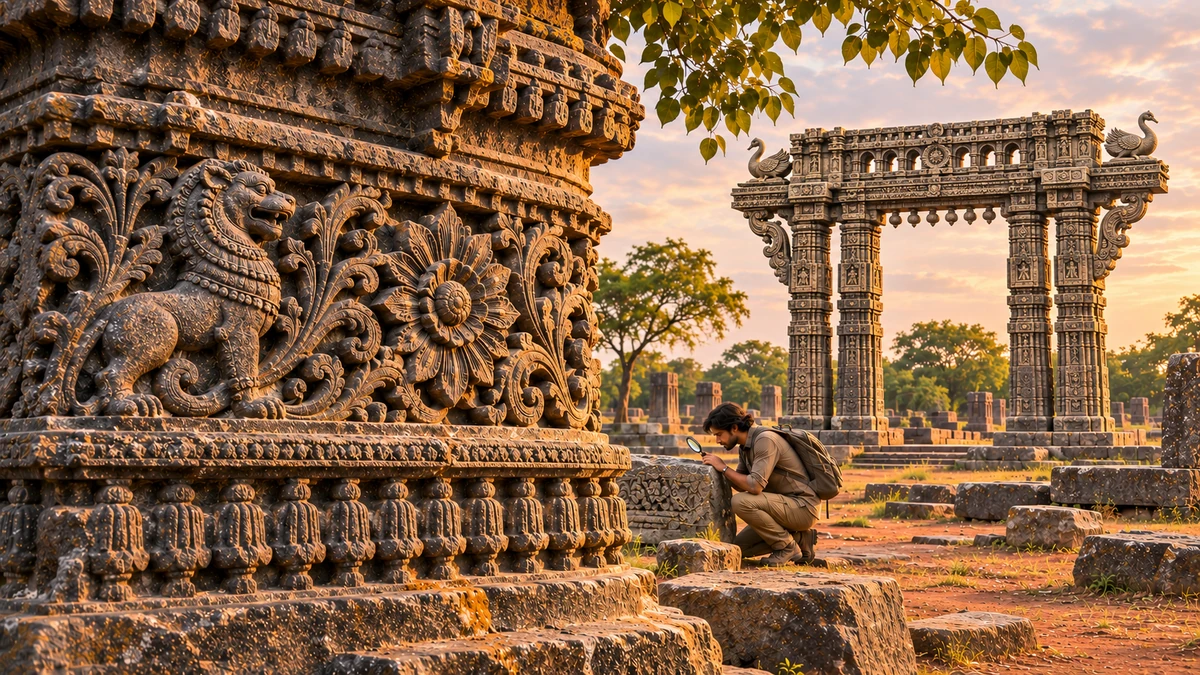
An artistic interpretation of Warangal’s stone-carving heritage. This is not a documentary reconstruction of a particular pillar or manufacturing process.
In Warangal, in the present-day Indian state of Telangana, four monumental stone gateways still stand. Around them lie pillars, lintels, reliefs, and other pieces of a former sacred centre. Floral ornaments, geometric bands, animals, and divine figures cover the stone. On some surfaces, the details are so intricate that the amount of labour invested in making them seems almost beyond belief. Yet the question of how this work was accomplished cannot be settled by a single photograph. [1][2][3]
Warangal was an important political and cultural centre of the Kakatiya dynasty. Its stoneworking reflects knowledge far beyond the ability of any one master craftsperson: patrons, plans, a supply of stone, trained workshops, and the sustained cooperation of many people were all required. Today's ruins show us the results, but not every step that led to them. [2][14]
The real research question, then, goes beyond asking whether medieval craftspeople were “capable” of producing such carvings. Which rocks did they use? How did they plan complex forms? What traces did their methods leave? What do we actually know about their workshops, and where does our knowledge end? These questions can be investigated without underestimating historical artisans in advance, and without automatically dismissing technological hypotheses that have yet to be tested.
Warangal and the Kakatiyas: City, Power, and Sacred Space
Warangal is also known as Orugallu, a name that the local administration associates with the meaning “one stone.” During the twelfth and thirteenth centuries, the Kakatiya dynasty established a powerful regional state whose authority found expression in fortifications, temples, irrigation systems, art, and monumental construction. Warangal was more than a military stronghold. Its centre combined defence, royal representation, and religious life. [1][2]
Visitors today encounter different categories of remains: earthen fortifications, stone walls, gates, ceremonial temple gateways, and scattered architectural components. They were not all built at the same time, nor did they all serve the same purpose. That matters when considering dates, construction methods, and material choices. A block in a defensive wall was primarily intended to bear loads; an elaborately decorated pillar might combine a structural role with a ritual or symbolic message.
In its report on fieldwork during the 2010–2011 season, the Archaeological Survey of India (ASI) distinguished four developmental phases at the site. The first is associated with pre-Kakatiya remains of the tenth and eleventh centuries; the second with the early dynasty and its earthen fortifications in the twelfth and thirteenth centuries. The third, particularly during the thirteenth and fourteenth centuries, is marked by monumental temple gateways, the Svayambhu shrine, extensive sculptural activity, and broader urban development. The fourth covers changes following the fall of dynastic rule. This archaeological sequence is a reminder that the label “twelfth-century fort” cannot describe the site's entire history. [14]
Accounts of the building history often mention the rulers Ganapati Deva, Rudrama Devi, and the later Prataparudra. Heritage descriptions do not attribute every gateway, wall, and temple to a single moment. It is therefore more prudent to speak of several generations of builders than of one isolated construction campaign. This timescale also matters for understanding craftsmanship: workshop knowledge could develop, be transmitted, and become increasingly specialised over decades. [1][2][14]
Four Gateways and the Remains of a Great Temple
Authentic Kakatiya Kala Thoranam gateway at Warangal Fort
Warangal's most recognisable features are its four monumental gateways, variously known as the Kakatiya Kala Thoranam, Keerthi Torana, and related names. They stand along the approaches to what was once the central sacred space. Each consists of upright stone supports and elaborately shaped lintels with multiple ornamental bands. They have become a recognisable symbol of Kakatiya art in local and regional identity. [1][2]
Such a gateway is not simply the same thing as a defensive gate. A temple torana marks a ceremonial passage and shapes the experience of entering a sacred space; a fortification gate serves primarily to control access and provide defence. Confusing these architectural types can also distort the interpretation of their technical requirements. In a torana, the need to reconcile the stability of large stone members with an elaborate decorative programme is particularly evident.
An important Shiva shrine known as Svayambhu once stood in the central area. Today the complex is extensively fragmented. The surviving material includes decorated pillars, capitals, lintels, sculptural fragments, and pieces that have been moved or rearranged for visitors over time. Their present arrangement is therefore not always a direct plan of the medieval temple. [2][5]
This is more than a matter of conservation. When examining an individual relief, we need to ask whether it originally belonged to a gateway, a pillar, a ceiling element, or an independent sculpture. Its original position affects its load-bearing function, whether all sides could have been worked, how the details were intended to be seen, and even the choice of stone. A delicate ornament designed for close viewing could demand a different approach from a massive lintel seen at a distance.
Medieval architecture in this setting was a meeting of technique and meaning. Floral friezes, mythological creatures, human figures, and geometric divisions were not merely demonstrations of manual dexterity. Through them, the space expressed religious affiliation, political legitimacy, narratives, and aesthetic order. A history of stoneworking is incomplete if it identifies chisels but ignores the significance of the forms those tools produced.
What Stone Did They Use — and Why Does It Matter?
The material is one of the most important questions when trying to understand exceptionally fine carving. The claim that every dark, intricately carved stone at Warangal must be granite is not adequately supported. Different parts of a single monument may be made from different rocks, and the expression “black stone” is not a reliable petrographic identification. Granite, basalt, dolerite, and sandstone differ in mineral composition, texture, fracture behaviour, and response to tools. [3][6]
The ASI report on fieldwork in 2009–2010 described architectural remains made of different materials near the Svayambhu complex, including granite, worked red stone, yellowish stone debris, and brick. The finds also include a polished black granite ornamental element bearing a vyala motif. The important point is that this is documented material diversity, not a guess based on the colour of a stone in an online photograph. [15]
For a wider comparison, the Rudreshwara (Ramappa) Temple near Palampet is particularly relevant. It also belongs to the Kakatiya period, but it is not part of Warangal Fort. UNESCO describes the use of sandstone, granite, and hard dolerite there, drawing particular attention to finely carved dolerite figures with an almost metallic lustre. Ramappa's architecture also features lightweight porous bricks and different structural solutions. Together, these provide strong evidence of sophisticated material knowledge within the wider Kakatiya tradition. They do not, however, establish that any particular pillar at Warangal is dolerite or was produced by exactly the same method. [7]
How could the material be tested? We would first need a clearly identified object and its location, followed by a professional petrographic assessment, preferably using non-invasive examination where appropriate for conservation. Hardness on the Mohs scale alone does not tell us everything about workability: mineral grains, cracks, fracture behaviour, and the orientation of weaker planes also matter. Two similarly dark rocks can behave quite differently under blows or abrasion.
When a photograph shows extremely thin and repetitive cuts, the sensible first question is therefore “Which object, and which stone?”, followed by “Which tool?” Without that order, much of the debate may rest on a mistaken idea of the material that had to be shaped.
From Design to Carving: How a Stoneworking Workshop Operates
Monumental decoration takes shape through a sequence of decisions. A suitable block must first be obtained, its dimensions and fractures considered, the design established, and measurements transferred. Rough working follows, then the shaping of load-bearing surfaces, and only then more demanding decorative work. The final appearance may involve finer chiselling, abrasion, smoothing, or polishing. Whenever a construction consisted of more than one piece, joints had to be carefully prepared and the components assembled.
Researchers Will Wootton, Ben Russell, and Peter Rockwell distinguish three broad categories of equipment used in stoneworking: percussive tools, abrasives, and marking and measuring tools. The first remove stone through impact; the second through rubbing or grinding; and the third help define geometry. Tools that seem simple when viewed individually can, in combination, form a highly controlled process. [8][9]
For hard rocks, the way a pointed chisel is used is important. A blow directed more or less perpendicular to the surface can cause local crushing, while an unsuitable angle may reduce effectiveness. Tools wear down during prolonged work and must be sharpened. A carving workshop therefore depended on the maintenance of metal implements as well as artistic conception. Different edges and sequences of work may be more useful when working softer stone. [8]
This description is not a direct inventory of tools excavated at Warangal. It is a technical basis for comparison, from which hypotheses about the feasibility of particular methods can be developed. Likewise, documentation of contemporary stoneworkers at Shivarapatna in India records the use of templates, chisels, hammers, abrasives, measuring instruments, and divisions of labour among craftsmen. Electric tools are also part of the process today. The comparison demonstrates that complex stoneworking is the outcome of trained, organised craftsmanship; it does not demonstrate that a thirteenth-century workshop operated in every detail like a modern one. [10][11]
We know very little about the names of individual masons, the number of people on a building site, forms of payment, the time required for a single ornament, or the transmission of specialised skills within Warangal's workshops. These are significant open historical questions. A “lost technology” might also be lost knowledge of an entire sequence of work, rather than necessarily a lost machine.
The Geometry of Ornament: From an Impression of Perfection to Measurement

Many of Warangal's stone components display forms repeated in remarkably orderly bands. We see rhythmic friezes, similar leaves, narrow moulded edges, miniature figures, and geometric divisions that give the whole composition a powerful sense of symmetry. Such artistic consistency is an exceptional achievement, but visual regularity is not the same as measured identity across every repetition.
The difference matters. If two motifs look identical in a photograph, that does not mean their depths and widths are equal to a tenth of a millimetre. Light, shadow, camera angle, and subsequent enlargement can conceal or exaggerate differences. Precision needs to be expressed in verifiable measurements: length, height, depth, radius of curvature, spacing sequences, and the spread of those values.
Traditional workmanship was not devoid of geometry. Straightedges, centreline markings, compasses, squares, and templates make it possible to transfer similar patterns to different positions. Small variations may arise during hand-carving, and abrasion can partly smooth them away. This is another reason why precision cannot be judged from a single sharply lit photograph. [8][9]
Recessed cavities and undercuts are also of particular research interest: places where stone has been removed behind a projecting part of an ornament. They require carefully planned tool access, an appropriate working sequence, and precautions against breaking fragile elements. Their presence demonstrates high skill, but the finished shape alone cannot establish a complete list of the tools used. Such a conclusion would require examining internal surfaces, the directions of cuts, and surviving toolmarks.
A well-documented investigation would measure the same components using 3D photogrammetry or another suitable non-contact method, and then compare the results with macroscopic and, where permitted, microscopic examination. It might then be possible to investigate whether the motifs followed the same templates, whether more than one hand was involved, and whether individual masons employed different finishing methods. Until such measurements are available for the specific objects under discussion, expressions such as “perfectly identical,” “accurate to the micrometre,” or “impossible to make by hand” remain unsupported.
What Do Toolmarks and Excavations Actually Tell Us?
Stone can preserve part of its manufacturing sequence. Unfinished surfaces may retain marks from rough removal of material; other surfaces may show more uniform chisel strokes, drill holes, or evidence of abrasion. Yet similar final appearances can sometimes be produced by different methods. Grinding may conceal earlier blows, while later cleaning can alter some of the original traces. A toolmark must therefore be interpreted in the context and history of the object, not in isolation. [8][9]
In Warangal, it is valuable that we have more than photographs of ruins. The ASI has conducted field investigations and excavations. Its report for the 2009–2010 season describes five excavation trenches at the Svayambhu complex, with finds including architectural elements, ceramics, ornaments, smaller objects, and several types of building material. This provides a concrete archaeological framework for understanding the medieval site, rather than merely an impression gathered from tourist photographs. [15]
The following report, for 2010–2011, describes additional trenches near the eastern torana, along with walls, floors, a well, and other structural remains. These findings matter because they reveal a larger built environment around the monumental shrine, one that changed over time. They do not directly tell us which chisel was used to carve a particular decorative band on a pillar. [14]
That distinction is essential: archaeological evidence for the existence of complex stone architecture is not the same as experimental proof of the precise manufacturing process behind every ornament. A stronger conclusion would require detailed documentation of individual components, petrographic identification, examination of unfinished areas, and a record of later repairs. It would also be valuable to compare stone elements whose original positions are known with those whose present locations are uncertain.
A good research programme would therefore bring together archival photographs, archaeological plans, non-invasive measurements, and the expertise of present-day stoneworkers. A particular hypothesis might also be tested through an experimental relief carved from comparable stone using selected hand tools. Such an experiment could demonstrate achievable shapes, the time required, and characteristic traces. It would not, by itself, prove that precisely the same process was used historically at Warangal.
Forgotten Skills and Hypotheses About More Advanced Techniques
The idea of a forgotten technique is a perfectly reasonable research question, provided it is defined clearly. Workshop knowledge can disappear when commissions cease, craftspeople migrate, a particular specialisation dies out, or access to materials changes. A method of measurement, a carving sequence, a specialised tool shape, or a polishing skill may be lost even if basic hammers and chisels remain familiar.
We must distinguish three different claims: first, that we do not know every step of the production process today; second, that the past may have included specialised tools or methods we have not yet identified; and third, that the builders must have used industrial machinery or technology comparable to modern manufacturing. The first two are reasonable open research questions. The third is a much stronger claim and requires far more specific evidence.
What would support the hypothesis of a specialised implement? A surviving tool, a credible historical depiction of it, a workshop record, a distinctive series of marks across several independently documented stone components, or a repeatable experiment showing that existing explanations fail to account for an important combination of features. Even then, we would have to distinguish evidence for a particular mechanism from evidence that it was actually used at this particular site.
The wider history of stoneworking is useful here. Research into ancient tools shows that various civilisations possessed not only impact tools but also drilling, sawing, and abrasive techniques. Their existence in another time or place does not prove that identical mechanisms were used at Warangal. Any comparison must be tied to location, period, and material evidence. [8][9]
Conversely, closing down the discussion too quickly is also poor research practice. If a new, well-documented find or analysis emerges, the explanation should be revised accordingly. Genuine research openness does not mean accepting every attractive theory; it means stating in advance what evidence would support or challenge it.
| Hypothesis or explanation | What currently supports it? | What further evidence is needed? |
|---|---|---|
| Specialised hand stoneworking | Surviving complex ornaments and extensively documented historical techniques | More detailed local evidence of toolmarks and manufacturing sequences |
| Templates and measuring procedures | Repeating motifs; documented comparative craft practice | Measurements of multiple original motifs and a comparison of deviations |
| Special tools now poorly understood | Workshop specialisation is plausible, but direct evidence is limited | Tools, records, depictions, or distinctive repeatable traces |
| More advanced mechanical processes | The appearance of the carvings alone does not establish this | Local material evidence and a testable technical model |
| Different rocks required different methods | Archaeological finds confirm the presence of several materials | Petrographic identification of each object examined |
| Later interventions altered the surfaces | A long history of damage and conservation makes this possible | Conservation records, stratigraphic evidence, and surface examination |
Damage, Documentation, and Heritage Conservation
Warangal underwent major political change in the early fourteenth century. The year 1323 is commonly cited as a turning point associated with the end of independent Kakatiya rule. During the centuries that followed, some parts of the fort were altered, abandoned, damaged, or reused. The ruins we see today are the outcome of a long history, not a snapshot of one moment of destruction. [12][14]
An individual broken pillar cannot therefore be attributed to a particular siege or group without further documentation. Weather, falling masonry, relocation of the piece, later use of the space, or conservation work may all have affected its surface. The same applies to toolmarks: some may come from medieval production, others from later repairs. Without studying the original and its history, these cannot reliably be separated.
Special care is also needed when comparing photographs of different monuments. The Thousand Pillar Temple at Hanamkonda and Ramappa at Palampet are significant comparative monuments of the Kakatiya period, but they are not alternative names for Warangal Fort. A photograph of a pillar at either site cannot become evidence about another monument without a clear statement of its provenance. [7][13]
Careful documentation is therefore crucial for future generations: recording the position of every stone element, photographing it with a scale, preserving historical images, producing 3D models, studying materials, and maintaining separate records of original work and later restoration. This is not mere technical administration. Without it, we may lose information needed to explain how components were assembled and what they were intended to communicate.
Heritage protection at Warangal has another dimension as well. The stone is part of a community's cultural heritage, not merely an object of scholarly curiosity. Any material analysis must therefore respect conservation sensitivities, the public accessibility of results, and the historical significance of the site.
Conclusion: The Most Important Knowledge May Lie in the Process
Warangal's stoneworking heritage is no less astonishing when placed in historical context. Quite the opposite: understanding the development of the city, the different functions of its monuments, the demands of choosing stone, and the precision of craft processes makes the builders' achievement even more impressive. It depended on cooperation, planning, material knowledge, and the ability to transform individual stone components into an integrated symbolic space.
Archaeological documentation confirms several stages in the fort's development, monumental temple gateways, and a rich range of architectural and sculptural fragments. The comparative history of stoneworking shows that exceptionally demanding carving is not, by itself, proof of an industrial machine. At the same time, it would be unreasonable to claim that we know every tool and workshop practice that was actually used. [8][14][15]
Important questions remain open: how masters in different workshops divided labour; which templates they used; how they checked the consistency of repeated ornaments; how long it took to shape a particular pillar; which surfaces were originally polished; and whether individual objects still preserve traces of techniques that are poorly documented today. These are not gaps that must be filled with premature certainty, but invitations to focused research.
If future measurements and material analyses reveal convincing traces of a different, currently unrecognised process, that would be an important finding. Until then, the best approach is to respect the extraordinary achievement of the craft and consistently distinguish evidence from conjecture. At Warangal, the mystery does not end with the question of the shape of a chisel's cutting edge. It extends to the people, workshops, and knowledge that transformed hard stone into one of southern India's most recognisable architectural legacies.
Sources and further reading
- Warangal District Administration, Warangal Fort, a local historical account of the dynasty and fort: source Source
- Kakatiya Heritage Trust, Fort Warangal, the fort, four ceremonial gateways, and temple: source Source
- National Institute of Design, D’source, Warangal Fort and Temple Architecture — Warangal Fort, architectural components and materials: source Source
- Kakatiya Historical Compilation, Warangal Fort, historical synthesis referring to older documentation: source Source
- Kakatiya Historical Compilation, Swayambhu Temple, Warangal Fort, ruins and questions of reconstruction: source Source
- Kakatiya Historical Compilation, Architecture & Engineering, overview of materials and technical traditions: source Source
- UNESCO World Heritage Centre, Kakatiya Rudreshwara (Ramappa) Temple, Telangana, a description of a different, separate monument and its materials: source Source
- Will Wootton, Ben Russell, and Peter Rockwell, Stoneworking Tools and Toolmarks, Art of Making in Antiquity: source Source
- Will Wootton, Ben Russell, and Peter Rockwell, Stoneworking Techniques and Processes, Art of Making in Antiquity: source Source
- National Institute of Design, D’source, Shivarapatna Stone Crafts II — Tools and Raw Materials, modern comparative documentation: source Source
- National Institute of Design, D’source, Shivarapatna Stone Crafts II — Making Process, modern comparative documentation: source Source
- Kakatiya Historical Compilation, After the Kakatiyas, 1323–1948, later historical developments: source Source
- Hanumakonda District Administration, Places of Interest, details of the separate Thousand Pillar Temple: source Source
- Archaeological Survey of India, Indian Archaeology 2010–11 — A Review, “Exploration in Warangal Fort,” overview of four developmental phases; publication issued in 2016: source Source
- Archaeological Survey of India, Indian Archaeology 2009–10 — A Review, “Scientific Clearance at Swayambhu Temple Complex, Warangal Fort,” finds and materials; publication issued in 2016: source Source